Dr. Gymbro
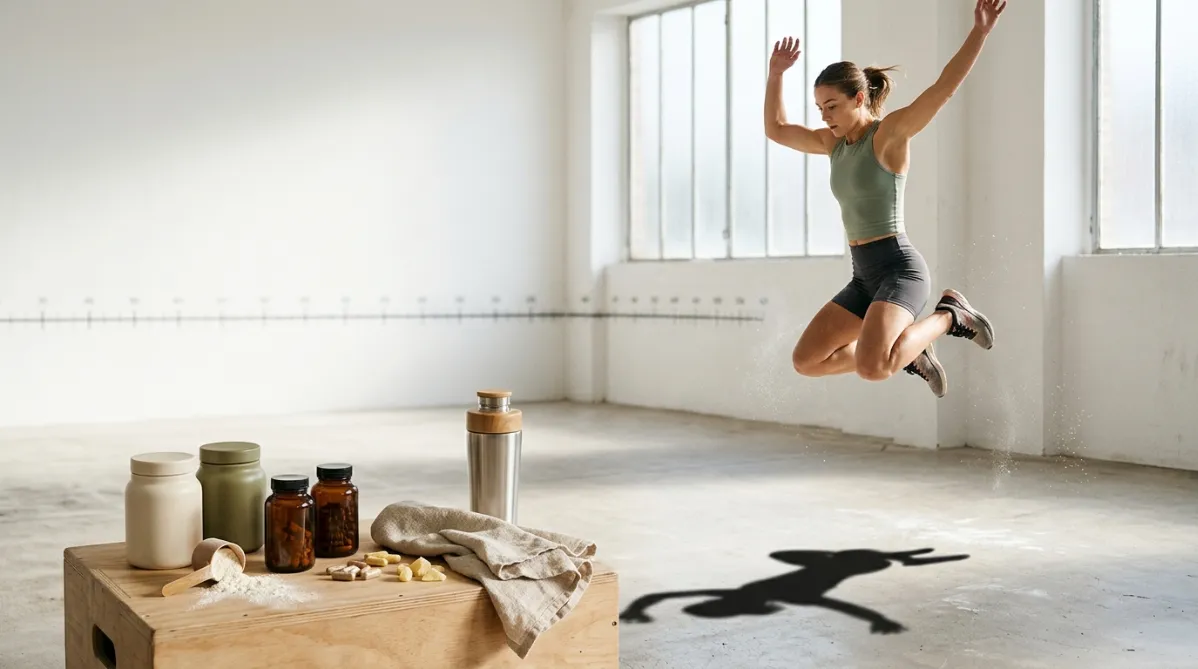
A wide, editorial-style photograph of a female athlete captured mid-jump in a bright, minimalist indoor training space with pale concrete floors and tall frosted windows that let in soft diffused morning light. She is frozen at the peak of a countermovement jump, knees tucked slightly, arms swinging upward, wearing a fitted sage-green training top and charcoal shorts. Her shadow stretches long on the floor below her, which emphasizes the height of the leap.

In the foreground at the lower left, a clean arrangement of supplement items sits on a light oak wooden plyo box: several matte, unlabeled ceramic jars and small amber glass bottles in cream, terracotta, and muted olive tones. Loose white powder is spilled in a soft arc beside a wooden scoop. A few capsules and a small pile of pale yellow beet-colored crystals add texture. Beside them are a folded linen towel and a stainless steel shaker bottle. The items are slightly out of focus, which creates shallow depth of field and leads the eye toward the athlete in the mid-ground.

The color palette is warm and modern: creamy off-white, soft sand, sage green, and subtle terracotta accents, with gentle natural shadows. The background is a clean, slightly blurred wall with a thin horizontal line of light, which suggests a measuring-stick rhythm without literal numbers. Fine particles of chalk dust hang in the air around her feet, lit by a shaft of sunlight.

The composition follows the rule of thirds, with the athlete on the right third and open negative space on the upper left, suitable for headline overlay. The style is contemporary lifestyle and sports-science journal photography, with a crisp, high-resolution, soft-contrast, matte finish and a subtle film-like grain. The mood is calm, premium, and trustworthy, in the spirit of a modern health and performance publication.
Science & Research

Best Supplements for Jump Height and Power: HMB, Betaine Surprise

Dr. Gymbro · · 4 min read

If you asked most lifters which supplement makes you jump higher, the answer would be creatine, and probably nothing else. A new Bayesian network meta-analysis in the Journal of the International Society of Sports Nutrition complicates that story. Pooling 119 randomized trials, the authors found that HMB led for peak power and betaine led for countermovement jump height, while creatine showed up as a solid but less dominant performer. The headline is fun. The fine print matters more.

What the Study Actually Did

Researchers from Guangzhou Sport University and collaborators searched four major databases for randomized controlled trials in healthy, physically active people and athletes. They built four separate networks, one for each outcome: peak power (PP), relative peak power (RPP), vertical jump (VJ), and countermovement jump (CMJ). The networks contained 47, 33, 31, and 44 studies respectively, and some trials fed more than one network.

A network meta-analysis lets researchers compare supplements that were never tested head to head by linking them through a shared placebo. That is powerful, but it also stretches thin data. The team graded confidence using CINeMA and risk of bias using RoB 2. This is the lens through which every number below should be read.

The Ranking, by Outcome

Peak power (absolute, in watts)

  1. HMB: +64.7 W versus placebo (95% CrI 19.15 to 110.50)
  2. Beta-alanine: also showed a favorable effect

Relative peak power (W/kg)

  1. HMB: +0.84 W/kg (95% CrI 0.42 to 1.28)
  2. Creatine: favorable effect
  3. Vitamin D: favorable effect

Countermovement jump

  1. Betaine: +3.72 cm (95% CrI 1.24 to 6.18)
  2. Creatine, caffeine, caffeine plus Rhodiola rosea, palmitoylethanolamide, and multi-ingredient products also had credible intervals excluding zero

Vertical jump

  1. Iron: +6.81 cm (95% CrI 0.84 to 12.83), but see the caveat below

The authors did not publish a simple winner's podium for the whole field, and they explicitly warn that rankings alone should not guide individual regimens. The lists above reflect which compounds cleared the bar within each network.

Why HMB Is the Surprise

HMB, a leucine metabolite usually marketed for muscle preservation and recovery, topped both power networks. Importantly, it was also the most robust finding. The HMB result for relative peak power held up across multiple sensitivity analyses, and both HMB comparisons for PP and RPP earned a moderate certainty rating. In a dataset where 1,564 of 1,636 pairwise comparisons were rated very low certainty, moderate is a real distinction.

A plausible explanation is that HMB's benefits show up in trained people during heavy training blocks, where reduced muscle damage and better recovery translate into better power output over weeks. That is a hypothesis, not something this analysis proves.

Betaine and Creatine: Context Matters

Betaine's 3.7 cm gain in countermovement jump is large for a cheap, widely available compound. Yet the authors noted that some favorable comparisons had prediction intervals including zero or weakened under sensitivity analyses. That means a future trial could plausibly find little or no effect. Betaine looks promising, not settled.

Creatine didn't "lose" so much as share the stage. It improved relative peak power and countermovement jump, and it has by far the deepest evidence base for strength and body composition outside this paper. A network model that spreads credit across many compounds does not erase decades of data. Beta-alanine's peak power signal and vitamin D's relative power signal are consistent with existing literature, though vitamin D likely helps mainly those who are deficient.

The Iron Finding: Read With Suspicion

The largest jump number, +6.81 cm from iron, rests on just one direct study. A wide credible interval (0.84 to 12.83) tells the same story. Iron is vital for people who are deficient, and correcting a deficiency can restore performance. It is not a proven jump booster for iron-replete athletes, and unnecessary iron supplementation carries real risks. Treat this as a hypothesis for deficient populations and nothing more.

Certainty Caveats

Only 17 of 1,636 comparisons were rated moderate certainty, 55 low, and the rest very low. The authors also point out that differences between networks cannot establish that outcome type changes a supplement's effect. A compound appearing in one network and not another may reflect which studies happened to measure which test. Exploratory links to training level and sport were also limited by sparse data.

Practical Takeaways Per Supplement

  • HMB: Most defensible new pick for power, especially for trained athletes in hard training phases. Expect modest, gradual gains rather than overnight changes.
  • Betaine: Low-cost option worth a trial if jump height is your target. Track your own CMJ over several weeks to see if you respond.
  • Creatine: Still the safest, best-studied foundation. Its jump and relative power benefits are an add-on to its strength benefits.
  • Beta-alanine: Most relevant for efforts of moderate duration; its effect here was on peak power.
  • Vitamin D: Test first. Supplement if low rather than expecting a power boost if you're sufficient.
  • Caffeine: Reliable acute performance aid; the jump effect is smaller and less certain.
  • Iron: Only if blood work shows deficiency and a clinician agrees.

The Bottom Line

This meta-analysis suggests HMB and betaine deserve more attention than they get, but it does not dethrone creatine, and most of its evidence is low quality. Build your power on training, sleep, and total nutrition, then treat supplements as small, testable experiments.
Original study

Read the original research on pubmed.ncbi.nlm.nih.gov →

This article summarizes published research for general information. It is not medical advice.

DG

Written by

Dr. Gymbro

Dr. Gymbro writes for Dr. Gymbro: science-backed fitness, nutrition & performance.

Related Articles

A bright, modern editorial still life shot from a slightly elevated angle on a pale warm-gray stone countertop, bathed in soft natural window light with gentle diffused shadows. In the center, a small glass bowl holds a scatter of translucent golden-amber fish oil softgel capsules, a few spilled casually onto the surface and catching the light like tiny glowing beads. Beside the bowl sits a single chrome dumbbell with a matte finish, slightly out of focus, and a neatly folded charcoal gym towel. To the left, a clean arrangement of alternative "better spent" items: a ceramic dish of raw eggs, a wedge of salmon fillet on a wooden board with a sprig of dill, and a small bowl of Greek yogurt with a spoon, all styled with restraint. A minimalist notebook with a thin pen lies at the right edge, with faint, abstract pencil-drawn bar charts and a flat horizontal line suggesting "no effect," legible only as soft shapes with no readable text. The color palette is muted and sophisticated: warm cream, soft sage green, sandy beige, and pops of golden amber from the capsules, with a single accent of coral from the salmon. Shallow depth of field keeps the capsules crisp while the background melts into a creamy blur of a sunlit kitchen with a hint of green plant leaves. The composition leaves generous negative space on the right third for title overlay, in a 16:9 landscape format. The mood is calm, thoughtful, and quietly skeptical, in the style of a contemporary health and science magazine, with a crisp editorial photography look, fine grain, and natural color grading. No people, no futuristic elements, and no text.
science research

Fish Oil for Gains? 8 Trials Say Don't Count on It

BY DR. GYMBRO ·

Fish oil has long been sold as a recovery and muscle-building booster, but a new meta-analysis in Nutrition says the evidence isn't there. Pooling four trials for fat-free mass and eight trials (22 effects) for strength in healthy non-obese adults, researchers found no clear benefit for either. The strength result was essentially zero, while the fat-free mass estimate was too imprecise to say anything. Certainty of evidence was very low, so this isn't proof of no effect, but it's no reason to buy fish oil for gains. Here's what the numbers mean and where your money is better spent.

A calm, modern editorial still life shot from a slightly elevated angle on a pale oak tabletop, bathed in soft natural window light from the left. At center sits a clear glass of water beside a small matte ceramic bowl holding a mound of fine white creatine powder, with a wooden scoop resting next to it and a few loose grains dusted across the surface. To the right, a neatly arranged printed lab report on cream paper, with blurred rows of numbers and a single line highlighted in soft coral pink marker, partially overlapped by a minimalist silver pen. A folded pair of thin-framed glasses sits at the edge of the paper. In the foreground, a small glass vial with a pale amber liquid sample and a second empty vial stand upright, suggesting blood and urine testing, with gentle refraction and soft caustic light on the wood. Behind them, a sprig of eucalyptus in a small stone vase adds a touch of green. The background is a softly blurred, warm off-white wall with a gentle gradient shadow and a hint of a window frame. The palette is muted and refined: warm creams, sage green, soft coral, pale amber, and light oak, with crisp whites in the powder. Shallow depth of field, with the powder bowl and highlighted lab line in sharp focus and the edges falling away into creamy blur. Generous negative space on the right third of the composition for text overlay. The overall feel is clean, trendy health-journal photography, tactile and editorial, with subtle film-like grain, natural shadows, and a quiet, reassuring mood. No people, no text legible, no futuristic elements.
supplements

Creatine Raised Kidney Markers in 26 Trials. Probably Not Damage

BY DR. GYMBRO ·

You start creatine, get bloodwork, and your creatinine is up while your eGFR looks worse. A 2026 meta-analysis of 26 randomized trials (1,036 participants) found exactly that: creatinine rose 0.14 mg/dL and creatinine-based GFR fell about 10.75 mL/min. But when kidney filtration was measured with Cr-EDTA, the drop didn't appear, and urea, albuminuria and proteinuria were unchanged. Here's why the lab number misleads, what to tell your doctor, and who should check with a nephrologist first.

A softly lit, minimalist strength-training studio photographed in a modern editorial style. In the foreground, a matte black barbell loaded with weight plates rests on a light oak platform, with fine chalk dust floating in warm morning light. Beside it on a pale concrete bench sits a simple ceramic scoop of white creatine powder, with a small spill of fine crystals catching the light, next to a minimal frosted glass jar with no label. A matte sage-green shaker bottle and a folded cream towel sit nearby. In the soft-focus background, tall windows let in diffused golden sunlight, casting long, gentle shadows across the floor. A rack of neatly arranged dumbbells is blurred in muted charcoal tones.

The color palette is calm and sophisticated: warm off-white, sand, sage green, soft charcoal, and touches of terracotta. A small open notebook with a pencil lies on the bench, suggesting research and data tracking, with abstract hand-drawn bar graph lines faintly visible on the page but not legible. The composition follows the rule of thirds, with the barbell and powder on the left and generous negative space on the right for headline text. Shallow depth of field, crisp textures on the metal knurling and powder grains, subtle film grain, and a contemporary wellness-magazine look. Clean, airy, and editorial, with a grounded, scientific yet approachable mood. Landscape 16:9 composition.
science research

Creatine Plus Lifting: Bigger Strength Gains, No Dosing Winner

BY DR. GYMBRO ·

A meta-analysis of 63 studies and 1,489 participants asked how much creatine adds on top of lifting. The strength boost was moderate and consistent in both upper and lower body, while the lean mass gain was smaller and fat mass didn't significantly change. The surprise is that dosing strategy, daily dose and protocol did not significantly influence the results. Age emerged as the one exploratory clue, with larger strength effects in younger participants. Here is what the paper actually found, and what it can't tell you.

A bright, minimalist flat-lay photograph of two supplement scoops on a pale warm-gray stone surface, shot from directly above in soft natural window light. On the left, a matte ceramic scoop holds fine white creatine monohydrate powder, heaped in a clean mound. On the right, a second scoop of the same shape holds slightly coarser off-white beta-alanine powder, with a small, deliberate gap between the two. Each scoop sits in its own soft shadow, which suggests separation rather than combination. Between them, a thin brushed-brass ruler or a single slim line of fine powder runs across the surface and subtly divides the composition.

Around the scoops, a few restrained props in a muted editorial palette of sage green, cream, terracotta, and soft charcoal: a small glass jar with a minimalist label that has no readable text, a folded linen napkin, a single sprig of eucalyptus, and a stainless-steel shaker bottle softly out of focus in the upper corner. A few loose powder grains are scattered naturally across the stone. A small stack of blank cream index cards with a pencil rests in the lower right, hinting at research and note-taking without any legible writing.

The composition follows a clean rule-of-thirds layout, with generous negative space on the right third for headline overlay. The lighting is gentle and diffused, with long, soft shadows falling to the lower left. The color grading is calm and slightly desaturated, with creamy highlights and a subtle film-like grain. The overall look is a modern wellness and science journal cover, with an airy, trustworthy, contemporary editorial feel, shallow depth of field, and crisp detail on the powders.
nutrition

Creatine + Beta-Alanine: The Stack Bonus Researchers Couldn't Find

BY DR. GYMBRO ·

The creatine plus beta-alanine stack is marketed as a performance power couple, but a new network meta-analysis of 52 randomized trials found no synergy between them. Creatine alone significantly improved sprint, jump, repeated-sprint and upper-body endurance outcomes versus placebo. Beta-alanine's effects were non-significant or context-specific, and the combo added nothing beyond creatine. Here's what the study did, where it falls short, and what it means for your supplement budget.

This page is available in