Dr. Gymbro
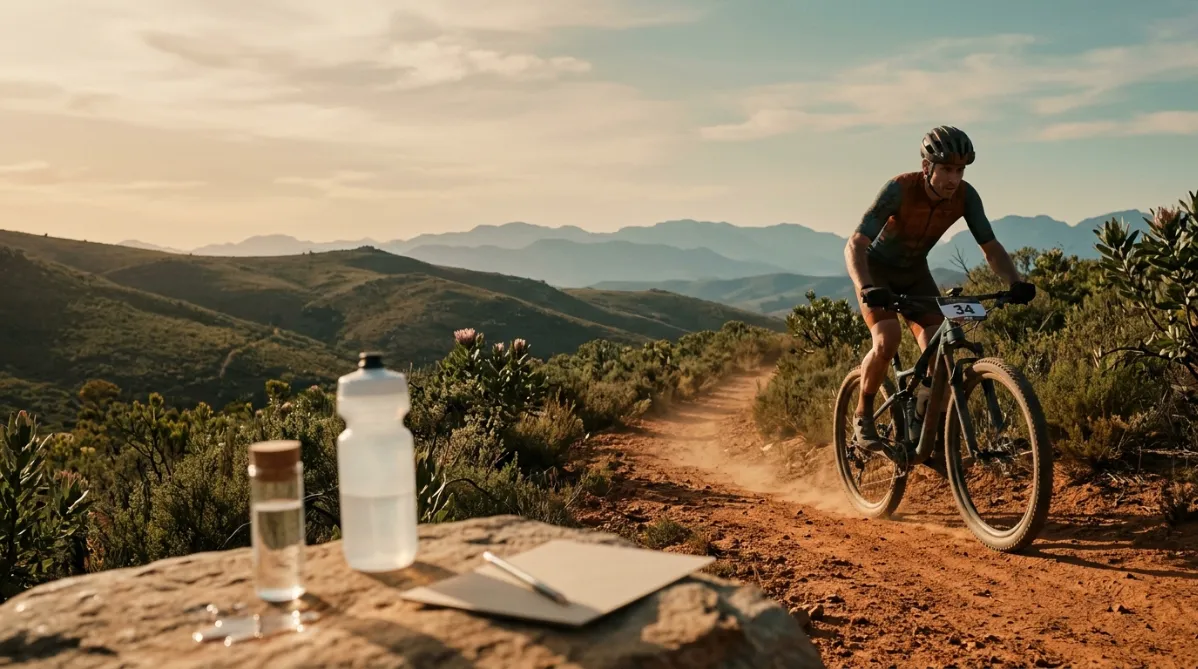
Wide landscape editorial photograph of a mountain biker mid-ride on a dusty red-orange singletrack trail in the South African Western Cape, golden hour light raking across the scene. The rider is in sharp focus on the right third of the frame, wearing a weathered cycling kit with a race number plate on the handlebars, dust kicking up from the rear tire. Behind them, rolling hills covered in fynbos shrubland and silhouetted protea plants fade into soft, hazy blue mountains. Warm amber sunlight creates long shadows and a soft rim light around the rider and bike.

In the lower left foreground, slightly out of focus, a small minimalist glass vial and a clear water bottle sit on a flat sun-bleached rock, with a few drops of liquid catching the light. Next to them, a simple matte paper notecard and a pencil suggest data collection, with no legible text. The vial and bottle are clean, understated, and modern, with no branding.

The color palette is earthy and refined: terracotta, ochre, sage green, dusty teal sky, and cream highlights. The composition uses shallow depth of field, a generous negative space in the upper left sky for headline overlay, and subtle film grain. The mood is contemplative, skeptical, and quietly sophisticated, like a feature photograph from a high-end outdoor sports and science magazine. Natural, candid, cinematic, shot on a 50mm lens with soft contrast and muted saturation. No futuristic elements, no glowing effects, no molecular graphics, no text.
Science & Research

Ketone IQ Raised Ketones at Cape Epic, But Did Nothing Else

Dr. Gymbro · · 4 min read

Eight days. Hundreds of kilometres of punishing South African singletrack. Two doses of a premium ketone drink every day. And at the end of it, riders who drank Ketone IQ looked, felt and performed about the same as riders who drank a placebo.

That is the headline from a new double-blind trial in the European Journal of Sport Science, and it is a useful reality check for anyone considering ketone supplements for recovery.

What the researchers tested

Engelbrecht and colleagues followed 18 trained mountain bikers (10 teams) through the 2025 Absa Cape Epic, an 8-day multi-stage race. Riders were randomised to take either 87.5 mL of Ketone IQ, whose active ingredient is R-1,3-butanediol (BDO), or a placebo. They took it twice daily: once after each stage and once before sleep.

The team tracked a broad set of real-world markers:

  • Heart rate, both during exercise and at rest
  • Energy and carbohydrate intake
  • Hydration
  • Sleep metrics
  • Cognitive performance, including reaction time
  • Subjective stress and recovery

This was the point of the study. Most ketone research happens in controlled lab sessions. This one asked whether BDO helps when fatigue, sleep debt and fuelling pressure pile up over a week of racing.

The striking result: ketosis, but no payoff

The drink did what it promised on blood chemistry. BDO produced mild post-stage ketosis of about 1.0 mM β-hydroxybutyrate (BHB), starting from stage 1.

The benefits did not follow. Across the race, both groups showed the same signs of accumulating strain:

  • Lower heart rate during exercise
  • Higher resting heart rate
  • Increased energy and carbohydrate intake
  • Slower reaction time by stage 6

BDO did not change any of these patterns compared with placebo. The title of the paper states it plainly: post-exercise BDO did not improve markers of fatigue or recovery. The authors conclude that the modest ketosis was not effective under real-world racing conditions.

The pattern is the textbook picture of cumulative fatigue in stage racing, and the ketone drink did not bend it.

Butanediol is not the same as a ketone ester

This is the part buyers most often miss. "Ketone supplement" covers several different products.

The background literature the authors point to centres on ketone monoester (KME), which has been linked to better recovery and reduced physiological stress during endurance exercise. BDO is a different compound. It is a ketone precursor: the body has to convert it into BHB, rather than receiving a ketone directly. As a general rule, that conversion route tends to produce lower blood ketone levels than monoester drinks, and the roughly 1 mM seen here fits that picture.

The authors stress the point themselves, calling for "formulation-specific" evaluations. In plain terms, a null result for BDO does not prove that ketone esters fail, and a positive ester study does not prove BDO works. They are separate products with separate evidence.

What this means if you're thinking of buying

The study does not show that ketones are useless, but it does undercut the idea that Ketone IQ is a recovery shortcut for multi-day endurance efforts.

  • Dose and timing tested: 87.5 mL twice daily, post-exercise and before sleep. That is the protocol that failed to move recovery markers here. Taking more, or at other times, was not tested.
  • Who it might not be for: if your main goal is better recovery, sleep or next-day freshness across a stage race, this trial gives you no evidence of benefit.
  • Where your money probably goes further: the riders in both groups were eating more carbohydrate and energy as the race went on. Nailing fuelling, sleep and hydration is a well-supported place to put effort and budget before a speculative supplement.
  • Check the compound: if you are shopping, confirm whether a product is BDO or a ketone ester, and do not assume results transfer between them.

Limitations worth taking seriously

This was a small study, and the caveats matter.

  1. Sample size: 18 riders is small. A small trial can miss modest real effects, so "no difference detected" is not the same as "proven zero effect."
  2. Riders raced in teams: the 10 teams add real-world noise, such as differences in pacing, terrain exposure and individual stage demands, that a lab study would remove.
  3. One compound, one dose, one schedule: the findings apply to this BDO product, at this dose, in a post-exercise protocol. They say nothing about pre-exercise use or other formulations.
  4. Mild ketosis: blood BHB reached about 1.0 mM. Whether higher levels would change outcomes was not tested here.

The design is also a strength. Double-blind, placebo-controlled testing in an actual 8-day race is hard to do, and it is the kind of ecologically valid evidence that supplement marketing often lacks.

Bottom line

Ketone IQ raised ketones in Cape Epic riders, but it did not reduce strain, protect reaction time or improve recovery compared with placebo. For endurance athletes weighing a premium ketone drink, the evidence from this trial says to be sceptical about BDO for recovery. Larger studies, and direct comparisons with ketone esters, would give a fuller answer.

Source: Engelbrecht et al., "Post-Exercise R-1,3-Butanediol did not Improve Markers of Fatigue or Recovery During a Multi-Stage Mountain Bike Race," Eur J Sport Sci (2026). DOI: https://doi.org/10.1002/ejsc.70260. PubMed: PMID 42852530.
Original study

Read the original research on pubmed.ncbi.nlm.nih.gov →

This article summarizes published research for general information. It is not medical advice.

DG

Written by

Dr. Gymbro

Dr. Gymbro writes for Dr. Gymbro: science-backed fitness, nutrition & performance.

Related Articles

A sunlit outdoor running track in late afternoon, shot from a low angle with shallow depth of field. In the foreground, a matte black bottle with a minimal off-white label sits on the edge of a warm terracotta-colored track lane, beside a folded white towel and a small glass of amber liquid catching golden light. Condensation beads on the bottle. A faint heat shimmer rises from the track surface and softens the background.

In the midground, slightly out of focus, a lean athlete in a sage-green tank top and charcoal shorts runs on a treadmill-like stretch of track, a thin sheen of sweat on their shoulders, their expression focused and calm. Their motion is gently blurred, suggesting endurance and rhythm. Long soft shadows stretch across the lane lines.

The background fades into hazy peach, apricot, and pale yellow tones, with the suggestion of tall trees and a distant stadium wall. Warm sun flare enters from the upper right, creating a subtle glow and a few soft light streaks across the frame.

Subtle editorial touches: a small notebook with a pencil and a stopwatch rest beside the bottle, hinting at data and timing without any text legible. The color palette is warm and muted, with terracotta, cream, sage, and charcoal accents, and a fine film-like grain. The composition leaves open negative space on the left third for a headline overlay. The overall mood is clean, modern, and health-journal inspired, natural and aspirational, with a calm scientific curiosity rather than hype.
nutrition

Ketone Drinks in the Heat: Longer Endurance and Sharper Memory?

BY DR. GYMBRO ·

Ketone drinks are supposed to be for fat-burning biohackers, but a new heat-stress trial suggests they might also help you finish stronger. In 17 trained men, ketone monoester plus caffeine extended time to exhaustion to 8.9 minutes versus 7.0 with carbs plus caffeine, after 90 minutes of loaded treadmill work at 34 °C. Working-memory accuracy on the 1-back task improved too, while heart rate and core temperature didn't differ meaningfully. But 2-back, reaction time and the hit-and-avoid task showed no benefit, and the study was small, male-only and single-session. Here's what the data show, and what they don't.

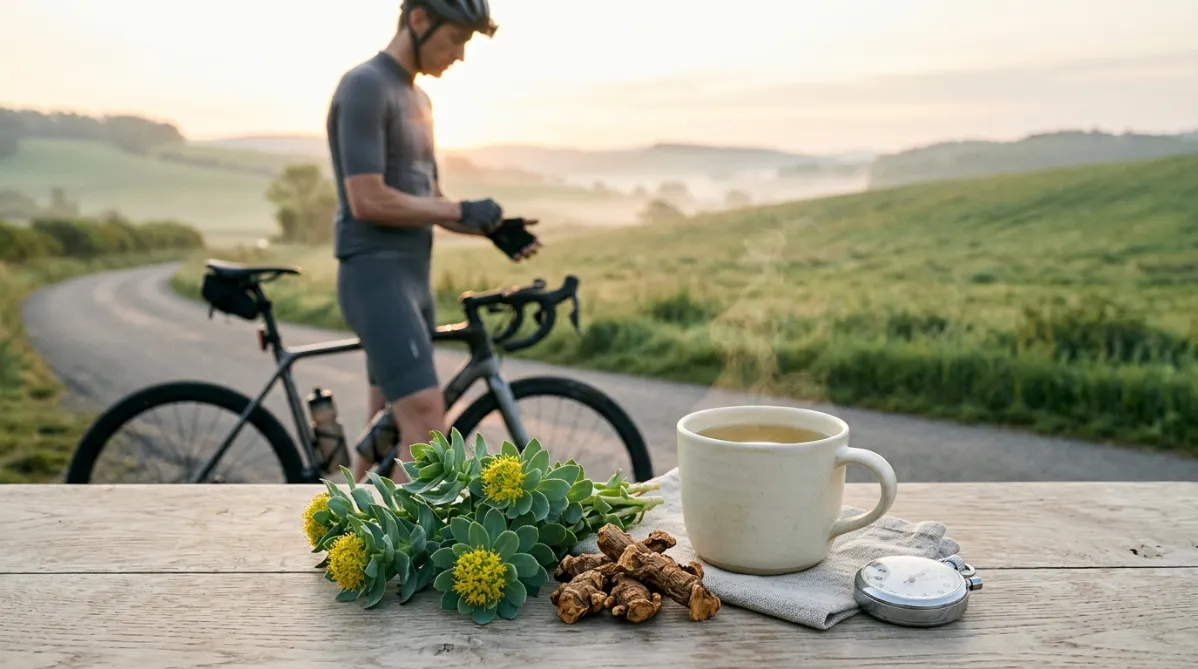
A landscape editorial photograph in soft natural morning light. In the foreground on a rustic light oak table, a small cluster of fresh Rhodiola rosea plants with thick succulent blue-green leaves and tiny golden-yellow flower clusters rests beside a few dried, knobby amber-brown rhizome pieces. A matte ceramic cup of pale golden herbal tea sits beside them, with a thin curl of steam and a small linen cloth. The plants and roots are sharp, with fine texture and dewy highlights.

In the softly blurred background, a lean cyclist in a fitted charcoal jersey stands beside a road bike on a quiet country lane at sunrise. Rolling green hills fade into pale mist behind them, and warm light rims the rider's shoulders. The cyclist tightens a glove, calm and focused, in a pre-ride moment of preparation. A water bottle is mounted on the bike frame, and a simple analog stopwatch with a brushed metal casing lies on the table near the herbs, hinting at timed effort.

The palette is muted and modern: sage green, warm cream, soft gold, and slate gray, with gentle peach tones from the sunrise. Shallow depth of field, a clean, airy composition with generous negative space on the right third for headline text, and subtle film grain. The mood is calm, health-conscious, and quietly athletic, like a premium wellness and sports science magazine cover. No text, no logos, no futuristic elements.
science research

Rhodiola Rosea: A Stimulant-Free Pre-Workout for Hard Cardio?

BY DR. GYMBRO ·

A 2013 crossover trial found that a single 3 mg/kg dose of Rhodiola rosea an hour before a 6-mile bike time trial shaved the finish time from 25.8 to 25.4 minutes. Warm-up heart rate dropped from 140 to 136 bpm, and perceived exertion fell from 6.6 to 6.0. The gain is small, around 1.5%, and comes from only 18 people, so it's no miracle. Still, the effort-perception angle makes it an intriguing stimulant-free option for endurance athletes. Here's what the data show and how to try it sensibly.

A sunlit, minimalist home gym corner photographed in soft golden morning light, with a young athletic man seated on a wooden bench, leaning forward with his elbows resting on his knees, catching his breath after a hard leg session. He wears a muted sage-green t-shirt and charcoal shorts, his face turned slightly away from the camera, calm and focused. A matte ceramic dish in the foreground holds a few small, translucent golden softgel capsules, with a glass of water beside it catching the light and casting a soft caustic shadow across a pale oak floor. Behind him, a loaded barbell rests on a squat rack, slightly out of focus, and a tall window pours warm sunlight diagonally across the scene, creating long gentle shadows and a hazy glow. A small potted green plant sits on a shelf at the edge of the frame. The color palette is warm and editorial: cream, soft gold, sage green, pale wood, and charcoal accents. Shallow depth of field, with crisp focus on the capsules and glass in the lower third and a creamy bokeh background. The composition leaves generous negative space on the right side for a headline overlay. The mood is clean, modern, and aspirational, like a high-end wellness magazine or a trendy health journal feature. Shot on a 50mm lens, natural light, fine film grain, subtle matte finish, landscape 16:9 framing.
recovery

Vitamin D Sped Strength Recovery in Men Who Weren't Deficient

BY DR. GYMBRO ·

Men with perfectly normal vitamin D levels still recovered strength faster after a brutal leg workout when they took 4,000 IU daily. In this randomized, placebo-controlled trial of 28 active men, peak isometric force bounced back about 8% better at 24 hours. Muscle-damage markers ALT and AST also rose less. But there's a twist: soreness didn't improve at all. Here's what the study found, where it falls short, and who might actually care.

A wide, editorial-style flat lay photographed from above on a pale warm-gray linen surface in soft natural window light. At the center, a small open amber glass jar tips gently onto its side, spilling a few cream-colored capsules across the fabric. Next to the jar sits a loose arrangement of fresh mushrooms: a cluster of golden-tan reishi with glossy, lacquered caps, a few slender white enoki stems, a halved shiitake showing its pale gills, and a curl of turkey tail with concentric bands of rust, cream, and charcoal. A small wooden scoop holds a pile of fine beige mushroom powder.

On the left third of the frame, a matte black sports watch with a minimal face lies beside a folded sage-green running shirt and a pair of lightweight off-white running shoes, hinting at athletic training without showing a person. A slim white notebook with a single pencil rests nearby, open to a blank page with a faint hand-drawn line graph trending upward, in thin graphite strokes.

On the right side, a pair of clear glass beakers and a single small petri dish with a soft amber-tinted liquid add a subtle laboratory note, kept calm and organic. A single sprig of dried herbs and a few scattered oat-colored grains add texture.

The palette is earthy and refined: oatmeal, soft sage, terracotta, warm amber, and charcoal accents against the muted neutral background. Shadows are soft and diffused, with a gentle highlight on the glass and the glossy reishi cap. The composition leaves generous negative space in the upper right for a headline overlay. Shallow depth of field blurs the edges slightly, while the central mushrooms and capsules stay crisp. The overall feel is modern, clean, and trendy, like a wellness and science magazine cover, with tactile natural textures, minimal styling, and a quiet sense of curiosity and skepticism.
science research

A Mushroom Capsule Lifted VO2max 14.8%—But There's a Big Catch

BY DR. GYMBRO ·

A mushroom capsule, 40 days, and a 14.8% rise in VO2max sounds almost too good to be true. In this new Antioxidants paper, 50 young male athletes taking 320 mg/day of a beta-glucan-rich multi-mushroom extract improved from 46.26 to 53.12 mL/kg/min. The big catch is that there was no placebo group, no randomization and no blinding, and the athletes kept training throughout. Cell experiments on rat heart cells add a hypoxia-related hint, but they tested single compounds, not the capsule. Here's what the study found, what it can't tell us, and who should think twice.

This page is available in