A 14.8% jump in VO2max would be a remarkable result. Elite coaches spend years chasing gains like that, and here it appears after 40 days of a mushroom capsule. That is the headline number from a new paper in Antioxidants. It is also a number you should treat with caution, because the study had no placebo group.
The Striking Number
The paper (Kumar, Gill, Verma and Singh, Antioxidants 2026;15(11):1386) reports that 50 healthy male athletes aged 18 to 22 took 320 mg per day of a beta-glucan-rich, multi-mushroom extract for 40 days. Their relative VO2max rose from 46.26 to 53.12 mL/kg/min, a 14.8% increase (p<0.001). Absolute VO2 rose 11.6%. Coverage in NutraIngredients also reports that time to exhaustion increased.
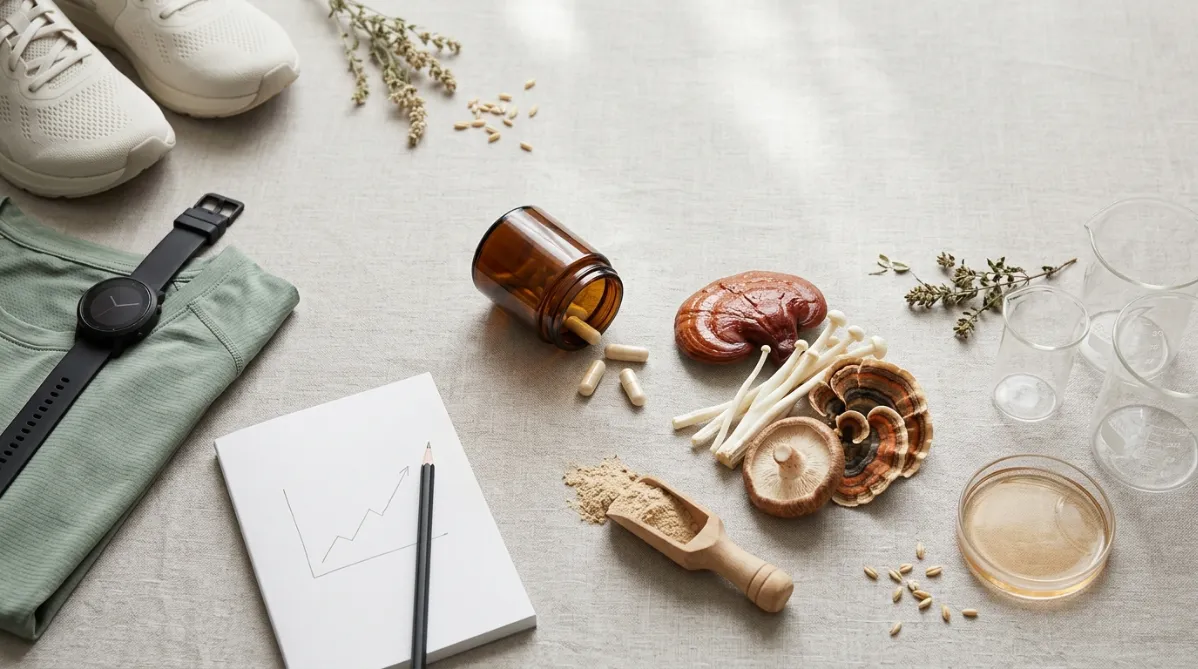
The product was a "7-in-1 Mushroom Complex Extract" capsule. The material I reviewed does not specify which mushroom species it contained, so I won't guess.
The Big Catch: No Placebo, No Control
This was an uncontrolled, single-arm, pre-post pilot. There was no placebo group, no randomization and no blinding. The authors themselves describe the results as hypothesis-generating.
That matters for three reasons:
- Training kept going. The athletes continued their usual training during the 40 days. A young athlete who trains for six weeks can improve VO2max without any supplement, and this design cannot separate the two effects.
- Expectation effects. Everyone knew they were taking a supplement. Motivation matters in a maximal exercise test, and nothing here controls for it.
- Narrow population. All participants were healthy young men, so the results say nothing about women, older adults or non-athletes.
The design did include some structure. Participants had a 14 to 17 day supplement washout first, and they ate a standardized isocaloric diet. Those steps help, but they don't replace a control group.
What Else Changed in the Blood and Breath
The secondary findings are mixed and harder to interpret:
- Peak respiratory quotient (RQ) rose from 1.096 to 1.308. That is an unusually high value, which is a reason for caution about how the measurement should be read.
- Hematocrit fell from 44.5% to 42.1%, which runs opposite to the usual "more red cells, more oxygen" story.
- Mean corpuscular volume (MCV) went up.
- White blood cell count dropped from 7.53 to 6.80, with neutrophils down and lymphocytes up.
A lower hematocrit alongside a higher VO2max is an interesting combination, but this study cannot explain it. It could be a real physiological effect, a plasma-volume shift, or noise. Without a control arm, no one can say which.
The Cell Experiments: Interesting, but a Different Question
The paper also has a lab component. The researchers used H9c2 rat cardiomyoblasts (heart-derived cells) and imposed chemical hypoxia with cobalt chloride (CoCl2). They tested three compounds separately:
- Beta-glucan at 20 µg/mL
- Taurine at 40 µM
- L-arginine at 50 µM
All three improved metabolic activity, to 83.65–97.40% against 67.29% in the hypoxia-only cells. All three also lowered Hif1a transcripts, a marker tied to the cellular hypoxia response. The Seahorse measurements of mitochondrial function showed changes that were not statistically significant.
There is a gap between this work and the human trial. The cell work tested single compounds in rat cells under a chemical model of low oxygen. The human work tested a mushroom extract in athletes. The cell data may suggest a plausible mechanism, but they do not show that the capsule works through it in people.
What the Evidence Can and Can't Support
Can support: a signal worth testing. A large pre-post change with a small p-value in 50 people, plus cell data pointing toward hypoxia-related pathways, justifies a proper trial.
Can't support: the claim that mushroom extract raises VO2max by roughly 15%. Training adaptation, expectation, test familiarity and measurement variation could each account for some or all of the change. A well-run placebo-controlled trial would likely show a much smaller effect, if any.
Practical Takeaways
- Dose studied: 320 mg/day of a beta-glucan-rich multi-mushroom extract.
- Duration: 40 days. The source material I reviewed doesn't specify the time of day, so there is no evidence-based timing advice.
- Who it might interest: healthy, young, trained men who want to run a careful personal experiment. Even then, treat it as an experiment, not a proven performance aid. Track your own testing under consistent conditions.
- Who should skip it or ask a professional first: people with mushroom allergies, anyone pregnant or breastfeeding, people with medical conditions, and anyone on prescription medication, especially immune-modulating drugs. Tested athletes should also check product labels and third-party certification. This is general caution, not a finding from the paper.
- What not to do: don't swap proven performance basics (structured training, sleep, fueling) for a capsule.
The Bottom Line
A 14.8% VO2max rise is the kind of number that spreads fast, and the missing placebo group is the reason to slow down. This pilot gives researchers a hypothesis, not athletes a result. The real test is a randomized, placebo-controlled trial with a defined mushroom composition, a broader participant pool and blinded testing. Until then, the answer to "does the mushroom capsule really add 15% to VO2max?" is that we don't know yet.