You crack a cold can of Red Bull on the way to the gym and expect a jolt in your sprint, jump, and grip. A new randomized trial in Nutrition and Health suggests that one standard can may not deliver much of that. Across 13 performance measures, it did not beat a lookalike placebo on a single one.
How the study was built
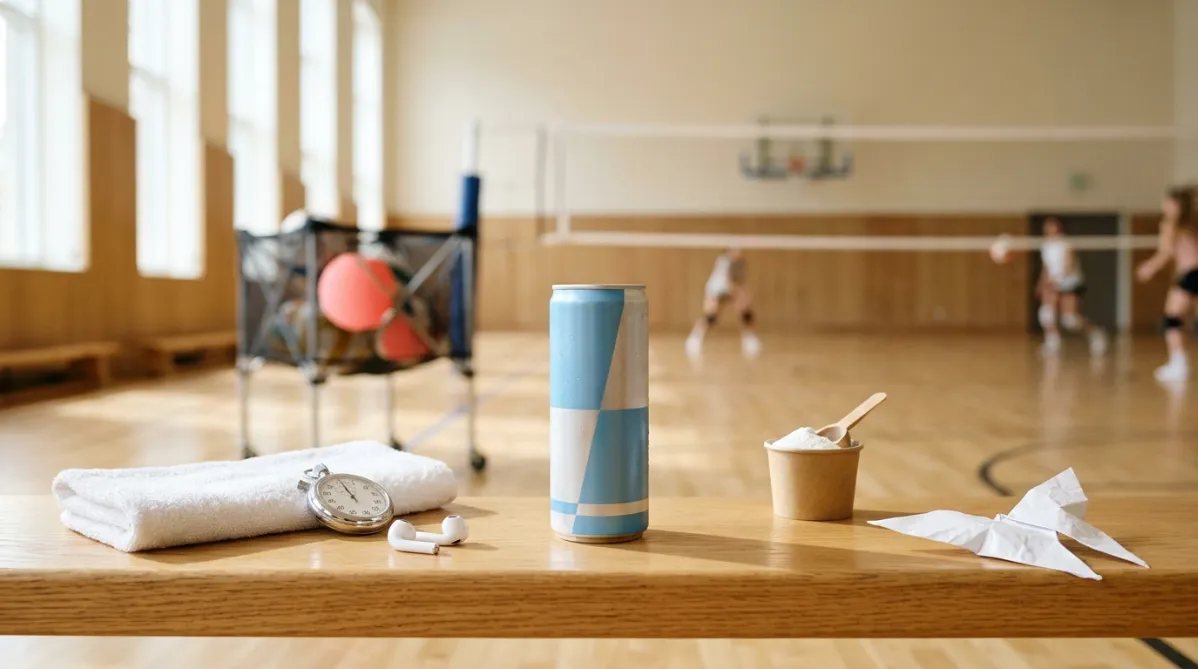
The research team from the University of South Bohemia in České Budějovice recruited 15 female sub-elite volleyball players, with a mean age of 21.3 years. They used a randomized, double-blind, placebo-controlled crossover design. Each athlete did both conditions, drinking Red Bull in one session and a placebo made to match its taste and appearance in the other, a week apart.
The crossover format means every player acts as her own control. That matters in a small sample, because differences in fitness, body size, and baseline power between people don't muddy the comparison. Double-blinding means neither the athletes nor the testers knew which drink was which, which limits expectation effects.
Players drank about 251 mL of Red Bull, delivering roughly 80 mg of caffeine. Testing began 33 minutes later and included three tasks: a Wingate anaerobic test, a jump test, and a handgrip strength test. Together these yielded 13 performance variables, compared between conditions with paired t-tests.
The result: nothing moved
None of the 13 variables differed significantly between Red Bull and placebo (all p > 0.05). That covers anaerobic power output, jump performance, and handgrip strength. The authors concluded that, under these conditions, a standard commercial serving did not produce measurable improvements in short-duration, high-intensity performance.
This is a null result, not proof that Red Bull hurts performance. It simply failed to show a detectable advantage over a placebo.
The side effect: nausea
Eight of the 15 participants reported mild nausea after drinking Red Bull. That's more than half the group. The abstract doesn't break down how common it was after the placebo, so we can't say how much of this was the drink itself. Still, for athletes about to do an all-out sprint test or a hard session, a queasy stomach is a poor trade for no measurable payoff.
Why the dose probably matters
The most useful detail is the caffeine dose. The Red Bull supplied about 1.14 mg of caffeine per kilogram of body mass. Sports nutrition guidance commonly cites roughly 3 to 6 mg/kg as the range with the best-supported performance benefits. That figure comes from the wider caffeine literature, not from this paper, but it frames the result.
The math is simple. The players in this study averaged roughly 70 kg, going by the reported dose per kilogram. At 3 to 6 mg/kg, a person that size would need around 210 to 420 mg of caffeine, which is well beyond one 250 mL can. So the study arguably tests whether a low caffeine dose helps, and the answer here is no. It doesn't test whether an effective dose delivered through an energy drink would help.
Limits you should keep in mind
- Small sample: 15 athletes gives limited power to detect small effects. A modest real benefit could have been missed.
- Specific population: All participants were female, sub-elite volleyball players. Results may not carry over to male athletes, elite competitors, or other sports.
- Short-duration tests only: The tasks were brief, high-intensity efforts. Endurance or prolonged sessions weren't assessed.
- One serving, one timing: Testing came about 33 minutes after the drink, and only a single standard can was studied.
- Human trial, not lab-only: This was a controlled human experiment, which is a strength, but it's a single study and shouldn't be treated as the final word.
Practical takeaways
How much caffeine actually works? Based on the broader research, aim for roughly 3 to 6 mg per kg of body weight, not the ~1 mg/kg in a single can. Start at the low end to see how you tolerate it, since higher doses can bring jitters, GI upset, or poor sleep.
Timing. A window of about 30 to 60 minutes before training is the usual guidance. The 33-minute gap in this study fits that window, so poor timing is an unlikely explanation for the null result.
Who it's for. If you're a lifter, sprinter, or team-sport athlete who already tolerates caffeine and wants an edge, a properly dosed option is more promising than a single can of Red Bull. If you're prone to nausea or anxiety, or you train late in the day, you may be better off skipping it.
Energy drinks vs. pills vs. coffee. The advantage of caffeine pills or measured powders is that you control the dose exactly. Coffee varies widely by brew and cup size. Energy drinks bring sugar or sweeteners, carbonation, and a fixed, fairly small caffeine amount per can, and carbonation and volume may add to stomach discomfort. This study didn't compare these formats directly, so that's a practical inference rather than a finding.
Bottom line
One can of Red Bull before training didn't make these volleyball players stronger, more powerful, or higher jumpers, and it left many of them nauseated. The likely culprit is a caffeine dose well below what the research supports, so the study says more about under-dosing than about caffeine itself. If you want a performance lift, dose by body weight, time it 30 to 60 minutes before you train, and test it in practice first.