Dr. Gymbro
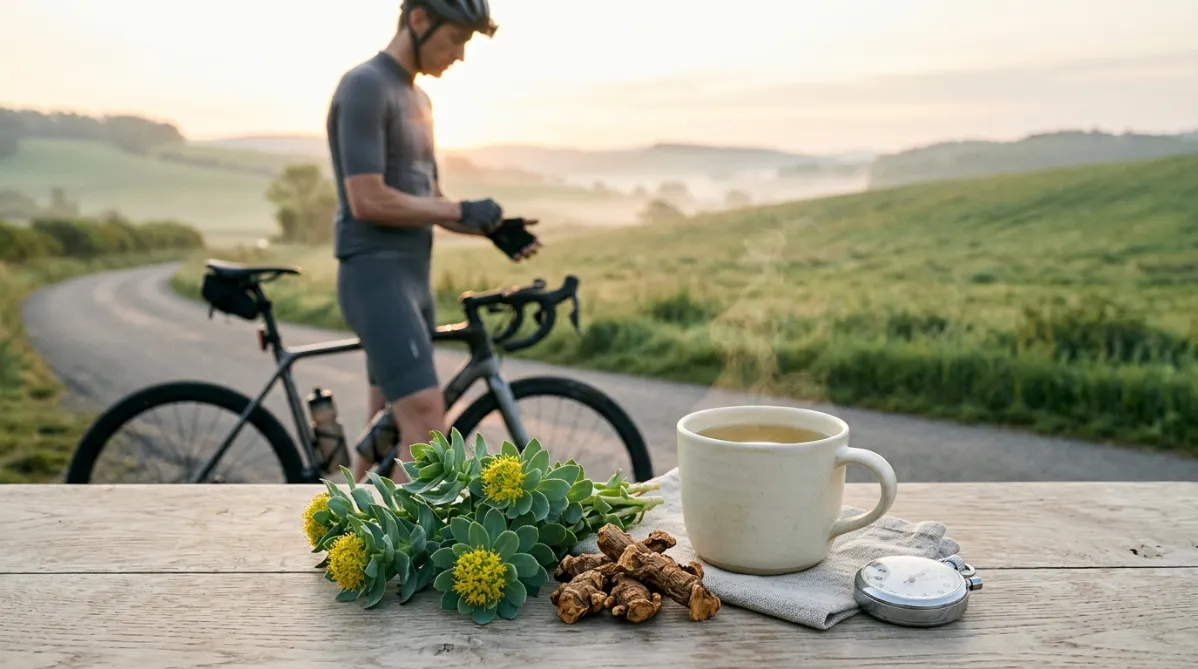
A landscape editorial photograph in soft natural morning light. In the foreground on a rustic light oak table, a small cluster of fresh Rhodiola rosea plants with thick succulent blue-green leaves and tiny golden-yellow flower clusters rests beside a few dried, knobby amber-brown rhizome pieces. A matte ceramic cup of pale golden herbal tea sits beside them, with a thin curl of steam and a small linen cloth. The plants and roots are sharp, with fine texture and dewy highlights.

In the softly blurred background, a lean cyclist in a fitted charcoal jersey stands beside a road bike on a quiet country lane at sunrise. Rolling green hills fade into pale mist behind them, and warm light rims the rider's shoulders. The cyclist tightens a glove, calm and focused, in a pre-ride moment of preparation. A water bottle is mounted on the bike frame, and a simple analog stopwatch with a brushed metal casing lies on the table near the herbs, hinting at timed effort.

The palette is muted and modern: sage green, warm cream, soft gold, and slate gray, with gentle peach tones from the sunrise. Shallow depth of field, a clean, airy composition with generous negative space on the right third for headline text, and subtle film grain. The mood is calm, health-conscious, and quietly athletic, like a premium wellness and sports science magazine cover. No text, no logos, no futuristic elements.
Science & Research

Rhodiola Rosea: A Stimulant-Free Pre-Workout for Hard Cardio?

Dr. Gymbro · · 4 min read

If you want a pre-workout that makes hard cardio feel easier but has no caffeine in it, Rhodiola rosea is one of the few herbal options with a controlled trial behind it. A 2013 study in the Journal of Strength and Conditioning Research by Noreen and colleagues tested a single dose of Rhodiola before a cycling time trial. The results were modest but interesting, and they are easy to oversell. Here is what the study found, what it didn't, and how to think about using it.

What the Researchers Did

Eighteen participants took part in a double-blind, randomized crossover trial. Each person ingested either Rhodiola rosea at 3 mg per kilogram of body weight or a carbohydrate placebo one hour before testing. They then completed a standardized 10-minute warm-up followed by a 6-mile time trial on a bicycle ergometer. A week or less later (2 to 7 days), they repeated the protocol with the other condition.

The team tracked more than finishing time. Rating of perceived exertion (RPE) was recorded every 5 minutes on a 10-point Borg scale. Blood lactate, salivary cortisol, and salivary alpha amylase were measured around the warm-up and the time trial (in 15 participants). Mood was assessed with the Profile of Mood States questionnaire, and cognitive function with a Stroop Color Test.

The Headline Numbers

Three results reached statistical significance:

  • Time trial: 25.4 ± 2.7 minutes with Rhodiola versus 25.8 ± 3.0 minutes with placebo (p = 0.037).
  • Warm-up heart rate: 136 ± 17 bpm versus 140 ± 17 bpm (p = 0.001).
  • Perceived exertion: 6.0 ± 0.9 versus 6.6 ± 1.0 (p = 0.04).

When the researchers expressed RPE relative to workload, the gap widened: 0.048 versus 0.057 (p = 0.007). In plain terms, participants felt they were working less hard for the same output. Nothing else, including lactate, cortisol, alpha amylase, mood, and Stroop performance, differed significantly.

Keeping the Time Gain in Perspective

A 0.4-minute improvement is roughly 24 seconds, or about 1.5% of the total time. For a recreational rider that is a nice-to-have. For a competitive cyclist, 1.5% can matter, since races are often decided by smaller margins. But this is a small effect from a small sample of 18 people, and the standard deviations on finishing time (around 3 minutes) show how widely individuals varied. A crossover design helps because each person serves as their own control, yet one acute session per condition is still a limited snapshot.

It is also worth being clear about what this study is not. It tested a single acute dose, not weeks of daily supplementation. It should not be treated as equivalent to earlier Rhodiola research that used different protocols, dosing schedules, or outcomes. Findings from one design do not automatically carry over to another, so the claims here apply only to this specific setup: one dose, one hour before, a 6-mile cycling effort.

Why Perceived Effort May Be the Real Story

The interesting part is the mechanism the authors suggest. Because lactate and stress hormones didn't change, the performance edge doesn't appear to come from a clear metabolic shift. Instead, the lower heart rate during submaximal work and the lower RPE point toward a reduced perception of effort. The authors concluded that Rhodiola appears to improve endurance performance by decreasing how hard exercise feels.

That framing matters. Endurance performance is partly governed by the brain's tolerance of discomfort, and anything that shifts effort perception can let someone sustain a higher output. It also explains the appeal as a stimulant-free option: the effect is not described as a caffeine-like jolt, and the study found no mood or cognitive changes to suggest one. This is an interpretation, though, and the trial wasn't designed to prove a mechanism.

Practical Takeaways

Dose: 3 mg/kg works out to about 200 to 250 mg for most adults (roughly 66 to 83 kg). A 60 kg person would take about 180 mg, and a 90 kg person about 270 mg. Check your product label and adjust to body weight.

Timing: The study dosed 60 minutes before testing, so take it about an hour before your session.

Product quality: Look for a standardized extract that lists its active compounds, typically rosavins and salidroside. Supplement quality varies, and unstandardized products make it hard to know what you're getting. The paper's abstract doesn't specify extract details, so treat standardization as sensible due diligence rather than a study-backed requirement.

Who it's for: Endurance athletes such as cyclists, runners, and rowers who want an edge on hard efforts, and people who avoid caffeine because of sleep, anxiety, or sensitivity. If you already tolerate caffeine well, this isn't a replacement for what's proven there, but the two address effort differently.

Test it first: Because responses vary, trial it in training rather than on race day. Compare how a familiar session feels with and without it.

The Bottom Line

Rhodiola rosea shows early, plausible promise as a stimulant-free way to make hard cardio feel easier. The effects in this study were real in statistical terms but small in size, and they come from 18 people in one acute-dose experiment. Treat it as a low-risk experiment for endurance training, not a guaranteed performance upgrade, and let larger, longer trials say more before drawing firmer conclusions.
Original study

Read the original research on pubmed.ncbi.nlm.nih.gov →

This article summarizes published research for general information. It is not medical advice.

DG

Written by

Dr. Gymbro

Dr. Gymbro writes for Dr. Gymbro: science-backed fitness, nutrition & performance.

Related Articles

A wide, editorial still life photographed in soft natural window light on a pale oatmeal-colored linen surface. At the center sits a small, rustic ceramic dish holding a handful of dried golden-orange Rhodiola rosea root pieces and a few fresh, fleshy green-gray succulent rosettes with rosy-pink tips. Beside it, a single matte amber glass capsule bottle lies on its side, with two cream-colored capsules spilling out. On the left, a minimalist analog stopwatch with a brushed brass case rests slightly out of focus, its hands suggesting a duration just past the quarter-hour mark. On the right, a worn, chalk-dusted steel kettlebell handle and a folded charcoal gym towel fill the negative space, hinting at lifting without showing a full gym scene.

In the foreground, a neat row of seven tiny ceramic pill cups arranged in a gentle diagonal line, the first cup holding one capsule and the rest sitting empty, as a quiet visual metaphor for a single dose versus daily dosing. A sprig of dried alpine moss and a few small speckled pebbles add organic texture. The background is a softly blurred warm-gray plaster wall with a gentle gradient shadow cast by a window frame, creating diagonal light stripes across the scene.

The palette is muted and earthy: sage green, terracotta, warm cream, brushed brass, and soft charcoal, with one subtle pop of coral from the Rhodiola tips. Shallow depth of field, crisp focus on the root and capsules, and fine film-like grain. The composition leaves generous clean negative space in the upper left for a headline overlay. The overall feel is a modern wellness and science journal: calm, tactile, minimal, and sophisticated, with a slightly moody, high-end magazine look. There is no text, no people, and no futuristic elements.
nutrition

200 mg of Rhodiola Bought Lifters 24 Extra Seconds. Then Four Weeks of Daily Dosing Added Nothing

BY DR. GYMBRO ·

A single 200 mg dose of Rhodiola rosea taken an hour before exercise nudged time to exhaustion from 16.8 to 17.2 minutes and raised VO2peak in a double-blind crossover trial. The twist is that four weeks of daily dosing didn't build on that effect or change any measured variable. The gain was small, about 24 seconds, and strength, reaction time and attention didn't budge. Here is what the study actually found, who might try an acute dose, and why you shouldn't count on "loading" rhodiola.

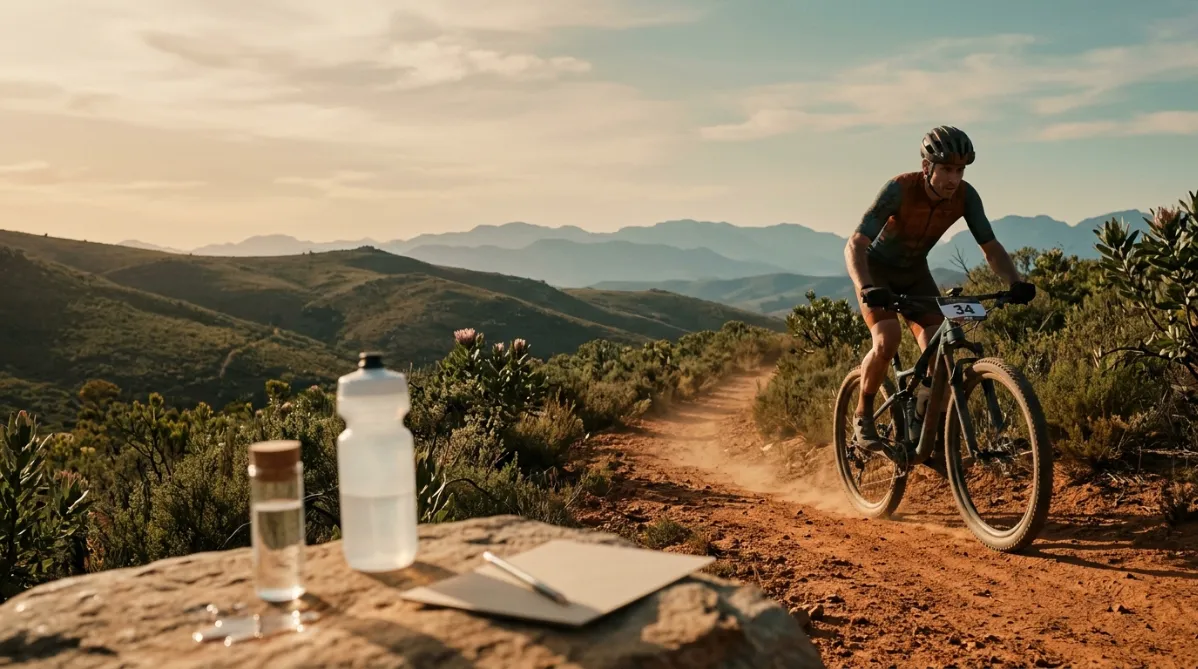
Wide landscape editorial photograph of a mountain biker mid-ride on a dusty red-orange singletrack trail in the South African Western Cape, golden hour light raking across the scene. The rider is in sharp focus on the right third of the frame, wearing a weathered cycling kit with a race number plate on the handlebars, dust kicking up from the rear tire. Behind them, rolling hills covered in fynbos shrubland and silhouetted protea plants fade into soft, hazy blue mountains. Warm amber sunlight creates long shadows and a soft rim light around the rider and bike.

In the lower left foreground, slightly out of focus, a small minimalist glass vial and a clear water bottle sit on a flat sun-bleached rock, with a few drops of liquid catching the light. Next to them, a simple matte paper notecard and a pencil suggest data collection, with no legible text. The vial and bottle are clean, understated, and modern, with no branding.

The color palette is earthy and refined: terracotta, ochre, sage green, dusty teal sky, and cream highlights. The composition uses shallow depth of field, a generous negative space in the upper left sky for headline overlay, and subtle film grain. The mood is contemplative, skeptical, and quietly sophisticated, like a feature photograph from a high-end outdoor sports and science magazine. Natural, candid, cinematic, shot on a 50mm lens with soft contrast and muted saturation. No futuristic elements, no glowing effects, no molecular graphics, no text.
science research

Ketone IQ Raised Ketones at Cape Epic, But Did Nothing Else

BY DR. GYMBRO ·

Riders at the 8-day Cape Epic drank Ketone IQ twice a day and hit about 1 mM blood ketones, yet their fatigue, heart rate, reaction time and recovery looked the same as placebo riders. The double-blind trial tested R-1,3-butanediol in real racing conditions rather than a lab. The authors say the modest ketosis was not effective, and that butanediol should not be confused with ketone esters. With only 18 riders, the study has real limits, but it is a sobering data point for anyone considering a pricey ketone drink for recovery.

A landscape editorial photograph of a lone runner's hands resting on a weathered wooden table beside a small white ceramic dish of fine white powder and a clear glass of water, shot in soft morning light. A slim matte aluminum energy drink can, unbranded with a minimalist pale sage-green label, stands slightly out of focus in the background, with a single scoop of powder dusted lightly on the tabletop. A pair of worn running shoes and a folded gray towel sit at the edge of the frame. Through a large window behind them, a blurred misty trail winds through green trees at sunrise, with warm golden light spilling across the scene.

The color palette is calm and modern: creamy off-white, sage green, warm honey gold, and soft charcoal. The composition follows the rule of thirds, with the dish and glass in the lower left third and generous negative space on the right for a title overlay. The depth of field is shallow, with a crisp focus on the powder's delicate texture and tiny glints of light on the glass rim. The mood is clean, thoughtful, and quietly energetic, like a contemporary health and science magazine feature. Natural grain, subtle film-like softness, and gentle shadows give it an authentic lifestyle-editorial look. There are no text, logos, or futuristic elements, only tactile, real-world materials like wood, ceramic, glass, cotton, and metal.
nutrition

The Energy Drink Ingredient That Boosts Endurance on Its Own

BY DR. GYMBRO ·

Everyone talks about caffeine, but the other ingredient on the energy drink can may be quietly doing its own work. A 2018 meta-analysis of 10 studies found that isolated taurine improved endurance performance (Hedges' g = 0.40), and a single dose appeared to be enough. Neither dose (1–6 g) nor supplementation length changed the effect in a meaningful way. The catch is a small evidence base and wide confidence intervals, so this is a promising signal, not a guarantee. Here's what the study found and how to try taurine sensibly.

A wide, editorial-style flat lay on a warm, matte cream stone surface, shot from slightly above in soft natural morning light. On the left, a ceramic espresso cup in muted terracotta holds dark coffee, with a few roasted coffee beans scattered beside it. In the center, a small wooden board holds three bright red chili peppers, one sliced open to show pale seeds, next to a small pile of coarse red pepper flakes. On the right, a pair of minimalist off-white running shoes with sage green accents rests at an angle, and a slim stopwatch with a clean white face lies in front of them. Three small matte white capsules sit in a neat row at the center of the composition, a quiet nod to the placebo and the active doses. Soft shadows fall to the lower right. A sprig of dried eucalyptus and a folded linen cloth in oatmeal tones add texture at the edges. The palette is warm and restrained: terracotta, chili red, cream, sage, and charcoal brown, with a gentle pop of red as the focal accent. The depth of field is shallow, so the foreground beans are slightly soft and the chilies and capsules stay crisp. The mood is clean, modern, and magazine-like, in the style of a contemporary health and science journal. There is no text, no people, and no logos, and plenty of negative space on the upper left and right edges leaves room for a headline overlay.
nutrition

Caffeine + Capsaicin Beat Placebo in a 10K. Capsaicin Alone Didn't

BY COACH RYAN ·

A chili-pepper compound plus caffeine was the only combo that beat placebo over 10 km in a new crossover trial, yet capsaicin alone did nothing. Caffeine drove the statistical effect, and there's no proof of synergy. The dose, 6 mg/kg, works out to roughly 450 mg for a 75 kg runner, which is a lot. Insomnia, anxiety, headaches, and racing heart showed up more often with caffeine. Here's what the 20-runner study found and who should skip it.

This page is available in