Dr. Gymbro
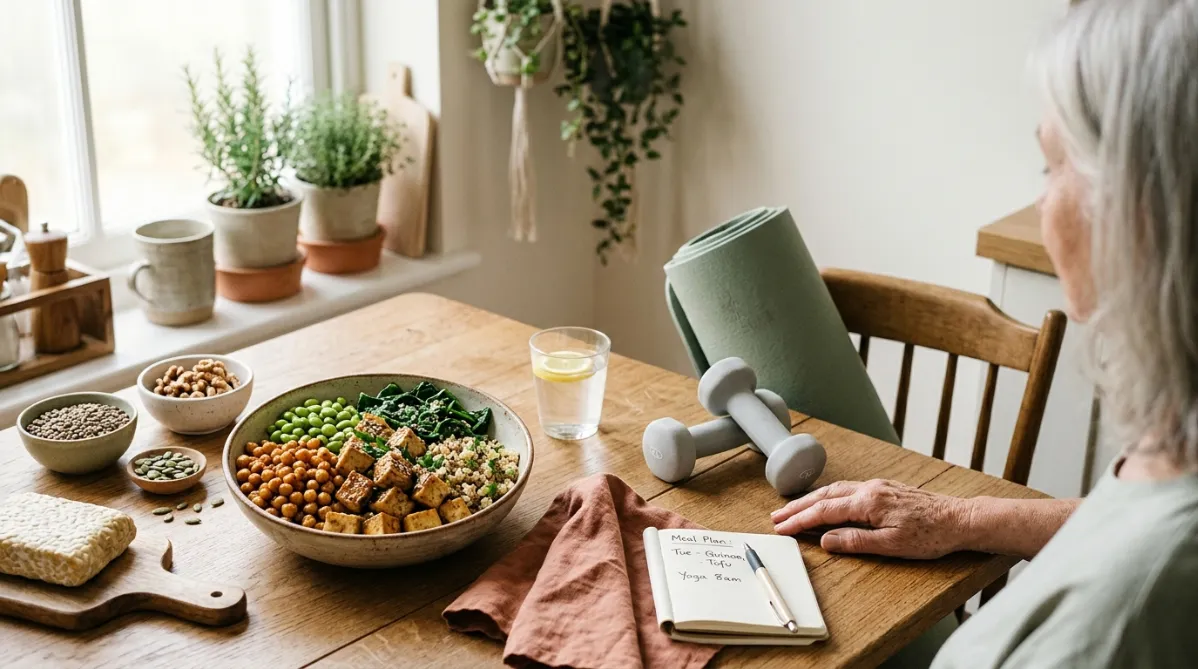
A landscape editorial photograph of a sunlit kitchen table, shot from a slightly elevated three-quarter angle. On the left, a rustic ceramic bowl holds a warm plant-based protein meal: roasted chickpeas, marinated tofu cubes, edamame, quinoa, and wilted greens, topped with toasted sesame seeds. Around it are small dishes of lentils, walnuts, pumpkin seeds, and a block of tempeh on a wooden board. On the right, a pair of weathered hands belonging to an older adult with silver hair, partially visible and softly out of focus, rests beside a pair of light dumbbells and a rolled sage-green yoga mat leaning against a chair. A linen napkin, a glass of water with a lemon slice, and a small handwritten notebook with a pen suggest careful planning. Soft morning light streams through a large window on the left and casts gentle long shadows across the pale oak tabletop. The color palette is muted and earthy: warm cream, sage green, terracotta, soft mustard, and natural wood tones. The background has shallow depth of field, with blurred shelves of herbs in pots and a few hanging plants. The mood is calm, hopeful, and health-focused, in the style of a modern lifestyle magazine or science journal feature, with clean composition, generous negative space in the upper right for headline text, and a subtle film-like grain. No text, no logos, no futuristic elements.
Nutrition

Going Vegan at 65+? Lean Mass Fell 1.15 kg in 12 Weeks

Dr. Gymbro · · 4 min read

Here's the part most headlines will skip: the muscle loss in this new trial wasn't really about plants. It was about protein that quietly went missing from the plate. A 12-week randomized controlled trial in older adults found that switching to a self-selected vegan diet, with no special protein planning, cost participants more than a kilogram of lean mass. Adding resistance training cut that loss roughly in half.

What the researchers actually did

The study, published in The American Journal of Clinical Nutrition, came from teams at Wageningen University and Maastricht University. It enrolled 72 healthy adults aged 65 or older and randomly assigned them to one of three arms for 12 weeks:

  • VEG: a self-selected vegan diet
  • OMNI: their habitual omnivorous diet
  • VEG-RE: a self-selected vegan diet plus resistance exercise

The measurements were thorough. Thigh muscle volume and fat infiltration were assessed by MRI, appendicular lean mass by DXA, and strength on a Biodex dynamometer. Muscle protein synthesis (MPS) was tracked over the first 10 days with a deuterium oxide protocol.

The protein gap behind the headline

The key word is self-selected. Participants chose their own vegan foods, and protein intake fell. Compared with baseline, the VEG group ate 27.7 g/day less protein in week 1, 22.0 g/day less in week 6, and 19.3 g/day less in week 12. The VEG-RE group dropped by a similar amount, while the omnivore group's intake didn't change.

So the trial tested what happens when older adults go vegan without deliberately rebuilding their protein intake. It did not test a carefully protein-matched vegan diet. That distinction matters for how you read everything below.

The muscle numbers

Over 12 weeks, the VEG group lost thigh muscle volume (−0.61 L) and appendicular lean mass (−1.15 kg). The omnivore group held steady, at −0.01 L and +0.05 kg. Both differences were statistically significant (P < 0.0001).

The vegan-plus-lifting group fared better than the vegan-only group but did not come out ahead of the omnivores. They lost −0.35 L of thigh muscle and −0.62 kg of lean mass. That's about half the lean-mass loss seen without training, but it's still a loss. The authors' conclusion is that resistance exercise mitigates the negative impact, which is not the same as erasing it.

Muscle protein synthesis told the same story

MPS was lower in the VEG group (1.09 %/day) than in the OMNI group (1.27 %/day) or the VEG-RE group (1.24 %/day). Older muscle is already less responsive to protein, so a lower protein supply plus no training stimulus is a poor combination. The training group's MPS landed close to the omnivores', which fits with exercise helping the body make better use of the protein it gets.

What this doesn't say

It doesn't say veganism is bad for aging muscle. The authors attribute the findings to reduced protein intake, and the study wasn't designed to show that a well-planned vegan diet fails. Participants also weren't coached on protein targets. Keep in mind that this is a 12-week trial in healthy older adults, so it can't speak to long-term outcomes or to people with medical conditions.

On funding, the authors disclose research support from government bodies and from food-industry sources, including dairy, meat, and plant-protein companies. They state that none of these organizations influenced the study's design, analysis, or publication.

Practical takeaways for older vegans (and vegan-curious)

The trial itself didn't test specific protein doses or products, so treat the following as sensible applications of its findings, not study-proven protocols.

  • Treat protein as a number to hit. If you switch to plant-based eating, track your intake before and after. The people in this trial lost roughly 20 to 28 g/day without trying to. Many experts recommend around 1.0 to 1.2 g/kg of body weight per day for healthy older adults, but check what's right for you with a dietitian or physician.
  • Choose concentrated sources. Soy foods, lentils, beans, tempeh, seitan, and plant-protein powders make it easier to close a gap. Protein powder is a practical tool here, since appetite often declines with age. Blends that are rich in leucine, an amino acid central to switching on MPS, are a reasonable pick, though this study didn't test specific products.
  • Spread it out. Aim for a meaningful protein serving at each meal rather than loading it all at dinner. That's a general strategy, not something this trial tested.
  • Lift something. Resistance training was the one intervention in the trial that clearly reduced the damage. Two to three sessions a week of leg presses, sit-to-stands, bands, or machines is a sensible start. Get cleared by your doctor first if you have heart or joint concerns.

Who this matters most for

This is most relevant for adults 65+ who are considering a switch to vegan eating, especially those who already have a small appetite, low muscle mass, or a history of unintentional weight loss. It also applies to long-time vegans who haven't checked their protein intake in years.

Who can relax a bit? Younger adults, and older vegans who already hit a solid protein target and train regularly. For them, this trial is a reminder to keep doing what's working, not a reason to abandon plants.

The bottom line

The study shows what happens when protein quietly drops and nothing replaces the muscle-building signal. Older adults who went vegan without planning lost over a kilogram of lean mass in three months, and lifting cut that loss by about half. If you want to eat plant-based and keep your muscle, plan your protein deliberately and lift weights.
Original study

Read the original research on pubmed.ncbi.nlm.nih.gov →

This article summarizes published research for general information. It is not medical advice.

DG

Written by

Dr. Gymbro

Dr. Gymbro writes for Dr. Gymbro: science-backed fitness, nutrition & performance.

Related Articles

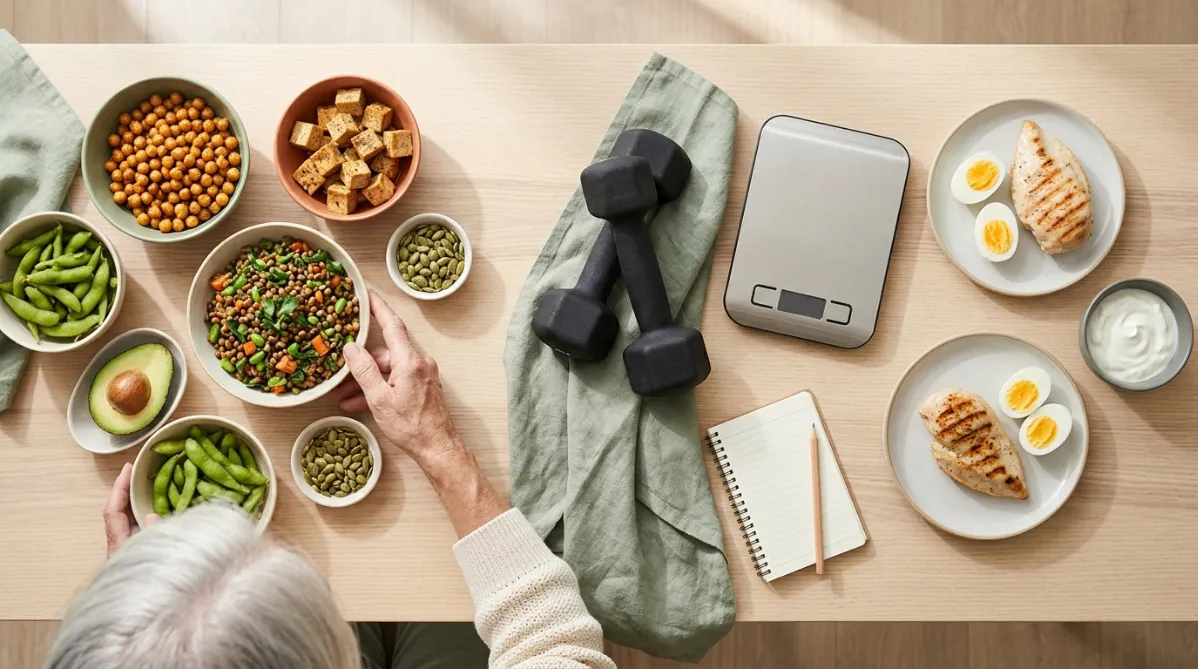
A bright, airy overhead flat-lay on a pale oak table in soft morning light. On the left, a vibrant plant-based protein spread in ceramic bowls: roasted chickpeas, marinated tofu cubes, lentil salad with herbs, edamame, sliced avocado, and a small dish of pumpkin seeds. On the right, a few contrasting items: a simple plate with grilled chicken breast, a hard-boiled egg halved, and a small bowl of Greek yogurt. Between the two sides, a pair of compact, matte-black hexagonal dumbbells rests on a folded sage-green linen towel, with a simple stainless-steel kitchen scale and a small open notebook with a pencil, suggesting tracking protein intake. A pair of weathered, elegant older hands, silver-haired and mid-60s, reaches in gently to pick up a bowl, with a casual cream knit sleeve visible. Natural window light casts soft diagonal shadows across the table. The palette is warm and muted: sage green, cream, terracotta, soft charcoal, with pops of fresh green and orange from the vegetables. Shallow depth of field, crisp focus on the food and dumbbells, gentle blur at the edges. The composition follows a clean editorial style with generous negative space at the top and right for headline text. The overall feel is modern wellness-magazine photography: calm, clean, and inviting, with tactile textures of linen, ceramic, wood, and fresh produce. Landscape 16:9 framing.
nutrition

Going Vegetarian After 55? What a 108-Person Lifting Trial Found

BY DR. GYMBRO ·

Thinking about ditching meat while you lift in your late 50s, 60s or beyond? The IMPACT randomized trial of 108 older adults found that vegetarians and omnivores both gained muscle and strength over 12 weeks of resistance training. But the vegetarian group ate less protein (1.24 vs 1.58 g/kg/day) and gained less appendicular muscle (+0.38 vs +0.66 kg). The researchers could not show the vegetarian diet was noninferior, and the muscle result was statistically inconclusive. Here is what the trial really shows, where it falls short, and how to set protein targets if you lift on a plant-leaning diet.

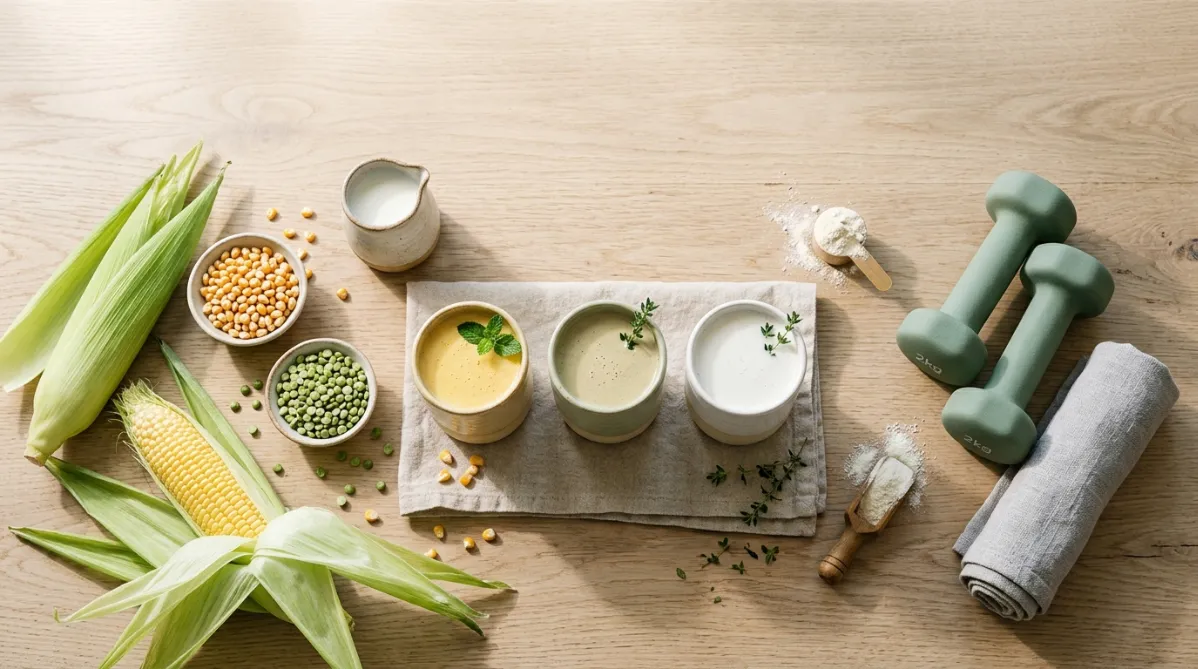
A bright, airy overhead flat-lay on a pale oak wooden table in soft morning daylight. At the center, three matching ceramic glasses in a neat row, each holding a creamy shake in a slightly different tone: one warm golden-yellow, one soft sage green-beige, one pure milky white. Beside the glasses, small shallow ceramic bowls hold the raw sources: dried yellow corn kernels, split green peas, and a small pitcher of fresh milk. A few fresh corn husks and a single ear of corn with pale green leaves are arranged diagonally across the left side of the frame, while a sprig of fresh herbs adds a touch of green. On the right, a pair of matte sage-green dumbbells and a rolled linen towel suggest light resistance exercise, placed with calm, editorial restraint. A linen napkin, a wooden scoop dusted with fine powder, and a few scattered kernels add natural texture. The color palette is warm cream, butter yellow, muted sage, and soft white, with gentle natural shadows falling to the lower right. Shallow depth of field, clean negative space at the top for headline overlay, minimalist modern magazine styling, crisp food-photography look, subtle film-like grain, wide landscape composition.
nutrition

The Plant Protein That Just Matched Milk for Muscle Synthesis

BY DR. GYMBRO ·

Plant protein is supposed to lose to milk when it comes to building muscle, but a new trial in older adults says corn protein didn't get the memo. In a randomized study of 48 healthy adults around age 68, 20 g of corn protein, a pea-corn blend, and milk protein all boosted muscle protein synthesis well above placebo, with no differences between protein groups. Resistance exercise amplified the response in every group. Here is the dose, the numbers, who it may suit, and the caveats you need before swapping your shake.

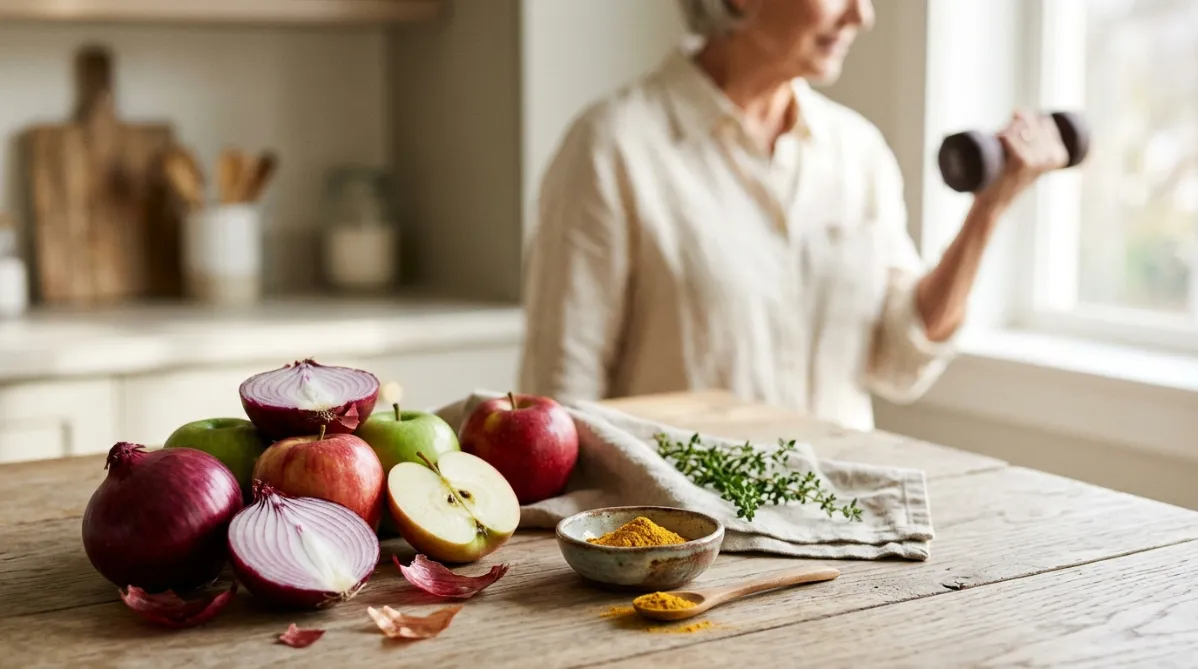
A landscape editorial photograph of a rustic kitchen table in soft morning window light. On a weathered light oak surface, a loose arrangement of fresh red onions, a few halved to show their purple-white rings, and crisp red and green apples, one sliced open to reveal pale flesh. A small ceramic bowl holds a pinch of golden-yellow quercetin powder, with a wooden spoon resting beside it. In the softly blurred background, an older woman in a cream linen shirt lifts a modest dumbbell near a sunlit window, her posture strong and relaxed. Her silhouette is out of focus, which keeps the produce as the main subject.

The palette is warm and natural: deep magenta onion skins, glossy apple reds, buttery yellow accents, and creamy neutrals. A gentle shallow depth of field gives creamy bokeh in the background. The light is diffused and golden, with delicate shadows and a few dried onion skin flakes scattered across the wood for texture. A folded linen napkin and a small sprig of thyme add a curated, modern lifestyle-magazine feel.

The composition follows the rule of thirds, with the produce at lower left and negative space on the right, where the blurred lifter and window glow provide balance. The overall look is clean, calm, and contemporary, like a premium health and wellness journal cover: natural, tactile, and optimistic, with fine film-like grain and true-to-life color.
nutrition

Quercetin Tripled Strength Gains in Older Lifters—Without More Muscle

BY DR. GYMBRO ·

A cheap flavonoid found in onions and apples may have just boosted strength gains in older lifters far beyond what training alone delivered. In a randomized, double-blind trial, older adults taking 200 mg/day of quercetin glycosides gained about 15% in knee strength over six weeks, versus about 5% on placebo. Strangely, muscle mass didn't change in either group. The edge appeared to come from the nervous system, with higher-threshold motor units firing faster. Here's what the study found, how to apply it, and why the small sample demands caution.

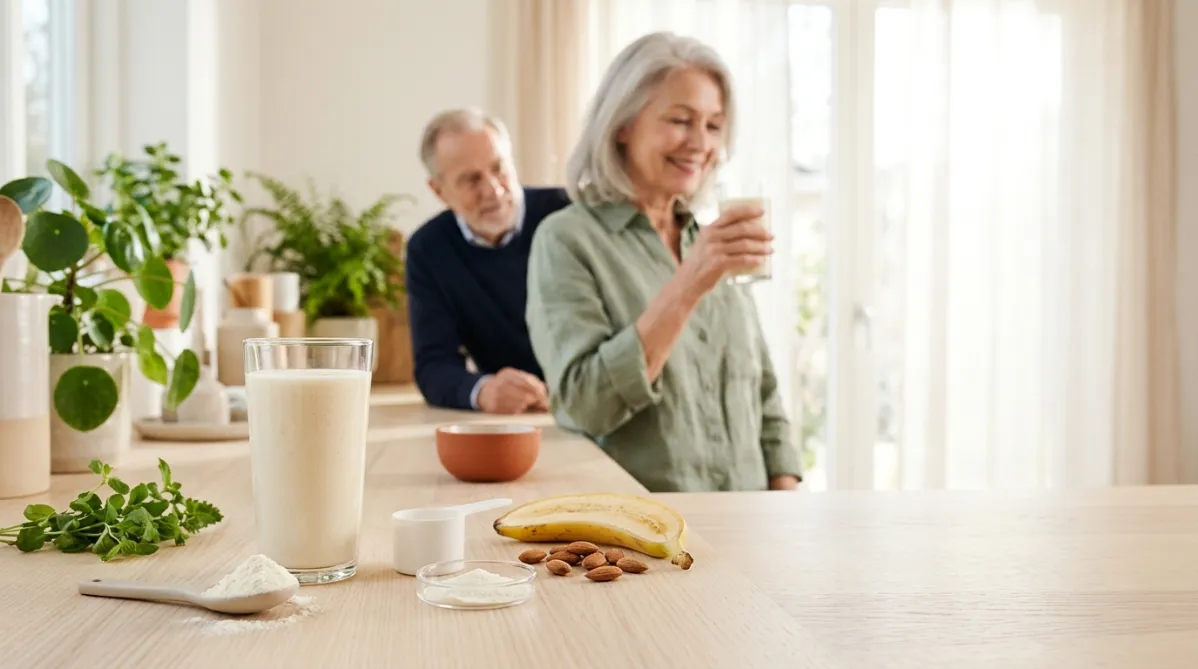
A bright, modern editorial still life on a clean, softly lit kitchen countertop of pale ash wood. In the foreground, a tall glass of creamy off-white protein shake sits beside a small ceramic spoon holding a mound of fine white powder. Next to it is a minimalist matte-white scoop and a small glass dish with a few pinches of powder. Scattered nearby are a few natural elements: a halved banana, a handful of raw almonds, and a sprig of fresh green herbs for a splash of color.

In the soft-focus midground, an older woman in her late 60s with silver-gray hair, wearing a sage-green linen shirt, smiles gently as she lifts a glass. Her face is slightly blurred and warm, bathed in natural window light. Beside her, slightly further back and out of focus, an older man in a navy sweater leans on the counter, a neutral presence that subtly contrasts with her. A wide window behind them floods the scene with soft morning light, with sheer curtains and a few leafy houseplants.

The color palette is muted and fresh: warm cream, soft sage, pale peach, and light oak, with a touch of terracotta from a small ceramic bowl. Shallow depth of field, creamy bokeh, subtle film-like grain, and gentle shadows give it a contemporary lifestyle-magazine feel. Composition follows the rule of thirds, with the shake and powder on the left third and open negative space on the right for headline overlay. The mood is calm, optimistic, and health-focused, polished like a trendy wellness journal cover, with no text, no logos, and no futuristic or sci-fi elements.
nutrition

3 g HMB + 40 g Whey: The Surprise Boost Hit Women, Not Men

BY DR. GYMBRO ·

Everyone assumed a muscle-building add-on would help older men most. A new tracer study found the opposite: adding 3 g of calcium-HMB to a 40 g whey shake boosted muscle protein synthesis in older women, but not men. HMB also reduced late-fed muscle breakdown across the group. But this was a 3-hour acute study of just 24 adults with Abbott Nutrition co-authors, so it's no proof of long-term muscle gain. Here's the dose, timing, who might benefit, and who should skip it.

This page is available in