Dr. Gymbro
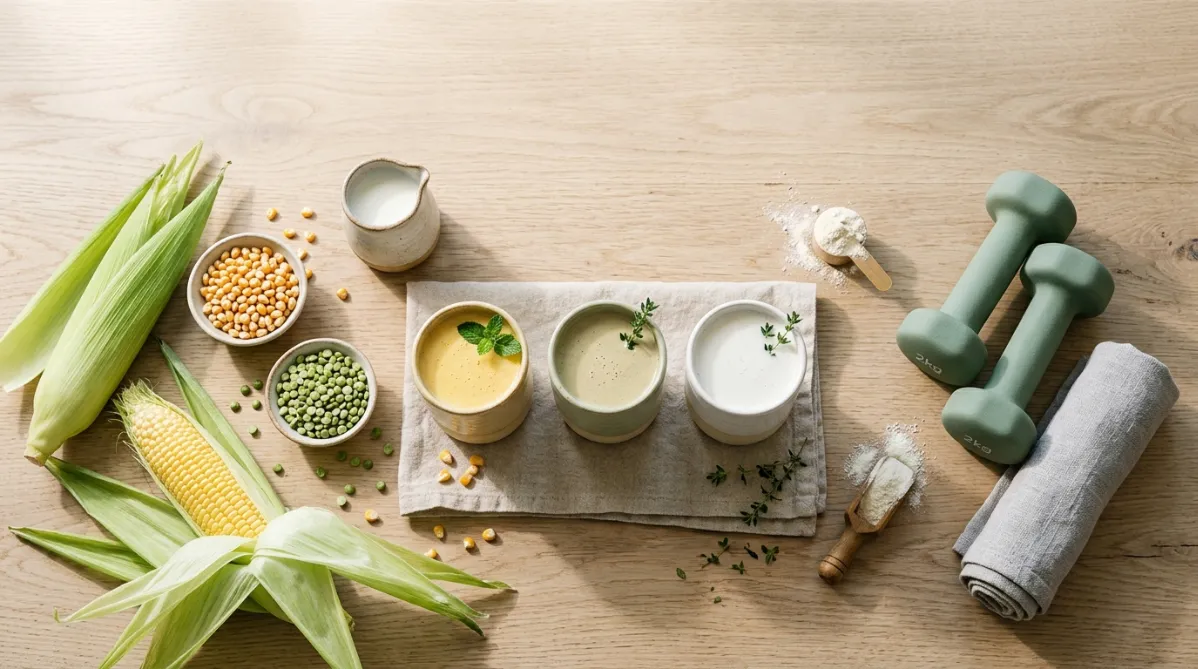
A bright, airy overhead flat-lay on a pale oak wooden table in soft morning daylight. At the center, three matching ceramic glasses in a neat row, each holding a creamy shake in a slightly different tone: one warm golden-yellow, one soft sage green-beige, one pure milky white. Beside the glasses, small shallow ceramic bowls hold the raw sources: dried yellow corn kernels, split green peas, and a small pitcher of fresh milk. A few fresh corn husks and a single ear of corn with pale green leaves are arranged diagonally across the left side of the frame, while a sprig of fresh herbs adds a touch of green. On the right, a pair of matte sage-green dumbbells and a rolled linen towel suggest light resistance exercise, placed with calm, editorial restraint. A linen napkin, a wooden scoop dusted with fine powder, and a few scattered kernels add natural texture. The color palette is warm cream, butter yellow, muted sage, and soft white, with gentle natural shadows falling to the lower right. Shallow depth of field, clean negative space at the top for headline overlay, minimalist modern magazine styling, crisp food-photography look, subtle film-like grain, wide landscape composition.
Nutrition

The Plant Protein That Just Matched Milk for Muscle Synthesis

Dr. Gymbro · · 4 min read

Plant proteins have long been treated as the weaker option for building muscle. A new randomized trial suggests corn protein may be an exception. In older adults, 20 g of corn protein stimulated muscle protein synthesis (MPS) about as well as 20 g of milk protein. Here is what the study found, and what it can't tell you yet.

The Study: Corn Protein Versus Milk

The paper, published in The Journal of Nutrition by Lim and colleagues (DOI: 10.1016/j.tjnut.2026.101895; PubMed 42933646), tested a question that had not been examined in older adults. Plant proteins usually have lower essential amino acid content, especially leucine, so they are generally considered less anabolic than animal proteins. The authors point out that corn protein is unusual because its leucine content is relatively high. Older adults also show reduced anabolic sensitivity, which makes them a demanding test group.

The researchers ran a double-blind, placebo-controlled, randomized parallel-group trial with 48 healthy older adults (average age 68 ± 5; 24 men and 24 women). Participants received 20 g of one of four things:

  • CORN: corn protein isolate
  • PEA+CORN: a pea and corn protein blend
  • MILK: milk protein isolate
  • PLA: a non-protein, low-energy placebo

Everyone did unilateral knee extension exercise (3 sets of 10 repetitions at 75% of one-repetition maximum). MPS was measured with a primed continuous infusion of L-[ring-13C6] phenylalanine, with blood and muscle samples taken throughout.

The Headline Numbers

The increase in MPS over basal values was:

Group MPS increase vs. basal
Corn protein 216 ± 170% (P < 0.001)
Pea + corn blend 217 ± 167% (P = 0.001)
Milk protein 138 ± 78% (P = 0.033)
Placebo 77 ± 46%

All three protein groups beat placebo, and the authors report no differences between the protein groups. The corn and blend averages were numerically higher than milk, but the spread was wide (note the large standard deviations), so the fair reading is "comparable," not "better." Don't read it as corn beating milk.

Exercise Still Matters

Resistance exercise further increased MPS compared with supplementation alone in every group (all P < 0.001). Protein helps, but lifting amplified the response regardless of the protein source. For older lifters, the paper supports pairing protein with training rather than relying on either one alone.

Why Leucine Gets the Spotlight

Leucine is the amino acid most associated with switching on the muscle-building response. Plant proteins often fall short on it, which is why they are usually assumed to be less effective per gram. The authors frame corn protein's relatively high leucine content as the reason it might behave differently. The abstract does not give leucine figures or test leucine as the cause, so treat that explanation as the paper's rationale, not a proven mechanism.

Practical Takeaways

Dose: The study used 20 g of protein per serving. That is the only dose tested, so it is the evidence-based number to anchor on. The trial didn't compare other amounts.

Timing: The abstract describes participants consuming the protein around a single bout of leg exercise. It doesn't test different timing windows, so it can't tell you whether before, during, or after is best.

Who it may suit:

  • Older lifters: This is the population studied (healthy adults around 68), and the response held up despite the age-related blunting of anabolic sensitivity.
  • People limiting dairy or animal products: Corn protein and a pea-corn blend produced MPS responses similar to milk protein. The participants were not selected as vegans, so this is an inference from the protein source, not a result in vegan eaters.
  • Anyone building a plant-based protein mix: The pea-corn blend performed as well as corn alone, which suggests blending is a workable option.

Who should be cautious or skip it:

  • People with a corn allergy or sensitivity: The study doesn't address this, but it is the obvious practical exclusion.
  • Anyone expecting proof of long-term muscle gains: This trial measured MPS, a short-term mechanistic marker, not changes in muscle size or strength over weeks or months.
  • People with medical conditions: Participants were healthy older adults. The findings may not carry over to those with kidney disease, frailty, or other illnesses, so check with a clinician first.

The Fine Print

Three caveats matter. First, 48 participants split across four groups is a small sample, and the wide variability in the corn groups means individual responses differed a lot. Second, MPS over a short measurement window is not the same as muscle growth over time. Third, the placebo group also showed an MPS rise of 77% from baseline, which is a reminder that exercise and measurement context affect these numbers, so interpret the percentages within the study design.

Bottom Line

The conclusion in the paper is straightforward: 20 g of corn protein, a pea-corn blend, or milk protein raised MPS in healthy older adults, and resistance exercise boosted the response further. For people who want a plant-based option without assuming a trade-off in anabolic response, corn protein is now a credible candidate. Longer training trials will show whether the short-term advantage translates into actual muscle and strength gains.

Source: Lim et al., The Journal of Nutrition. Trial registration NCT05917223. PubMed: https://pubmed.ncbi.nlm.nih.gov/42933646/
Original study

Read the original research on pubmed.ncbi.nlm.nih.gov →

This article summarizes published research for general information. It is not medical advice.

DG

Written by

Dr. Gymbro

Dr. Gymbro writes for Dr. Gymbro: science-backed fitness, nutrition & performance.

Related Articles

A landscape editorial photograph of a sunlit kitchen table in soft morning light, styled like a modern wellness journal cover. In the center sits a simple white ceramic bowl of plain Greek yogurt topped with walnuts and blueberries. Beside it are a small glass of water and a matte stone scoop holding a pale powder, with a few loose grains scattered on a light oak surface. To the left, a pair of weathered hands, clearly an older man's with silver hair on the wrist, rests near a neatly folded linen napkin and a slim stainless steel wristwatch. To the right, a pair of modest hex dumbbells in muted sage green sits on a woven rug at the edge of the frame, slightly out of focus, hinting at strength training. In the background, a tall window with sheer curtains lets in warm golden light, and a small potted olive plant stands on the sill. A minimalist analog clock on the wall is softly blurred, suggesting fasting windows without being literal. The palette is calm and earthy: warm cream, oatmeal, sage green, soft terracotta, and pale wood tones. The composition uses generous negative space on the upper left for headline overlay, shallow depth of field, and gentle natural shadows. The style is clean, contemporary, and slightly muted, like a lifestyle magazine or health journal feature, shot on a 50mm lens with soft film-like grain. Calm, thoughtful, and quietly authoritative, with no text, logos, or futuristic elements.
nutrition

Leucine vs Protein on Fasting Diets: Older Men's Surprise Result

BY DR. GYMBRO ·

Leucine is often called the muscle "master switch," so you'd expect it to protect older lifters on fasting diets. A 28-day randomized trial of 61 older men on alternate-day fasting tested leucine and protein supplements against a control. Strength, function, blood pressure and cholesterol markers improved in all groups, and the supplements added no measurable edge on most outcomes. Here are the doses tested, who might still benefit, who can skip it, and where the study falls short.

A softly lit, minimalist gym interior photographed in a modern editorial style. In the foreground, a muscular lifter in a fitted charcoal tank top is mid-set at a cable station, forearm and shoulder muscles defined, a light dusting of chalk on their hands. The frame is shot at a slight low angle with shallow depth of field, so the background gym equipment melts into creamy blur. On a matte concrete-textured bench beside them sits a clean, unbranded matte-white scoop container of white powder, a stainless steel shaker bottle, and a small analog stopwatch, arranged with careful, magazine-style composure. A few loose grains of white powder catch the light on the bench surface.

Warm golden late-afternoon sunlight pours through tall industrial windows on the left, creating long diagonal light streaks, gentle lens flare, and a subtle haze of floating chalk dust that glows in the beams. The palette is restrained and sophisticated: warm sand, soft cream, muted terracotta, deep charcoal, and a single accent of sage green from a potted plant on a shelf. Rows of neatly racked dumbbells in dark metal repeat in the mid-ground, adding rhythm and depth.

The composition follows the rule of thirds: the lifter and supplement still life occupy the right two-thirds, while the left third remains calm, with a smooth, softly blurred wall and window light, leaving generous negative space for headline text. Subtle film grain, natural color grading, and a slightly desaturated, high-end lifestyle photography look evoke a contemporary health and science journal. No text, logos, or graphics. Clean, aspirational, grounded, and tactile, with a sense of focused effort and quiet intensity.
nutrition

Beta-Alanine Finally Works for Lifters—If You Train Like This

BY DR. GYMBRO ·

Beta-alanine has long had a murky track record for lifting, but a new randomized controlled trial may explain why. When trained lifters took 6.4 g per day for four weeks, their total reps rose 17.3% on drop sets and 18.2% on bi-sets, while placebo showed no significant gains. Perceived exertion, motivation, and affect did not differ between groups, so the boost was physical rather than psychological. Here is the dose, the loading period, who the data applies to, and who should stay skeptical.

A softly lit, minimalist strength-training studio photographed in a modern editorial style. In the foreground, a matte black barbell loaded with weight plates rests on a light oak platform, with fine chalk dust floating in warm morning light. Beside it on a pale concrete bench sits a simple ceramic scoop of white creatine powder, with a small spill of fine crystals catching the light, next to a minimal frosted glass jar with no label. A matte sage-green shaker bottle and a folded cream towel sit nearby. In the soft-focus background, tall windows let in diffused golden sunlight, casting long, gentle shadows across the floor. A rack of neatly arranged dumbbells is blurred in muted charcoal tones.

The color palette is calm and sophisticated: warm off-white, sand, sage green, soft charcoal, and touches of terracotta. A small open notebook with a pencil lies on the bench, suggesting research and data tracking, with abstract hand-drawn bar graph lines faintly visible on the page but not legible. The composition follows the rule of thirds, with the barbell and powder on the left and generous negative space on the right for headline text. Shallow depth of field, crisp textures on the metal knurling and powder grains, subtle film grain, and a contemporary wellness-magazine look. Clean, airy, and editorial, with a grounded, scientific yet approachable mood. Landscape 16:9 composition.
science research

Creatine Plus Lifting: Bigger Strength Gains, No Dosing Winner

BY DR. GYMBRO ·

A meta-analysis of 63 studies and 1,489 participants asked how much creatine adds on top of lifting. The strength boost was moderate and consistent in both upper and lower body, while the lean mass gain was smaller and fat mass didn't significantly change. The surprise is that dosing strategy, daily dose and protocol did not significantly influence the results. Age emerged as the one exploratory clue, with larger strength effects in younger participants. Here is what the paper actually found, and what it can't tell you.

A warm, sunlit boutique fitness studio in soft morning light, shot in wide landscape composition. In the foreground, a woman in her late 60s with silver-white hair in a loose bun and a relaxed, confident smile holds a light dumbbell mid-curl. She wears a sage green athletic top and charcoal leggings. Her posture is strong and graceful. Beside her, slightly out of focus, a second older woman with short gray hair performs a bodyweight squat. Both are part of a small circuit training class.

On a pale oak wooden bench in the sharp foreground, a minimalist glass tumbler holds a cloudy, pale lemon-colored drink. Next to it is a small ceramic dish of white powder with a tiny wooden scoop, a folded linen towel, and a matte white water bottle. Scattered nearby are a few fresh lemon slices and a sprig of mint for a clean, editorial still-life touch.

The studio has tall arched windows with sheer white curtains, letting in golden diffused light that creates long soft shadows on a light blonde wood floor. Background details include neatly arranged pastel-colored kettlebells and rubber resistance bands in muted terracotta, sand, and sage hanging on a minimalist wall rack. A leafy fiddle-leaf fig plant sits in a terracotta pot in the corner.

The color palette is calm and modern: warm creams, soft sage green, terracotta, muted peach, and gentle gold highlights. Shallow depth of field with a creamy bokeh background, shot as if on a 50mm lens at f/2. Natural film-like grain, subtle warmth, high-end wellness magazine aesthetic, clean negative space on the right side of the frame for title overlay. The mood is optimistic, vital, and grounded, celebrating healthy aging, strength, and community. Photorealistic, editorial lifestyle photography.
nutrition

Amino Acids Plus Lifting Pushed Back Myostatin in Women 65+

BY DR. GYMBRO ·

What if the hormone that puts the brakes on muscle growth could be nudged in the right direction after 65? In a 12-week randomized trial of 96 healthy older women, combining circuit training with 5.5 g of essential amino acids twice daily produced the biggest shift in the follistatin/myostatin ratio. The combo group also gained muscle mass and saw broader drops in inflammatory markers. Here's the exact dose, the protocol, who it applies to, who should skip it, and what the study can't prove.

This page is available in