Dr. Gymbro
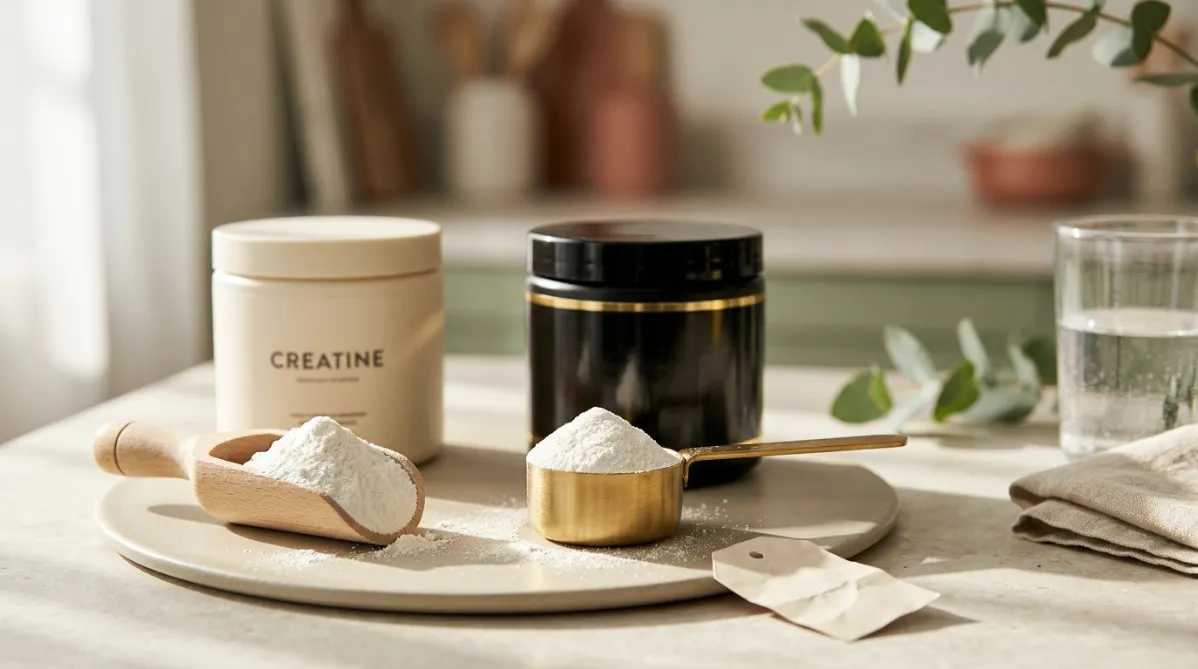
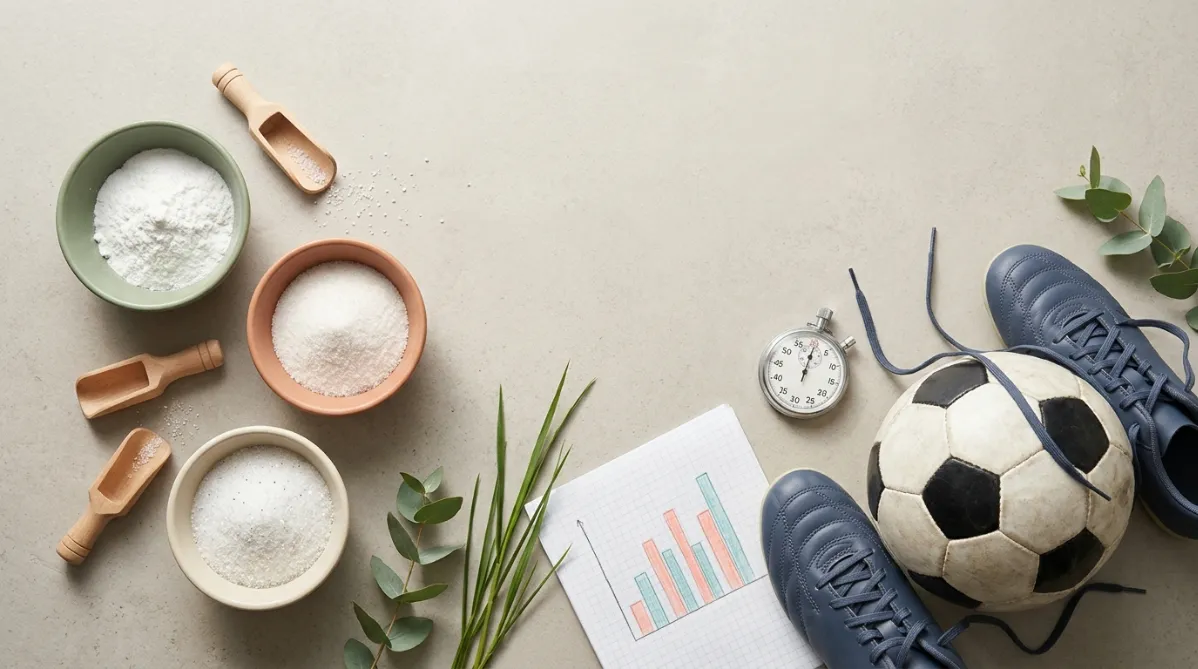
A wide, editorial-style flat lay photographed from above on a pale warm-gray concrete surface, lit by soft natural window light with gentle shadows. On the left, three small matte ceramic bowls in sage green, soft terracotta, and cream, each holding a different white crystalline powder. The textures vary subtly: fine and powdery, slightly granular, and glittery with tiny crystalline flecks. Beside them rest three minimalist wooden scoops, a few scattered grains catching the light. In the center-right, a worn classic black-and-white soccer ball sits slightly off-frame, partially cropped by the edge, with a pair of muted navy cleats resting nearby, laces loosely draped. A small stopwatch with a brushed-steel finish and a folded sheet of graph paper with a hand-drawn bar chart in soft coral and teal pencil add a subtle sense of data and measurement. A few blades of fresh-cut grass and a sprig of eucalyptus add organic accents. The palette is calm and modern: warm neutrals, sage, terracotta, and muted navy, with one pop of coral. The composition leaves generous negative space in the upper right for headline text. The mood is clean, curious, and trustworthy, like a contemporary health and science journal. Shallow depth of field, crisp focus on the powders, with the soccer elements slightly softer. High-end editorial photography, 16:9 landscape.
Science & Research

La creatina HCl supera al monohidrato en futbolistas: no la deseches todavía

Dr. Gymbro · · 4 min read

La creatina HCl supera al monohidrato en futbolistas: no la deseches todavía

El barato saco de creatina monohidrato que tienes en la alacena acaba de perder una comparativa directa contra sus primos más caros y de moda. Pero antes de volver a encargarlo, lee las letras pequeñas: el estudio tiene limitaciones reales y sus hallazgos van en contra de investigaciones anteriores.

Qué probaron realmente los investigadores

Un equipo del Departamento de Ciencias del Deporte de la Universidad Médica de Wenzhou (China), liderado por Duan, publicó un ensayo aleatorizado, controlado con placebo, en la Journal of the International Society of Sports Nutrition en 2026. Reclutaron a 40 futbolistas universitarios masculinos y los dividieron en cuatro grupos paralelos de 10 atletas cada uno:

  • Creatina monohidrato (Cr‑Mon)
  • Creatina éster etílico (Cr‑Ee)
  • Creatina hidrocloruro (Cr‑HCl)
  • Placebo

Todos realizaron la misma fase preparatoria de cuatro semanas de entrenamiento repetido de sprint, tres sesiones por semana (12 sesiones en total). Antes y después de la intervención se evaluaron salto vertical con contramovimiento (CMVJ), sprint de 20 m, test de agilidad en forma de L, prueba anaeróbica Wingate (potencia pico, potencia media e índice de fatiga) y un test incremental para VO₂máx.

Resultado principal: las formas "de moda" se impusieron

Primero, la parte predecible. Todos los grupos mejoraron, incluso el placebo, lo cual es esperable tras un mes de entrenamiento estructurado de sprint. Los grupos que recibieron creatina, sin embargo, mejoraron de manera significativamente mayor que el placebo en rendimiento físico, potencia pico e índice de fatiga (p = 0,001).

El giro surgió en el resumen: según los autores, el éster etílico y la HCl produjeron ganancias superiores (p < 0,05) en rendimiento físico y potencia pico comparados con el monohidrato. Destacaron particularmente el CMVJ, el sprint de 20 m, la prueba de agilidad en L y la potencia pico como variables donde Cr‑Ee y Cr‑HCl aportaron una ventaja extra.

En este ensayo, las formulaciones de mayor precio y mayor publicidad no solo igualaron al monohidrato, sino que lo superaron en las medidas explosivas que más importan al fútbol.

En qué no hubo diferencias entre las formas

No todo se dividió según la formulación. El resumen indica que no hubo diferencias significativas entre los grupos en potencia media ni en VO₂máx. Eso encaja con la visión habitual de la creatina como ayuda para esfuerzos de alta intensidad y corta duración, más que para la capacidad aeróbica.

Por qué aún no debes abandonar el monohidrato

Aquí es donde una lectura honesta supera a un titular llamativo.

Los grupos son diminutos. Con solo 10 atletas por brazo, unos pocos participantes con respuestas atípicas pueden sesgar los promedios.

Cuatro semanas es poco tiempo. El estudio no informa sobre efectos a más largo plazo, marcadores de salud ni cómo se comparan las formulaciones a lo largo de una temporada completa.

La muestra es muy específica. Todos los participantes eran hombres jóvenes, futbolistas universitarios. Los resultados pueden no extrapolarse a mujeres, atletas mayores, otras disciplinas o a personas que no entrenen de forma similar.

No se midió la creatina muscular. Sin una medida directa del contenido de creatina en el músculo no sabemos si las formas más nuevas realmente aumentaron los depósitos de creatina o si otro factor explica la ventaja observada. Además, el resumen omite la dosis empleada, por lo que no podemos confirmar que los grupos estuvieran emparejados en cuanto a contenido de creatina.

Contradice estudios previos. Un estudio conocido de 2009 de Spillane y colaboradores mostró que el éster etílico no era mejor que el monohidrato en composición corporal ni en rendimiento, y que elevaba la creatinina sérica. Un solo ensayo no invalida esa evidencia y los hallazgos son difíciles de reconciliar sin más datos.

El monohidrato sigue teniendo la ventaja de la evidencia. Es la forma de creatina más investigada, disponible en abundancia y, usualmente, la más barata. Una formulación puede superar al monohidrato en un ensayo pequeño y, sin embargo, no ser la opción más rentable ni la mejor a largo plazo.

Los autores declararon no tener conflictos de interés, lo cual es tranquilizador, pero no soluciona las limitaciones metodológicas.

Conclusiones prácticas

  • Dosis: El resumen no indica la dosis utilizada para cada forma; no reproduzcas el protocolo del artículo. Si usas monohidrato, sigue la dosificación recomendada en la etiqueta del producto o la indicada por un dietista deportivo calificado. Si optas por HCl, sigue la dosificación que indique el fabricante.
  • Momento de ingestión: El estudio aplicó suplementación diaria durante las cuatro semanas de entrenamiento, pero no especifica la hora del día. La creatina muestra mayores efectos con una ingesta constante que con un horario preciso.
  • A quién puede convenir: Atletas de campo y pista que buscan mejorar su capacidad de sprint, salto y agilidad, especialmente en bloques de pretemporada. Aquellos que experimenten malestar gastrointestinal con el monohidrato podrían probar la HCl, aunque este estudio no evaluó la tolerancia.
  • A quién debe ser cauteloso o descartarlo: Personas con enfermedad renal u otras condiciones médicas, usuarios de medicación que puedan interferir, y menores de 18 años deben consultar a un profesional antes de usar cualquier forma de creatina. El éster etílico merece precaución extra por los hallazgos de aumento de creatinina.
  • ¿Cambiar o no? Si ya obtienes buenos resultados con monohidrato y no tienes problemas digestivos, no hay una razón sólida para cambiar basándose únicamente en esta evidencia.

En resumidas cuentas

Este ensayo aporta una señal interesante: la creatina HCl y el éster etílico podrían ofrecer una ventaja en salto, sprint, agilidad y potencia pico durante un bloque corto de entrenamiento. Sin embargo, 40 atletas, 4 semanas y la ausencia de desglose de dosis convierten el estudio en un estímulo para más investigación, no en una razón para desechar tu monohidrato. Hasta que ensayos más amplios y prolongados con mediciones de creatina muscular lo confirmen, el monohidrato sigue siendo la opción probada y asequible por defecto, mientras que la HCl permanece como el intrigante retador a observar.
Original study

Read the original research on pubmed.ncbi.nlm.nih.gov →

This article summarizes published research for general information. It is not medical advice.

DG

Written by

Dr. Gymbro

Dr. Gymbro writes for Dr. Gymbro: science-backed fitness, nutrition & performance.

Related Articles

A modern editorial still life photographed from a slightly elevated angle on a pale, matte stone surface in soft natural window light. On the left, a heaping mound of fine white creatine monohydrate powder spills from a matte ceramic scoop, with a few crisp grains scattered across the surface. In the center, a small, minimalist amber glass capsule bottle sits tipped on its side, with a handful of off-white capsules spilling out. The label is blank and clean. On the right, a neat row of three clear glass lab-style vials rests on a slim oak tray. The vials hold different amounts of white powder: the first nearly empty, the second slightly fuller, the third filled almost to the brim. This quietly suggests the difference in dose and result. Beside the tray lies a simple stainless steel measuring spoon and a folded sheet of cream paper with soft, abstract bar-chart lines in muted sage green and terracotta. The lines are hand-drawn and unlabeled.

Behind the objects, slightly out of focus, a lean athletic forearm in a gray linen sleeve rests on the edge of the surface, one hand loosely holding a matte shaker bottle. This hints at a training context without showing a face. A single sprig of eucalyptus in the corner adds a soft organic touch.

The palette is warm neutral: bone white, oatmeal, soft sage, muted terracotta, and touches of amber. Shadows are gentle and long, with a shallow depth of field that gives creamy bokeh in the background. The mood is calm, clean, and trustworthy, like a premium health and science journal's feature spread, with generous negative space at the top and right for headline overlay. The composition is wide, balanced, and uncluttered, with subtle film-like grain and a natural, true-to-life color grade. No text, no logos, no futuristic elements.
nutrition

La dosis recomendada de Kre‑Alkalyn no aumentó la creatina muscular, según biopsias

BY DR. GYMBRO ·

La creatina tamponada (Kre‑Alkalyn) se vende como más absorbible, con dosis menores y menos distensión abdominal. Un ensayo doble ciego de Texas A&M, que analizó biopsias musculares de 36 levantadores durante 28 días, demostró que, con la dosis de etiqueta de 1,5 g/día, la creatina muscular apenas cambió, mientras que la creatina monohidrato produjo un aumento mucho mayor.

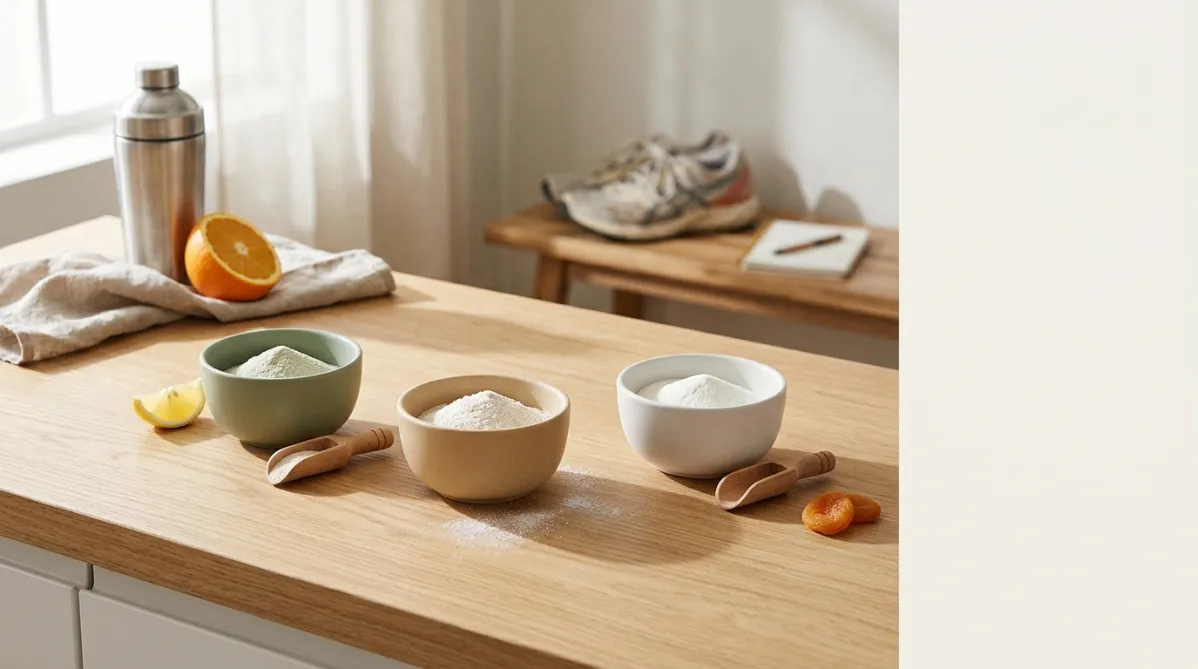
A landscape editorial photograph of a clean, sunlit kitchen-counter or light oak table, shot from slightly above at a gentle angle. Three small matte ceramic bowls in muted sage green, warm sand, and soft white sit in a loose row. Each holds a different fine white powder, and each has a small wooden scoop resting beside it. The middle bowl is slightly closer to the camera and sharper in focus, with a faint dusting of powder spilling onto the surface. In the soft-focus background, a stainless steel shaker bottle and a half-peeled orange sit beside a folded linen napkin, suggesting citrus without being literal. A single lemon wedge sits near the left bowl, and a small dried apricot sits near the right, a subtle visual nod to citrate and pyruvate.

In the background, a blurred athletic scene: a running shoe resting on a wooden bench and a small notebook with a pen, suggesting a training log. Soft diffused morning light enters from the left through a window and casts long, gentle shadows. The palette is warm neutrals, creamy whites, soft greens, and a hint of terracotta orange. The look is a modern wellness magazine with a shallow depth of field, a fine-grain film feel, and generous negative space on the right third of the frame for title text. The mood is calm, trustworthy, and scientific yet approachable, with no text, labels, or logos.
nutrition

Piruvato de creatina vs citrato: una forma mantuvo la fuerza elevada por más tiempo

BY DR. GYMBRO ·

Dos formas de creatina superaron al placebo en un ensayo de 28 días, pero solo una mantuvo la fuerza muscular alta durante los diez intervalos máximos, mientras que la otra perdió el efecto. El piruvato de creatina aumentó la fuerza en todos los intervalos (p < 0,001), mientras que el beneficio del citrato desapareció a partir del sexto intervalo. Además, el piruvato mejoró la velocidad de relajación y el consumo de oxígeno en reposo. Antes de desechar tu creatina habitual, hay un detalle importante: el estudio no incluyó un grupo de monohidrato de creatina.

A wide, landscape editorial photograph of a clean, sunlit kitchen counter or pale stone tabletop, styled like a modern wellness magazine spread. Two scoops sit side by side on a matte ceramic surface. The left one is a plain, humble wooden scoop heaped with fine white creatine powder. The right is a glossy, ornate brushed-gold scoop holding the same white powder, which hints at "premium" branding. Behind each scoop stands a tub. The left tub is minimal, matte, and cream-colored with simple sans-serif lettering and no readable words. The right tub is sleek black with metallic gold accents and an overly polished look. A few fine grains of powder are scattered across the surface, catching the light.

The composition uses a shallow depth of field. The foreground scoops are crisp, and the background softly blurs into a warm neutral palette of oatmeal, soft sage green, and muted terracotta. Soft morning window light comes in from the left, casting long, gentle shadows and a subtle highlight along the scoops' edges. A small price tag shape, blank and unmarked, sits near the gold scoop, with a slightly crumpled paper texture to suggest the "pricey" angle without any text. A glass of water with condensation and a folded linen napkin sit at the edge of the frame. A single green sprig or eucalyptus stem adds a natural accent.

The overall mood is calm, intelligent, and quietly skeptical, with the plain option feeling confident and the flashy one a bit overdressed. The color grading is soft and slightly desaturated with creamy highlights, and there is fine film grain. The layout leaves generous negative space on the right third for a headline overlay. It looks like a high-end lifestyle and science journal cover, with a minimalist, tactile, trendy feel and no futuristic or sci-fi elements.
science research

Éster Etílico de Creatina vs Monohidrato: La Opción Costosa que No Vale la Pena

BY DR. GYMBRO ·

Los fabricantes de suplementos adoran promocionar la creatina “avanzada” como más absorbible que la versión tradicional. Un ensayo doble ciego de 2009 comparó el éster etílico de creatina (CEE) con el monohidrato y con placebo en 30 hombres sin experiencia previa, durante siete semanas de entrenamiento intenso. El CEE mostró menores concentraciones de creatina plasmática y un notable aumento de creatinina sérica, lo que indica que se descompone en desechos. La creatina muscular aumentó en ambos grupos de creatina, pero la fuerza, la potencia y la composición corporal no presentaron diferencias entre los grupos. Conclusión: evita la forma premium y mantén la simplicidad.

A wide, editorial-style still life photographed from slightly above on a pale oat-colored linen surface, lit by soft morning window light from the left. In the center sits a small matte ceramic bowl holding a mound of fine white powder, with a minimalist wooden scoop resting beside it. Next to the bowl is an open amber glass supplement jar with a plain cream label, and a few white capsules spill across the linen in a loose arc.

To the right, a neatly arranged cluster of analog "study" objects suggests careful measurement: a vintage stopwatch with a clean white face, a slim notebook with a sage-green cover open to a hand-drawn bar chart (blurred, no legible text), and a mechanical pencil lying across the page. A small row of six identical ceramic dishes, each holding a pinch of powder, is lined up along the top edge of the frame to hint at the six-week trial. One dish is slightly out of alignment, a subtle visual cue for ambiguity.

A shallow glass of water and a single sprig of green eucalyptus add a calm, organic note in the foreground. Soft, long shadows fall across the textured linen, and the palette stays restrained: warm cream, soft sage, muted terracotta, pale gray, and touches of amber from the glass jar. A few translucent paper cutouts in two tones (sage and blush) overlap in the upper right corner as a modern graphic accent, evoking overlapping data points without showing any numbers.

Depth of field is shallow, with the bowl and stopwatch in crisp focus and the edges gently softened. The composition leaves generous negative space on the left third for title text overlay. The overall mood is thoughtful, balanced, and quietly skeptical, in the style of a contemporary wellness and science magazine: clean, tactile, minimal, with a subtle film-like grain and natural color grading. No people, no futuristic or sci-fi elements, no readable text or logos.
nutrition

¿Es el GAA un potenciador cerebral? El resultado del ensayo de 6 semanas es complicado

BY DR. GYMBRO ·

El GAA, precursor de la creatina que se vende como potenciador cerebral, acaba de recibir su primera prueba seria en humanos. En un ensayo doble ciego de seis semanas con 58 adultos sanos, se observaron algunas mejoras en la velocidad de reacción y leves indicios de cambios en el ánimo y el estrés. Sin embargo, la mayoría de las pruebas cognitivas no mostraron efectos y muchos resultados primarios fueron solo tendencias. Los marcadores de seguridad fueron normales, pero el estudio fue pequeño, exploratorio y no incluyó un grupo de comparación con solo creatina. Aquí se explica qué evidencia existe realmente, a quién podría interesar y por qué el veredicto es mixto.

This page is available in