Dr. Gymbro
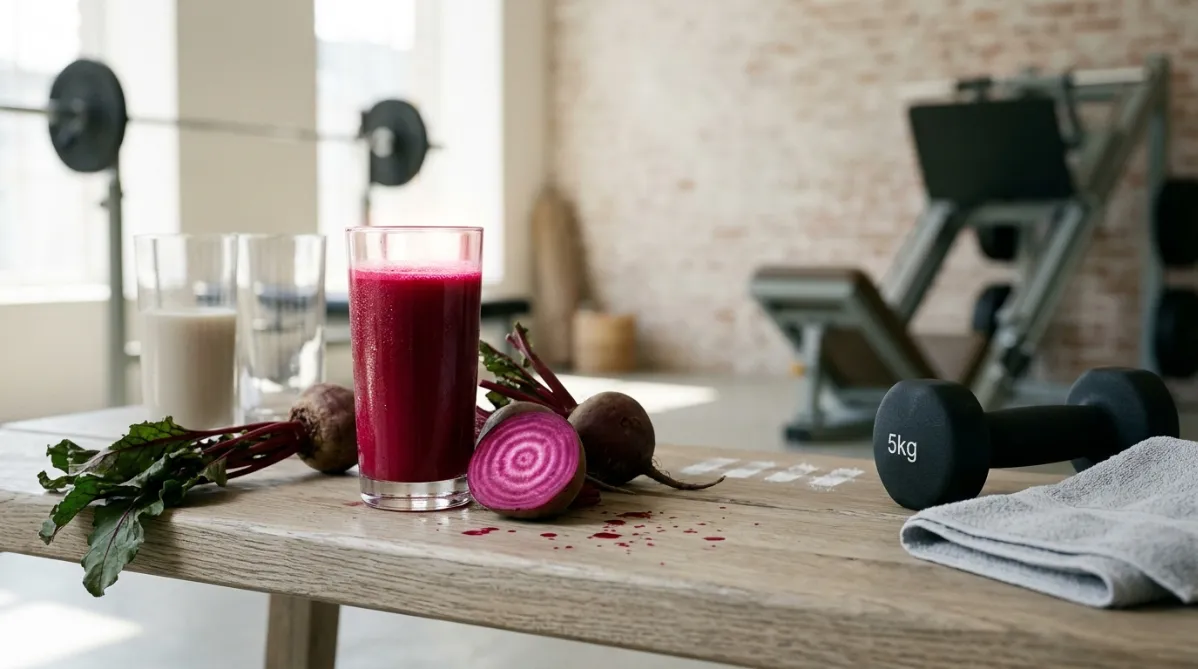
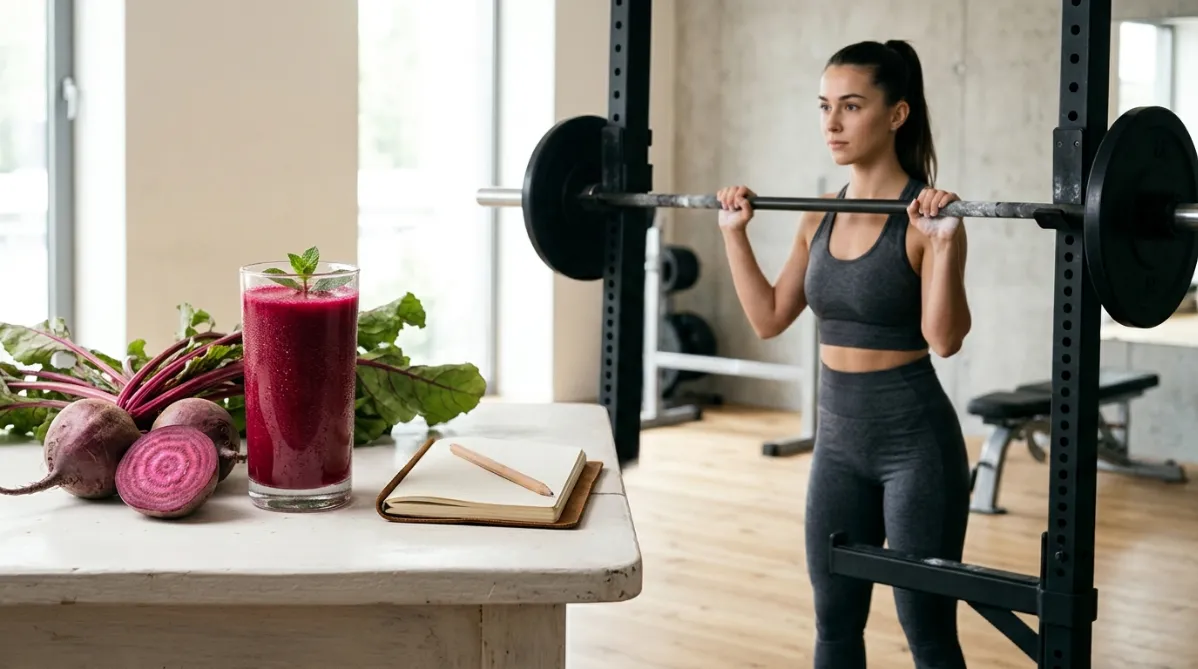
A wide, editorial-style photograph of a bright, modern gym corner softened by morning window light. In the foreground, a rustic matte-white ceramic table holds a tall clear glass of deep magenta beetroot juice, beads of condensation on the glass, a few fresh whole beetroots with leafy crimson-veined stems beside it, and one beetroot sliced in half to reveal its vivid concentric purple-pink rings. Next to the glass sits a small, neat notebook with a pencil, suggesting a research note, with no legible text. Behind the table, slightly out of focus, a young woman lifter with a tidy ponytail and a fitted charcoal training set stands at a barbell resting on a squat rack, chalk-dusted hands gripping the bar, calm and focused expression. A loaded bench with a bar is visible further back, with matte black plates and a light wooden floor. The palette is restrained and trendy: warm off-white, soft concrete gray, muted sage green accents from the beet leaves, and a bold beetroot magenta as the focal color. Shallow depth of field with a creamy bokeh background, natural side lighting casting long gentle shadows, subtle film grain. Composition follows the rule of thirds, with the juice and beets on the left third and the lifter on the right, leaving clean negative space in the upper area for a headline overlay. Mood is thoughtful, clean, and slightly skeptical, like a contemporary health and science journal cover. Realistic photography style, high-end magazine look, no text, no logos, no futuristic elements.
Nutrition

El jugo de remolacha decepcionó a las levantadoras, e incluso ralentizó el press de banca

Dr. Gymbro · · 4 min read

Has visto el bombo: jugo de remolacha, el pre‑entrenamiento morado que supuestamente convierte los vasos sanguíneos en autopistas y tu velocidad de barra en un cohete. Un nuevo ensayo aleatorizado en mujeres entrenadas en resistencia acaba de poner esa promesa bajo la barra. ¿El resultado? Ningún beneficio en la sentadilla y una leve caída en la potencia del press de banca en una carga.

Qué probaron realmente los investigadores

Un equipo liderado por investigadores de la Pepperdine University, con colaboradores de la University of Virginia, McMaster, Birmingham City y Loughborough, publicó el estudio en el European Journal of Applied Physiology (2026). Participaron dieciocho mujeres entrenadas en resistencia en un diseño cruzado, aleatorizado y doble ciego. Cada participante realizó ambas condiciones, lo que hace la comparación más limpia que comparar dos grupos separados.

Las dos bebidas fueron:

  • Placebo (PL): jugo de remolacha despojado de nitrato, con nitrato insignificante.
  • Jugo de remolacha (BR): jugo rico en nitrato que aportaba alrededor de 6,7 mmol de nitrato, equivalentes a unos 415 mg.

Ambas se consumieron 2,5 h antes del ejercicio, una ventana de tiempo habitual en la investigación sobre nitratos.

El entrenamiento: rápido, ligero‑a‑moderado, explosivo

No se trató de una prueba de fuerza máxima. Las participantes realizaron una serie de tres repeticiones explosivas de sentadilla trasera y press de banca con la barra al 55 %, 60 % y 65 % de su una‑repetición‑máxima, con dos minutos de descanso pasivo entre series. Un transductor lineal midió la potencia pico y media, así como la velocidad en cada serie. El protocolo apunta a los esfuerzos rápidos y potentes que el nitrato suele alegar mejorar.

El titular: la sentadilla no cambió nada

En la sentadilla trasera, no hubo diferencias entre condiciones en ninguna variable (todos los P > 0,05). El jugo de remolacha no mejoró la potencia ni la velocidad en ninguna de las tres cargas. Los autores concluyen que la ingestión aguda de nitrato no mejora el desempeño en sentadilla en este grupo.

La vuelta de tuerca: el press se volvió ligeramente peor al 60 %

El press de banca también resultó nulo en general, salvo una excepción. Al 60 % de 1RM, el jugo de remolacha salió peor que el placebo:

  • Potencia media: 201 ± 61 W con BR vs. 206 ± 61 W con placebo (P = 0,047, gz = ‑0,48)
  • Velocidad media: 0,68 ± 0,08 m/s con BR vs. 0,70 ± 0,08 m/s con placebo (P = 0,049, gz = ‑0,50)

Eso representa una diferencia de unos 5 W y 0,02 m/s. Ambos valores p apenas superan el umbral de 0,05 y el efecto apareció solo en una carga. Las series al 55 % y 65 % no mostraron diferencias. Con tantos resultados medidos, un hallazgo marginal como este podría ser simplemente una coincidencia estadística. Los autores no afirman que el nitrato dañe a los levantadores; simplemente piden más investigación para determinar si el nitrato puede tener un efecto ergolítico (reductor del rendimiento) en mujeres entrenadas en resistencia.

Cómo leer esto con honestidad

Estos son datos humanos, no trabajos con animales o células, pero tienen limitaciones. La muestra fue pequeña (18 mujeres), la dosis fue única y aguda, y solo se probaron tres cargas ligeras‑a‑moderadas y series de tres repeticiones. No dice nada sobre levantamientos máximos pesados, series de alta repetición hasta el fallo, o suplementos diarios durante semanas. Los autores declararon no tener conflictos de interés.

Conclusiones prácticas

Dosis y tiempo usados en el estudio: aproximadamente 6,7 mmol de nitrato (unos 415 mg), ingeridos 2,5 h antes del entrenamiento. Revisa la etiqueta de tu producto, ya que el contenido de nitrato varía mucho entre jugos y shots.

Quién probablemente no debería preocuparse: si eres una mujer que entrena fuerza y potencia en sentadilla y press, este estudio no te da razón para esperar un impulso pre‑entrenamiento del jugo de remolacha. En el mejor de los casos no hizo nada y, en una carga de press, estuvo ligeramente peor.

Quién podría aún beneficiarse: el estudio no puede responder a eso, porque no evaluó resistencia ni trabajo de sprint. La investigación con nitrato se ha centrado históricamente en el rendimiento aeróbico y de alta intensidad, así que los atletas de esas áreas podrían seguir experimentando. Considera eso como contexto, no como un hallazgo de este artículo.

Manera inteligente de experimentar: si te gusta el jugo de remolacha, no cambies el resto de tu rutina. Úsalo en unos cuantos días de entrenamiento, registra la velocidad de la barra o la percepción de rendimiento y compáralo con los días sin él. Si no ayuda, solo estarás pagando por una bebida morada cara.

La conclusión final

El jugo de remolacha no es un pre‑entrenamiento mágico para la potencia con barra de las mujeres. En este ensayo no generó ganancias en la sentadilla y produjo una pequeña caída en una carga del press, que necesita replicarse antes de extraer conclusiones importantes. La lección mayor es que la fuerte reputación de un suplemento en un deporte no se transfiere automáticamente a la plataforma de levantamiento de pesas.

Original study

Read the original research on pubmed.ncbi.nlm.nih.gov →

This article summarizes published research for general information. It is not medical advice.

DG

Written by

Dr. Gymbro

Dr. Gymbro writes for Dr. Gymbro: science-backed fitness, nutrition & performance.

Related Articles

A wide editorial still life on a clean, pale oatmeal-colored linen surface, lit by soft natural window light from the left. In the center-left, a small clear glass shot glass filled with deep magenta-crimson beetroot juice catches a glowing highlight, with a few droplets beaded on the surface beside it. Behind it sit two whole beetroots with their leafy stems, the skins a dusty burgundy and the stems a vivid pink-red, and one beetroot sliced in half to reveal concentric rings of magenta and soft pink. To the right, a vintage-style brass stopwatch rests at an angle on the linen, its white face crisp and its hands frozen, slightly out of focus in the foreground edge. A faint curve of a sprinting track lane, in muted terracotta with thin white lines, sweeps diagonally across the blurred background, hinting at a running track without showing any people. Scattered across the surface are a few small, delicate beet-colored splashes and a light dusting of coarse sea salt. The palette is restrained and modern: warm cream, terracotta, dusty rose, deep magenta, and touches of sage green from the leaves. Shallow depth of field and a gentle film-like grain give it a contemporary lifestyle-magazine feel. The composition leaves generous negative space on the upper right for title overlay. Minimalist, tactile, calm, and sophisticated, in the style of a high-end health and science journal's editorial photography, 16:9 landscape.
nutrition

El jugo de remolacha elevó el nitrito 35 veces, pero los velocistas no fueron más rápidos

BY DR. GYMBRO ·

Un estudio con 12 velocistas entrenados mostró que 70 mL de jugo de remolacha aumentaron el nitrito salival unas 35 veces, pero no mejoraron ni el sprint de 60 m ni el de 100 m, ni la altura del salto ni la mayoría de los parámetros musculares. Aquí analizamos qué se hizo, qué no se pudo demostrar y a quién conviene (o no) invertir en este suplemento.

A wide, editorial-style still life photographed on a pale warm-gray concrete surface in soft, diffused morning window light. On the left side, a tall clear glass filled with deep magenta-crimson beetroot juice sits beside two halved raw beetroots, their concentric rings of vivid fuchsia and purple clearly visible, with a few small green-and-red-veined leaves draped casually nearby. On the right side, a matching clear glass of cloudy white creatine solution rests next to a small matte ceramic bowl heaped with fine white powder and a minimal wooden scoop, a light dusting of powder scattered across the surface. In the center, between the two sides, a simple matte black barbell grip and a single chalk-dusted weight plate edge rise into the frame at a low angle, hinting at lifting without showing a person. The composition is split in a balanced, symmetrical way, with a subtle vertical shadow line dividing the saturated magenta tones on the left from cool, neutral whites and creams on the right. The background is softly blurred with a muted sage-green and oatmeal-toned wall, with plenty of negative space at the top for a headline overlay. Shallow depth of field, crisp focus on the glasses' condensation droplets and the textured beetroot flesh. The color palette is limited and refined: magenta, cream, charcoal, and soft sage. The mood is clean, modern, and health-journal chic, like a contemporary wellness magazine cover, with natural shadows, a tactile matte finish, and subtle film-like grain. No text, no logos, no futuristic elements.
nutrition

Jugo de remolacha vs creatina: ¿Quién gana en el levantamiento en 72 horas?

BY DR. GYMBRO ·

Un nuevo ensayo aleatorizado cruzado comparó jugo de remolacha con creatina durante unas 72 horas en levantadores novatos. La creatina mejoró el número de repeticiones en press de banca al 80 % de 1RM, mientras que el jugo de remolacha sobresalió en velocidad de barra, oxigenación muscular, frecuencia cardíaca máxima y recuperación medida por HRV. El resumen no indica dosis ni horarios de ingesta, por lo que señalamos lo que falta. Aquí tienes la tabla de resultados y quién podría elegir cada suplemento.

A wide, editorial-style still life photographed in soft natural window light, set on a pale oak gym bench or a light concrete surface. In the center foreground, a tall clear glass of deep magenta-crimson beetroot juice catches the light, with a faint luminous glow along its rim and condensation beading on the outside. Two other glasses sit slightly behind it, one holding a pale, neutral-colored liquid and one empty. They suggest the placebo and no-treatment conditions without any labels. Beside the glasses, a halved raw beetroot shows concentric rings of vivid fuchsia and violet. A few whole beets with their leafy stems and dark green and burgundy leaves are scattered casually nearby.

On the right side of the frame, slightly out of focus, a matte black women's-size dumbbell and a neatly folded light gray towel rest on the bench. Behind them, the soft blur of a minimalist, airy training space includes a barbell rack and a leg press machine in muted tones. The background is bright and neutral, in warm off-white, soft sand, and light gray, so the magenta of the juice is the dominant accent color.

A small, restrained motif of four evenly spaced chalk marks or four small round weight plates arranged in a neat row on the bench hints at the "four sets" of the trial. A few drops of beet juice have splashed onto the surface, forming a tasteful organic pattern.

The composition follows the rule of thirds, with the glass of juice on the left third and open negative space on the right for headline text. Shallow depth of field, crisp focus on the glass and beet, subtle film-like grain, and a calm, modern, trendy magazine aesthetic. The palette is magenta, deep burgundy, sage green, cream, and soft gray. The mood is quiet, skeptical, and scientific without any laboratory imagery, with clean lines and an elegant, minimal feel.
supplements

El jugo de remolacha no sumó ni una sola repetición en mujeres entrenadas en resistencia

BY DR. GYMBRO ·

El jugo de remolacha se promociona como un potenciador natural de repeticiones, pero un nuevo ensayo cruzado, doble ciego, en mujeres entrenadas en resistencia no encontró ningún beneficio. Dieciséis participantes bebieron jugo rico en nitrato (12,8 mmol), un placebo o nada antes de cuatro series de press de banca y prensa de piernas hasta el fallo. El número total de repeticiones, la percepción del esfuerzo, la frecuencia cardiaca, la presión arterial y el lactato no cambiaron de forma estadísticamente significativa. Los resultados no descartan por completo la remolacha, pero sugieren que el efecto ergogénico del nitrato puede ser limitado para esta población y este protocolo.

A sunlit, minimalist kitchen counter in a modern home, photographed from a slightly elevated three-quarter angle with soft natural morning light spilling in from a window on the left. In the center sits a matte white ceramic mug of black coffee with a thin curl of steam, beside a small glass jar of deep magenta beetroot powder with a wooden scoop resting on the lid. A scattering of fine crimson powder dusts the pale oak surface in an artful, casual swirl. Nearby, a halved raw beetroot reveals vivid concentric rings of purple and pink, next to a few roasted coffee beans and a neatly folded charcoal gym towel. In the soft-focus background, a pair of clean white running shoes and a stainless steel water bottle sit on a floating shelf, hinting at a pre-workout routine. A single sprig of green beet leaves adds a fresh accent.

The color palette is warm and editorial: creamy neutrals, espresso browns, and rich beet magenta, with gentle highlights and long soft shadows. The composition has generous negative space on the right side for headline text, shallow depth of field, and a crisp, tactile texture on the ceramic, powder, and wood grain. The mood is calm, health-conscious, and contemporary, like a lifestyle feature in a premium wellness magazine or a trendy nutrition journal. Clean, balanced, natural, with subtle film-like grain and a slightly muted, high-end finish.
science research

La cafeína en el pre‑entrenamiento endurece las arterias; el polvo de remolacha lo contrarresta

BY DR. GYMBRO ·

Un nuevo ensayo cruzado aleatorizado encontró que una dosis de cafeína equivalente a la de un pre‑entrenamiento (6 mg/kg) incrementó los marcadores de rigidez arterial a las 2,5 h. Añadir polvo de remolacha con 400 mg de nitrato devolvió esos marcadores a niveles similares al placebo. La presión arterial y la función endotelial no variaron, por lo que se trata de un efecto sutil, no de una alarma. El estudio incluyó sólo a 24 adultos jóvenes sanos y una única dosis, dejando abiertas muchas preguntas sobre el uso crónico y en poblaciones mayores o hipertensas.

This page is available in