Dr. Gymbro
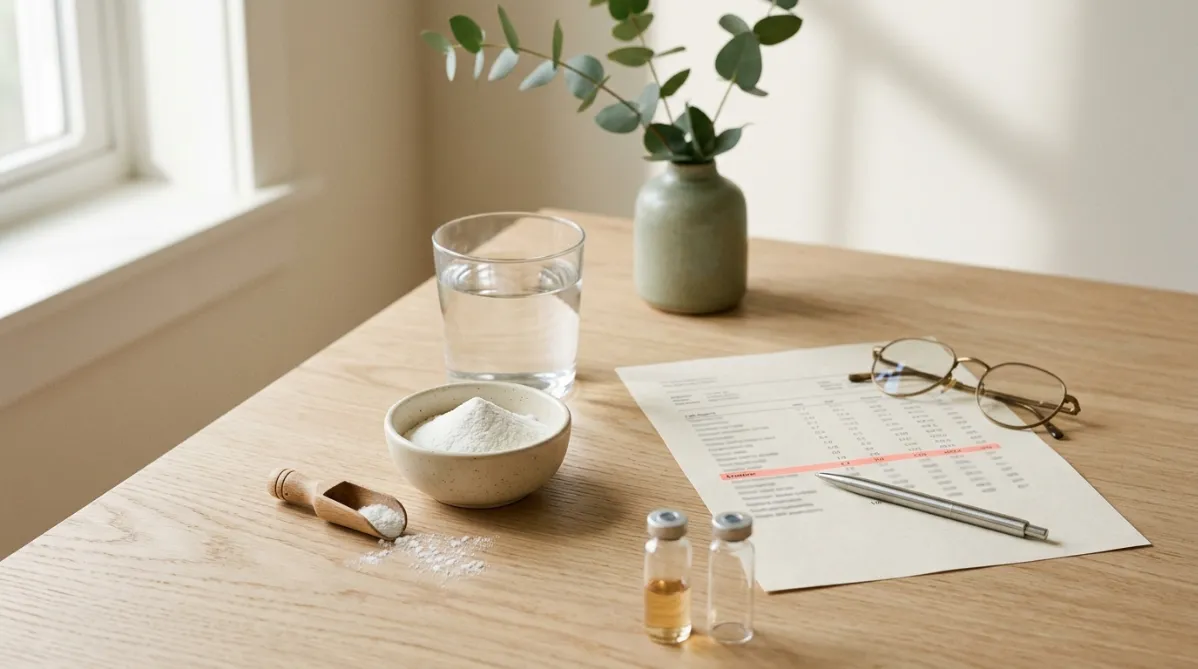
A calm, modern editorial still life shot from a slightly elevated angle on a pale oak tabletop, bathed in soft natural window light from the left. At center sits a clear glass of water beside a small matte ceramic bowl holding a mound of fine white creatine powder, with a wooden scoop resting next to it and a few loose grains dusted across the surface. To the right, a neatly arranged printed lab report on cream paper, with blurred rows of numbers and a single line highlighted in soft coral pink marker, partially overlapped by a minimalist silver pen. A folded pair of thin-framed glasses sits at the edge of the paper. In the foreground, a small glass vial with a pale amber liquid sample and a second empty vial stand upright, suggesting blood and urine testing, with gentle refraction and soft caustic light on the wood. Behind them, a sprig of eucalyptus in a small stone vase adds a touch of green. The background is a softly blurred, warm off-white wall with a gentle gradient shadow and a hint of a window frame. The palette is muted and refined: warm creams, sage green, soft coral, pale amber, and light oak, with crisp whites in the powder. Shallow depth of field, with the powder bowl and highlighted lab line in sharp focus and the edges falling away into creamy blur. Generous negative space on the right third of the composition for text overlay. The overall feel is clean, trendy health-journal photography, tactile and editorial, with subtle film-like grain, natural shadows, and a quiet, reassuring mood. No people, no text legible, no futuristic elements.
supplements

La creatina elevó los marcadores renales en 26 ensayos. Probablemente no hay daño

Dr. Gymbro · · 5 min read

Imagina lo siguiente: llevas varios meses tomando creatina, te haces los análisis de sangre de rutina y la creatinina está alta. Tu eGFR, el número que los médicos usan para valorar la función renal, parece peor de lo que debería para un deportista sano. Es una forma fácil de convencerte de dejar un suplemento que, a día de hoy, cuenta con abundante evidencia a su favor.

Una revisión sistemática y un meta‑análisis publicados en International Urology and Nephrology (2026) explican por qué ocurre eso. Los autores agruparon 26 ensayos controlados aleatorios con un total de 1 036 participantes. La creatina elevó la creatinina sérica y redujo el eGFR estimado con ecuaciones basadas en creatinina. Pero, cuando la filtración glomerular se midió con un método más directo, la caída no se observó.

Los números alarmantes

En comparación con el placebo, la suplementación con creatina se asoció a:

  • Creatinina sérica aumentó 0,14 mg/dL (IC 95 % 0,05 a 0,22; p = 0,002)
  • eGFR basado en creatinina disminuyó 10,75 mL/min (IC 95 % -17,48 a -4,02; p = 0,002)

Si ves esos valores en un informe de laboratorio sin contexto, es fácil entrar en pánico. Una caída de eGFR de unos 11 mL/min es el tipo de cambio que haría que un médico investigara más a fondo. La clave está en lo que los autores midieron además.

El giro: el GFR de referencia no se movió

El equipo separó los resultados de GFR según el método utilizado. Las ecuaciones basadas en creatinina estiman la filtración a partir de un marcador sanguíneo. El GFR medido con Cr‑EDTA emplea un trazador para valorar la filtración de forma más directa y se considera el método de referencia.

Con Cr‑EDTA no hubo diferencia significativa entre creatina y placebo (diferencia media 5,89 mL/min; IC 95 % -0,30 a 12,08; p = 0,06). La estimación puntual se inclinó ligeramente hacia un GFR más alto con creatina, aunque no alcanzó significación y el intervalo es amplio.

Los demás marcadores renales tampoco mostraron diferencias relevantes: urea sérica, albuminuria, proteinuria y creatinina urinaria fueron similares entre los grupos. Los autores concluyeron que los hallazgos "probablemente reflejan una alteración del metabolismo de la creatinina y no una lesión renal".

Por qué la creatina hace que la creatinina parezca peor

La creatinina es un producto de degradación de la creatina. El cuerpo convierte continuamente una pequeña fracción del depósito de creatina, mayormente en los músculos, en creatinina, la cual los riñones eliminan. Al suplementar con creatina aumentas la materia prima, de modo que puede aparecer más creatinina en sangre aunque la filtración renal sea idéntica.

El problema es que las ecuaciones de eGFR asumen que la creatinina refleja únicamente la depuración renal, con una masa muscular y una dieta promedio. No saben que estás tomando suplementos. Cuando la creatinina sube por razones metabólicas, la fórmula la interpreta como una reducción de la filtración. Es, pues, un artefacto de medición, no evidencia de daño.

Los datos urinarios respaldan esta interpretación. Los autores no hallaron cambios significativos en la albuminuria ni en la proteinuria, marcadores que típicamente se alteran cuando el tejido renal está estresado o lesionado.

Cautelas honestas: heterogeneidad y limitaciones

Esto no es una carta blanca, y el estudio tiene limitaciones que conviene señalar.

  • Los resultados de creatinina sérica fueron muy heterogéneos (I² = 93,9 %). Los ensayos difirieron bastante en cuánto aumentó la creatinina, de modo que el promedio de 0,14 mg/dL es solo eso, un promedio.
  • El eGFR basado en creatinina mostró consistencia entre estudios (I² = 0 %), al igual que la heterogeneidad del Cr‑EDTA (I² = 6,3 %).
  • El intervalo de confianza del Cr‑EDTA es amplio y su p‑valor es 0,06. No constituye prueba de ausencia de efecto, sino de que con los datos disponibles no se detectó un daño.
  • El resumen del artículo no desglosa los protocolos de dosis ni la duración de los ensayos, por lo que no puede hablar de usos a muy largo plazo o de dosis muy altas.

Los autores describen este trabajo como el meta‑análisis más exhaustivo sobre el tema hasta la fecha y el primero en estratificar el GFR según el método de medición. Esa estratificación es, sin duda, su mayor aporte.

¿Y las personas con enfermedad renal?

La revisión incluyó tanto a sujetos sanos como a pacientes con enfermedad renal crónica (ERC). En el subgrupo de hemodiálisis, la creatina se asoció a un aumento significativo de la creatinina sérica, mientras que la urea sérica disminuyó de forma significativa. No se trata de un signo de daño, pero es un hallazgo específico que no debe extrapolarse a todas las personas con problemas renales.

Si padeces ERC, tienes un trasplante, un solo riñón o cualquier otra condición renal diagnosticada, consulta a tu nefrólogo antes de iniciar la suplementación. La creatinina es el marcador que ellos usan para seguir la enfermedad, y la creatina puede confundirlo. Es posible que prefieran otro esquema de monitorización.

Consejos prácticos para los deportistas

  1. Utiliza dosis basadas en la evidencia. La pauta estándar es de 3 a 5 g/día de creatina monohidrato. Más no equivale a más beneficio.
  2. Informa a tu médico que tomas creatina antes de los análisis de sangre. Una línea en el formulario de historia clínica puede evitar alarmas innecesarias y una cascada de pruebas complementarias.
  3. Pregunta por la cistatina C. Este marcador de función renal no depende de la masa muscular ni de la ingesta de creatina, por lo que ofrece una lectura más limpia. Un eGFR basado en cistatina C es una buena alternativa si tu valor basado en creatinina parece discordante.
  4. Mira el panorama completo. Urea normal, ausencia de proteínas en la orina y ausencia de albumina son tan relevantes como un solo valor de creatinina.
  5. Mantente bien hidratado y evita otros factores que puedan estresar los riñones, como el uso intenso de antiinflamatorios no esteroideos sin supervisión médica.
  6. Si ya tienes enfermedad renal, obtén autorización médica antes de usar creatina. En ese grupo, "probablemente esté bien" no es suficiente para autoprotocolarse.

Conclusión

La creatina altera los valores de tu informe de laboratorio. En los 26 ensayos aleatorizados analizados, aumentó la creatinina sérica y redujo el eGFR estimado con creatinina, pero la filtración medida directamente, la urea, la albuminuria y la proteinuria no mostraron cambios significativos. La explicación más plausible es que los análisis están detectando el metabolismo de la creatina, no una lesión renal.

Para los deportistas sanos, eso es tranquilizador, siempre que el médico sepa lo que estás tomando y pueda interpretar los resultados en contexto. Para quienes conviven con enfermedad renal, es una razón para conversar más a fondo con el especialista, no para descartar el suplemento.
Original study

Read the original research on pubmed.ncbi.nlm.nih.gov →

This article summarizes published research for general information. It is not medical advice.

DG

Written by

Dr. Gymbro

Dr. Gymbro writes for Dr. Gymbro: science-backed fitness, nutrition & performance.

Related Articles

A bright, modern editorial still life shot from a slightly elevated angle on a pale warm-gray stone countertop, bathed in soft natural window light with gentle diffused shadows. In the center, a small glass bowl holds a scatter of translucent golden-amber fish oil softgel capsules, a few spilled casually onto the surface and catching the light like tiny glowing beads. Beside the bowl sits a single chrome dumbbell with a matte finish, slightly out of focus, and a neatly folded charcoal gym towel. To the left, a clean arrangement of alternative "better spent" items: a ceramic dish of raw eggs, a wedge of salmon fillet on a wooden board with a sprig of dill, and a small bowl of Greek yogurt with a spoon, all styled with restraint. A minimalist notebook with a thin pen lies at the right edge, with faint, abstract pencil-drawn bar charts and a flat horizontal line suggesting "no effect," legible only as soft shapes with no readable text. The color palette is muted and sophisticated: warm cream, soft sage green, sandy beige, and pops of golden amber from the capsules, with a single accent of coral from the salmon. Shallow depth of field keeps the capsules crisp while the background melts into a creamy blur of a sunlit kitchen with a hint of green plant leaves. The composition leaves generous negative space on the right third for title overlay, in a 16:9 landscape format. The mood is calm, thoughtful, and quietly skeptical, in the style of a contemporary health and science magazine, with a crisp editorial photography look, fine grain, and natural color grading. No people, no futuristic elements, and no text.
science research

¿Aceite de pescado para ganar músculo? 8 estudios dicen que no cuentes con él

BY DR. GYMBRO ·

El aceite de pescado se ha promocionado como un potenciador de la recuperación y el desarrollo muscular, pero un meta‑análisis publicado en *Nutrition* muestra que la evidencia es escasa. Al combinar cuatro ensayos sobre masa libre de grasa y ocho ensayos (22 efectos) sobre fuerza en adultos sanos no obesos, los investigadores no encontraron beneficios claros. La estimación del efecto sobre la fuerza fue prácticamente nula y la de la masa libre de grasa demasiado imprecisa para sacarle conclusiones. La certeza de la evidencia es muy baja, lo que no prueba que el suplemento no tenga efecto, pero tampoco justifica comprar aceite de pescado para ganar músculo. Aquí explicamos qué significan los números y dónde es mejor invertir tu dinero.

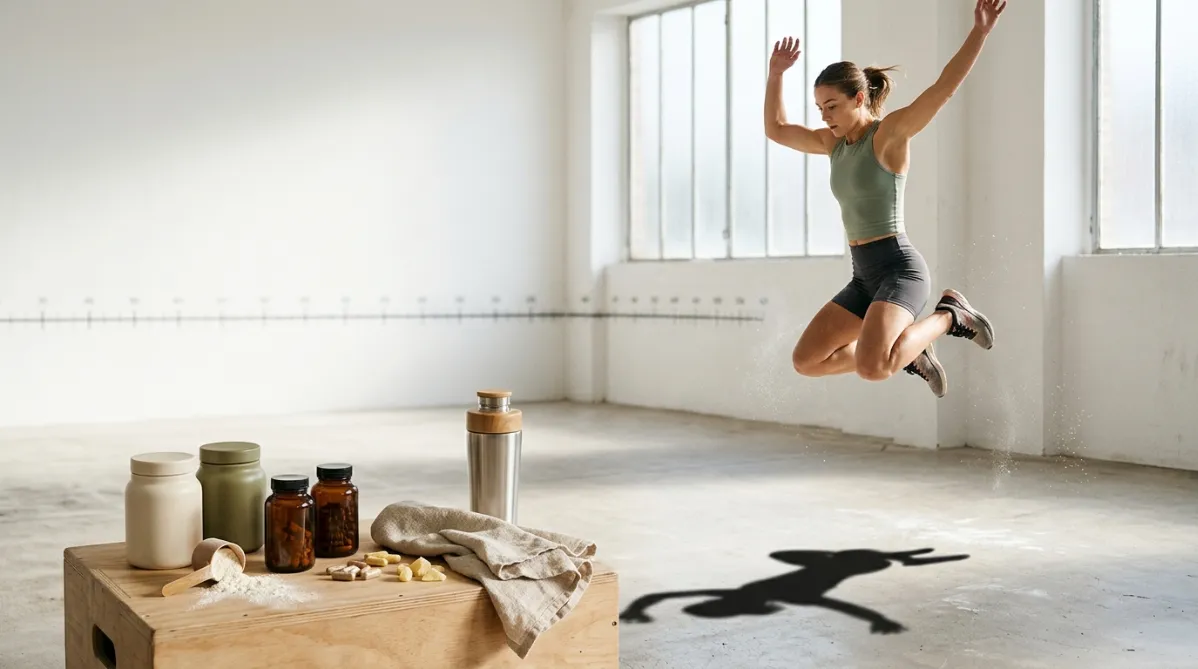
A wide, editorial-style photograph of a female athlete captured mid-jump in a bright, minimalist indoor training space with pale concrete floors and tall frosted windows that let in soft diffused morning light. She is frozen at the peak of a countermovement jump, knees tucked slightly, arms swinging upward, wearing a fitted sage-green training top and charcoal shorts. Her shadow stretches long on the floor below her, which emphasizes the height of the leap.

In the foreground at the lower left, a clean arrangement of supplement items sits on a light oak wooden plyo box: several matte, unlabeled ceramic jars and small amber glass bottles in cream, terracotta, and muted olive tones. Loose white powder is spilled in a soft arc beside a wooden scoop. A few capsules and a small pile of pale yellow beet-colored crystals add texture. Beside them are a folded linen towel and a stainless steel shaker bottle. The items are slightly out of focus, which creates shallow depth of field and leads the eye toward the athlete in the mid-ground.

The color palette is warm and modern: creamy off-white, soft sand, sage green, and subtle terracotta accents, with gentle natural shadows. The background is a clean, slightly blurred wall with a thin horizontal line of light, which suggests a measuring-stick rhythm without literal numbers. Fine particles of chalk dust hang in the air around her feet, lit by a shaft of sunlight.

The composition follows the rule of thirds, with the athlete on the right third and open negative space on the upper left, suitable for headline overlay. The style is contemporary lifestyle and sports-science journal photography, with a crisp, high-resolution, soft-contrast, matte finish and a subtle film-like grain. The mood is calm, premium, and trustworthy, in the spirit of a modern health and performance publication.
science research

Los mejores suplementos para la altura del salto y la potencia: la sorpresa del HMB y la betaína

BY DR. GYMBRO ·

Un meta‑análisis de red bayesiano que reunió 119 ensayos encontró que el HMB lidera la potencia máxima y la betaína la altura del salto con contramovimiento, mientras que la creatina sigue siendo una opción sólida. Los resultados son intrigantes, pero la evidencia es, en su mayoría, de baja certeza. El mayor aumento reportado, +6,81 cm con hierro, proviene de un solo estudio. En resumen, HMB y betaína merecen atención, aunque la creatina no pierde protagonismo.

A softly lit, minimalist strength-training studio photographed in a modern editorial style. In the foreground, a matte black barbell loaded with weight plates rests on a light oak platform, with fine chalk dust floating in warm morning light. Beside it on a pale concrete bench sits a simple ceramic scoop of white creatine powder, with a small spill of fine crystals catching the light, next to a minimal frosted glass jar with no label. A matte sage-green shaker bottle and a folded cream towel sit nearby. In the soft-focus background, tall windows let in diffused golden sunlight, casting long, gentle shadows across the floor. A rack of neatly arranged dumbbells is blurred in muted charcoal tones.

The color palette is calm and sophisticated: warm off-white, sand, sage green, soft charcoal, and touches of terracotta. A small open notebook with a pencil lies on the bench, suggesting research and data tracking, with abstract hand-drawn bar graph lines faintly visible on the page but not legible. The composition follows the rule of thirds, with the barbell and powder on the left and generous negative space on the right for headline text. Shallow depth of field, crisp textures on the metal knurling and powder grains, subtle film grain, and a contemporary wellness-magazine look. Clean, airy, and editorial, with a grounded, scientific yet approachable mood. Landscape 16:9 composition.
science research

Creatina y entrenamiento de fuerza: mayores ganancias sin que la dosificación importe

BY DR. GYMBRO ·

Un meta‑análisis de 63 estudios con 1.489 participantes evaluó el efecto de la creatina en el entrenamiento con pesas. El aumento de fuerza fue moderado y consistente tanto en la parte superior como inferior del cuerpo, mientras que la ganancia de masa magra fue menor y la grasa corporal no cambió de forma significativa. Sorprendentemente, la estrategia de dosificación, la cantidad diaria y el protocolo no influyeron significativamente en los resultados. La edad surgió como la única pista exploratoria, mostrando efectos mayores en participantes más jóvenes.

A bright, minimalist flat-lay photograph of two supplement scoops on a pale warm-gray stone surface, shot from directly above in soft natural window light. On the left, a matte ceramic scoop holds fine white creatine monohydrate powder, heaped in a clean mound. On the right, a second scoop of the same shape holds slightly coarser off-white beta-alanine powder, with a small, deliberate gap between the two. Each scoop sits in its own soft shadow, which suggests separation rather than combination. Between them, a thin brushed-brass ruler or a single slim line of fine powder runs across the surface and subtly divides the composition.

Around the scoops, a few restrained props in a muted editorial palette of sage green, cream, terracotta, and soft charcoal: a small glass jar with a minimalist label that has no readable text, a folded linen napkin, a single sprig of eucalyptus, and a stainless-steel shaker bottle softly out of focus in the upper corner. A few loose powder grains are scattered naturally across the stone. A small stack of blank cream index cards with a pencil rests in the lower right, hinting at research and note-taking without any legible writing.

The composition follows a clean rule-of-thirds layout, with generous negative space on the right third for headline overlay. The lighting is gentle and diffused, with long, soft shadows falling to the lower left. The color grading is calm and slightly desaturated, with creamy highlights and a subtle film-like grain. The overall look is a modern wellness and science journal cover, with an airy, trustworthy, contemporary editorial feel, shallow depth of field, and crisp detail on the powders.
nutrition

Creatina + beta‑alanina: el supuesto beneficio del stack que los investigadores no hallaron

BY DR. GYMBRO ·

El combo de creatina y beta‑alanina se promociona como la pareja perfecta para el rendimiento, pero un meta‑análisis de redes con 52 ensayos aleatorizados no encontró sinergia entre ambos. La creatina sola mejoró de forma significativa los resultados de sprint, salto, sprint repetido y resistencia muscular de la parte superior frente al placebo. Los efectos de la beta‑alanina fueron no significativos o dependientes del contexto, y la combinación no aportó nada adicional a la creatina. A continuación, analizamos qué hizo el estudio, sus limitaciones y qué implica para tu presupuesto de suplementos.

This page is available in