Dr. Gymbro
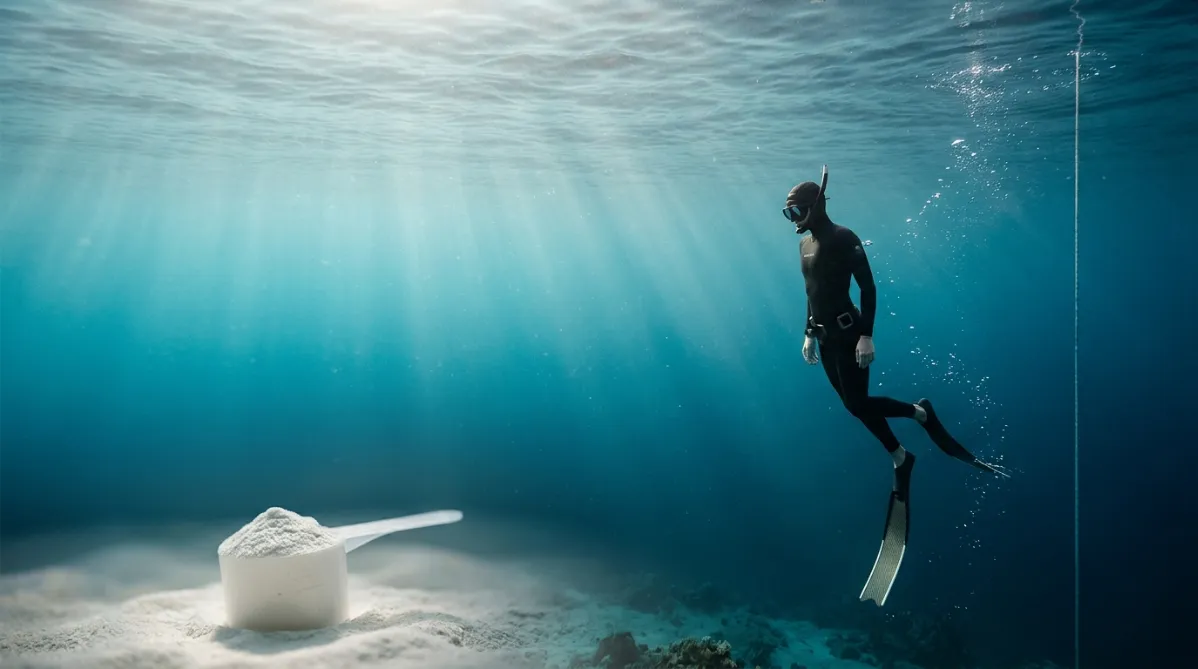
A wide, cinematic landscape photograph of a freediver suspended mid-water in a calm, sunlit turquoise sea, shot from slightly below so the surface glimmers above like rippling silver glass. The diver wears a sleek matte black wetsuit and a long, elegant pair of carbon fins. Their body is streamlined, arms relaxed at their sides, head tilted slightly down in a state of serene focus. Shafts of soft golden sunlight pierce the water diagonally and illuminate fine floating particles and a trail of tiny bubbles rising from the diver's fins. A single thin dive line descends vertically into deeper blue at the right of the frame, adding a graphic compositional element.

In the lower left foreground, slightly out of focus, a minimalist still-life element rests on a pale sandy seabed: a small, clean white scoop with a mound of fine white powder, casually echoing creatine without any text or labels. The scoop is softly lit and has a shallow depth of field blur, creating a gentle visual link between supplement and sport.

The color palette is refined and modern: deep teal, aquamarine, soft cerulean, warm cream highlights, and touches of sunlit gold. The water gradients smoothly from bright, luminous turquoise near the top to a rich inky navy at the bottom, giving depth and a sense of quiet intensity. Leave generous negative space on the left third of the image for headline placement, with the diver positioned on the right third following the rule of thirds.

The mood is calm, athletic, and contemplative, like an editorial image from a premium health and science magazine. Style: high-end editorial photography, natural light, subtle film grain, soft contrast, crisp detail on the diver and gentle bokeh in the background. No text, no logos, no futuristic or sci-fi elements, no graphics overlays.
Nutrition

La creatina funciona incluso sin respirar: lo que revela un estudio en apneístas

Dr. Gymbro · · 4 min read

La creatina funciona incluso sin respirar: lo que revela un estudio en apneístas


¿Qué le ocurre a tus músculos cuando los fuerzas a trabajar al máximo sin recibir oxígeno nuevo? Un reciente ensayo aleatorizado en apneístas sugiere que la creatina, el suplemento más investigado en nutrición deportiva, podría ser útil precisamente en esa circunstancia.

El gran hallazgo: más trabajo, menos lactato

Investigadores liderados por Kurmazovic aplicaron un protocolo clásico de carga de creatina monohidratada a buceadores entrenados en apnea. Los participantes pedalearon en un ergómetro con una única respiración, intentando cubrir la mayor distancia posible. Tras una semana de suplementación, el grupo que tomó creatina generó más trabajo total y permaneció activo durante más tiempo antes del agotamiento que el grupo placebo.

Lo más sorprendente fue el resultado del lactato. La concentración sanguínea de lactato fue más baja en el grupo de creatina, a pesar de que su rendimiento fue mayor. Forzar más normalmente implica producir más lactato, por lo que este hallazgo contradice la intuición. El artículo reporta una interacción significativa Tiempo × Grupo para lactato (p = 0.003).

Cómo se llevó a cabo el estudio

  • Diseño: ensayo doble ciego, aleatorizado y controlado con placebo, publicado en el Journal of the International Society of Sports Nutrition (2026).
  • Población: 20 buceadores entrenados en apnea (18 hombres, 2 mujeres), edad media ≈ 41.6 años.
  • Intervención: creatina monohidratada 20 g/día durante 7 días (fase de carga) vs. placebo.
  • Prueba: después de un breve calentamiento, esfuerzo máximo en bicicleta con una sola respiración, intentando lograr la mayor distancia posible.
  • Variables medidas: trabajo total, tiempo hasta el agotamiento, lactato sanguíneo, pCO₂ exhalado tras el esfuerzo, percepción del esfuerzo durante la apnea y de la fatiga muscular, y composición corporal mediante DXA.
  • Registro: ClinicalTrials.gov NCT07233707.

Por qué la creatina podría importar cuando mantienes la respiración

Los autores explican que la creatina favorece la disponibilidad de energía anaeróbica y la capacidad de amortiguación de los protones. Durante una apnea, los músculos dependen en mayor medida de la producción anaeróbica de ATP; por tanto, el ATP derivado de la fosfocreatina puede resultar especialmente valioso. Hasta ahora, nadie había evaluado si ese beneficio se manifestaba bajo apnea voluntaria.

Los resultados son consistentes con esa hipótesis: tanto el trabajo total (p = 0.011) como el tiempo hasta el agotamiento (p = 0.028) mejoraron significativamente con creatina respecto al placebo. El estudio no prueba directamente el mecanismo, por lo que la explicación sigue siendo plausible, pero no definitiva.

Otros hallazgos

  • Masa libre de grasa aumentó más con creatina (p = 0.017). La creatina suele asociarse a retención de agua, y este estudio no separó la causa, por lo que conviene ser cauteloso al interpretar este dato como ganancia muscular pura.
  • Percepción del esfuerzo durante la apnea no mostró diferencias entre grupos; la creatina mejoró el rendimiento sin que la apnea se sintiera más difícil.
  • Valoración de fatiga muscular mostró un leve incremento en el grupo creatina, lo que los autores señalan como una posible desventaja.
  • pCO₂ exhalado, masa grasa y masa corporal total no presentaron diferencias significativas entre grupos.

Conclusiones prácticas

  • Dosis: 20 g/día de creatina monohidratada durante 7 días, siguiendo el protocolo clásico de carga. El estudio no especifica cómo se dividió la dosis diaria; muchos atletas la reparten en varias tomas, práctica habitual pero no evaluada aquí.
  • Momento de ingesta: No se investigó el tiempo relativo al entrenamiento o competición, por lo que no hay evidencia que respalde una ingesta puntual antes de la inmersión.
  • A quién puede interesar:
    • Apneístas y pescadores submarinos: población estudiada, por lo que la evidencia es directa.
    • Atletas de combate y natación: ambos deportes incluyen esfuerzos con respiración restringida y ráfagas anaeróbicas repetidas; la extrapolación es razonable aunque no probada.
    • Cualquier persona que realice trabajo anaeróbico de alta intensidad: la creatina ya posee un historial sólido en este contexto; este ensayo añade un escenario adicional donde parece ser eficaz.

Limitaciones

  1. Muestra pequeña. Sólo 20 participantes; los resultados son preliminares y pueden sobreestimar el efecto.
  2. Población limitada. Predominantemente hombres de ~41 años; solo dos mujeres, lo que dificulta la generalización por sexo.
  3. Ciclismo en laboratorio ≠ buceo real. La prueba de ciclismo con una respiración no equivale a una inmersión profunda, a una apnea estática o a una competición bajo el agua.
  4. Seguridad. La apnea conlleva riesgos graves, incluido el desmayo. Ningún hallazgo sugiere que la creatina haga la apnea más segura; nunca practiques apnea sin supervisión.
  5. Lactato bajo inexplicado. Menor lactato junto a mayor trabajo es intrigante, pero el estudio no profundiza en el porqué.
  6. Fatiga muscular percibida. El pequeño aumento en la sensación de fatiga indica que el beneficio no está exento de costos.

Conclusión

Una semana de carga con creatina monohidratada aumentó el trabajo total y el tiempo hasta el agotamiento en una prueba de ciclismo con apnea en buceadores entrenados, y redujo la concentración de lactato sanguíneo frente al placebo. Dado el tamaño reducido de la muestra, estos resultados deben considerarse una señal prometedora más que una prueba definitiva. Si practicas apnea o deportes anaeróbicos y ya utilizas creatina, este hallazgo ofrece un respaldo adicional. Consulta a un profesional de la salud antes de iniciar la suplementación si tienes problemas renales u otras condiciones médicas.

Fuente: Kurmazovic et al. Load and breath‑hold: impact of 7‑day creatine monohydrate loading on breath‑hold exercise performance – a double‑blind randomized controlled trial. J Int Soc Sports Nutr, 2026. DOI: https://doi.org/10.1080/15502783.2026.2732743 | PubMed: https://pubmed.ncbi.nlm.nih.gov/42868132/
Original study

Read the original research on pubmed.ncbi.nlm.nih.gov →

This article summarizes published research for general information. It is not medical advice.

DG

Written by

Dr. Gymbro

Dr. Gymbro writes for Dr. Gymbro: science-backed fitness, nutrition & performance.

Related Articles

A bright, modern editorial flat-lay photographed from above on a soft off-white stone surface. At the center sits a matte ceramic scoop heaped with fine white creatine powder, with a loose dusting of powder fanning out across the surface. Beside it is a minimalist frosted-glass jar with a plain label and a brushed-steel shaker bottle lying on its side. To the left, a wooden comb and a small folded strip of graph paper with a single hand-drawn upward curve in muted terracotta ink, suggesting a data spike without any text. A few loose strands of dark brown hair curve elegantly across the stone near the comb. To the right, a clean glass beaker filled with water and a sprig of green rosemary, and an open notebook with blank pages and a sleek pen. The palette is warm neutrals: cream, sand, soft sage green, and a single accent of terracotta orange. Natural window light falls from the upper left, casting long, gentle shadows and a subtle diffused glow. The composition leaves generous negative space on the right third for title overlay. Shallow depth of field with crisp focus on the powder scoop, a premium health-and-science magazine look, minimalist, calm, and trendy, with fine grain and soft contrast. Landscape 16:9 framing.
science research

Creatina y caída del cabello: el aumento del 56 % de DHT explicado

BY DR. GYMBRO ·

Un estudio de 2009 mostró que una fase de carga de creatina de 7 días (25 g/día) elevó el DHT en un 56 %, y que con una dosis de mantenimiento de 5 g/día los niveles permanecieron alrededor de un 40 % por encima de la línea de base, mientras que la testosterona no cambió. Como el DHT está relacionado con la calvicie de patrón masculino, este hallazgo avivó el debate sobre la creatina y la pérdida de pelo. Sin embargo, el ensayo contó con solo 20 jugadores de rugby, duró tres semanas y nunca midió el cabello. Estudios posteriores no han reproducido consistentemente el aumento de DHT. Aquí se resume lo que realmente muestra la investigación, a quién le puede interesar y cómo actuar si te preocupa.

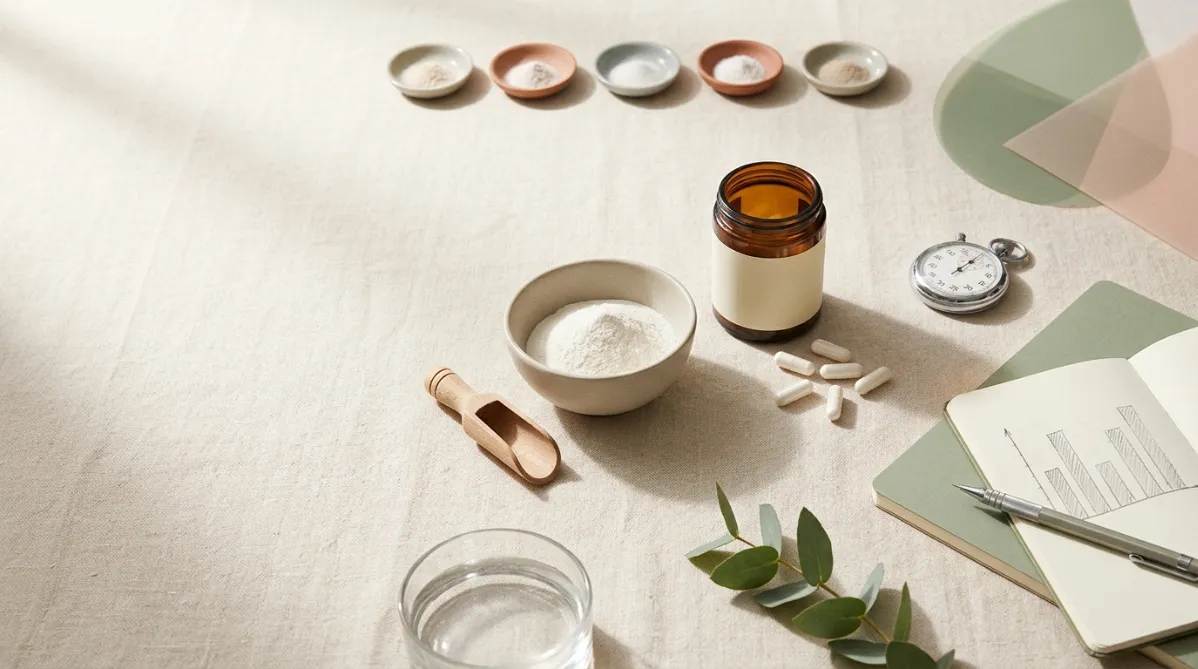
A wide, editorial-style still life photographed from slightly above on a pale oat-colored linen surface, lit by soft morning window light from the left. In the center sits a small matte ceramic bowl holding a mound of fine white powder, with a minimalist wooden scoop resting beside it. Next to the bowl is an open amber glass supplement jar with a plain cream label, and a few white capsules spill across the linen in a loose arc.

To the right, a neatly arranged cluster of analog "study" objects suggests careful measurement: a vintage stopwatch with a clean white face, a slim notebook with a sage-green cover open to a hand-drawn bar chart (blurred, no legible text), and a mechanical pencil lying across the page. A small row of six identical ceramic dishes, each holding a pinch of powder, is lined up along the top edge of the frame to hint at the six-week trial. One dish is slightly out of alignment, a subtle visual cue for ambiguity.

A shallow glass of water and a single sprig of green eucalyptus add a calm, organic note in the foreground. Soft, long shadows fall across the textured linen, and the palette stays restrained: warm cream, soft sage, muted terracotta, pale gray, and touches of amber from the glass jar. A few translucent paper cutouts in two tones (sage and blush) overlap in the upper right corner as a modern graphic accent, evoking overlapping data points without showing any numbers.

Depth of field is shallow, with the bowl and stopwatch in crisp focus and the edges gently softened. The composition leaves generous negative space on the left third for title text overlay. The overall mood is thoughtful, balanced, and quietly skeptical, in the style of a contemporary wellness and science magazine: clean, tactile, minimal, with a subtle film-like grain and natural color grading. No people, no futuristic or sci-fi elements, no readable text or logos.
nutrition

¿Es el GAA un potenciador cerebral? El resultado del ensayo de 6 semanas es complicado

BY DR. GYMBRO ·

El GAA, precursor de la creatina que se vende como potenciador cerebral, acaba de recibir su primera prueba seria en humanos. En un ensayo doble ciego de seis semanas con 58 adultos sanos, se observaron algunas mejoras en la velocidad de reacción y leves indicios de cambios en el ánimo y el estrés. Sin embargo, la mayoría de las pruebas cognitivas no mostraron efectos y muchos resultados primarios fueron solo tendencias. Los marcadores de seguridad fueron normales, pero el estudio fue pequeño, exploratorio y no incluyó un grupo de comparación con solo creatina. Aquí se explica qué evidencia existe realmente, a quién podría interesar y por qué el veredicto es mixto.

A bright, minimalist flat-lay photograph of two supplement scoops on a pale warm-gray stone surface, shot from directly above in soft natural window light. On the left, a matte ceramic scoop holds fine white creatine monohydrate powder, heaped in a clean mound. On the right, a second scoop of the same shape holds slightly coarser off-white beta-alanine powder, with a small, deliberate gap between the two. Each scoop sits in its own soft shadow, which suggests separation rather than combination. Between them, a thin brushed-brass ruler or a single slim line of fine powder runs across the surface and subtly divides the composition.

Around the scoops, a few restrained props in a muted editorial palette of sage green, cream, terracotta, and soft charcoal: a small glass jar with a minimalist label that has no readable text, a folded linen napkin, a single sprig of eucalyptus, and a stainless-steel shaker bottle softly out of focus in the upper corner. A few loose powder grains are scattered naturally across the stone. A small stack of blank cream index cards with a pencil rests in the lower right, hinting at research and note-taking without any legible writing.

The composition follows a clean rule-of-thirds layout, with generous negative space on the right third for headline overlay. The lighting is gentle and diffused, with long, soft shadows falling to the lower left. The color grading is calm and slightly desaturated, with creamy highlights and a subtle film-like grain. The overall look is a modern wellness and science journal cover, with an airy, trustworthy, contemporary editorial feel, shallow depth of field, and crisp detail on the powders.
nutrition

Creatina + beta‑alanina: el supuesto beneficio del stack que los investigadores no hallaron

BY DR. GYMBRO ·

El combo de creatina y beta‑alanina se promociona como la pareja perfecta para el rendimiento, pero un meta‑análisis de redes con 52 ensayos aleatorizados no encontró sinergia entre ambos. La creatina sola mejoró de forma significativa los resultados de sprint, salto, sprint repetido y resistencia muscular de la parte superior frente al placebo. Los efectos de la beta‑alanina fueron no significativos o dependientes del contexto, y la combinación no aportó nada adicional a la creatina. A continuación, analizamos qué hizo el estudio, sus limitaciones y qué implica para tu presupuesto de suplementos.

A wide, editorial-style photograph of a volleyball player mid-landing from a jump on a sunlit indoor court, captured from a low side angle. The athlete's knee is slightly bent and the patellar tendon area is in sharp focus, with soft natural muscle definition and a light strip of kinesiology tape just below the kneecap. The polished honey-toned hardwood floor reflects warm window light, and the background falls away into a creamy blur of pale court lines and tall windows.

In the lower right foreground, slightly out of focus, a matte ceramic bowl holds a small mound of fine white creatine powder. A wooden scoop rests beside it, next to a clear glass of water and a folded white towel. This sits on a light oak bench at the edge of the court. A resistance band and a slanted decline board, used for eccentric rehab, lean softly against the wall behind the bench.

The palette is warm and natural: cream, soft white, honey oak, muted sage green accents from a gym bag, and a touch of terracotta from the athlete's sneakers. Light is golden-hour and diffused, with gentle shadows and a subtle film-grain finish. The composition follows the rule of thirds, with the athlete on the left and the supplement still life on the right. Negative space in the upper portion leaves room for a headline overlay.

The overall mood is calm, modern, and health-focused, like a contemporary wellness or sports-science journal cover. Shallow depth of field, a clean minimalist aesthetic, and true-to-life color. No text, no logos, no futuristic or digital elements.
recovery

¿Creatina para la rodilla de saltador? El alivio del dolor apareció a las 4 semanas

BY DR. GYMBRO ·

La rodilla de saltador puede dejar fuera a los atletas durante meses, y un nuevo ensayo investiga si la creatina puede acelerar la recuperación. En 20 deportistas que siguieron un programa de rehabilitación excéntrica, solo el grupo que tomó creatina mostró una mejora significativa en dolor y función (VISA‑P) a las 4 semanas, junto con aumentos en la altura del salto. A las 8 semanas, ambos grupos alcanzaron resultados similares y la interacción entre grupos apenas tendió a ser significativa (p = 0,099). A continuación, describimos el diseño del estudio, la forma de administración de la creatina, quién podría beneficiarse y por qué el pequeño tamaño de la muestra obliga a ser cautelosos.

This page is available in