Dr. Gymbro
A quiet, sunlit editorial still life on a pale oatmeal linen surface, shot from a slightly elevated three-quarter angle with soft morning window light raking in from the left. On the left side, a small matte ceramic dish holds a few white round tablets, next to a minimalist amber glass bottle with a blank cream label. In the center, a slim glass of water sits beside a handmade stoneware espresso cup filled with dark coffee, with a thin ribbon of steam curling upward. On the right, a pair of worn but clean sage-green running shoes rests on a pale wooden bench, with a folded charcoal athletic towel and a stainless steel stopwatch beside them. The background is softly blurred: a calm bedroom-to-morning transition, with the left third of the frame in cool, dusky blue-gray tones suggesting night, with rumpled white bedding and a small bedside lamp glowing dimly. The tones then blend gradually across the frame into warm golden peach morning light on the right, where a blurred indoor court or track line is faintly visible through a tall window. The color palette is muted and modern: warm cream, soft sage, dusty blue, terracotta accents, and hints of amber. Delicate shadows, shallow depth of field, fine natural film grain, and generous negative space across the top of the frame for headline text. The mood is calm, precise, and thoughtful, in the style of a contemporary wellness and science journal photograph, clean and minimalist with tactile textures of linen, ceramic, glass, and wood.
Nutrition

Melatonina y luego cafeína: solo la combinación reduce los marcadores de daño muscular

Dr. Gymbro · · 4 min read

La cafeína hizo que hombres entrenados corrieran más lejos. Esa parte no sorprende. El giro de este nuevo ensayo cruzado es que solo la combinación melatonina por la noche y cafeína por la mañana también redujo los marcadores de daño muscular e inflamación; la cafeína sola no lo hizo y la melatonina sola tampoco. ¿Y el beneficio para el sueño por el que la melatonina es famosa? Los investigadores no lo detectaron.

La combinación en una línea

El protocolo fue sencillo: 6 mg de melatonina antes de acostarse y, al día siguiente, 3 mg/kg de cafeína una hora antes de la prueba de carrera de 5 m shuttle. El estudio, publicado en Nutrients en 2026 por un equipo tunecino, español y noruego, buscaba observar una interacción que los atletas podrían estar creando sin querer. Muchos usan melatonina para relajarse y cafeína para despertarse, pero pocos estudios han probado ambas sustancias juntas.

Cómo se realizó el estudio

Catorce hombres entrenados (edad media 22,4 ± 2,9 años) completaron cuatro condiciones en un diseño cruzado aleatorio, doble ciego y controlado con placebo:

  • PLA + PLA: placebo por la noche y placebo por la mañana.
  • PLA + CAF: placebo por la noche y 3 mg/kg de cafeína por la mañana.
  • MEL + PLA: 6 mg de melatonina por la noche y placebo por la mañana.
  • MEL + CAF: melatonina por la noche y cafeína por la mañana.

Se tomaron muestras de sangre antes y después del ejercicio para medir creatina quinasa, lactato deshidrogenasa, aspartato aminotransferasa y alanina aminotransferasa (marcadores de daño muscular), así como proteína C‑reactiva (marcador de inflamación). También se registraron la frecuencia cardíaca máxima y la percepción de esfuerzo durante la prueba. El sueño se evaluó solo la noche posterior a la ingesta de melatonina o placebo.

Hallazgo 1: La cafeína aumentó la distancia, con o sin melatonina

La distancia total recorrida en la prueba de shuttle aumentó tanto en las condiciones MEL + CAF como PLA + CAF respecto al doble placebo. La melatonina sola no elevó la distancia. En términos prácticos, la mejora se asemeja al efecto típico de la cafeína. La dosis de 3 mg/kg es moderada y está ampliamente estudiada, y este resultado se alinea con el amplio historial de la cafeína mejorando esfuerzos de alta intensidad repetidos.

Hallazgo 2: Solo la combinación redujo los marcadores de daño e inflamación

Este es el titular. MEL + CAF disminuyó los marcadores de daño muscular e inflamación en comparación con las tres condiciones restantes (PLA + PLA, MEL + PLA y PLA + CAF), con p < 0,05. Ninguno de los compuestos logró esa reducción por sí solo. El patrón sugiere una interacción, aunque el estudio no puede explicar el porqué. La melatonina posee propiedades antioxidantes y antiinflamatorias, y los autores describen a ambas sustancias como complementarias: una favorece la recuperación y la otra el rendimiento. Es una hipótesis, no una conclusión definitiva.

Hallazgo 3: No hubo cambio en el sueño

La melatonina suele venderse como ayuda para dormir, por lo que esto puede sorprender. No se observaron diferencias en los parámetros de sueño entre las condiciones (p > 0,05). Hombres jóvenes, sanos y entrenados pueden simplemente tener poco margen de mejora. Además, el sueño solo se evaluó la noche tras la dosis vespertina. Así que, si esperabas un sueño más profundo, este estudio no aporta evidencia al respecto. Cualquier beneficio observado no se explica por una mejora del sueño medida.

Protocolo práctico (basado en lo que se probó)

  • Noche: 6 mg de melatonina antes de acostarse.
  • Mañana: cafeína a 3 mg/kg de peso corporal (un atleta de 70 kg tomaría unos 210 mg).
  • Timing: la prueba de ejercicio comenzó una hora después de la dosis de cafeína.
  • A quién podría interesar: atletas que entrenan o compiten por la mañana y jugadores de deportes de equipo cuyas sesiones incluyen sprints repetidos, ya que la prueba de 5 m shuttle se asemeja a esas demandas.

Esas son las condiciones que el estudio realmente utilizó. Otras dosis, horarios o tipos de atletas no fueron evaluados aquí. La tolerancia a la cafeína también es individual, y las personas sensibles pueden no responder de la misma forma. La melatonina y la cafeína son suplementos con sus propias consideraciones; cualquier persona con alguna condición médica o que tome medicación debe consultar a un profesional antes de usarlos.

Las advertencias que no debes pasar por alto

  • Muestra pequeña. Catorce hombres jóvenes entrenados es un grupo reducido, y los resultados pueden no extrapolarse a mujeres, adultos mayores o atletas de élite.
  • Una sola prueba. El rendimiento se midió con una única prueba, el shuttle de 5 m. La propia conclusión de los autores es cautelosa: mejoras en ciertos resultados de alta intensidad.
  • Los marcadores sanguíneos no son rendimiento. Niveles menores de creatina quinasa o proteína C‑reactiva tras el ejercicio son interesantes, pero no prueban una recuperación más rápida, menos lesiones o una mejor adaptación al entrenamiento. El estudio no siguió a los atletas durante días o semanas.
  • Sin ventaja adicional de rendimiento por la melatonina. En distancia, la combinación no superó claramente a la cafeína sola según los resultados reportados.
  • Mecanismo desconocido. El ensayo muestra una asociación en una sesión, no la razón subyacente.

Conclusión

Si ya usas cafeína antes de tus sesiones matutinas, este estudio no brinda motivos para esperar que la melatonina aumente la distancia que cubres. Sí sugiere que el par podría modificar los marcadores de daño muscular e inflamación de una manera que ninguno de los dos logra por sí solo. Eso vale la pena replicar en grupos más grandes, durante períodos más largos y con resultados de recuperación que los atletas realmente perciban. Por ahora, considera la combinación como una pista interesante más que como un truco de recuperación probado.
Original study

Read the original research on pubmed.ncbi.nlm.nih.gov →

This article summarizes published research for general information. It is not medical advice.

DG

Written by

Dr. Gymbro

Dr. Gymbro writes for Dr. Gymbro: science-backed fitness, nutrition & performance.

Related Articles

A wide, editorial-style photograph of a competition swimming pool lane seen from just above the water line at the starting end, in soft morning light. In the foreground, on the pool deck, a white ceramic espresso cup sits on the edge of a blue-gray starting block, a thin curl of steam rising from it. The cup is in crisp focus, with a few droplets of water on the textured non-slip deck around it. Behind it, the pool stretches into the distance as a series of calm lanes divided by red and white lane ropes. The turquoise water glints with gentle ripples and long, shimmering reflections. At the far end, a lone swimmer in a dark cap and goggles is mid-stroke, caught in a small burst of white splash, and slightly out of focus because of the shallow depth of field.

Large windows along the side wall let in pale golden sunlight, which throws soft diagonal light across the water and the deck. The palette is clean and modern: aqua, deep teal, warm cream and a small accent of coffee brown. The cup's warm tones stand out against the cool blues. The composition follows the rule of thirds, with the cup in the lower left third and open negative space of water and light on the right, leaving room for headline text. The look is minimal, airy and contemporary, like a high-end sports and science magazine, with subtle film grain, natural color grading, and a slightly desaturated, calm mood. Faint stopwatch-like details appear only as a thin black timing pad edge on the starting block, with no text or numbers visible. The overall feel is quiet anticipation just before a race, precise and fresh, with a sense of small margins and measured performance.
nutrition

La cafeína hace a los nadadores más rápidos, pero menos de lo que piensas

BY DR. GYMBRO ·

Los nadadores llevan años tomando café antes de las pruebas, pero ¿realmente les brinda una ventaja? Un meta‑análisis multinivel de 13 ensayos cruzados sitúa la mejora en torno al 1,7 %, una diferencia significativa en un deporte decidido por centésimas de segundo. El beneficio más claro aparece con dosis de 6 mg/kg o más, mientras que cantidades menores no mostraron un efecto convincente. La cafeína también elevó el lactato sanguíneo post‑carrera, y los resultados variaron mucho entre los estudios. A continuación, lo que la evidencia respalda y lo que aún queda por esclarecer.

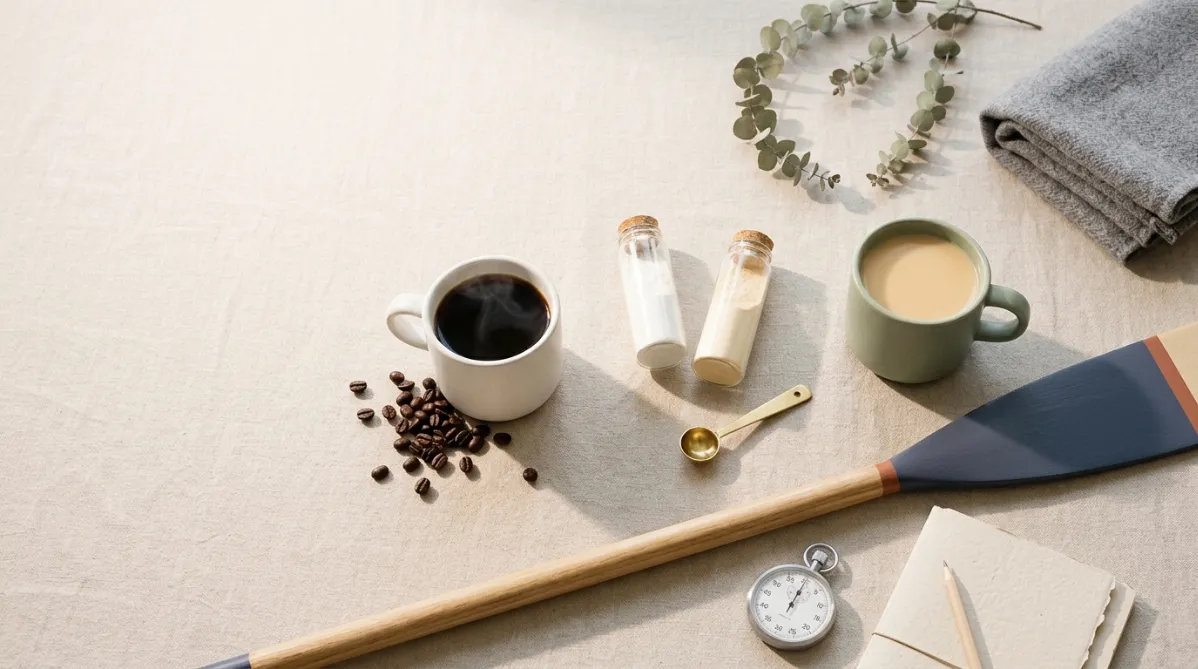
A wide, editorial-style flat lay photographed from above on a pale oat-colored linen surface in soft morning window light. On the left, a small matte white ceramic cup of black coffee with a delicate swirl of steam, beside a few scattered roasted coffee beans. On the right, a second matte sage-green ceramic cup holding a pale, creamy golden tea-like drink, mirroring the first. Between them, two small glass vials with cork stoppers sit side by side: one holding fine white powder, the other holding slightly warmer cream-colored powder, with a tiny brass measuring spoon resting nearby. In the lower foreground, a slim wooden rowing oar lies diagonally across the frame, its blade edge softly entering from the right, painted a muted navy with a thin terracotta stripe. A minimalist analog stopwatch with a brushed-steel case rests near the oar, and a folded cream notebook with a thin pencil suggests data-taking. In the upper corner, a crescent-shaped dried eucalyptus sprig and a small folded gray wool throw hint at sleep and calm without being literal. The palette is warm and restrained: oat, cream, sage, soft navy, terracotta, and espresso brown. Shadows are long and gentle, with shallow depth of field and subtle film grain, giving a refined, modern wellness-magazine feel. Generous negative space on the left third of the composition leaves room for a headline overlay. Clean, calm, tactile, and contemporary, with no text, logos, or futuristic elements.
science research

Paraxanthine vs cafeína: la combinación ganadora y el aliado del sueño

BY DR. GYMBRO ·

Paraxanthine, el principal metabolito de la cafeína, se enfrentó cara a cara con ésta en un ensayo con 14 remeros. La combinación de 200 mg de cada una superó al placebo en una carrera de 2000 m, aunque con un efecto pequeño (d = 0,30). Ninguno de los compuestos por sí solo mostró una mejora clara del rendimiento. Sin embargo, la paraxanthine sola pareció ser más amable con el sueño subjetivo. Aquí tienes los números, sus limitaciones y quién podría beneficiarse realmente.

A wide, softly lit editorial flat-lay on a pale warm-gray stone countertop, shot from slightly above. On the left, a small rustic ceramic bowl in matte cream holds a handful of dried guarana seeds, dark glossy brown with pale cream arils, a few spilling onto the surface. Beside it sits a halved fresh guarana fruit in vivid red-orange, split open to show the white flesh and black seed inside, looking like a tiny eye. On the right, two open clear capsules rest side by side. One is filled with fine white caffeine powder, the other with a fine earthy brown guarana powder, and a little of each dusts the stone in delicate, deliberate lines. Between them, a minimalist matte-black espresso cup with a thin ribbon of steam rises on the right edge of the frame. A brushed-steel stopwatch and a slim dark-green linen notebook with a pencil sit in the upper background, slightly out of focus, to hint at performance testing without clutter. A few green leaves of a guarana vine curve in from the top-left corner, catching soft light.

The lighting is natural window light from the left, with gentle long shadows and a subtle warm highlight on the seeds. The palette is muted and modern: warm creams, terracotta red, deep espresso brown, sage green, and charcoal accents. The background is clean with generous negative space on the upper right for headline text. Shallow depth of field, crisp focus on the seeds and capsules, fine grain, and a calm premium magazine look like a contemporary wellness and sports-science journal. No people, no text, no logos, no futuristic elements.
science research

Guaraná vs cafeína: misma dosis, solo el guaraná aumentó la potencia máxima

BY DR. GYMBRO ·

Misma dosis de cafeína, distinta cápsula, y solo el guaraná produjo un aumento estadísticamente significativo de la potencia máxima. En un ensayo cruzado aleatorizado con 18 hombres activos, el guaraná elevó la potencia pico en un 4,0 % frente al placebo, mientras que la cafeína anhidra no alcanzó significación. Sin embargo, el guaraná no superó a la cafeína en la comparación directa y las diferencias entre ambos fueron meramente descriptivas. Aquí se resumen los datos, las limitaciones del estudio y cómo dosificar guaraná según su contenido de cafeína si decides probarlo.

A cyclist's legs mid-pedal on a stationary road bike, shot in a bright, airy, minimalist studio with a soft warm-grey backdrop. In the foreground on a pale oak table sits a small ceramic dish holding four deep coral-red softgel capsules, with a few translucent droplets of red-orange oil glistening beside them. Beside the dish is a sprig of dried red microalgae-toned seaweed and a halved wild salmon fillet, its coral flesh echoing the capsule color. Behind the table, slightly out of focus, a cyclist in a fitted charcoal jersey and matte black shorts rides a bike on an indoor trainer. Only the torso and legs are visible, with no face. A white towel hangs over the handlebars and a clear water bottle catches the light.

Soft diffused morning light streams from a large window on the left, creating long gentle shadows and a subtle golden-hour glow on the skin and the glossy capsules. The palette is restrained and editorial: warm cream, sand, soft grey and charcoal, with vivid coral-red as the single accent color. A minimalist analog stopwatch with a clean white face sits on the table, its hands near the 85-minute mark. A thin, elegant line-graph shape is subtly suggested by a curved strip of red ribbon lying on the table, rising from left to right to hint at the performance gain without any text.

The composition follows the rule of thirds, with the capsules and stopwatch in the lower left and the cyclist's motion-blurred legs sweeping across the right. Shallow depth of field, crisp macro detail on the capsules, and a fine film-like grain. The overall feel is a modern health and science magazine cover: clean, calm, sophisticated, and natural, with negative space in the upper area for a headline. There are no futuristic elements, no glowing effects, no laboratory equipment, and no text or logos. Landscape 16:9 format.
nutrition

La astaxantina, tras 4 días, incrementó el tiempo hasta el agotamiento en ciclismo de 72 a 85 minutos en un pequeño ensayo

BY DR. GYMBRO ·

Cuatro días de astaxantina (28 mg/día) prolongaron el tiempo hasta el agotamiento en ciclismo de unos 72 a 85 minutos, lo que representa un aumento de alrededor del 18 %. El mismo protocolo atenuó la elevación de los marcadores de daño muscular (CK y LDH) y de peroxidación lipídica (MDA) tras un esfuerzo intenso al 75 % del VO2 máx. Los indicadores inflamatorios y el consumo de combustible no variaron, de modo que el mecanismo sigue sin quedar claro. La dosis supera con creces la que contienen la mayoría de las cápsulas blandas, y el estudio contó solo con diez hombres jóvenes. A continuación se presentan los números y los límites de la evidencia.

This page is available in