Dr. Gymbro
←

#ketone ester

3 articles
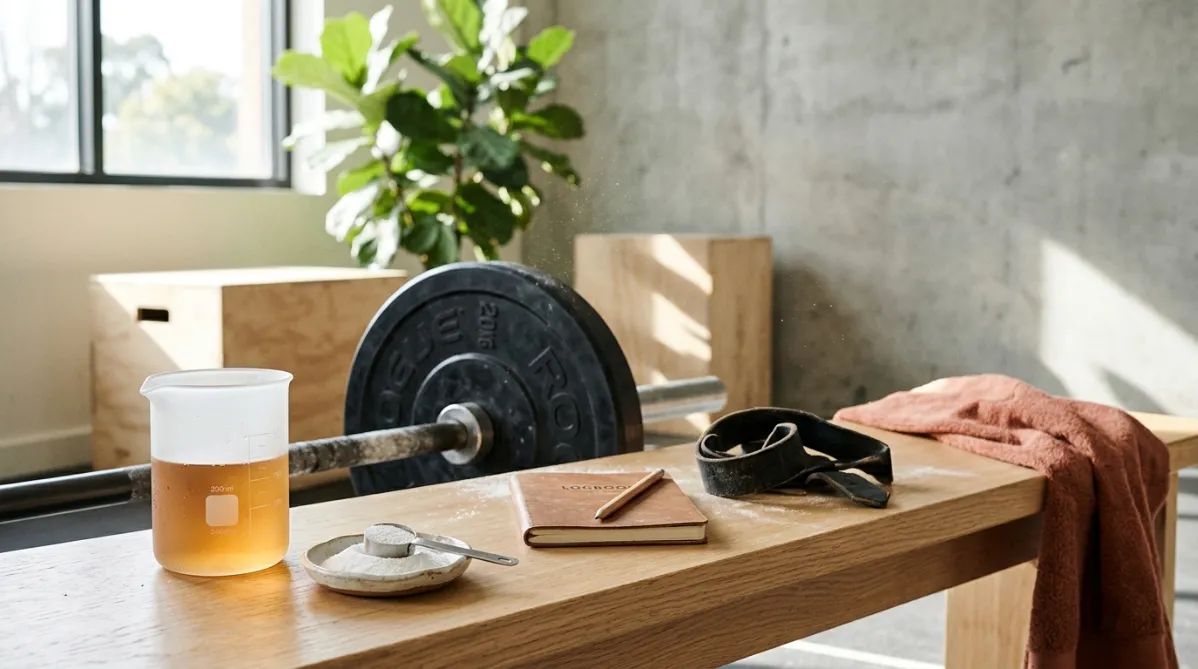
A wide, editorial-style still life shot from a slightly elevated three-quarter angle on a pale oak gym bench, lit by soft morning window light. In the foreground sits a minimalist matte-white glass beaker of clear, faintly amber liquid, with a few condensation droplets on its surface. Beside it rests a small ceramic dish of white crystalline powder and a stainless steel scoop. In the middle ground, a chalk-dusted steel barbell with black bumper plates rests on the bench's edge. A pair of worn leather lifting straps and a small notebook with a pencil lie nearby, suggesting data logging. Behind them, softly blurred, is a bright, airy studio with concrete walls, a wooden plyo box, and a tall leafy plant catching the light.

The palette is warm and muted: cream, sand, soft sage green, and charcoal, with one small accent of burnt orange in the amber liquid and a terracotta towel draped over the bench. Fine chalk dust floats in sunbeams that cut diagonally across the frame. The shallow depth of field keeps the beaker and barbell sharp while the background melts into creamy bokeh. Composition follows the rule of thirds, with the beaker on the left third and generous negative space on the right for headline text. The mood is calm, premium, and contemporary, like a high-end wellness and sports-science magazine photograph with subtle film grain, natural shadows, and realistic textures.
nutrition

Las cetonas mantuvieron la tasa de desarrollo de fuerza un 8 % más alta, pero los saltos no variaron

BY DR. GYMBRO ·

Cincuenta gramos de un precursor de cetonas mantuvieron la tasa de desarrollo de fuerza un 8 % más alta una hora después en un estudio de la Universidad Estatal de Ohio, pero no influyeron en los saltos de contramovimiento. El ensayo cruzado aleatorizado con 20 adultos activos mostró picos de cetonas en sangre de alrededor de 2,2 mM a los 120 min. Además, se registró una caída del 24 % en la glucosa y un aumento de 13 latidos por minuto en la frecuencia cardíaca. El hallazgo es interesante para quienes realizan esfuerzos máximos repetidos, aunque el estudio es pequeño y de naturaleza aguda. A continuación, los datos, a quién pueden interesar y a quién conviene esperar.

A wide, editorial-style photograph of a runner's morning ritual on a quiet paved path at the edge of a park, shot in soft golden-hour light with a shallow depth of field. In the foreground, a small frosted glass bottle of pale amber liquid sits on a weathered wooden bench, beside a sleek analog stopwatch and a folded linen towel. Condensation beads on the glass and catches warm sunlight. The background melts into a creamy blur of a lone runner in a muted sage-green jacket and charcoal tights, mid-stride, heading away along a tree-lined track, with soft mist hovering above the grass.

The color palette is calm and modern: warm honey and amber tones, soft sage green, off-white, and touches of deep navy in the shadows. Subtle film grain and gentle natural contrast give it a contemporary lifestyle-magazine feel. Long, delicate shadows stretch across the path.

On the bench, a small open notebook with a loose hand-drawn sketch of a head profile and a simple line graph sits next to a pencil, hinting at cognition and measurement without any text legible. A few fallen autumn leaves add texture. The composition follows the rule of thirds, with the bottle and stopwatch on the left third, negative space on the right for headline overlay, and the runner small in the distance to suggest that speed is not the story.

The mood is thoughtful, clean, and quietly intelligent, evoking wellness science journalism: minimal, airy, organic, and refined. No futuristic elements, no neon, no digital effects, just natural light, tactile materials, and a considered, understated aesthetic.
supplements

El éster de cetona no hizo a los corredores más rápidos, pero agudizó su mente

BY DR. GYMBRO ·

Las bebidas de éster de cetona se promocionan como un atajo para correr más rápido, pero un ensayo de 31 días no encontró mejora en los 5 km. Lo que sí cambió de forma notable fueron respuestas más rápidas en el Stroop y en pruebas de cambio de tarea, una glucemia un 15 % más baja y un mayor VO₂ en una prueba graduada, incluso después de suspender la suplementación. El problema es el tamaño de la muestra, con solo 18 corredores recreativos en un diseño simple ciego. Aquí lo que demuestran los datos, lo que no, y a quién debería evitar un régimen de 90 g/día.

A calm, editorial-style landscape photograph of an athlete's bedroom at dawn, shot with soft natural light. In the foreground, a minimalist wooden bedside table holds a small frosted glass of pale amber drink beside a slim matte-white bottle with no label, a worn pair of running shoes tucked just beneath it. Soft morning light filters through sheer linen curtains, casting long, gentle gold and peach gradients across rumpled off-white bedding in the background, slightly out of focus. A folded gray training towel and a simple analog wristwatch rest on the table edge. On the wall above, a single abstract print in muted sage and terracotta tones adds a trendy, curated feel. The color palette is warm neutrals, oat, soft sage green, and dusty amber, with gentle shadows and a shallow depth of field. The composition uses generous negative space on the right third, ideal for headline overlay. The mood is quiet, restorative, and contemporary, like a lifestyle and wellness magazine cover. Fine film grain, natural textures of linen, oak, and glass, crisp but soft focus, high-end editorial photography.
recovery

El entrenamiento intenso reduce silenciosamente el sueño REM; una bebida con cetona lo impide

BY DR. GYMBRO ·

Siete semanas de entrenamiento progresivo redujeron el sueño REM en atletas que recibieron una bebida de control, mientras que los que tomaron un éster de cetona aumentaron su REM. El ensayo doble ciego, basado en polisomnografía, evaluó el sueño al inicio, a la mitad y al final del bloque. El éster de cetona no mejoró el sueño temprano ni la calidad percibida del sueño, y las puntuaciones de estrés‑recuperación no mostraron beneficios claros. Aquí tienes la dosis, el momento de consumo, a quién podría interesar y las limitaciones que debes conocer antes de entusiasmarte.

This page is available in