Dr. Gymbro
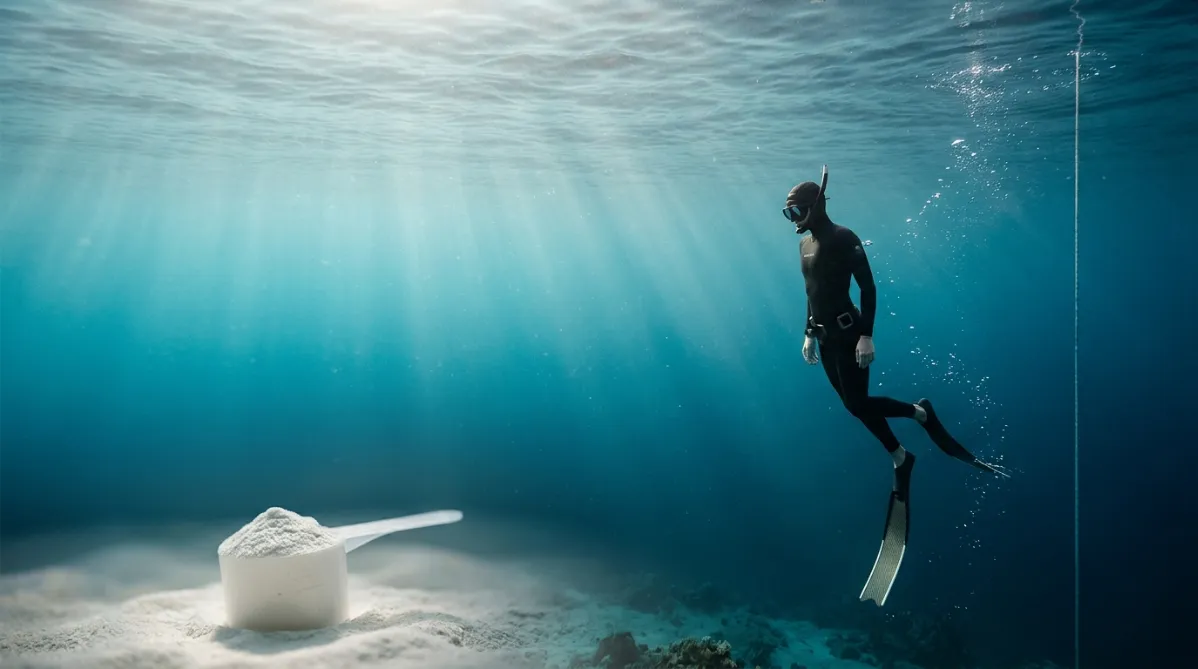
A wide, cinematic landscape photograph of a freediver suspended mid-water in a calm, sunlit turquoise sea, shot from slightly below so the surface glimmers above like rippling silver glass. The diver wears a sleek matte black wetsuit and a long, elegant pair of carbon fins. Their body is streamlined, arms relaxed at their sides, head tilted slightly down in a state of serene focus. Shafts of soft golden sunlight pierce the water diagonally and illuminate fine floating particles and a trail of tiny bubbles rising from the diver's fins. A single thin dive line descends vertically into deeper blue at the right of the frame, adding a graphic compositional element.

In the lower left foreground, slightly out of focus, a minimalist still-life element rests on a pale sandy seabed: a small, clean white scoop with a mound of fine white powder, casually echoing creatine without any text or labels. The scoop is softly lit and has a shallow depth of field blur, creating a gentle visual link between supplement and sport.

The color palette is refined and modern: deep teal, aquamarine, soft cerulean, warm cream highlights, and touches of sunlit gold. The water gradients smoothly from bright, luminous turquoise near the top to a rich inky navy at the bottom, giving depth and a sense of quiet intensity. Leave generous negative space on the left third of the image for headline placement, with the diver positioned on the right third following the rule of thirds.

The mood is calm, athletic, and contemplative, like an editorial image from a premium health and science magazine. Style: high-end editorial photography, natural light, subtle film grain, soft contrast, crisp detail on the diver and gentle bokeh in the background. No text, no logos, no futuristic or sci-fi elements, no graphics overlays.
Nutrition

La créatine fonctionne même lorsqu’on ne peut pas respirer : le test chez les apnéistes l’atteste

Dr. Gymbro · · 4 min read

La créatine fonctionne même lorsqu’on ne peut pas respirer : le test chez les apnéistes l’atteste

Qu’arrive‑t‑il aux muscles quand on leur demande de travailler à plein régime sans oxygène supplémentaire ? Une récente étude randomisée menée chez des apnéistes suggère que la créatine, le supplément le plus étudié en nutrition sportive, pourrait être efficace dans ce contexte.

La grande découverte : plus de travail, moins de lactate

Des chercheurs dirigés par Kurmazovic ont appliqué le protocole de charge classique de créatine monohydrate (20 g/jour pendant 7 jours) à des plongeurs en apnée entraînés. Les participants ont pédalé sur un ergomètre en ne prenant qu’une seule respiration, tentant de couvrir la plus grande distance possible. Après la phase de charge, ils ont produit davantage de travail total et ont tenu plus longtemps avant l’épuisement que le groupe placebo.

Le résultat le plus surprenant porte sur le lactate. Le taux de lactate sanguin était inférieur chez le groupe créatine que chez le groupe placebo, bien que les performances aient été supérieures. Or, on s’attend habituellement à une hausse du lactate lorsqu’on pousse davantage ; l’étude rapporte une interaction significative Temps × Groupe (p = 0,003).

Déroulement de l’étude

Il s’agit d’un essai randomisé, double‑aveugle, contrôlé par placebo, publié dans le Journal of the International Society of Sports Nutrition (2026). Il a recruté 20 apnéistes entraînés (18 hommes, 2 femmes, âge moyen ≈ 41,6 ans).

  • Test : échauffement bref, puis effort cycliste maximal sur une seule respiration, visant la distance la plus longue possible.
  • Protocole : test de base, puis assignation aléatoire à la créatine monohydrate (20 g/jour pendant 7 jours) ou à un placebo, suivie d’un nouveau test.
  • Mesures : travail total, temps d’épuisement, lactate sanguin, pCO₂ expiré après l’effort, effort perçu pendant l’apnée et fatigue musculaire, composition corporelle par densitométrie DXA.
  • Enregistrement : ClinicalTrials.gov NCT07233707.

Pourquoi la créatine pourrait aider en apnée

Le raisonnement des auteurs est simple : la créatine augmente la disponibilité d’énergie anaérobie et améliore le tamponnement acido‑basique. Lors d’un effort en apnée, les muscles dépendent davantage de la voie anaérobie ; l’ATP provenant du phosphocréatine pourrait donc être particulièrement précieux. Jusqu’ici, aucune étude n’avait évalué cet avantage dans le cadre d’une apnée volontaire.

Les résultats corroborent cette hypothèse. Le travail total (p = 0,011) et le temps d’épuisement (p = 0,028) ont été significativement améliorés avec la créatine comparé au placebo. L’article ne démontre pas directement le mécanisme, la proposition reste donc plausible mais non confirmée.

Autres constatations

  • Masse maigre : augmentation plus marquée avec la créatine (p = 0,017). La créatine est souvent associée à une rétention d’eau ; l’étude ne distingue pas cette contribution, il faut donc rester prudent avant de la qualifier de gain musculaire pur.
  • Effort perçu en apnée : aucune différence entre les groupes. La créatine a donc amélioré la performance sans rendre l’apnée plus difficile.
  • Fatigue musculaire perçue : légère hausse dans le groupe créatine, soulignée par les auteurs.
  • pCO₂ expiré, masse grasse et poids total : aucune différence significative.

Applications pratiques

  • Posologie : 20 g/jour de créatine monohydrate pendant 7 jours – protocole de charge classique. L’article ne précise pas la répartition quotidienne; de nombreux athlètes fractionnent la dose en plusieurs prises, pratique courante mais non étudiée ici.
  • Timing : le moment de la prise par rapport à l’entraînement ou à la compétition n’a pas été évalué. Le bénéfice observé provient d’une charge hebdomadaire, pas d’une prise unique avant la plongée.
  • Qui pourrait en profiter :
    • Apnéistes et pêcheurs sous‑marins : groupe étudié, la preuve la plus directe.
    • Athlètes de combat et nageurs : leurs entraînements comprennent souvent des séquences d’apnée ou de respiration restreinte et des sprints anaérobies répétés. Il s’agit d’une extrapolation, l’étude ne les a pas testés spécifiquement.
    • Toute personne pratiquant des efforts anaérobies intenses : la créatine est déjà reconnue efficace dans ce contexte ; cet essai ajoute un nouveau cadre d’application.

Limites

  1. Échantillon restreint : seulement 20 participants ; les résultats restent préliminaires et peuvent sur‑estimer l’effet.
  2. Population très ciblée : plongeurs entraînés, majoritairement des hommes d’environ 41 ans; seules deux femmes, limitant la généralisation aux sexes.
  3. Test de cyclisme en laboratoire ≠ vraie plongée : un effort cycliste maximal sur une respiration ne reproduit ni une descente, ni une apnée statique, ni une compétition réelle.
  4. Sécurité : l’apnée comporte des risques graves (black‑out). Rien dans l’étude ne rend l’apnée plus sûre, et la créatine ne doit pas servir d’excuse pour pousser ses limites. Ne jamais s’entraîner en apnée seul.
  5. Lactate inexpliqué : un taux plus bas de lactate malgré un travail plus élevé reste intrigant et n’est pas expliqué par les auteurs.
  6. Fatigue musculaire perçue : la légère hausse indique que le bénéfice n’est pas totalement sans compromis.

Conclusion

L’étude montre qu’une semaine de charge en créatine monohydrate augmente le travail produit et le temps d’épuisement lors d’un test de cyclisme en apnée chez des plongeurs entraînés, tout en affichant un taux de lactate sanguin plus bas que le placebo. Vu la petite taille de l’échantillon, il s’agit d’un signal prometteur plutôt que d’une conclusion définitive. Si vous pratiquez l’apnée ou un sport fortement anaérobie et envisagez déjà la créatine, ces résultats offrent un appui supplémentaire. Consultez un professionnel de santé si vous avez des problèmes rénaux ou d’autres conditions médicales.

Source : Kurmazovic et al. Load and breath‑hold: impact of 7‑day creatine monohydrate loading on breath‑hold exercise performance – a double‑blind randomized controlled trial. J Int Soc Sports Nutr, 2026. DOI : https://doi.org/10.1080/15502783.2026.2732743 | PubMed : 42868132
Original study

Read the original research on pubmed.ncbi.nlm.nih.gov →

This article summarizes published research for general information. It is not medical advice.

DG

Written by

Dr. Gymbro

Dr. Gymbro writes for Dr. Gymbro: science-backed fitness, nutrition & performance.

Related Articles

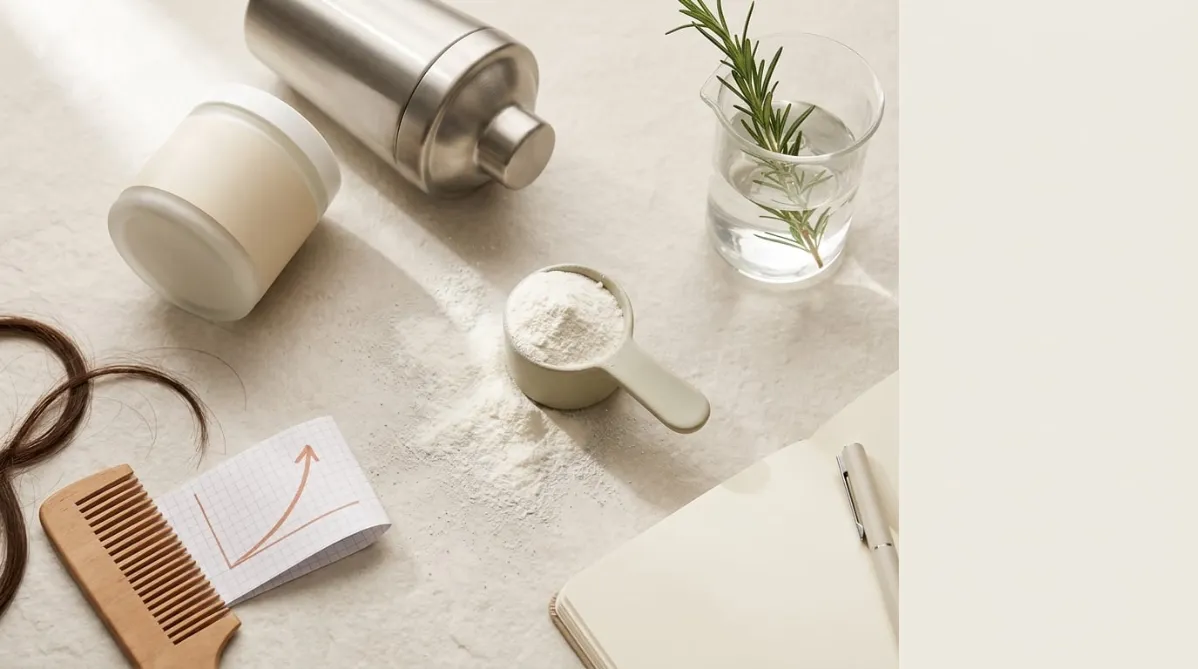
A bright, modern editorial flat-lay photographed from above on a soft off-white stone surface. At the center sits a matte ceramic scoop heaped with fine white creatine powder, with a loose dusting of powder fanning out across the surface. Beside it is a minimalist frosted-glass jar with a plain label and a brushed-steel shaker bottle lying on its side. To the left, a wooden comb and a small folded strip of graph paper with a single hand-drawn upward curve in muted terracotta ink, suggesting a data spike without any text. A few loose strands of dark brown hair curve elegantly across the stone near the comb. To the right, a clean glass beaker filled with water and a sprig of green rosemary, and an open notebook with blank pages and a sleek pen. The palette is warm neutrals: cream, sand, soft sage green, and a single accent of terracotta orange. Natural window light falls from the upper left, casting long, gentle shadows and a subtle diffused glow. The composition leaves generous negative space on the right third for title overlay. Shallow depth of field with crisp focus on the powder scoop, a premium health-and-science magazine look, minimalist, calm, and trendy, with fine grain and soft contrast. Landscape 16:9 framing.
science research

Créatine et perte de cheveux : l’augmentation de 56 % du DHT expliquée

BY DR. GYMBRO ·

Une étude de 2009 a montré qu’une phase de charge de créatine de 7 jours à 25 g/jour augmentait le DHT de 56 %, les niveaux restant environ 40 % au‑dessus du point de départ avec une dose d’entretien de 5 g/jour, tandis que la testostérone restait stable. Comme le DHT est associé à la calvitie masculine, ces résultats ont alimenté le débat sur la créatine et la perte de cheveux. Mais l’essai ne comptait que 20 joueurs de rugby, ne durait que trois semaines et n’a jamais mesuré la chevelure. Des études ultérieures n’ont pas reproduit de façon systématique cette hausse du DHT. Voici ce que révèlent réellement les recherches, qui pourraient être concernés et comment ajuster votre approche si vous êtes inquiet.

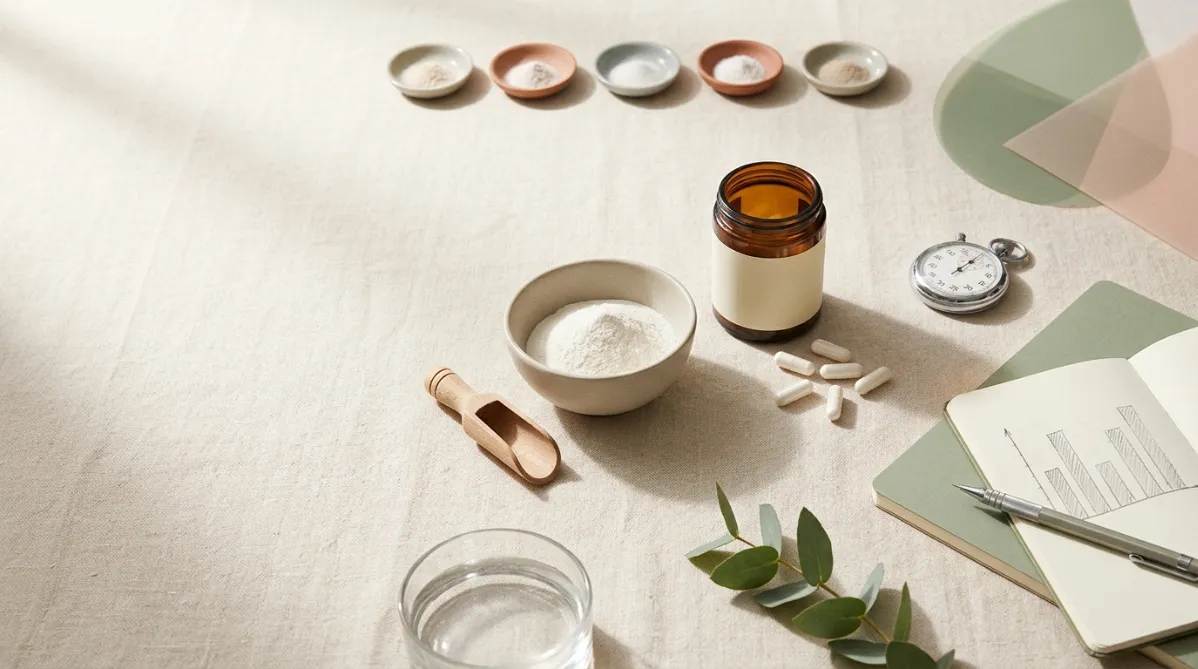
A wide, editorial-style still life photographed from slightly above on a pale oat-colored linen surface, lit by soft morning window light from the left. In the center sits a small matte ceramic bowl holding a mound of fine white powder, with a minimalist wooden scoop resting beside it. Next to the bowl is an open amber glass supplement jar with a plain cream label, and a few white capsules spill across the linen in a loose arc.

To the right, a neatly arranged cluster of analog "study" objects suggests careful measurement: a vintage stopwatch with a clean white face, a slim notebook with a sage-green cover open to a hand-drawn bar chart (blurred, no legible text), and a mechanical pencil lying across the page. A small row of six identical ceramic dishes, each holding a pinch of powder, is lined up along the top edge of the frame to hint at the six-week trial. One dish is slightly out of alignment, a subtle visual cue for ambiguity.

A shallow glass of water and a single sprig of green eucalyptus add a calm, organic note in the foreground. Soft, long shadows fall across the textured linen, and the palette stays restrained: warm cream, soft sage, muted terracotta, pale gray, and touches of amber from the glass jar. A few translucent paper cutouts in two tones (sage and blush) overlap in the upper right corner as a modern graphic accent, evoking overlapping data points without showing any numbers.

Depth of field is shallow, with the bowl and stopwatch in crisp focus and the edges gently softened. The composition leaves generous negative space on the left third for title text overlay. The overall mood is thoughtful, balanced, and quietly skeptical, in the style of a contemporary wellness and science magazine: clean, tactile, minimal, with a subtle film-like grain and natural color grading. No people, no futuristic or sci-fi elements, no readable text or logos.
nutrition

GAA, stimulateur cérébral ? Le résultat d’un test de six semaines reste mitigé

BY DR. GYMBRO ·

Le GAA, précurseur de la créatine commercialisé comme stimulant cérébral, vient de subir son premier test humain sérieux. Lors d’un essai en double‑aveugle de six semaines mené sur 58 adultes en bonne santé, il a légèrement accéléré les temps de réaction et a produit quelques effets sur l’humeur et le stress. En revanche, la majorité des tests cognitifs n’ont rien révélé, et les résultats les plus prometteurs n’étaient que des tendances. Les indicateurs de sécurité étaient rassurants, mais l’étude était petite, exploratoire et n’incluait pas de groupe comparatif à la créatine seule. Voici ce qu’elle montre réellement, à qui elle pourrait convenir, et pourquoi le verdict reste mitigé.

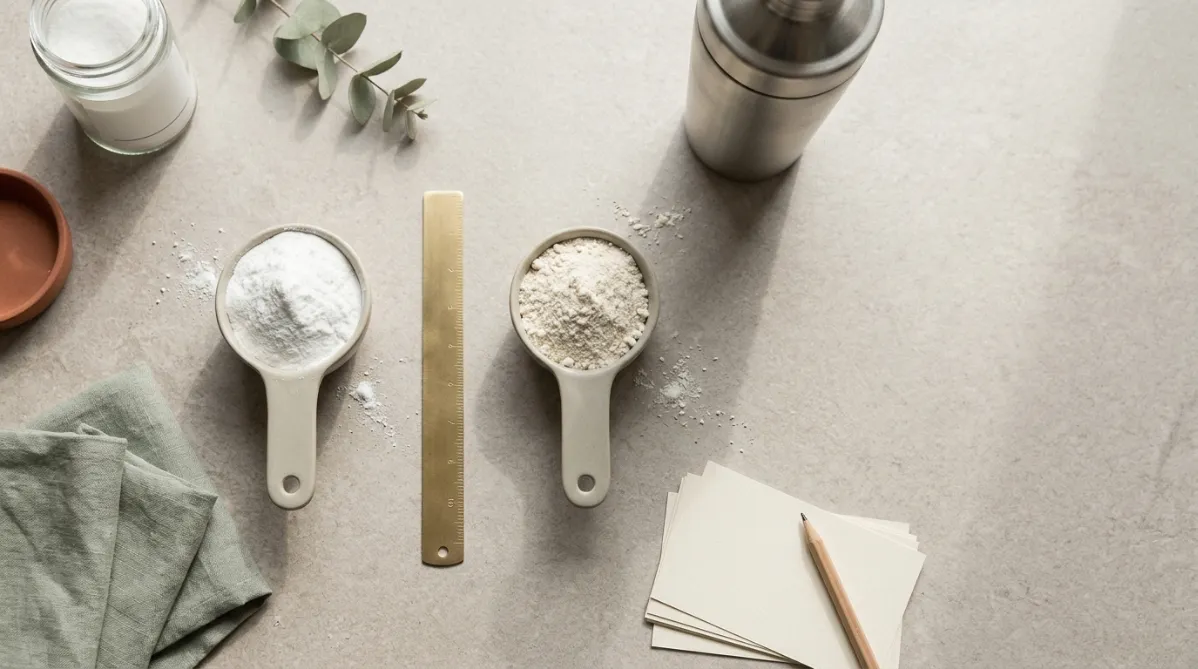
A bright, minimalist flat-lay photograph of two supplement scoops on a pale warm-gray stone surface, shot from directly above in soft natural window light. On the left, a matte ceramic scoop holds fine white creatine monohydrate powder, heaped in a clean mound. On the right, a second scoop of the same shape holds slightly coarser off-white beta-alanine powder, with a small, deliberate gap between the two. Each scoop sits in its own soft shadow, which suggests separation rather than combination. Between them, a thin brushed-brass ruler or a single slim line of fine powder runs across the surface and subtly divides the composition.

Around the scoops, a few restrained props in a muted editorial palette of sage green, cream, terracotta, and soft charcoal: a small glass jar with a minimalist label that has no readable text, a folded linen napkin, a single sprig of eucalyptus, and a stainless-steel shaker bottle softly out of focus in the upper corner. A few loose powder grains are scattered naturally across the stone. A small stack of blank cream index cards with a pencil rests in the lower right, hinting at research and note-taking without any legible writing.

The composition follows a clean rule-of-thirds layout, with generous negative space on the right third for headline overlay. The lighting is gentle and diffused, with long, soft shadows falling to the lower left. The color grading is calm and slightly desaturated, with creamy highlights and a subtle film-like grain. The overall look is a modern wellness and science journal cover, with an airy, trustworthy, contemporary editorial feel, shallow depth of field, and crisp detail on the powders.
nutrition

Créatine + Bêta‑alanine : le prétendu avantage du combo que les chercheurs n’ont pas confirmé

BY DR. GYMBRO ·

Le duo créatine + bêta‑alanine est souvent présenté comme le combo miracle pour la performance, mais une méta‑analyse en réseau portant sur 52 essais randomisés n’a détecté aucune synergie entre les deux. La créatine seule a nettement amélioré le sprint, le saut, les efforts répétés et l’endurance du haut du corps par rapport à un placebo. Les effets de la bêta‑alanine étaient non significatifs ou dépendants du contexte, et le mélange n’a rien apporté de plus que la créatine. Voici comment l’étude a été menée, ses limites, et ce que cela implique pour votre budget de compléments.

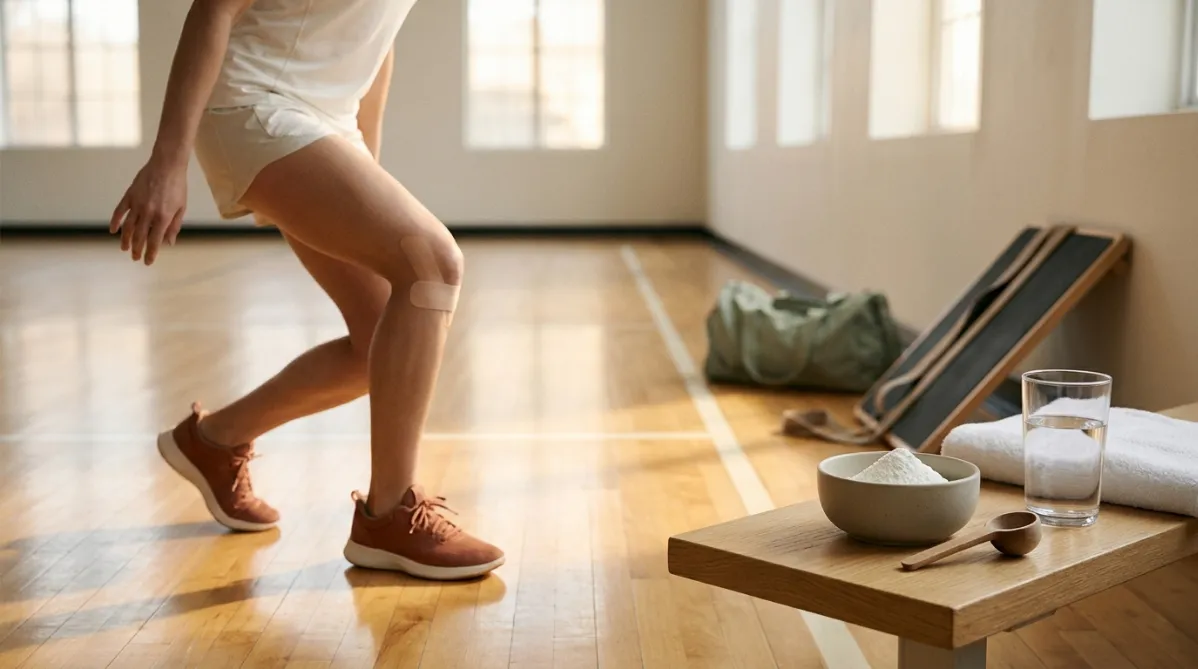
A wide, editorial-style photograph of a volleyball player mid-landing from a jump on a sunlit indoor court, captured from a low side angle. The athlete's knee is slightly bent and the patellar tendon area is in sharp focus, with soft natural muscle definition and a light strip of kinesiology tape just below the kneecap. The polished honey-toned hardwood floor reflects warm window light, and the background falls away into a creamy blur of pale court lines and tall windows.

In the lower right foreground, slightly out of focus, a matte ceramic bowl holds a small mound of fine white creatine powder. A wooden scoop rests beside it, next to a clear glass of water and a folded white towel. This sits on a light oak bench at the edge of the court. A resistance band and a slanted decline board, used for eccentric rehab, lean softly against the wall behind the bench.

The palette is warm and natural: cream, soft white, honey oak, muted sage green accents from a gym bag, and a touch of terracotta from the athlete's sneakers. Light is golden-hour and diffused, with gentle shadows and a subtle film-grain finish. The composition follows the rule of thirds, with the athlete on the left and the supplement still life on the right. Negative space in the upper portion leaves room for a headline overlay.

The overall mood is calm, modern, and health-focused, like a contemporary wellness or sports-science journal cover. Shallow depth of field, a clean minimalist aesthetic, and true-to-life color. No text, no logos, no futuristic or digital elements.
recovery

Créatine pour le genou du sauteur : soulagement de la douleur dès la 4e semaine

BY DR. GYMBRO ·

Le genou du sauteur peut tenir les athlètes à l'écart du terrain pendant des mois. Un nouvel essai a étudié si la créatine pouvait accélérer la récupération. Chez 20 athlètes suivis lors d’une rééducation excentrique, seul le groupe créatine a présenté une amélioration significative de la douleur et de la fonction (VISA‑P) à 4 semaines, accompagnée d’une hausse du saut vertical. À 8 semaines, les deux groupes avaient progressé de façon similaire, l’interaction entre groupes n’étant qu’une tendance (p = 0,099). Voici le protocole, le dosage, les bénéficiaires potentiels et les limites liées à la petite taille de l’échantillon.

This page is available in