Dr. Gymbro
←

#freediving

1 article
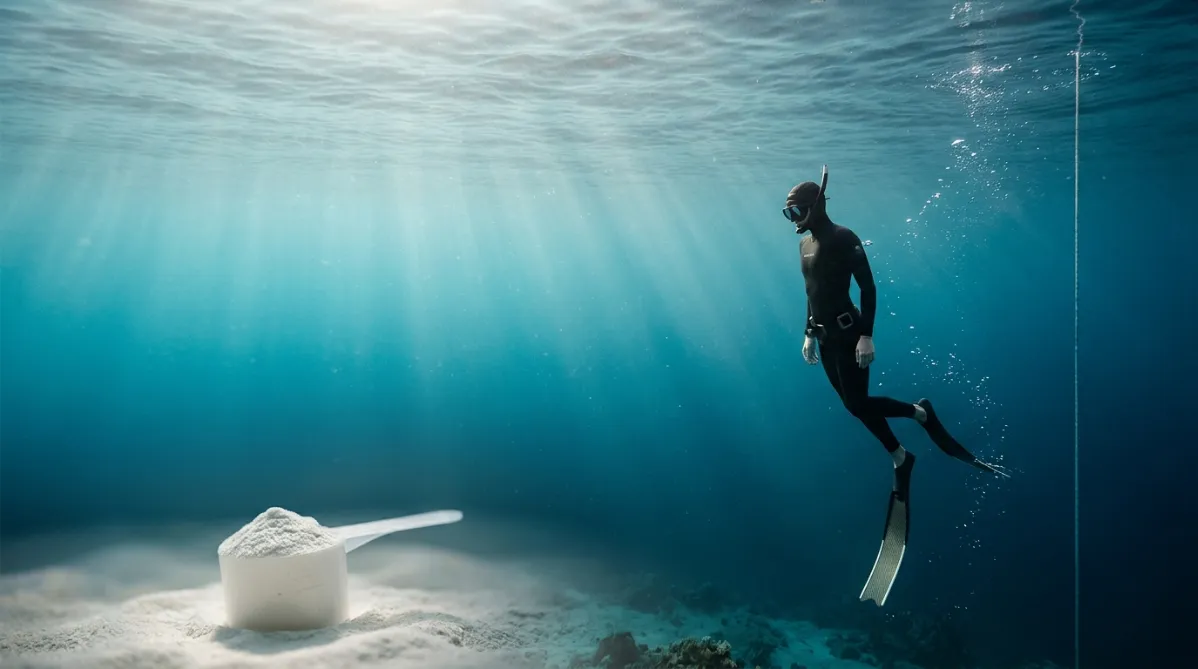
A wide, cinematic landscape photograph of a freediver suspended mid-water in a calm, sunlit turquoise sea, shot from slightly below so the surface glimmers above like rippling silver glass. The diver wears a sleek matte black wetsuit and a long, elegant pair of carbon fins. Their body is streamlined, arms relaxed at their sides, head tilted slightly down in a state of serene focus. Shafts of soft golden sunlight pierce the water diagonally and illuminate fine floating particles and a trail of tiny bubbles rising from the diver's fins. A single thin dive line descends vertically into deeper blue at the right of the frame, adding a graphic compositional element.

In the lower left foreground, slightly out of focus, a minimalist still-life element rests on a pale sandy seabed: a small, clean white scoop with a mound of fine white powder, casually echoing creatine without any text or labels. The scoop is softly lit and has a shallow depth of field blur, creating a gentle visual link between supplement and sport.

The color palette is refined and modern: deep teal, aquamarine, soft cerulean, warm cream highlights, and touches of sunlit gold. The water gradients smoothly from bright, luminous turquoise near the top to a rich inky navy at the bottom, giving depth and a sense of quiet intensity. Leave generous negative space on the left third of the image for headline placement, with the diver positioned on the right third following the rule of thirds.

The mood is calm, athletic, and contemplative, like an editorial image from a premium health and science magazine. Style: high-end editorial photography, natural light, subtle film grain, soft contrast, crisp detail on the diver and gentle bokeh in the background. No text, no logos, no futuristic or sci-fi elements, no graphics overlays.
nutrition

La créatine fonctionne même lorsqu’on ne peut pas respirer : le test chez les apnéistes l’atteste

BY DR. GYMBRO ·

La créatine est reconnue pour augmenter la force et la vitesse, mais peut‑elle être utile lorsqu’on ne respire pas du tout ? Une étude en double‑aveugle menée chez des apnéistes entraînés a montré qu’une phase de charge de 7 jours à 20 g/jour augmentait le travail total et le temps d’épuisement lors d’un test de cyclisme en apnée. Curieusement, le groupe « créatine » présentait une concentration lactique sanguine plus basse que le groupe placebo malgré de meilleures performances. Voici ce qui a été testé, qui pourrait en bénéficier, et pourquoi les résultats, basés sur seulement 20 plongeurs, doivent être interprétés avec prudence.

This page is available in