Dr. Gymbro
←

#gut microbiome

2 articles
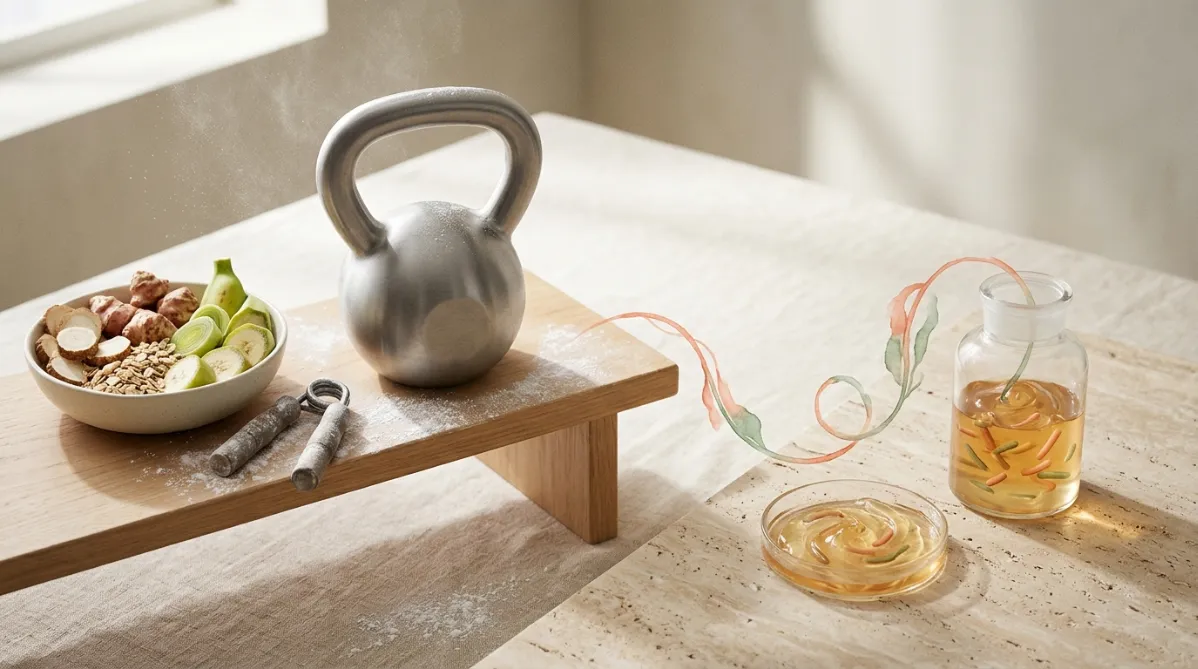
A landscape editorial still life on a soft, warm-neutral background of pale oat linen and light travertine stone. In the center-left, a matte brushed-steel kettlebell and a pair of worn chalk-dusted hand grippers rest on a low pale wooden bench. Beside them sits a shallow ceramic bowl of fermented and fiber-rich foods: sliced chicory root, Jerusalem artichokes, oats, leeks, and a few green banana slices. Soft powdery chalk drifts in the air like fine dust in a sunbeam.

On the right, a minimalist glass apothecary jar and a delicate petri-style glass dish hold a swirl of translucent amber-gold gel with tiny, organic rod-shaped forms. They are rendered as abstract, elegant botanical-looking filaments in soft coral and sage green, like watercolor ink bleeding through water. A single fine thread of this ink-like color curls out of the jar and gently loops across the surface toward the kettlebell, suggesting a quiet connection between gut and muscle without literal anatomy.

Late-morning window light enters from the upper left and casts long, soft shadows with gentle highlights on the metal and glass. Sage green, terracotta, cream, and muted gold make up the palette, with a subtle film-grain finish. The composition is airy, with generous negative space on the far right and top for headline overlay. The shallow depth of field, crisp focus on the foreground objects, and creamy blur behind them give it the polished, modern feel of a wellness and science magazine cover.
science research

Le microbe intestinal lié à une force accrue : Roseburia inulinivorans

BY DR. GYMBRO ·

Une bactérie intestinale, *Roseburia inulinivorans*, est corrélée à une meilleure performance au hand‑grip, à la presse à jambes et au développé couché. Chez la souris, son administration a augmenté la force de préhension, mais aucun probiotique commercial n’existe encore. D’autres espèces du genre *Roseburia* n’ont pas reproduit cet effet et la souche est moins abondante chez les personnes âgées. La preuve de causalité repose uniquement sur l’étude murine, ce qui place la recherche encore au stade préliminaire.
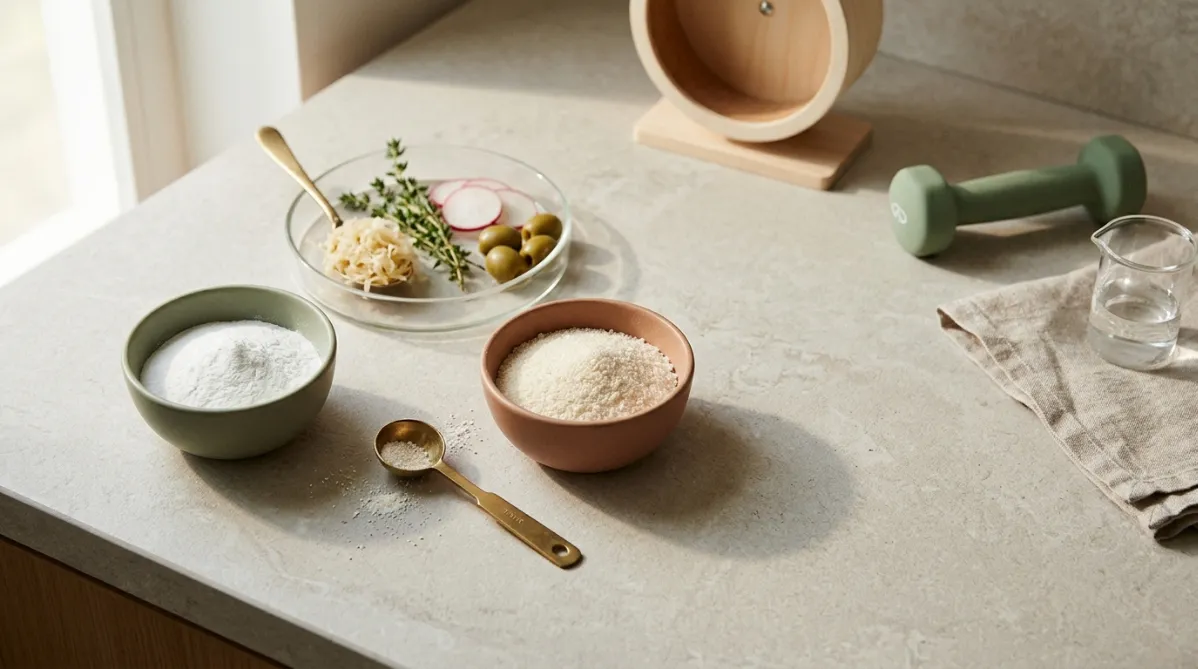
A wide editorial still life on a pale warm-gray stone countertop, lit by soft natural window light from the left. In the center, two small matte ceramic bowls sit side by side. One holds fine white creatine powder, and the other holds a slightly coarser, creamy off-white crystalline powder. Between them, a delicate brass measuring spoon rests at a slight angle, dusted with a few grains. Behind the bowls, a shallow glass dish holds a handful of whole food ingredients that suggest gut health: fermented sauerkraut, a few sprigs of fresh thyme, sliced radishes, and a small cluster of green olives. Their colors are soft and natural. To the right, a minimalist wooden mouse running wheel stands out of focus as a quiet visual nod to the exercise study. Beside it, a small, slim dumbbell in muted sage green rests on the counter. A folded linen napkin in oatmeal tone and a single glass beaker with clear water add a subtle lab-meets-kitchen feel without looking clinical. The palette is calm and modern: sage green, terracotta, cream, soft sand, and touches of warm brass. Shadows are gentle and elongated, with a shallow depth of field that keeps the powders crisp and the background creamy. The composition leaves generous negative space on the right third for title text. The overall mood is clean, thoughtful, and trendy, like a contemporary wellness and science magazine, with fine film-like grain, natural textures, and a refined editorial look.
science research

Le composé microbien PAS dépasse la créatine chez la souris – mais il y a un hic

BY DR. GYMBRO ·

Une étude menée sur des souris montre qu’une combinaison de deux molécules d’origine microbienne intestinale – l’acide pipecolique et le succinate (PAS) – a surpassé la créatine monohydrate en termes de force de préhension et de force musculaire après sept semaines de course sur roue lestée. La surprise réside dans le fait qu’aucun des deux composés n’a entraîné d’augmentation de la masse ou de la taille des fibres ; l’avantage est fonctionnel, pas morphologique. Les deux suppléments ont également amélioré les performances de course par rapport au groupe contrôle. Il s’agit toutefois d’une recherche exploratoire réalisée uniquement sur des souris, sans données de dosage ni de sécurité chez l’homme. Voici ce que l’étude a révélé et ce que l’on peut en retenir.

This page is available in