Dr. Gymbro
←

#sprint interval training

1 article
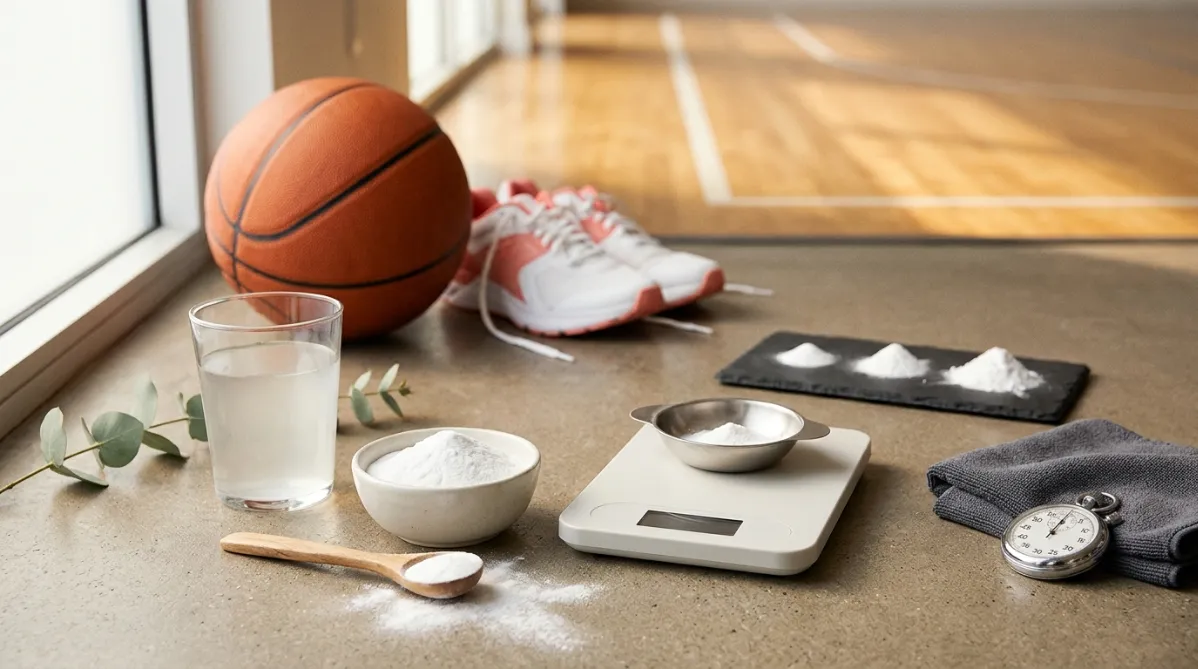
A wide, editorial-style still life shot from a slightly elevated angle on a pale, warm-gray concrete surface lit by soft natural window light from the left. In the center foreground, a clear glass of cloudy water sits beside a small white ceramic bowl heaping with fine white baking soda powder, a wooden measuring spoon resting beside it with a light dusting of powder spilling across the surface in a graceful arc. Next to them, a minimalist digital kitchen scale in matte white shows a small portion of powder in a shallow dish. Slightly behind, an orange basketball is partially in frame, its pebbled texture catching the light, resting beside a pair of clean white and coral athletic sneakers with the laces loosely undone. A folded charcoal gray towel and a stainless steel stopwatch lie to the right, the stopwatch face crisp and legible. Three small, neatly arranged piles of white powder on a slate tile in the midground, in ascending sizes, hint at different doses without any text or labels. In the soft-focus background, the faint outline of an indoor basketball court with warm honey-colored hardwood floor and blurred lane lines stretches across the frame, glowing with golden-hour light. The color palette is restrained and modern: warm off-white, soft gray, burnt orange, and touches of sage green from a single sprig of mint or eucalyptus laid near the glass. Shallow depth of field, crisp textures on powder grains and the ball's surface, gentle shadows, subtle film-like grain. Clean negative space in the upper right for headline overlay. The mood is calm, sleek, and contemporary, like a premium health and sports science magazine cover, with a fresh, minimalist composition and no people, no text, and no futuristic elements.
nutrition

Bicarbonate de soude + sprints : la dose qui a surpassé le placebo à chaque test

BY DR. GYMBRO ·

Un nouvel essai randomisé chez des basketteurs a montré que l’ajout de bicarbonate de soude pendant quatre semaines d’entraînement sprint a surpassé le placebo sur le saut, le sprint, l’agilité, la distance Yo‑Yo et la puissance Wingate. La dose plus élevée, 0,45 g/kg, a dépassé 0,3 g/kg sur chaque critère. Il s’agit donc d’un complément peu coûteux et tentant pour les athlètes de sports d’équipe, mais il peut provoquer des troubles gastriques, et l’étude est petite, courte et n’a porté que sur des hommes. Voici les calculs de dose, des astuces pour limiter les effets digestifs, et à qui cela s’adresse réellement.

This page is available in