Dr. Gymbro
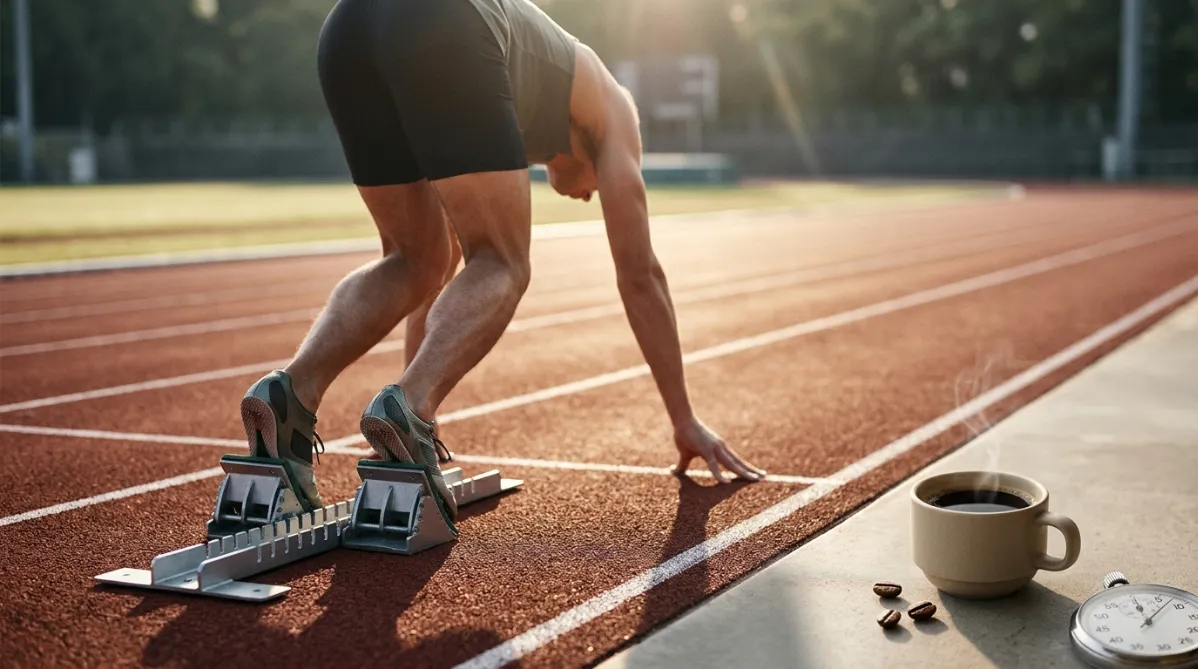
A wide landscape editorial still life on a pale warm-gray linen surface, shot from a slightly elevated three-quarter angle in soft diffused morning window light. At center-left, a tall clear glass filled with deep magenta-crimson beetroot juice catches the light, its edges glowing ruby with a few condensation droplets on the surface. Beside it sits a small white ceramic espresso cup with dark, glossy coffee and a delicate swirl of crema. A few roasted coffee beans are scattered casually near the cup's saucer. To the left, two whole raw beetroots with their leafy burgundy-veined greens still attached rest on a rustic wooden board, with one beet sliced in half to reveal concentric rings of vivid fuchsia and pale pink. A folded white judo gi sleeve with a worn black belt loosely coiled on top is draped along the right side of the frame, the cotton weave texture visible, hinting at the sport without any people. In the background, a soft-focus tatami mat texture in muted straw-green creates a subtle horizontal band, blurred into creamy bokeh. A small scattering of beet juice droplets and a faint magenta stain on the linen add an organic, lived-in touch. The palette is restrained and modern: magenta, espresso brown, off-white, muted sage, and warm beige. Composition leaves generous negative space on the upper right for headline overlay. The mood is clean, calm, and contemporary, like a premium health and science magazine cover, with shallow depth of field, crisp focus on the glass and cup, fine natural shadows, and subtle film-like grain.
Nutrition

Bietensap + cafeïne: de judo‑truc die cafeïne alleen verslaat

Dr. Gymbro · · 4 min read

Jouw pre‑wedstrijdkoffie raakt misschien leeg precies wanneer het toernooi serieuzer wordt. Een nieuwe gerandomiseerde studie suggereert dat het voordeel van cafeïne in judo tegen de vijfde ronde kan verdwijnen, terwijl bietensap de achterstand laat inlopen. Het duo lijkt beide eindes te dekken.

De grote bevinding: cafeïne vervaagt, bietensap finisht

Onderzoekers onder leiding van Karabağ, Sajedi, Güler en collega's testten bietensap (BJ), cafeïne (CAF), beide samen (BJ + CAF) en een placebo tijdens een gesimuleerde judodag. De resultaten werden gepubliceerd in het European Journal of Sport Science in 2026 (PubMed | DOI).

De belangrijkste uitkomst is een timing‑verhaal. Vergeleken met placebo verbeterde cafeïne de Special Judo Fitness Test (SJFT)‑prestaties, neuromusculaire functie en cognitieve scores in proef 1‑3, maar niet in proef 5. Bietensap liet precies het tegenovergestelde zien en verbeterde diezelfde parameters in proef 5. Volgens de auteurs was het ergogene effect van cafeïne “niet behouden gedurende de gesimuleerde wedstrijddag”, terwijl bietensap “late‑stage voordelen” bood.

Hoe de studie werd opgezet

Dit was een gerandomiseerde, dubbel‑blinde, placebogecontroleerde crossover‑studie – een robuust design voor deze vraagstelling. Vijfendertig competitieve judoka’s (leeftijd 23 ± 5 jaar, lichaamsgewicht 74 ± 13 kg) voltooiden vier sessies: BJ, CAF, BJ + CAF en placebo. Elke sessie bestond uit vijf rondes judorandori (live sparring) en een SJFT, gevolgd door neuromusculaire en cognitieve metingen. Die opzet bootst een dag met meerdere wedstrijden na, waarin atleten herhaaldelijk moeten presteren terwijl de vermoeidheid toeneemt.

Omdat elke atleet elke conditie doorliep, zijn de vergelijkingen binnen‑persoonlijk. Dat vermindert de ruis die ontstaat door individuele verschillen.

Wat de combinatie deed

De combinatie dekte meer terrein dan elk supplement alleen, volgens de abstract:

  • SJFT‑prestaties: verbeterd in proef 1‑3 en 5 ten opzichte van placebo.
  • Cognitieve functie: verbeterd in proef 1, 2 en 4.
  • Neuromusculaire prestatie: verbeterd in alle proef‑momenten.
  • Proef 5 head‑to‑head: zowel BJ als BJ + CAF leverden betere SJFT‑prestaties, neuromusculaire functie en cognitieve uitkomsten op dan alleen cafeïne (p < 0,05).

De auteurs concluderen dat co‑inname “de later‑sessiondaling die met cafeïne alleen werd waargenomen tegenwerkte, terwijl de vroege voordelen behouden bleven.” Dat vormt het kernargument om te stapelen boven uitsluitend op cafeïne te vertrouwen.

Het voordeel was niet uniform in elke metric op elk tijdstip. De abstract meldt bijvoorbeeld geen SJFT‑verbetering voor de combinatie in proef 4. Het betreft een patroon over de dag, geen garantie voor elke ronde.

Waarom dit zou kunnen gebeuren

De abstract testte geen mechanismen, dus wat volgt is contextuele uitleg. Cafeïne is een centraal zenuwstelsel‑stimulerend middel en de effecten zijn vaak het sterkst vroeg in de wedstrijd. Bietensap is een bron van voedingsnitraat, die in de bredere literatuur wordt gekoppeld aan stikstofmonoxide‑routes en een lager zuurstofverbruik tijdens inspanning. De auteurs wijzen op “temporale dynamiek en metabole kosten” als belangrijke overwegingen voor multi‑bout, high‑intensity toernooien. In eenvoudige bewoordingen kunnen verschillende hulpmiddelen op verschillende momenten van belang zijn naarmate de vermoeidheid oploopt. Dit is een plausibele verklaring, maar geen direct bewijs uit de huidige studie.

Praktische conclusies

Voor wie: atleten in vechtsporten, vooral judoka’s, die meerdere rondes op één dag moeten doorstaan. De waarde van de studie ligt in de multi‑bout‑setting. Als je slechts één wedstrijd hebt, is het late‑stage voordeel wellicht minder relevant.

Dosis en timing: de abstract vermeldt geen exacte doseringen of tijdstippen. Raadpleeg het volledige artikel via de DOI voordat je een protocol overneemt. Als algemene sport‑voedingsrichtlijn (niet uit deze studie) wordt cafeïne vaak gedoseerd op 3‑6 mg/kg, en bietensap op basis van nitraatgehalte. Oefen elk plan eerst in de training, nooit op het moment van je eerste wedstrijd.

Wie beter kan overslaan of eerst moet overleggen:

  • Personen die gevoelig zijn voor cafeïne of slecht slapen vóór/na een wedstrijd.
  • Iedereen met een hart‑ of vaatziekte, hoge bloeddruk of die bloeddrukverlagende medicatie gebruikt. Voedingsnitraat kan de bloeddruk beïnvloeden, dus eerst een arts raadplegen.
  • Atleten die maagklachten krijgen van bietensap. Een toernooidag is niet het moment om hiermee te experimenteren.
  • Jongere sporters en zwangere personen, die professioneel advies moeten inwinnen over cafeïne‑gebruik.

Eerlijke kanttekeningen

  • Acute, eendaagse opzet. Het ging om een eenmalige suppletie in een gesimuleerde competitie, niet een echt toernooi met weegkappen, reisstress en publieke druk.
  • Steekproefgrootte. Vijfendertig atleten is respectabel voor een crossover‑studie, maar nog steeds bescheiden. De abstract splitst de resultaten niet op naar geslacht of wedstrijdniveau.
  • Simulatie, geen echte wedstrijd. Sparren en fitness‑testprestaties zijn proxy’s voor wedstrijdresultaten. De studie toonde niet dat atleten meer gevechten winnen.
  • Details ontbreken in de abstract. Doses, timing en effectgroottes moeten in de volledige tekst worden nagekeken.

De conclusie

Cafeïne hielp nog steeds vroeg in deze trial, en bietensap hielp laat. Samen dekte ze beide fasen, en in proef 5 waren zowel de combinatie als bietensap alleen beter dan alleen cafeïne. Voor atleten wiens wedstrijddag lang is en waarvan de laatste ronde net zo belangrijk is als de eerste, biedt deze gerandomiseerde studie een data‑gedreven reden om bietensap toe te voegen aan het cafeïne‑plan. Controleer het volledige protocol, test het in de training en laat het goedkeuren door een professional als je gezondheidsproblemen hebt.

Bron: Karabağ S, et al. Eur J Sport Sci. 2026. PubMed 42905127 | DOI: 10.1002/ejsc.70278
Original study

Read the original research on pubmed.ncbi.nlm.nih.gov →

This article summarizes published research for general information. It is not medical advice.

DG

Written by

Dr. Gymbro

Dr. Gymbro writes for Dr. Gymbro: science-backed fitness, nutrition & performance.

Related Articles

A wide, editorial-style still life shot from a slightly elevated angle on a pale oak gym bench, bathed in soft morning window light. In the center sits a matte ceramic cup of black coffee with delicate steam curling upward, flanked by a small white scoop of coffee beans and two identical glass vials, one filled with a few grains of fine powder and one empty, hinting at dose comparison. Next to the cup rests a pair of worn white boxing hand wraps, loosely coiled, and a slim black stopwatch with its face softly visible. In the foreground, a minimalist notebook lies open with blurred handwritten numbers and a simple pen sketch of a bar graph with bars of equal height, subtle and unreadable, suggesting a null result without any legible text. A small brass kitchen scale sits to the side with a few coffee beans on its tray.

In the soft-focus background, a boxing gym interior is visible: a hanging heavy bag in muted charcoal, exposed brick wall painted off-white, and tall windows casting long diagonal light across the floor. The color palette is warm and restrained: cream, sand, espresso brown, soft charcoal, with a single accent of muted terracotta orange in the hand wraps and a faint sage green in the notebook cover. Shallow depth of field with creamy bokeh, fine film grain, and gentle shadows give it a contemporary lifestyle-magazine and wellness-journal feel. The composition leaves generous negative space on the left third for headline overlay. Clean, calm, trendy, and tactile, with natural textures like wood grain, ceramic glaze, and cotton fabric. No people, no text, no futuristic elements.
science research

Koffie met lage cafeïnedosis gaf elite vechters geen sprintboost

BY DR. GYMBRO ·

Dacht je dat een pre‑workout kop koffie je sprints een boost geeft? Een nieuw, gerandomiseerd, dubbelblind crossover‑onderzoek met 15 nationale vechtsporters vond geen prestatiewinst bij cafeïnedoses van 1,5 mg/kg en 3 mg/kg – ongeveer 100 mg resp. 200 mg voor een sporter van 68 kg. Noch piek‑vermogen, gemiddeld vermogen, vermoeidheidsindex noch de geschatte bijdrage van de verschillende energiesystemen verschilden van decaf. Het betreft echter een kleine nulbevinding, geen bewijs dat cafeïne faalt, en de meeste positieve studies gebruiken capsules met 3–6 mg/kg.

A wide, editorial-style photograph of a sprinter crouched in starting blocks on a deep terracotta-red running track, shot from a low angle at the side as the first morning light rakes across the lanes. The athlete is mid-set, hips lifted, hands poised behind crisp white lane lines, with a soft focus on their muscular calves and spiked shoes in the foreground. Warm golden sunlight creates long, elegant shadows and subtle lens flare, while the distant lanes fade into a creamy bokeh.

In the lower right foreground, slightly out of focus, sits a minimalist still life on a matte concrete ledge beside the track: a small ceramic cup of black coffee with a thin wisp of steam, two loose roasted coffee beans, and a simple stopwatch with a clean white face. The ceramic is a muted sand color, adding a refined, modern lifestyle touch.

The color palette is restrained and trendy: terracotta, warm cream, soft charcoal, and a hint of sage green from trees blurred in the far background. The composition uses generous negative space across the upper left, ideal for headline text overlay. The look is similar to a contemporary health and sports science magazine: natural film-like grain, gentle contrast, shallow depth of field, and a calm, focused mood. No text, no logos, no graphics, and no futuristic elements, just a realistic, tactile, sunlit scene that suggests precision, preparation, and explosive speed.
science research

Dubbele dosis cafeïne, snellere sprints? Wat 6 mg/kg echt toevoegt

BY DR. GYMBRO ·

Een nieuw gerandomiseerd, dubbelblind crossover‑onderzoek vergeleek 3 mg/kg met 6 mg/kg cafeïne bij 21 getrainde mannelijke sprinters. Beide doses presteerden beter dan placebo, maar de hogere dosis leverde extra snelheid alleen op de eerste 30 en 60 m, niet op 10 m. Ook gaf het een extra boost aan spronghoogte en de krachtontwikkeling in de startblokken, maar niets meer voor reactietijd of Wingate piekvermogen. Hieronder zie je wat de doseringen betekenen in milligrammen voor een atleet van 70‑80 kg, wanneer je ze moet innemen, voor wie de bewijzen gelden, en wat het onderzoek niet vertelt over bijwerkingen.

A landscape editorial photograph in a bright, modern gym studio with soft natural light pouring through tall windows. In the foreground, a matte ceramic cup and a small glass jar of plain white powder sit on a light oak bench, with a wooden scoop resting beside them and a few loose grains dusted across the wood. The jar has no label, which hints at mystery without being heavy-handed. Slightly out of focus behind them, a female athlete in a sage green athletic set stands at a barbell, chalked hands gripping the bar, her expression calm and focused. A male cyclist on a stationary bike is blurred in the far background. The palette is warm neutrals: cream, soft sand, pale oak, muted sage, and a touch of terracotta, with gentle golden-hour highlights and soft shadows. The composition follows the rule of thirds, with the cup and jar in the lower left, the athlete on the right, and open negative space in the upper area for headline text. The depth of field is shallow, with a creamy bokeh background. The mood is contemplative, curious, and trendy, like a contemporary health and science magazine cover. Fine film grain, subtle matte finish, clean minimalist styling, and no text or logos.
science research

Valse cafeïne maakte atleten nog harder en sneller

BY DR. GYMBRO ·

Wat als een deel van je pre‑workout boost eigenlijk uit je hoofd komt en niet uit de schep? Een meta‑analyse uit 2026 van 17 onderzoeken toont aan dat een placebo waarvan atleten dachten dat het cafeïne was, toch de sportprestaties verbetert (d = 0.49) bij bankdrukken, fietstijdritten en herhaalde sprints. De effecten waren groter in studies waarin de onderzoekers geblinderd waren en waarin relatief meer vrouwen deelnamen, hoewel het bewijs een lage zekerheid heeft en een hoog risico op bias vertoont. Dit is geen reden om echte cafeïne (3‑6 mg/kg) over te slaan, maar wel een herinnering dat verwachting een prestatievariabele is.

A landscape editorial still life on a pale warm-gray concrete surface, shot from a slightly elevated three-quarter angle in soft diffused morning window light. In the foreground left, a small open foil blister pack of mint-green caffeine gum sits beside two neatly arranged piles of gum pieces, one with three pieces and one with six, each on a small matte ceramic dish in oat and sage tones. The pieces are slightly glossy, rounded rectangles with crisp shadows. In the center-right, a worn leather basketball rests on the surface with deep amber-orange tones and visible pebbled texture. Next to it is a loosely chalked barbell collar and a single steel weight plate edge, partly out of focus. A minimalist analog stopwatch with a matte white face and a thin black hand lies at the lower right, and a slim notebook with a pencil rests nearby. The page shows a simple hand-drawn bar graph of two equal bars, with no legible text. In the soft-focus background, a blurred indoor basketball court with warm honey-colored hardwood and distant hoop lines fades into creamy bokeh. A narrow band of sunlight crosses the scene diagonally and picks out chalk dust particles in the air. The palette is muted and modern: sage green, warm oat, terracotta orange, charcoal, and cream. The composition leaves open negative space on the upper left for title overlay. Shallow depth of field, fine film grain, and a calm, clean magazine aesthetic like a contemporary health and science journal. No people, no text, no futuristic elements.
science research

Caféïnekauwgom en dezelfde‑dagprestaties: waarom 3 mg/kg net zo effectief is als 6 mg/kg

BY DR. GYMBRO ·

Een crossover‑studie bij basketbalspelers liet zien dat caféïnekauwgom van 3 mg/kg dezelfde‑dag kracht, power, sprint‑snelheid en reactieve behendigheid verbetert – ongeveer even sterk als een dosis van 6 mg/kg. Beide doseringen zorgden ook voor een hogere halssnelheid tijdens zware squat‑priming, maar na 24‑48 uur was het effect verdwenen. Omdat de studie geen basismetingen en geen zuivere caféïnedosis bevatte, moeten de resultaten kritisch worden bekeken. Hieronder lees je wat dit betekent voor dosering, timing en voor wie het relevant kan zijn.

This page is available in