Your pre-fight coffee may be running out just when the tournament gets serious. A new randomized trial suggests caffeine's edge in judo can fade by the fifth bout, while beetroot juice picks up the slack late in the day. The pairing seems to cover both ends.
The Big Finding: Caffeine Fades, Beet Juice Finishes
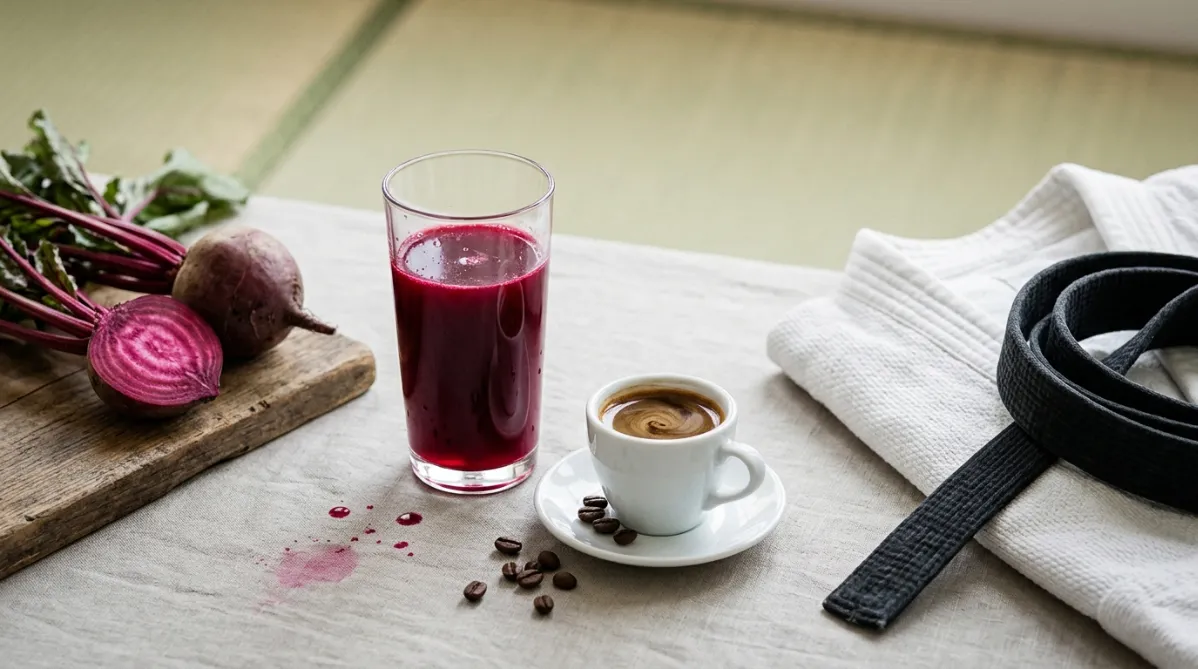
Researchers from the team of Karabağ, Sajedi, Güler and colleagues tested beetroot juice (BJ), caffeine (CAF), both together (BJCAF), and a placebo across a simulated judo competition day. The work was published in the European Journal of Sport Science in 2026 (PubMed | DOI).
The headline result is a timing story. Compared with placebo, caffeine improved Special Judo Fitness Test (SJFT) performance, neuromuscular function and cognition in trials 1-3, but not in trial 5. Beetroot juice did the opposite and improved those same metrics in trial 5. In the authors' words, the ergogenic effect of caffeine "was not maintained throughout the simulated competition day," while beetroot juice "provided late-stage benefits."
How the Study Worked
This was a randomized, double-blind, placebo-controlled crossover trial, a strong design for this kind of question. Thirty-five competitive judo athletes (age 23 ± 5 years, body mass 74 ± 13 kg) completed four sessions: BJ, CAF, BJCAF and placebo. Each session had five trials of judo randori (live sparring) and an SJFT, followed by neuromuscular and cognitive assessments. That structure mimics a multi-bout tournament day, where athletes must perform repeatedly while fatigue builds.
Because every athlete tried every condition, the comparisons are within-person. That reduces the noise that comes from differences between athletes.
What the Combo Did
The stack covered more ground than either supplement alone, according to the abstract:
- SJFT performance: improved in trials 1-3 and 5 versus placebo.
- Cognitive function: improved in trials 1, 2 and 4.
- Neuromuscular performance: improved in all trials.
- Trial 5 head-to-head: both BJ and BJCAF produced better SJFT performance, neuromuscular function and cognitive outcomes than caffeine alone (p < 0.05).
The authors conclude that co-ingestion "counteracted the later-session decline observed with CAF alone while maintaining its early advantages." That is the core argument for stacking over relying on caffeine only.
The benefit was not uniform in every metric at every time point. The abstract doesn't report an SJFT improvement for the combination in trial 4, for example. It's a pattern across the day, not a guarantee in every bout.
Why Might This Happen?
The abstract doesn't test mechanisms, so what follows is context rather than a finding. Caffeine is a central nervous system stimulant, and its effects can be strongest early. Beetroot juice is a dietary nitrate source, commonly linked in the wider literature to nitric oxide pathways and lower oxygen cost of exercise. The authors point to "temporal dynamics and metabolic costs" as the key design considerations for multi-bout, high-intensity tournaments. In plain terms, different aids may matter at different points as fatigue accumulates. That is an interpretation to treat cautiously, not something this study proves.
Practical Takeaways
Who it's for: Combat-sport athletes, especially judoka, facing several bouts in one day. The study's value lies in the multi-bout setting. If you compete once, the late-stage benefit may matter less.
Dose and timing: The abstract does not report the doses or timing used. Read the full paper via the DOI before copying a protocol. As general sports-nutrition background (not from this study), caffeine is commonly used at roughly 3-6 mg/kg, and beetroot juice is usually dosed by nitrate content. Rehearse any plan in training, never for the first time at a competition.
Who should probably skip or check first:
- People sensitive to caffeine, or who sleep poorly before or after competition.
- Anyone with a heart condition, high blood pressure or on blood-pressure medication. Dietary nitrate can affect blood pressure, so talk to a clinician first.
- Athletes who get stomach upset from beet juice. Tournament day is not the time to find out.
- Younger athletes and pregnant individuals, who should seek professional advice on caffeine use.
Honest Caveats
- Acute, single-day design. This tested one-off supplementation in a simulated competition, not a real tournament with weight cuts, stress and travel.
- Sample size. Thirty-five athletes is respectable for a crossover trial, but still modest. The abstract does not break results down by sex or competitive level.
- Simulation, not real competition. Sparring and fitness-test performance are proxies for match outcomes. The study did not show that athletes win more fights.
- Details missing from the abstract. Doses, timing and effect sizes need to be checked in the full text.
The Bottom Line
Caffeine still helped early in this trial, and beetroot juice helped late. Together they covered both phases, and in trial 5 the combination and beet juice alone both beat caffeine alone. For athletes whose day is long and whose last bout matters as much as the first, this randomized trial gives a data-backed reason to consider adding beet juice to the caffeine plan. Check the full protocol, test it in training, and clear it with a professional if you have health conditions.
Source: Karabağ S, et al. Eur J Sport Sci. 2026. PubMed 42905127 | DOI: 10.1002/ejsc.70278