Dr. Gymbro
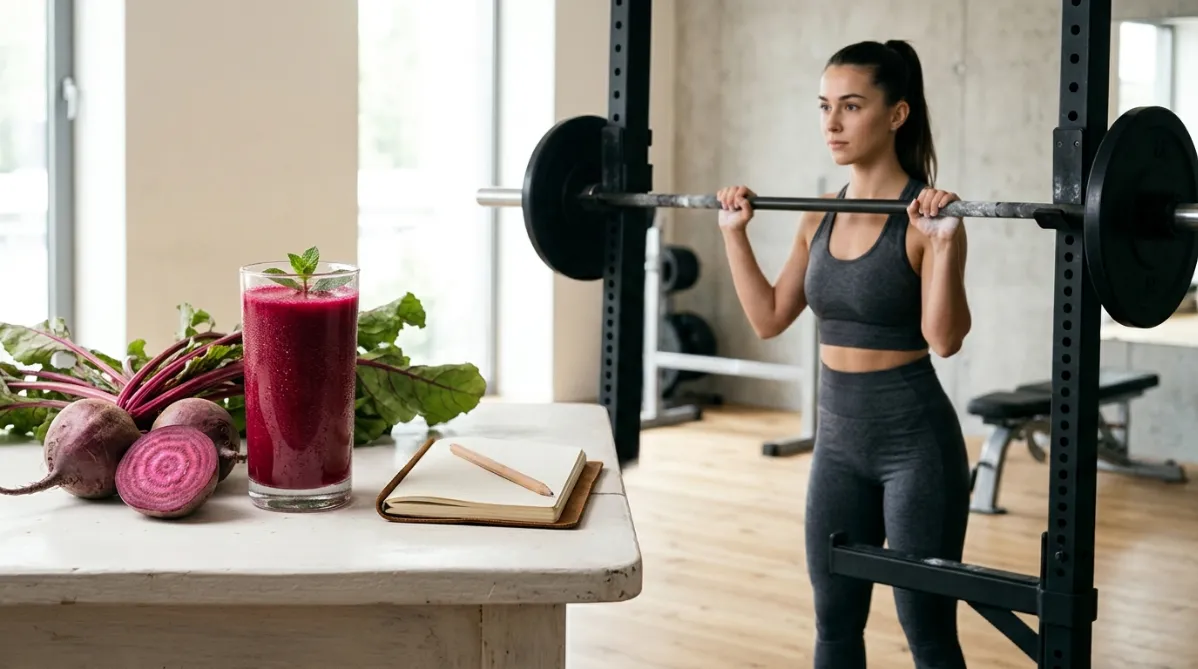
A wide, editorial-style photograph of a bright, modern gym corner softened by morning window light. In the foreground, a rustic matte-white ceramic table holds a tall clear glass of deep magenta beetroot juice, beads of condensation on the glass, a few fresh whole beetroots with leafy crimson-veined stems beside it, and one beetroot sliced in half to reveal its vivid concentric purple-pink rings. Next to the glass sits a small, neat notebook with a pencil, suggesting a research note, with no legible text. Behind the table, slightly out of focus, a young woman lifter with a tidy ponytail and a fitted charcoal training set stands at a barbell resting on a squat rack, chalk-dusted hands gripping the bar, calm and focused expression. A loaded bench with a bar is visible further back, with matte black plates and a light wooden floor. The palette is restrained and trendy: warm off-white, soft concrete gray, muted sage green accents from the beet leaves, and a bold beetroot magenta as the focal color. Shallow depth of field with a creamy bokeh background, natural side lighting casting long gentle shadows, subtle film grain. Composition follows the rule of thirds, with the juice and beets on the left third and the lifter on the right, leaving clean negative space in the upper area for a headline overlay. Mood is thoughtful, clean, and slightly skeptical, like a contemporary health and science journal cover. Realistic photography style, high-end magazine look, no text, no logos, no futuristic elements.
Nutrition

Bietensap faalt bij vrouwelijke lifters — en vertraagt zelfs de bench‑press

Dr. Gymbro · · 3 min read

Je kent de hype rond bietensap: die paarse pre‑workout die zogenaamd je bloedvaten tot supersnelwegen maakt en je bar‑snelheid tot een raket. Een nieuwe gerandomiseerde studie bij vrouwen die krachttraining doen, heeft die belofte flink op de proef gesteld.

Resultaat? Geen enkel squat‑voordeel en een lichte dip in bench‑press‑power bij één belasting.

Wat de onderzoekers eigenlijk hebben getest

Een team onder leiding van wetenschappers van Pepperdine University, met medeauteurs van de University of Virginia, McMaster, Birmingham City en Loughborough, publiceerde de studie in European Journal of Applied Physiology (2026). Achttien vrouwen die weerstandstraining doen, namen deel aan een gerandomiseerd, dubbelblind crossover‑ontwerp. Elke deelnemer doorliep beide condities, waardoor de vergelijking schoner is dan twee aparte groepen.

De twee dranken waren:

  • Placebo (PL): nitraatarm bietensap met verwaarloosbare nitraatinhoud.
  • Bietensap (BR): nitraatrijk sap dat ongeveer 6,7 mmol nitraat levert (rond de 415 mg).

Beide dranken werden 2,5 uur vóór de training ingenomen, een tijdsvenster dat gangbaar is in nitraatonderzoek.

De training: snel, licht‑tot‑matig, explosief

Dit was geen maximale krachttest. De deelnemers voerden één set van drie explosieve herhalingen uit van de barbell back squat en de bench‑press bij 55 %, 60 % en 65 % van hun één‑repetitie‑maximum (1RM), met twee minuten rust tussen de sets. Een lineaire transducer meette piek‑ en gemiddelde power en velocity bij elke set. De opzet richt zich op het type snelle, krachtige inspanningen waarbij nitraat vaak wordt geclaimd te helpen.

Geen effect op de squat

Voor de back squat waren er geen verschillen tussen de condities voor welke variabele dan ook (alle p‑waarden > 0,05). Bietensap verbeterde geen power of velocity bij een van de drie belastingen. De auteurs concluderen dat een acute nitraatinname de squat‑prestaties in deze groep niet verbetert.

De wending: bench‑press iets slechter bij 60 %

De bench‑press was overal gelijk, op één uitzondering na. Bij 60 % van 1RM scoorde bietensap slechter dan placebo:

  • Gemiddelde power: 201 ± 61 W (BR) vs. 206 ± 61 W (placebo) (p = 0,047, gz = ‑0,48)
  • Gemiddelde velocity: 0,68 ± 0,08 m/s (BR) vs. 0,70 ± 0,08 m/s (placebo) (p = 0,049, gz = ‑0,50)

Dat is een verschil van ongeveer 5 W en 0,02 m/s. Beide p‑waarden zakken net onder de 0,05‑drempel, en het effect verschijnt bij slechts één belasting. Bij 55 % en 65 % was er geen verschil. Met zoveel uitkomsten kan een marginale bevinding makkelijk een toevallige fluctuatie zijn. De auteurs beweren niet dat nitraat lifters schaadt; ze stellen dat meer onderzoek nodig is om te bepalen of nitraat een ergolytisch (prestatie‑verminderend) effect heeft bij vrouwen die krachttraining doen.

Hoe je dit eerlijk moet interpreteren

Dit zijn gegevens van mensen, geen dier‑ of celstudies, en ze hebben beperkingen. De steekproef is klein (18 vrouwen), de dosis een enkele acute portie, en alleen drie licht‑tot‑matige belastingen en drie‑reps sets werden getest. Het zegt niets over zware max‑lifts, hoge‑rep sets tot falen, of langdurige dagelijkse suppletie. De auteurs verklaarden geen belangenconflict.

Praktische conclusies

  • Dosis en timing in de studie: ca. 6,7 mmol nitraat (≈ 415 mg), ingenomen 2,5 uur vóór de training. Controleer het etiket van jouw product; nitraatgehalten variëren sterk tussen sappen en shots.
  • Wie waarschijnlijk niet hoeft te proberen: vrouwen die kracht en power in squat en bench‑press willen verbeteren, vinden in deze studie geen reden om een pre‑workout‑boost van bietensap te verwachten. Het leverde niets op, en bij één bench‑belasting was het zelfs iets slechter.
  • Wie wellicht nog wel baat kan hebben: de studie beantwoordt die vraag niet, omdat er geen uithoudings‑ of sprintwerk werd getest. Historisch richt nitraatonderzoek zich op aerobe en hoge‑intensiteit‑uithoudingsprestaties, dus atleten in die disciplines kunnen nog steeds reden hebben om te experimenteren.
  • Slim experimenteren: als je bietensap lekker vindt, verander dan niets aan de rest van je routine. Probeer het op een paar trainingsdagen, noteer bar‑speed of je eigen gevoel van prestatie, en vergelijk met dagen zonder. Als het niet helpt, betaal je gewoon voor een dure paarse drank.

De conclusie

Bietensap is geen magische pre‑workout voor de barbell‑kracht van vrouwen. In deze trial leverde het geen winst in de squat en slechts een kleine, enkel‑belasting‑bench‑daling die eerst moet worden gerepliceerd voordat men grote conclusies trekt. De grotere les is dat de goede reputatie van een supplement in één sport niet automatisch geldt voor krachttraining.

Original study

Read the original research on pubmed.ncbi.nlm.nih.gov →

This article summarizes published research for general information. It is not medical advice.

DG

Written by

Dr. Gymbro

Dr. Gymbro writes for Dr. Gymbro: science-backed fitness, nutrition & performance.

Related Articles

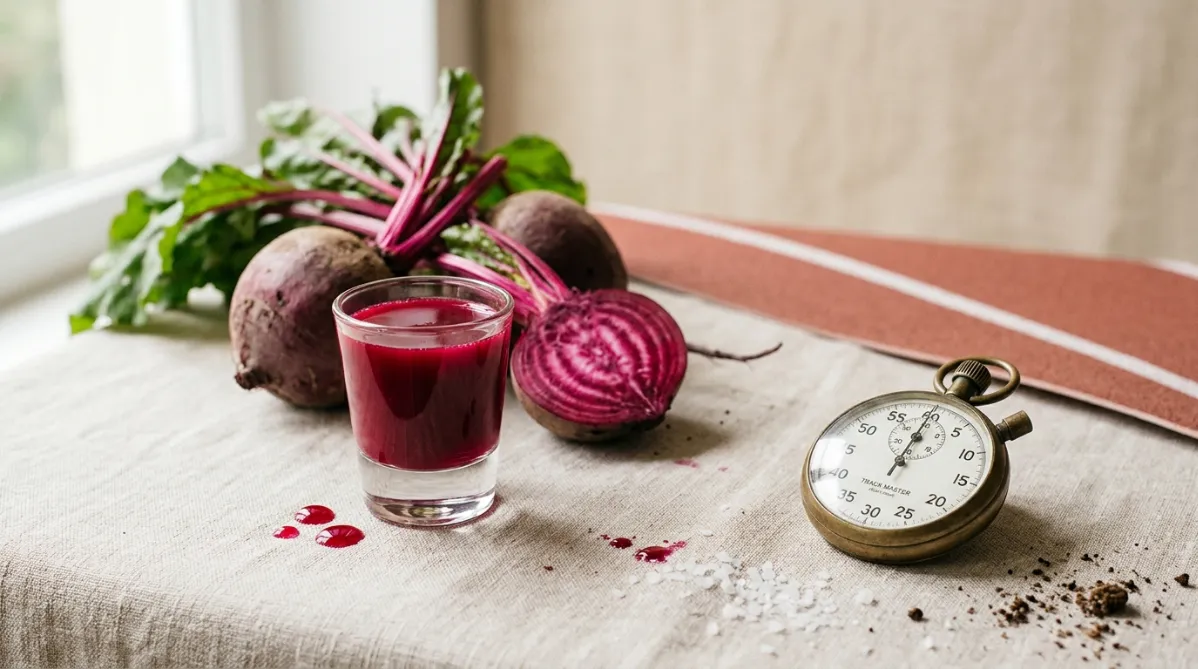
A wide editorial still life on a clean, pale oatmeal-colored linen surface, lit by soft natural window light from the left. In the center-left, a small clear glass shot glass filled with deep magenta-crimson beetroot juice catches a glowing highlight, with a few droplets beaded on the surface beside it. Behind it sit two whole beetroots with their leafy stems, the skins a dusty burgundy and the stems a vivid pink-red, and one beetroot sliced in half to reveal concentric rings of magenta and soft pink. To the right, a vintage-style brass stopwatch rests at an angle on the linen, its white face crisp and its hands frozen, slightly out of focus in the foreground edge. A faint curve of a sprinting track lane, in muted terracotta with thin white lines, sweeps diagonally across the blurred background, hinting at a running track without showing any people. Scattered across the surface are a few small, delicate beet-colored splashes and a light dusting of coarse sea salt. The palette is restrained and modern: warm cream, terracotta, dusty rose, deep magenta, and touches of sage green from the leaves. Shallow depth of field and a gentle film-like grain give it a contemporary lifestyle-magazine feel. The composition leaves generous negative space on the upper right for title overlay. Minimalist, tactile, calm, and sophisticated, in the style of a high-end health and science journal's editorial photography, 16:9 landscape.
nutrition

Bietensap Verhoogde Nitriet 35‑maal, Maar Sprinters Werden Niet Sneller

BY DR. GYMBRO ·

Een enkele shot van 70 ml bietensap verhoogde de speekselconcentratie van nitriet bij getrainde sprinters ongeveer 35‑maal, maar de 60‑ en 100‑meter tijden, spronghoogte en spierfunctie‑metingen bleven onveranderd. In deze samenvatting lees je wat er precies getest werd, welke conclusies de studie wel en niet kan ondersteunen, en voor wie het geld beter kan worden bespaard.

A wide, editorial-style still life photographed on a pale warm-gray concrete surface in soft, diffused morning window light. On the left side, a tall clear glass filled with deep magenta-crimson beetroot juice sits beside two halved raw beetroots, their concentric rings of vivid fuchsia and purple clearly visible, with a few small green-and-red-veined leaves draped casually nearby. On the right side, a matching clear glass of cloudy white creatine solution rests next to a small matte ceramic bowl heaped with fine white powder and a minimal wooden scoop, a light dusting of powder scattered across the surface. In the center, between the two sides, a simple matte black barbell grip and a single chalk-dusted weight plate edge rise into the frame at a low angle, hinting at lifting without showing a person. The composition is split in a balanced, symmetrical way, with a subtle vertical shadow line dividing the saturated magenta tones on the left from cool, neutral whites and creams on the right. The background is softly blurred with a muted sage-green and oatmeal-toned wall, with plenty of negative space at the top for a headline overlay. Shallow depth of field, crisp focus on the glasses' condensation droplets and the textured beetroot flesh. The color palette is limited and refined: magenta, cream, charcoal, and soft sage. The mood is clean, modern, and health-journal chic, like a contemporary wellness magazine cover, with natural shadows, a tactile matte finish, and subtle film-like grain. No text, no logos, no futuristic elements.
nutrition

Bietensap vs Creatine: Wie wint bij krachttraining in 72 uur?

BY DR. GYMBRO ·

Een nieuwe gerandomiseerde crossover‑studie zette bietensap tegenover creatine gedurende ongeveer 72 uur bij beginnende lifters. Creatine scoorde beter met meer bench‑press‑herhalingen op 80 % van 1RM, terwijl bietensap beter scoorde op barsnelheid, spierzuurstof, maximale hartslag en HRV‑herstel. De samenvatting vermeldt geen dosering of timing, een belangrijk gemis. Hieronder de volledige scorekaart en welk supplement bij welke doelstelling past.

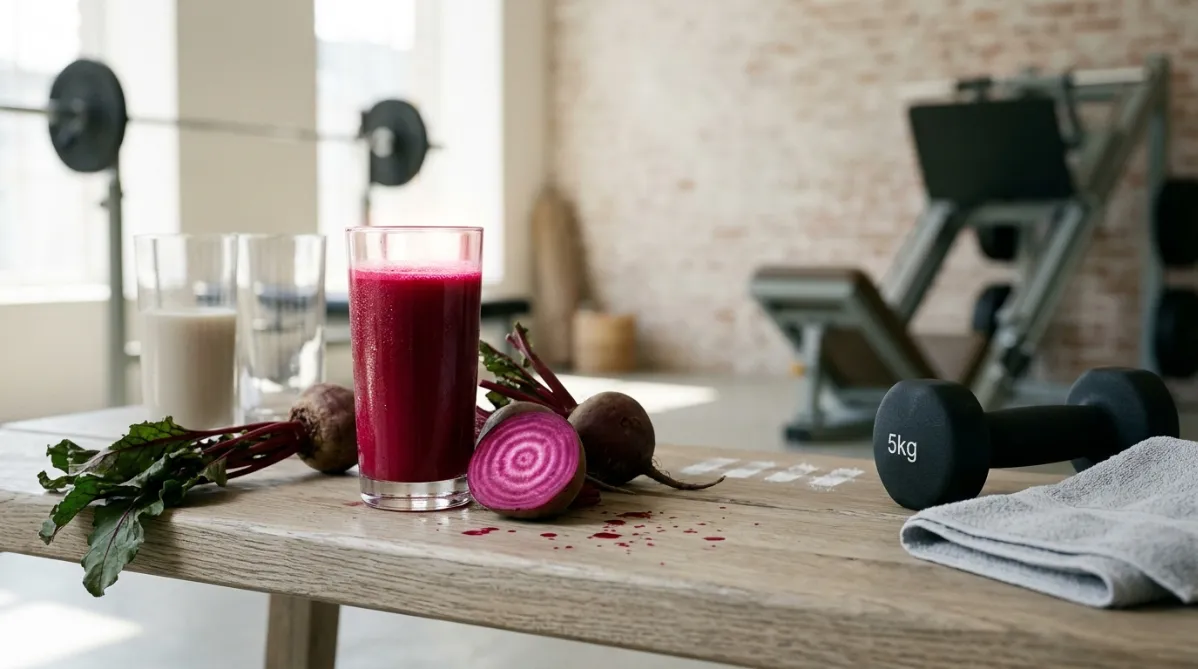
A wide, editorial-style still life photographed in soft natural window light, set on a pale oak gym bench or a light concrete surface. In the center foreground, a tall clear glass of deep magenta-crimson beetroot juice catches the light, with a faint luminous glow along its rim and condensation beading on the outside. Two other glasses sit slightly behind it, one holding a pale, neutral-colored liquid and one empty. They suggest the placebo and no-treatment conditions without any labels. Beside the glasses, a halved raw beetroot shows concentric rings of vivid fuchsia and violet. A few whole beets with their leafy stems and dark green and burgundy leaves are scattered casually nearby.

On the right side of the frame, slightly out of focus, a matte black women's-size dumbbell and a neatly folded light gray towel rest on the bench. Behind them, the soft blur of a minimalist, airy training space includes a barbell rack and a leg press machine in muted tones. The background is bright and neutral, in warm off-white, soft sand, and light gray, so the magenta of the juice is the dominant accent color.

A small, restrained motif of four evenly spaced chalk marks or four small round weight plates arranged in a neat row on the bench hints at the "four sets" of the trial. A few drops of beet juice have splashed onto the surface, forming a tasteful organic pattern.

The composition follows the rule of thirds, with the glass of juice on the left third and open negative space on the right for headline text. Shallow depth of field, crisp focus on the glass and beet, subtle film-like grain, and a calm, modern, trendy magazine aesthetic. The palette is magenta, deep burgundy, sage green, cream, and soft gray. The mood is quiet, skeptical, and scientific without any laboratory imagery, with clean lines and an elegant, minimal feel.
supplements

Bietensap leverde geen extra herhalingen bij weerstands‑getrainde vrouwen

BY DR. GYMBRO ·

Bietensap wordt geprezen als een natuurlijke rep‑booster, maar een nieuw dubbelblind crossover‑onderzoek bij weerstandsgetrainde vrouwen liet geen enkel voordeel zien. Zestien deelnemers dronken nitrate‑rijk sap (12,8 mmol), een placebo of niets vóór vier sets bankdrukken en leg press tot falen. Het totale aantal herhalingen, de waargenomen inspanning, hartslag, bloeddruk en lactaat bleven statistisch onveranderd. De resultaten sluiten nitrate als ergogene stof voor deze populatie en dit protocol niet definitief uit, maar wijzen op een beperkt effect.

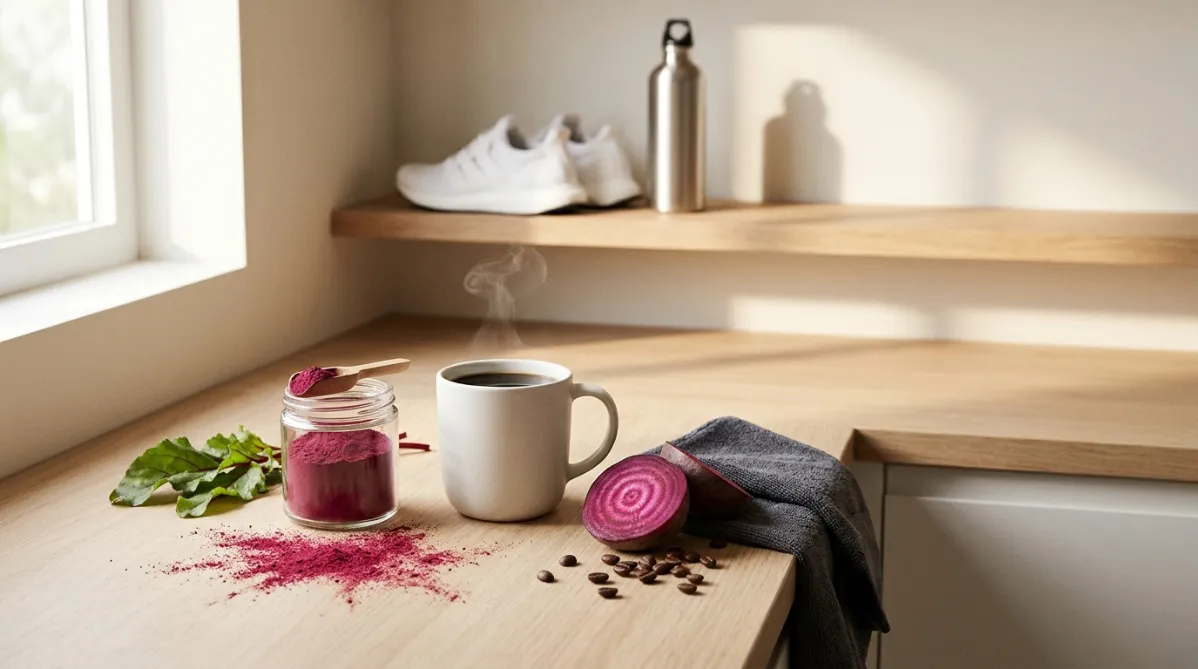
A sunlit, minimalist kitchen counter in a modern home, photographed from a slightly elevated three-quarter angle with soft natural morning light spilling in from a window on the left. In the center sits a matte white ceramic mug of black coffee with a thin curl of steam, beside a small glass jar of deep magenta beetroot powder with a wooden scoop resting on the lid. A scattering of fine crimson powder dusts the pale oak surface in an artful, casual swirl. Nearby, a halved raw beetroot reveals vivid concentric rings of purple and pink, next to a few roasted coffee beans and a neatly folded charcoal gym towel. In the soft-focus background, a pair of clean white running shoes and a stainless steel water bottle sit on a floating shelf, hinting at a pre-workout routine. A single sprig of green beet leaves adds a fresh accent.

The color palette is warm and editorial: creamy neutrals, espresso browns, and rich beet magenta, with gentle highlights and long soft shadows. The composition has generous negative space on the right side for headline text, shallow depth of field, and a crisp, tactile texture on the ceramic, powder, and wood grain. The mood is calm, health-conscious, and contemporary, like a lifestyle feature in a premium wellness magazine or a trendy nutrition journal. Clean, balanced, natural, with subtle film-like grain and a slightly muted, high-end finish.
science research

Pre‑workout cafeïne verhardt slagaders; bietpoeder neutraliseert dit

BY DR. GYMBRO ·

Een gerandomiseerde cross‑over studie toonde aan dat een pre‑workout‑dosis cafeïne (6 mg/kg) binnen 2,5 uur de markers van arteriële stijfheid laat stijgen. Het toevoegen van bietpoeder met 400 mg nitraat zette die markers terug naar placebonaamwaarden. Bloeddruk en endotheliale functie bleven onveranderd, waardoor het een subtiel effect is zonder rode vlaggen. De studie omvatte slechts 24 gezonde jonge volwassenen en één enkele dosis, waardoor er grote vragen blijven over langdurig gebruik en de effecten bij oudere of hypertensieve personen. Hier volgt wat de data laten zien, wat ze niet laten zien, en hoe je de resultaten moet interpreteren als je vóór de training op cafeïne vertrouwt.

This page is available in