Dr. Gymbro
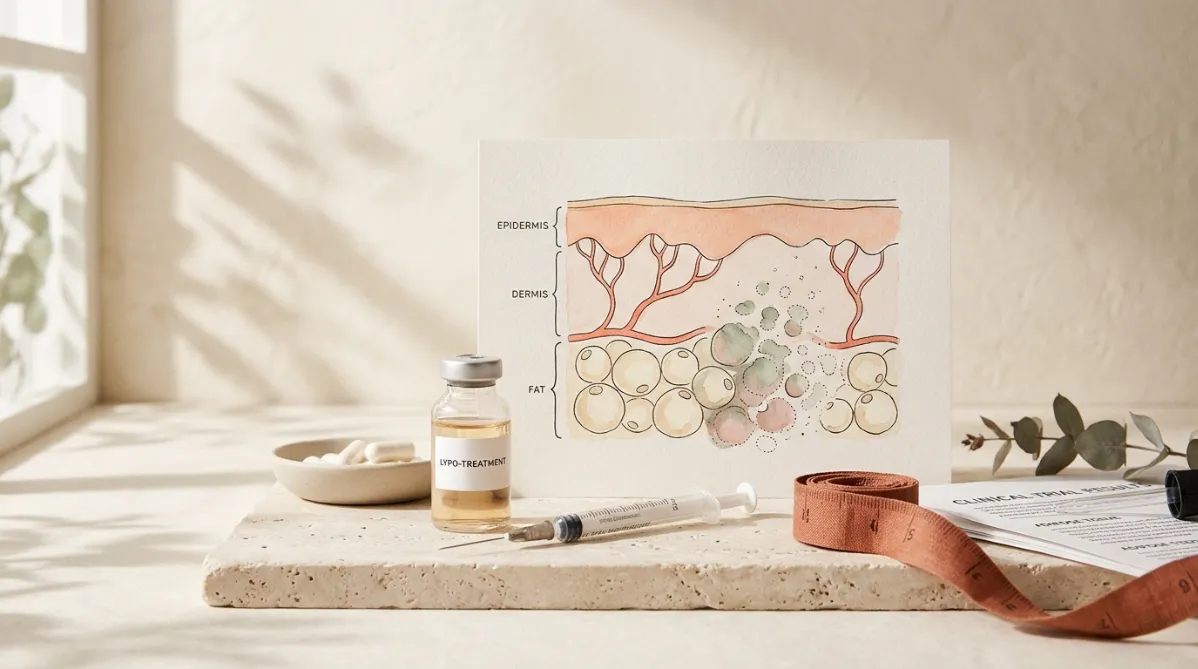
A softly lit, minimalist editorial still life on a warm off-white textured paper backdrop. In the center, a clean glass laboratory vial with a pale amber liquid sits beside a slim, sterile syringe with a fine needle, both placed on a pale travertine stone slab. Behind them, a large translucent cross-section illustration of skin layers is rendered as a delicate, hand-painted watercolor and ink diagram: soft peach epidermis, creamy yellow subcutaneous fat lobules shaped like clustered round cells, and thin coral capillary lines. A few of the fat cells in the diagram are gently fading, with dissolving edges and tiny dotted outlines to suggest cells quietly breaking down, painted in muted sage green and dusty rose.

On the left, a small ceramic dish holds a handful of matte white capsules, set aside and out of focus, hinting at what the treatment is not. On the right, a folded linen measuring tape in soft terracotta drapes across the stone, and a small stack of research papers with blurred text sits beneath a sprig of dried eucalyptus. Subtle botanical shadows from a window fall diagonally across the scene, creating a calm, natural-light atmosphere.

Color palette: warm cream, soft peach, sage green, muted terracotta, dusty rose, and touches of amber. The composition is balanced, with generous negative space on the upper left for title overlay. Shot as if with a 50mm lens, shallow depth of field, crisp focus on the vial and syringe, gentle film grain, and a refined, modern health-journal aesthetic. Contemporary, calm, trustworthy, and tactile. Landscape 16:9 format.
Science & Research

Hoe werkt CBL-514? Hier is de wetenschap

Dr. Gymbro · · 4 min read

Hoe werkt CBL-514? Hier is de wetenschap

Als je hoopt dat CBL‑514 de volgende thermogenic is, zit je ernaast. Het is geen stimulant, geen GLP‑1‑agonist en ook geen pil of poeder. (Let op de spelling: het is CBL‑514, soms foutief getypt als "CL‑514"). Het betreft een experimentele kleine‑molecuulinjectie van Caliway Biopharmaceuticals. De bewering is lokale injectielipolyse: wanneer het in een specifiek subcutaan vetgebied wordt geïnjecteerd, zouden de vetcellen daar geprogrammeerde celdood (apoptose) ondergaan. Dat is een heel ander concept dan het stimuleren van het metabolisme of het overal laten "smelten" van vet.

Dit artikel is een leesbare samenvatting van het voorgestelde mechanisme, gebaseerd op het open‑access fase‑2‑artikel en het eerdere fase‑2a‑artikel dat het citeert. Het is geen gebruiksaanwijzing.

Wat het fase‑2‑artikel zegt over CBL‑514

Het fase‑2‑artikel (Gold et al., Aesthetic Surgery Journal, 2025) omschrijft CBL‑514 als “een kleine‑molecuul‑injectielipolysemiddel dat adipocyten‑apoptose bevordert en gerichte subcutane vetreductie laat zien in pre‑klinische studies.” Dezelfde passage meldt dat dit gebeurde zonder huidnecrose, ulcus, zenuwbeschadiging of systemische bijwerkingen in die pre‑klinische rapporten.

Die veiligheidsclaims in dier‑ en celstudies zijn geen nieuwe data in dit artikel; ze verwijzen naar ongepubliceerde, vertrouwelijke Caliway‑rapporten plus het eerdere fase‑2a‑artikel. Beschouw ze als de eigen versie van de sponsor, niet als onafhankelijk geverifieerde bevindingen.

De publicaties onthullen bovendien niet de chemische structuur of exacte identiteit van het molecuul. Elke bewering over wat het "is" in chemische termen, of over een receptor die het zou raken, gaat dus verder dan wat daadwerkelijk is gepubliceerd.

Het voorgestelde mechanisme: DYRK1b, caspase 3 en Bax/Bcl‑2

De meer gedetailleerde mechanisme‑beschrijving komt uit het eerdere fase‑2a‑artikel (Goodman et al., 2022), dat kleiner en open‑label was, en dus niet placebogecontroleerd. Het meldt dat CBL‑514 in pre‑klinische studies:

  • de cell‑survival‑kinase DYRK1b remt;
  • de apoptose‑mediatoren caspase 3 en Bax/Bcl‑2 upreguleert;
  • dose‑afhankelijke adipocyten‑apoptose induceert in vitro en in vivo.

Het fase‑2a‑artikel rapporteert ook lipolyse in vitro en een gereduceerde subcutane adipositas in gerichte gebieden bij diermodellen. In gewone taal: het middel duwt vetcellen richting zelf‑destructie in plaats van hun inhoud te verbranden via een stress‑ of stimulantpad. De auteurs wijzen deze bevindingen toe aan ongepubliceerde, vertrouwelijke Caliway‑rapporten, waardoor de primaire data niet beschikbaar zijn voor externe controle.

Waarom het geen thermogenic is

Thermogenics en eetlustremmers werken over het hele lichaam, ofwel door het energieverbruik te verhogen of door de inname te verlagen. CBL‑514 doet geen van beide. Het voorgestelde effect is lokaal: vetcellen in het geïnjecteerde gebied worden aangevallen, de rest van het lichaam blijft onaangeroerd.

Dit verklaart ook waarom het klinische protocol niets lijkt op een supplementenschema. Onderzoekers gaven meerdere subcutane injecties over een in kaart gebracht buikgebied. Elke behandeling bestond uit 25‑tot‑50 injecties, 2,45 cm uit elkaar, en deelnemers konden tot vier behandelingen krijgen met een interval van vier weken. Het was geen enkele prik, niet oraal en niet systemisch.

Waarom de weegschaal niet bewoog

De fase‑2‑data illustreren duidelijk het lokale‑versus‑systemische onderscheid. In de intention‑to‑treat‑analyse daalde het least‑squares‑gemiddelde buikvetvolume van de CBL‑514‑groep met 199,80 mL na vier weken en met 209,46 mL na acht weken, gemeten met echografie. De placebogecorrigeerde verschillen lagen respectievelijk rond 207 mL en 216 mL.

Het gemiddelde lichaamsgewicht veranderde nauwelijks. De CBL‑514‑groep steeg met 0,45 kg na vier weken en met 0,02 kg na acht weken. De placebogroep daalde respectievelijk met 0,76 kg en 0,26 kg. Het artikel meldt geen statistisch significante verandering in gewicht of BMI, en stelt dat lokaal vetverlies zelfs bij deelnemers die meer dan 1 kg aankeerden, werd waargenomen (data niet getoond).

Dus een vetplekje kan op echografie krimpen terwijl de weegschaal stil blijft. Dat past bij een lokaal mechanisme; het is geen "gewichtsverlies door vetverbranding".

Hoe het verschilt van deoxycholzuur

De papers beschrijven deoxycholzuur (ATX‑101, Kybella) als adipocytolytisch en minder weefsel‑selectief. Het is het enige FDA‑goedgekeurde injectiemiddel voor vetreductie dat wordt genoemd, en dat alleen voor submentale (onder de kin) vet wordt gebruikt. CBL‑514 zou via apoptose werken in plaats van cellen mechanisch open te breken. Er is echter geen bewijs dat het op de lange termijn veiliger is dan deoxycholzuur. Het is niet FDA‑goedgekeurd en de bewijsbasis bestaat uit twee vroege‑fase‑studies.

Wat het menselijk bewijs wel en niet laat zien

Het bewijs voor het mechanisme bij mensen is indirect. De studie mat vetvolume en -dikte met echografie en 3D‑foto's. Er werden geen menselijke biopten gepubliceerd die apoptose in behandeld vet aantonen, en niets ondersteunt claims over menselijke assays van DYRK1b‑ of caspase‑activiteit. Het apoptose‑verhaal steunt op pre‑klinisch werk. De menselijk data laten zien dat het vetvolume in het behandelde gebied daalde, niet hoe het daalde.

Andere kanttekeningen:

  • De trial was single‑blind: deelnemers waren geblinddoekt, maar onderzoekers, staf en de sponsor niet.
  • Caliway was betrokken bij het study‑design, de dataverzameling, analyse, interpretatie en het schrijven van het manuscript.
  • Van de 75 behandelde deelnemers voltooiden er 38 de studie, een uitvalpercentage van 49,3 %.
  • De per‑protocol‑populatie bestond uit slechts 30 personen, en de aantallen namen af naarmate de follow‑up vorderde.
  • Het sample was voor ongeveer 94 % vrouwelijk in de CBL‑514‑groep.

In de intention‑to‑treat‑analyse had 63,9 % (23/36) van de CBL‑514‑deelnemers na vier weken minstens 150 mL vet‑volumevermindering, versus 17,4 % (4/23) bij placebo. Na acht weken waren dat 69,6 % (16/23) versus 0,0 % (0/16). De auteurs stellen dat de primaire en secundaire eindpunten behaald zijn, maar de ontbrekende follow‑up‑data en het ontbreken van multipliciteit‑correctie beperken de stevigheid van die cijfers.

Conclusie voor sporters

CBL‑514 moet gezien worden als een experimenteel, klinisch toegediend spot‑treatment, niet als een vetverbrandingsmiddel. Het voorgestelde mechanisme is vetcel‑apoptose via DYRK1b‑remming en opwaartse regulatie van caspase 3 en Bax/Bcl‑2, gebaseerd op pre‑klinisch werk van de sponsor. De menselijk data suggereren lokaal, met echografie gemeten, vetverlies zonder wezenlijke verandering in gemiddeld gewicht. Interessant voor lichaamscontour‑onderzoek, maar het zal je training, voeding of weegschaal niet veranderen.

Bronnen

Original study

Read the original research on pmc.ncbi.nlm.nih.gov →

This article summarizes published research for general information. It is not medical advice.

DG

Written by

Dr. Gymbro

Dr. Gymbro writes for Dr. Gymbro: science-backed fitness, nutrition & performance.

Related Articles

A wide, editorial-style photograph of a clean, bright clinical consultation space with a modern wellness-journal feel. In the foreground, a minimalist matte white tabletop holds a small glass vial with a soft gray label and a sterile syringe laid parallel beside it. Next to them sits a neatly folded stack of printed research pages, with a few subtle sage-green highlighted lines and a simple bar chart in muted tones. A slim stainless steel measuring tape curls loosely nearby, and a fine-point pen rests on the pages.

In the softly blurred midground, the torso of an athletic person in a fitted charcoal training top stands slightly out of focus. One hand rests lightly at the waist, which suggests body composition without showing a face. A weighted matte-black kettlebell and a folded gray gym towel sit on a pale oak bench to one side, a quiet reference to lifters and training.

The background is a calm wall in warm off-white and pale stone, with a tall window to the left. It lets in diffused morning daylight that casts long, gentle shadows across the table. A single green leafy plant in a ceramic pot adds a touch of organic color on the right edge.

The palette is restrained and contemporary: soft whites, warm beige, sage green, charcoal, and a small accent of muted coral. The composition follows the rule of thirds, with the vial and syringe on the left third and open negative space on the right, where headline text could sit. Use shallow depth of field, crisp focus on the vial's glass edges, and subtle highlights on the glass. The mood is thoughtful, credible, and analytical, in the style of a premium health and science magazine. Shoot it as if with a 50mm lens at f/2.8, with natural light, fine grain, and a clean, uncluttered finish.
science research

CBL‑514 Vetverliesinjecties: De fase‑2‑studie die lifters moeten lezen

BY DR. GYMBRO ·

Een placebo‑gecontroleerde fase‑2‑studie vond dat CBL‑514‑injecties de buiksubcutane vetlaag verminderden op echografie, terwijl het lichaamsgewicht nauwelijks veranderde. Na 8 weken had 69,6 % van de overgebleven behandelde deelnemers minstens 150 mL vetverlies, tegenover 0 % in de placebogroep. De studie was echter enkel‑blinde, bijna de helft van de behandelde deelnemers stopte voortijdig en de follow‑up was kort. Het medicijn is experimenteel, geen vetverbrander en niet goedgekeurd. Hieronder lees je wat lifters die in een cut zijn hier eigenlijk van moeten meenemen.

A soft, editorial still life in a bright, minimalist clinical-meets-wellness setting, shot in landscape format with a shallow depth of field. In the foreground, a single sterile glass vial with a clear liquid and a slim silver-capped syringe rest on a matte, pale sage-green ceramic tray. Next to them is a neatly folded white linen cloth. The vial's label is blank and clean, with no readable text. Behind the tray, slightly out of focus, the torso of a person in a simple cream-colored fitted tank top is visible from the ribs to the hips. A gentle, hand-drawn-style dotted grid of tiny ink dots is marked on the lower abdomen, suggesting localized injection points in a contained patch, not the whole body. A soft hand in a light nitrile glove hovers near the area holding a fine pen.

The background is a warm, creamy off-white wall with a faint, diffused window light casting long, soft shadows across the scene. A small sprig of dried eucalyptus in a minimalist stone vase sits at the far right edge, adding organic texture. Color palette: muted sage green, warm ivory, soft peach skin tones, and brushed silver accents, with a subtle touch of terracotta in a small ceramic dish at the left.

Lighting is natural morning daylight, airy and diffused, with gentle highlights on the glass vial that catch tiny reflections. The composition follows the rule of thirds, with the vial and syringe on the left third and open negative space on the right, which would suit headline overlay. The overall feel is modern, calm, trustworthy, and sophisticated, like a contemporary health and science magazine cover, with fine film-like grain, crisp detail on the glass and a creamy bokeh backdrop. No text, no logos, no futuristic elements.
science research

Wat is CBL‑514? Brandt het vet?

BY DR. GYMBRO ·

De term “vetverbrandende injectie” roept vaak de gedachte op aan een shortcut voor een cut‑cycle of een Ozempic‑achtige afslankinjectie, maar CBL‑514 is geen van beide. Het betreft een experimentele kleine‑molecuul‑injectie voor lipolyse die in klinische onderzoeken wordt toegediend als vele injecties in een pleister van buikvet. Een fase‑2‑studie uit 2025 liet zien dat het met echografie gemeten vetvolume verlaagde ten opzichte van placebo, terwijl het lichaamsgewicht nauwelijks veranderde. Hieronder lees je welke data er zijn, welke kanttekeningen belangrijk zijn en waarom dit een lokale contourering is in plaats van een systemische vetverbranding.

A soft-lit, minimalist editorial still life on a pale warm-gray seamless backdrop. In the center, a sterile glass vial with a clear, faintly golden liquid sits beside a slim syringe, both resting on a smooth matte terracotta ceramic slab. Beside them, a neat arrangement of translucent, pearly fat-like droplets in varying sizes, glistening like water beads, spills across the surface to suggest localized fat volume. Behind the objects, a large, softly blurred arc of cream and blush-pink paper forms a gentle curve suggesting an abdomen silhouette, without showing any human body. In the lower foreground, a slim measuring tape in muted sage green loops casually around the vial base, with legible tick marks hinting at volume reduction. To the right, a minimalist ceramic beaker with fine milliliter markings sits half-filled, catching a sliver of window light. Subtle data-inspired elements appear as flat, tasteful props: two thin stacks of off-white paper cards, one tall and one very short, symbolizing treatment versus placebo outcomes, with a few cards fading out toward the edge of frame to hint at participant dropout. A single small coral-red dot sticker on one card nods to injection-site reactions. Lighting is diffused natural morning light from the left, creating long, gentle shadows and soft highlights on glass and ceramic. The palette is restrained and modern: warm neutrals, soft sage, terracotta, blush, and touches of translucent gold. Shallow depth of field with crisp focus on the vial and syringe, background gently dissolving. Composition follows the rule of thirds with generous negative space on the right for headline overlay. The overall mood is calm, credible, and contemporary, like a premium health-science magazine cover, shot on a medium-format camera with fine grain and a clean, high-end editorial finish.
science research

Verbrandt CBL-514 echt vet? Dit weten we

BY DR. GYMBRO ·

In een fase‑2‑studie verloor 69,6 % (16 van 23) van de CBL‑514‑deelnemers binnen acht weken minstens 150 mL buikvet, tegenover 0 van de 16 placebo‑deelnemers. De aantallen krimpen echter doordat bijna de helft van de deelnemers de studie niet afmaakte, de proef enkel blind was en de follow‑up slechts acht weken duurde. Het lichaamsgewicht bleef nagenoeg gelijk, waardoor het gaat om lokale vetreductie en niet om vetverbranding. Bijna alle deelnemers kregen een injectie‑plaatsreactie en 18,4 % ervaarde ernstige pijn. Hieronder de precieze cijfers, kanttekeningen en wat ze wel en niet betekenen.

A calm, editorial-style still life photographed in soft natural window light on a pale travertine surface. In the foreground, a small clear glass vial with a silver cap and a slim, capped syringe rest beside a folded white linen cloth, their edges catching delicate highlights. Behind them is a minimalist arrangement of translucent frosted acrylic cards in pale sage green and warm sand, staggered like pages of a clinical report. A few of the cards carry abstract bar-chart shapes and simple circle diagrams in muted terracotta and deep teal. One circle is just under half filled, a quiet nod to the participants who did not finish the trial. A slim brass ruler and a rounded ultrasound-style glass paperweight lie diagonally across the middle ground, hinting at measurement without any machinery. On the right, a sprig of dried eucalyptus in a matte ceramic bud vase adds organic softness. The background is a smooth, softly blurred wall in warm cream, with long gentle shadows falling from the left. The palette is restrained: ivory, sage, sand, terracotta, and touches of teal and brass. The composition leaves generous negative space in the upper left for a headline overlay. The mood is thoughtful, trustworthy, and modern, like a contemporary health and science journal. Shot on a 50mm lens at shallow depth of field, with fine film-like grain and a clean, high-end magazine finish. There are no people, no text, no logos, and no futuristic elements.
science research

CBL-514 vetverwijderingsinjecties: Wat zegt de wetenschap?

BY DR. GYMBRO ·

CBL-514 is een experimentele injectie voor vetverwijdering, onderzocht in een echte fase‑2‑studie bij mensen, gerandomiseerd en placebogecontroleerd. De studie was echter enkelblind, de sponsor was betrokken bij het ontwerp, de analyse en het schrijven, en 37 van de 75 behandelde deelnemers (49,3 %) maakten de proef niet af. De behandelde groep bestond voor 94 % uit vrouwen en voor 86 % uit blanken. Deze uiteenzetting beschrijft wie werden opgenomen, hoe het protocol en de echografiemetingen werkten, en wat het ontwerp wel en niet kan aantonen. Het is uitsluitend educatief en geen medisch advies.

This page is available in