Dr. Gymbro
←

#adipocyte-apoptosis

2 articles
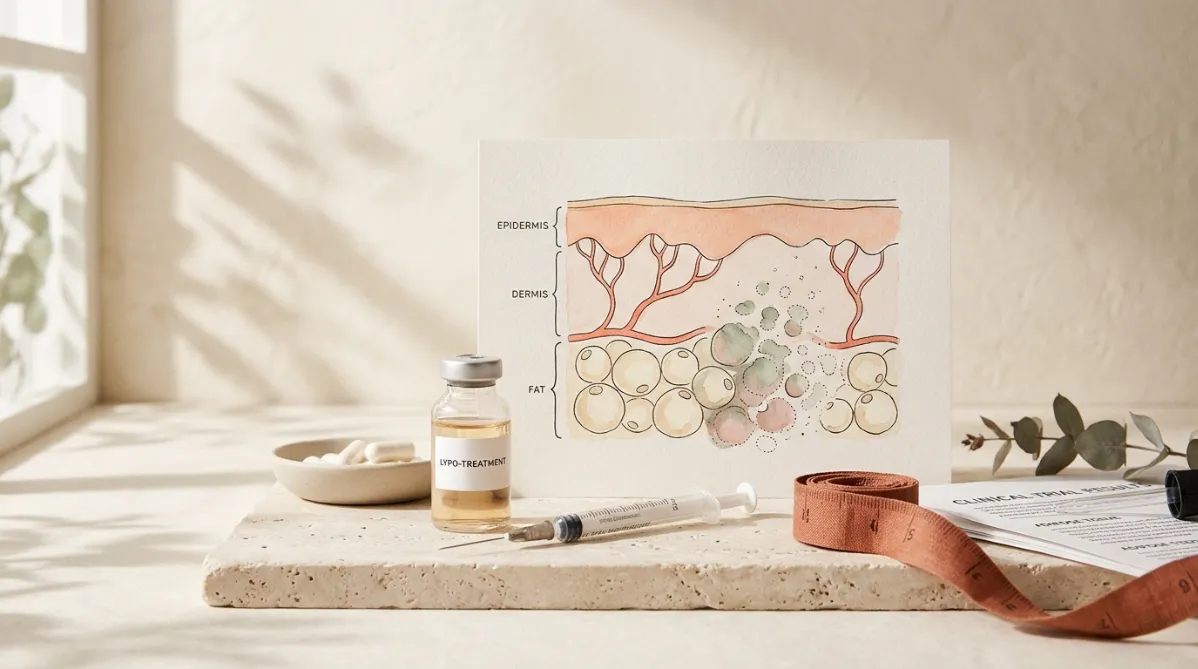
A softly lit, minimalist editorial still life on a warm off-white textured paper backdrop. In the center, a clean glass laboratory vial with a pale amber liquid sits beside a slim, sterile syringe with a fine needle, both placed on a pale travertine stone slab. Behind them, a large translucent cross-section illustration of skin layers is rendered as a delicate, hand-painted watercolor and ink diagram: soft peach epidermis, creamy yellow subcutaneous fat lobules shaped like clustered round cells, and thin coral capillary lines. A few of the fat cells in the diagram are gently fading, with dissolving edges and tiny dotted outlines to suggest cells quietly breaking down, painted in muted sage green and dusty rose.

On the left, a small ceramic dish holds a handful of matte white capsules, set aside and out of focus, hinting at what the treatment is not. On the right, a folded linen measuring tape in soft terracotta drapes across the stone, and a small stack of research papers with blurred text sits beneath a sprig of dried eucalyptus. Subtle botanical shadows from a window fall diagonally across the scene, creating a calm, natural-light atmosphere.

Color palette: warm cream, soft peach, sage green, muted terracotta, dusty rose, and touches of amber. The composition is balanced, with generous negative space on the upper left for title overlay. Shot as if with a 50mm lens, shallow depth of field, crisp focus on the vial and syringe, gentle film grain, and a refined, modern health-journal aesthetic. Contemporary, calm, trustworthy, and tactile. Landscape 16:9 format.
science research

Jak działa CBL‑514? Oto nauka

BY DR. GYMBRO ·

CBL‑514 nie jest stymulantem, nie podnosi termogenezy i nie należy do grupy leków GLP‑1. To eksperymentalny preparat do iniekcji, którego celem jest wywołanie apoptozy komórek tłuszczowych w wybranym obszarze podskórnym. Mechanizm opiera się na hamowaniu kinazy DYRK1b oraz zwiększeniu aktywności kaspazy‑3 i stosunku Bax/Bcl‑2 – informacje pochodzą z wczesnych prac przedklinicznych sponsorowanych przez firmę. W badaniu fazy 2 objętość tłuszczu w okolicy brzucha zmniejszyła się, podczas gdy średnia masa ciała praktycznie się nie zmieniła. Poniżej przedstawiamy, co potwierdzają wyniki naukowe, a czego nie, oraz dlaczego dowody na ludzki mechanizm pozostają pośrednie.

A soft, editorial still life in a bright, minimalist clinical-meets-wellness setting, shot in landscape format with a shallow depth of field. In the foreground, a single sterile glass vial with a clear liquid and a slim silver-capped syringe rest on a matte, pale sage-green ceramic tray. Next to them is a neatly folded white linen cloth. The vial's label is blank and clean, with no readable text. Behind the tray, slightly out of focus, the torso of a person in a simple cream-colored fitted tank top is visible from the ribs to the hips. A gentle, hand-drawn-style dotted grid of tiny ink dots is marked on the lower abdomen, suggesting localized injection points in a contained patch, not the whole body. A soft hand in a light nitrile glove hovers near the area holding a fine pen.

The background is a warm, creamy off-white wall with a faint, diffused window light casting long, soft shadows across the scene. A small sprig of dried eucalyptus in a minimalist stone vase sits at the far right edge, adding organic texture. Color palette: muted sage green, warm ivory, soft peach skin tones, and brushed silver accents, with a subtle touch of terracotta in a small ceramic dish at the left.

Lighting is natural morning daylight, airy and diffused, with gentle highlights on the glass vial that catch tiny reflections. The composition follows the rule of thirds, with the vial and syringe on the left third and open negative space on the right, which would suit headline overlay. The overall feel is modern, calm, trustworthy, and sophisticated, like a contemporary health and science magazine cover, with fine film-like grain, crisp detail on the glass and a creamy bokeh backdrop. No text, no logos, no futuristic elements.
science research

Czym jest CBL‑514? Czy spala tłuszcz?

BY DR. GYMBRO ·

„Iniekcja spalająca tłuszcz” kojarzy się z suplementacją odchudzającą albo z zastrzykiem w stylu Ozempicu, ale CBL‑514 nie jest ani tym, ani innym. To eksperymentalny lek w postaci małej cząsteczki, podawany wielokrotnie w wyznaczony obszar tłuszczu brzusznego. Badanie fazy 2 z 2025 r. wykazało zmniejszenie objętości tłuszczu mierzonej ultrasonograficznie w porównaniu z placebo, przy jednocześnie nieznacznej zmianie masy ciała. Poniżej opisujemy, co pokazują wyniki, ich ograniczenia i dlaczego chodzi o lokalne modelowanie sylwetki, a nie o systemowe spalanie tłuszczu.

This page is available in