Dr. Gymbro
←

#adipocyte-apoptosis

2 articles
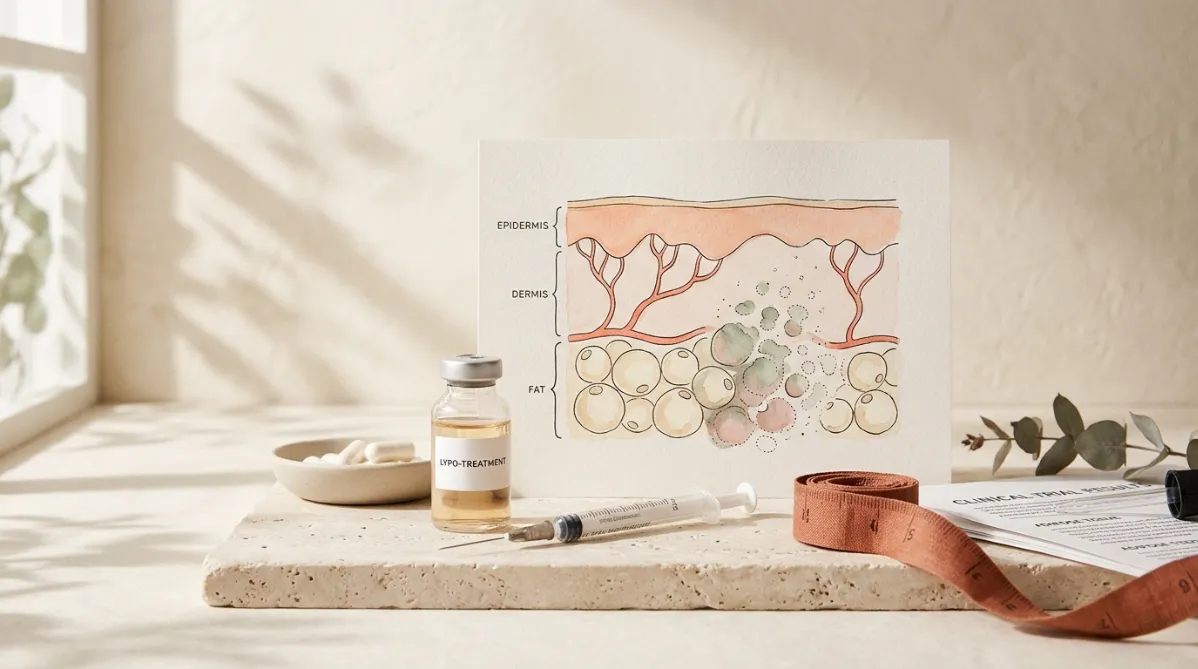
A softly lit, minimalist editorial still life on a warm off-white textured paper backdrop. In the center, a clean glass laboratory vial with a pale amber liquid sits beside a slim, sterile syringe with a fine needle, both placed on a pale travertine stone slab. Behind them, a large translucent cross-section illustration of skin layers is rendered as a delicate, hand-painted watercolor and ink diagram: soft peach epidermis, creamy yellow subcutaneous fat lobules shaped like clustered round cells, and thin coral capillary lines. A few of the fat cells in the diagram are gently fading, with dissolving edges and tiny dotted outlines to suggest cells quietly breaking down, painted in muted sage green and dusty rose.

On the left, a small ceramic dish holds a handful of matte white capsules, set aside and out of focus, hinting at what the treatment is not. On the right, a folded linen measuring tape in soft terracotta drapes across the stone, and a small stack of research papers with blurred text sits beneath a sprig of dried eucalyptus. Subtle botanical shadows from a window fall diagonally across the scene, creating a calm, natural-light atmosphere.

Color palette: warm cream, soft peach, sage green, muted terracotta, dusty rose, and touches of amber. The composition is balanced, with generous negative space on the upper left for title overlay. Shot as if with a 50mm lens, shallow depth of field, crisp focus on the vial and syringe, gentle film grain, and a refined, modern health-journal aesthetic. Contemporary, calm, trustworthy, and tactile. Landscape 16:9 format.
science research

¿Cómo funciona CBL‑514? La ciencia detrás

BY DR. GYMBRO ·

CBL‑514 no es un estimulante, ni un termogénico, ni un GLP‑1. Es un inyectable en fase de investigación que pretende inducir la apoptosis de adipocitos en una zona localizada de grasa subcutánea. Su mecanismo, que incluye la inhibición de DYRK1b y la regulación al alza de la caspasa‑3 y de la relación Bax/Bcl‑2, se basa en estudios preclínicos reportados por el patrocinador. En el ensayo de fase 2, el volumen de grasa abdominal medido por ultrasonido disminuyó, mientras que el peso corporal medio apenas variaba. A continuación se muestra lo que la ciencia sí y no demuestra, y por qué la evidencia del mecanismo en humanos sigue siendo indirecta.

A soft, editorial still life in a bright, minimalist clinical-meets-wellness setting, shot in landscape format with a shallow depth of field. In the foreground, a single sterile glass vial with a clear liquid and a slim silver-capped syringe rest on a matte, pale sage-green ceramic tray. Next to them is a neatly folded white linen cloth. The vial's label is blank and clean, with no readable text. Behind the tray, slightly out of focus, the torso of a person in a simple cream-colored fitted tank top is visible from the ribs to the hips. A gentle, hand-drawn-style dotted grid of tiny ink dots is marked on the lower abdomen, suggesting localized injection points in a contained patch, not the whole body. A soft hand in a light nitrile glove hovers near the area holding a fine pen.

The background is a warm, creamy off-white wall with a faint, diffused window light casting long, soft shadows across the scene. A small sprig of dried eucalyptus in a minimalist stone vase sits at the far right edge, adding organic texture. Color palette: muted sage green, warm ivory, soft peach skin tones, and brushed silver accents, with a subtle touch of terracotta in a small ceramic dish at the left.

Lighting is natural morning daylight, airy and diffused, with gentle highlights on the glass vial that catch tiny reflections. The composition follows the rule of thirds, with the vial and syringe on the left third and open negative space on the right, which would suit headline overlay. The overall feel is modern, calm, trustworthy, and sophisticated, like a contemporary health and science magazine cover, with fine film-like grain, crisp detail on the glass and a creamy bokeh backdrop. No text, no logos, no futuristic elements.
science research

¿Qué es CBL‑514? ¿Quema grasa?

BY DR. GYMBRO ·

La frase “inyección quemagrasas” evoca un atajo de ciclo de corte o una inyección al estilo Ozempic para perder peso, pero CBL‑514 no es nada de eso. Es un fármaco investigacional de pequeña molécula, inyectable para la lipólisis, probado con múltiples inyecciones en zona de grasa abdominal. Un ensayo de fase 2 de 2025 mostró que redujo el volumen de grasa medido por ultrasonido frente al placebo, mientras que el peso corporal apenas cambió. A continuación se analizan los datos, sus limitaciones y por qué se trata de contorneo local, no de quema de grasa sistémica.

This page is available in