Dr. Gymbro
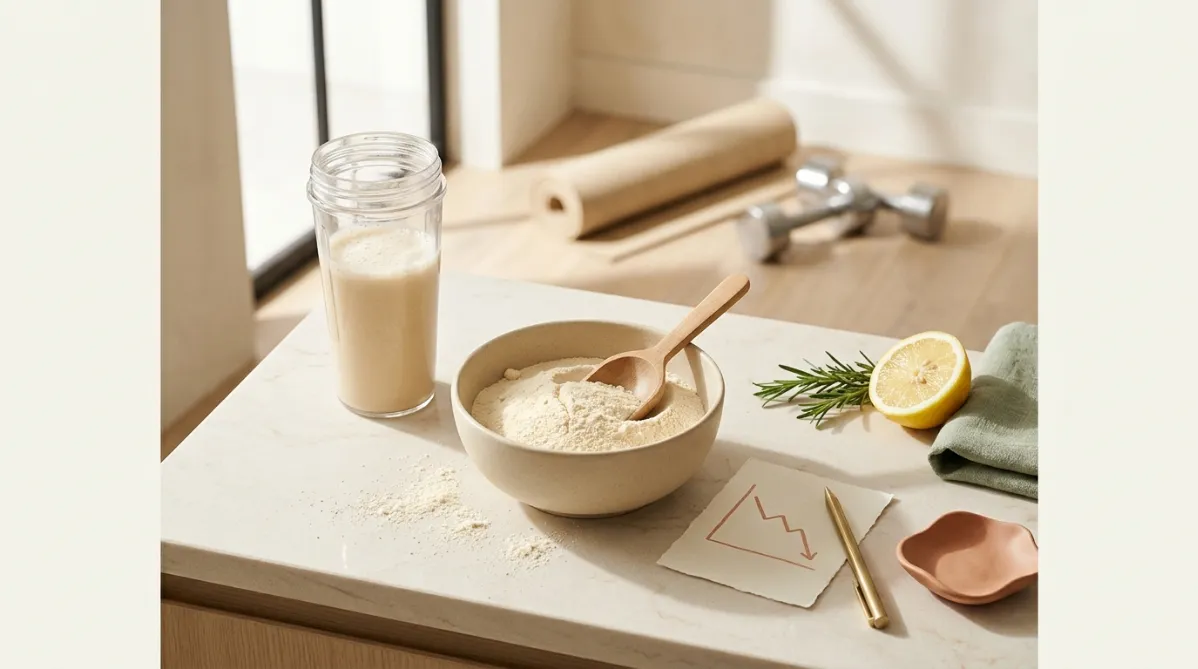
A wide, softly lit editorial still life on a warm off-white stone countertop. In the center sits a matte ceramic bowl of fine pale cream whey protein powder with a wooden scoop resting in it, a few fine grains dusted across the surface. To the left, a clear glass shaker bottle filled with a creamy, lightly frothy shake catches a gentle highlight. To the right, a minimalist arrangement of fresh produce and wellness cues: a halved lemon, a sprig of green rosemary, and a small folded sage-green linen towel. In the soft-focus background, a neatly rolled yoga mat and a pair of brushed-steel dumbbells rest on a pale oak floor beside a tall window. Morning sunlight streams in diagonally, creating long, gentle shadows and a luminous, airy atmosphere.

Subtle nods to the "liver" and "lab results" themes come through in tasteful, abstract ways: a small sheet of cream paper with a simple, hand-drawn downward-trending line graph in muted terracotta ink sits beside the bowl, with a slim brass pen laid across it. A delicate terracotta-colored ceramic dish nearby evokes organic form without being anatomical.

The color palette is calm and modern: warm creams, soft sand, sage green, muted terracotta, and touches of brushed brass. Shallow depth of field, crisp focus on the powder and scoop, with a creamy blurred background. Shot in a clean, contemporary magazine style with natural film-like grain, gentle contrast, and generous negative space on the left and right edges for headline overlay. Feels trustworthy, fresh, and approachable, like a trendy health and science journal cover.
supplements

A proteína whey destrói seu fígado? 59 atletas dizem o contrário

Dr. Gymbro · · 4 min read

A proteína whey destrói seu fígado? 59 atletas dizem o contrário

Você já ouviu na academia: "Todo esse whey está queimando seu fígado." Um novo ensaio randomizado, duplo‑cego e controlado por placebo com 59 atletas treinados testou diretamente essa preocupação. Após 8 semanas consumindo 30 g/dia de whey protein, as enzimas hepáticas não subiram. Na verdade, caíram. Mas o que isso realmente prova e o que não prova?

Sources: PubMed record | DOI: 10.1002/ejsc.70279

O mito vs. o ensaio

A ideia de que "whey danifica seu fígado" costuma se basear em um raciocínio simples: mais proteína significa mais trabalho metabólico e, consequentemente, mais estresse hepático. Enzimas sanguíneas como ALT e AST são os marcadores citados quando se tem essa preocupação. Se o whey fosse prejudicial ao fígado, esperaríamos que esses valores aumentassem.

O estudo, publicado no European Journal of Sport Science (2026) por Ben Mhamed e colaboradores, incluindo Beat Knechtle, mediu exatamente esses marcadores. Foram avaliados ALT, AST, proteína C‑reativa (CRP) e creatina quinase (CK) antes e depois da intervenção.

Como o estudo foi conduzido

  • Participantes: 59 atletas do sexo masculino, distribuídos em grupos de força (n = 30) e resistência (n = 29);
  • Desenho: randomizado, duplo‑cego, controlado por placebo;
  • Intervenção: 30 g/dia de whey protein (grupo whey) versus placebo (grupo controle);
  • Duração: 8 semanas;
  • Desfechos: ALT, AST, CRP e CK, medidos pré‑ e pós‑intervenção.

A estratificação pelo tipo de treinamento permite analisar se o whey age de forma diferente em atletas de força versus resistência.

O que eles encontraram

O destaque: ALT, AST e CK diminuíram de forma significativa após a suplementação, tanto em atletas de resistência quanto de força. Os valores‑p relatados foram 0,001, 0,015, 0,001 e 0,003 para os efeitos descritos no resumo. Os autores interpretam esses achados como uma atenuação do estresse hepático e muscular.

Nos grupos placebo, os valores de enzimas e CRP permaneceram estáveis ou até aumentaram, sobretudo nos atletas de resistência. Isso sugere que o treinamento intenso, por si só, pode elevar esses marcadores ao longo do tempo, e que o whey esteve associado a conter esse aumento.

Um ponto adicional: o ALT foi o único marcador com interação tripla estatisticamente significativa (Tempo × Suplementação × Modalidade de Treino; p = 0,003). Os autores o consideram o marcador que mostrou resposta genuinamente específica ao tipo de modalidade, evidenciando efeito no estresse hepático dos atletas de força.

A nota de rodapé sobre o CRP que você não deve ignorar

O CRP diminuiu significativamente dentro do grupo suplementado de atletas de força (p = 0,039), enquanto nos atletas de resistência as mudanças foram menores e não significativas. Contudo, a interação tripla para o CRP não foi significativa. Assim, os autores relatam esse resultado como uma tendência intra‑grupo, não como prova de que o whey afeta a inflamação de forma diferente segundo o tipo de treino. Considere o CRP como sugestivo, no melhor dos casos.

Limitações honestas: o que esses marcadores não podem dizer

É aqui que manchetes sensacionalistas extrapolam, então vamos ser cuidadosos.

  • Marcadores não são diagnósticos. ALT, AST e CK são indicadores sanguíneos. CK e AST, em particular, também provêm do músculo, de modo que alterações podem refletir estresse muscular mais que estado hepático. Valores mais baixos são compatíveis com menor estresse, mas não provam diretamente um fígado mais saudável.
  • Amostra somente de homens saudáveis e treinados. Todos os 59 participantes eram atletas do sexo masculino. Os resultados não se aplicam a mulheres, pessoas com doença hepática pré‑existente ou à população em geral.
  • Curto prazo e dose fixa. Oito semanas com 30 g/dia. Os próprios autores pedem estudos sobre efeitos a longo prazo e respostas a diferentes doses.
  • Mecanismo ainda especulativo. Os autores sugerem que efeitos antioxidantes e anti‑inflamatórios podem estar envolvidos, mas o ensaio não foi projetado para provar como o whey funciona.
  • Tamanho da amostra modesto. Com cerca de 15 atletas por subgrupo, achados de subgrupos (especialmente diferenças por modalidade) devem ser vistos como preliminares.

Trata‑se de um ensaio humano randomizado, não de pesquisa animal, mas ainda assim é um estudo único que utiliza marcadores substitutos ao invés de desfechos clínicos.

Dicas práticas

Dose e timing: O ensaio utilizou 30 g/dia por 8 semanas. O resumo não especifica o horário relativo ao treino, portanto não há evidência de que o momento da ingestão seja decisivo.

Para quem pode ser adequado: Adultos saudáveis, treinados em resistência ou endurance, que já desejam proteína extra e buscam conveniência. O estudo indica que, nessa dose, o whey não está associado ao agravamento dos marcadores de estresse hepático ou muscular nessa população.

Quem deve evitar ou consultar antes: Pessoas com diagnóstico de doença hepática ou renal, enzimas hepáticas elevadas, alergia ao leite ou intolerância à lactose (dependendo do produto), ou que receberam orientação médica para limitar a ingestão de proteína. O ensaio não inclui esses grupos; consulte um profissional de saúde antes de suplementar.

Hábitos inteligentes: Se você acompanha exames de sangue, lembre‑se de que treinamento intenso, álcool e alguns medicamentos também podem elevar ALT, AST e CK. Evite fazer o teste logo após uma sessão muito pesada e discuta resultados inesperados com um especialista.

Conclusão

O estudo não demonstra que o whey seja um tônico hepático. Ele oferece evidência tranquilizadora contra a afirmação genérica de que a suplementação moderada de whey prejudica o fígado em atletas saudáveis: ao longo de 8 semanas com 30 g/dia, ALT, AST e CK diminuíram, não aumentaram, em comparação ao placebo. A mensagem correta é otimismo cauteloso, enquanto ensaios maiores, mais longos e com amostras mais diversas ainda são necessários.

Registro completo: PubMed 42929456 | DOI
Original study

Read the original research on pubmed.ncbi.nlm.nih.gov →

This article summarizes published research for general information. It is not medical advice.

DG

Written by

Dr. Gymbro

Dr. Gymbro writes for Dr. Gymbro: science-backed fitness, nutrition & performance.

Related Articles

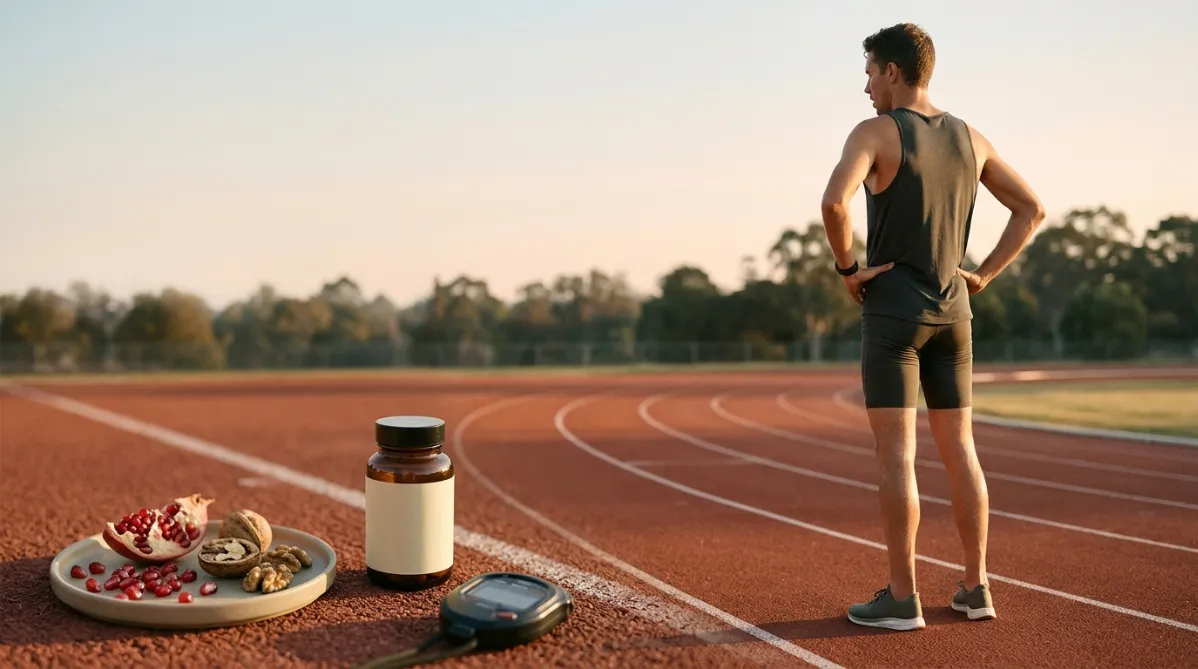
A wide landscape editorial photograph of a lone male distance runner, seen from behind in soft three-quarter profile, pausing on a red-clay outdoor running track at golden hour. He wears a minimalist charcoal singlet and fitted shorts, with a faint sheen of sweat on his calves and shoulders. His hands rest loosely on his hips as he catches his breath, and the white lane lines curve gracefully into the distance. Low amber sunlight rakes across the track and casts long, soft shadows. A hazy line of trees and a pale peach sky blur into creamy bokeh behind him.

In the lower foreground, slightly out of focus, a small matte ceramic dish holds a few pomegranate seeds and halved walnuts, a nod to the natural food sources of urolithin A. Beside it sits a minimalist amber glass supplement bottle with a plain cream label, and a stopwatch lies face-up on the track's edge. The stopwatch is blurred just enough to read as an object, not a number.

The palette is warm and earthy, with terracotta, burnt orange, soft cream, and muted sage green. The look is refined and contemporary, like a high-end wellness or sports-science magazine, with natural film-like grain, shallow depth of field, and gentle contrast. The composition follows the rule of thirds. The runner sits in the right third, the still life anchors the lower left, and open negative space in the upper left leaves room for a headline overlay. The mood is calm and thoughtful, suggesting recovery, measured results, and quiet scientific skepticism rather than hype. No text, no logos, no futuristic elements.
nutrition

Urolithin A Não Deixou Corredores de Elite Mais Rápidos — Mas Reduziu o Dano Muscular

BY DR. GYMBRO ·

Urolithin A tem sido divulgado como um “suplemento para mitocôndrias”. Em um estudo com corredores de elite masculinos (VO₂máx ~66 mL·kg⁻¹·min⁻¹) ele não acelerou os 3000 m, mas diminuiu a creatina quinase (CK) e a percepção de esforço pós‑corrida. O VO₂máx subiu 5,4 % no grupo UA contra 3,6 % no placebo, diferença que não foi estatisticamente significativa. Veja o que 1000 mg/dia durante quatro semanas fizeram – e não fizeram – e os pontos críticos sobre tamanho da amostra e vínculos com a indústria.

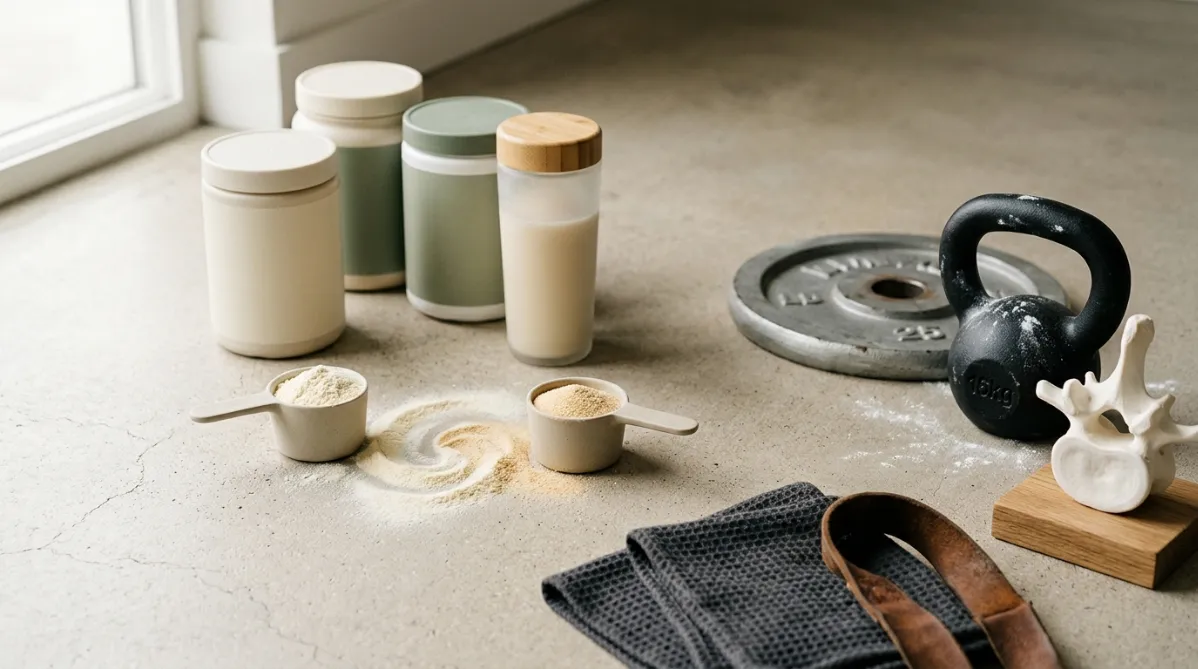
A wide, softly lit editorial still life on a pale warm-gray concrete surface, shot from a slightly elevated three-quarter angle. In the center-left, two matte ceramic scoops sit side by side. One holds fine ivory whey powder, the other holds slightly coarser, pale golden collagen peptide powder. A small, elegant dusting of both powders spills between them and blends into a soft swirl. Behind them, three minimalist cream and sage-green supplement tubs with no legible text stand in a staggered row, with a frosted glass shaker bottle of creamy liquid beside them.

On the right, a brushed-steel barbell plate and a compact chalk-dusted kettlebell rest slightly out of focus, suggesting resistance training. Pale wisps of chalk hang in the air. A folded charcoal gym towel and a pair of worn leather lifting straps lie in the foreground. A single cross-section of a clean white bone model, a stylized vertebra, rests on a small oak block at the far right. It subtly signals the bone-density theme without looking clinical.

Natural window light enters from the left, casting long, gentle shadows and a warm highlight on the powders. The palette is muted and modern: oatmeal, bone white, sage green, soft charcoal, and touches of warm amber. Shallow depth of field keeps the scoops tack-sharp and melts the background into creamy blur. Leave generous negative space in the upper right for headline overlay. The overall feel is a premium health and science journal cover: clean, tactile, minimalist, with fine film-like grain and a calm, editorial mood.
nutrition

Whey + colágeno supera qualquer outro suplemento em levantadores — mas há uma pegadinha

BY DR. GYMBRO ·

Misturar 30 g de whey com 10 g de colágeno superou whey sozinho, colágeno sozinho e placebo em todos os desfechos em um novo estudo de 8 semanas com homens treinados em resistência. A combinação acrescentou 2,66 kg de músculo (por BIA), elevou a DMO da coluna lombar e melhorou agachamento, supino e marcadores de turnover ósseo. O colágeno sozinho movimentou o osso, o whey sozinho o músculo. Porém, com apenas 40 participantes, totais de proteína desiguais e um salto inesperadamente grande na DMO, há uma pegadinha. Veja o que a combinação ganhou, para quem pode ser adequada e quem deve evitá‑la.

A bright, modern editorial still life on a clean, softly lit kitchen countertop of pale ash wood. In the foreground, a tall glass of creamy off-white protein shake sits beside a small ceramic spoon holding a mound of fine white powder. Next to it is a minimalist matte-white scoop and a small glass dish with a few pinches of powder. Scattered nearby are a few natural elements: a halved banana, a handful of raw almonds, and a sprig of fresh green herbs for a splash of color.

In the soft-focus midground, an older woman in her late 60s with silver-gray hair, wearing a sage-green linen shirt, smiles gently as she lifts a glass. Her face is slightly blurred and warm, bathed in natural window light. Beside her, slightly further back and out of focus, an older man in a navy sweater leans on the counter, a neutral presence that subtly contrasts with her. A wide window behind them floods the scene with soft morning light, with sheer curtains and a few leafy houseplants.

The color palette is muted and fresh: warm cream, soft sage, pale peach, and light oak, with a touch of terracotta from a small ceramic bowl. Shallow depth of field, creamy bokeh, subtle film-like grain, and gentle shadows give it a contemporary lifestyle-magazine feel. Composition follows the rule of thirds, with the shake and powder on the left third and open negative space on the right for headline overlay. The mood is calm, optimistic, and health-focused, polished like a trendy wellness journal cover, with no text, no logos, and no futuristic or sci-fi elements.
nutrition

3 g de HMB + 40 g de Whey: O surpreendente aumento beneficiou mulheres, não homens

BY DR. GYMBRO ·

Todos presumiam que um suplemento para ganhar músculo ajudaria principalmente os homens mais velhos. Um novo estudo com traçador encontrou o contrário: ao adicionar 3 g de cálcio‑HMB a um shake de 40 g de whey, a síntese proteica muscular aumentou em mulheres idosas, mas não em homens. O HMB também reduziu a degradação muscular tardia em todo o grupo. Entretanto, trata‑se de um estudo agudo de 3 horas com apenas 24 adultos e co‑autores da Abbott Nutrition, portanto não comprova ganho muscular a longo prazo. A seguir, a dose, o momento de uso, quem pode se beneficiar e quem deve evitar.

A wide, bright editorial photograph of a male athlete captured mid-jump in a minimalist, sunlit indoor training studio with pale concrete floors and tall windows. He is suspended at the peak of a plyometric box jump, knees tucked, with soft natural light and gentle motion blur at his feet. In the foreground, slightly out of focus, sits a small matte amber glass jar with a plain cream label, its lid resting beside it. Next to it are a few creamy white capsules spilled on a light oak wooden plyo box. A clear glass of water and a folded gray towel sit nearby.

The color palette is fresh and modern: warm off-white, sage green, soft sand, and touches of muted terracotta. A few green leaves of a potted fiddle-leaf plant in the corner add an organic feel. Shadows are long and soft, and the atmosphere is calm, clean, and health-focused, like a high-end wellness magazine spread.

The composition follows the rule of thirds. The jumping figure sits on the right third, and the supplement jar and capsules anchor the lower left. Negative space in the upper left leaves room for a headline overlay. The depth of field is shallow with a creamy bokeh background, shot on a 50mm lens with a subtle film-like grain. The overall look is crisp, airy, and contemporary, a lifestyle science journal cover aesthetic with no text, no logos, and no futuristic elements.
recovery

Cepa Probiótica Reduz Danos Musculares após 100 Saltos Máximos

BY DR. GYMBRO ·

Um ensaio randomizado mostrou que o probiótico *Lactiplantibacillus plantarum* GKK1 pode atenuar os efeitos de uma sessão pliométrica intensa. Após quatro semanas de suplementação (1,0 × 10¹¹ CFU/dia), 48 homens sem experiência de treino realizaram 100 saltos máximos; o grupo que recebeu a cepa perdeu menos desempenho, força e potência no teste de Wingate e apresentou marcadores de dano muscular mais baixos que o placebo. O estudo, porém, foi pequeno, limitado a homens não treinados e contou com autores ligados ao fabricante. Veja o que os dados realmente indicam e quem pode se beneficiar.

This page is available in