Dr. Gymbro
A wide, softly lit editorial still life on a warm off-white stone countertop. In the center sits a matte ceramic bowl of fine pale cream whey protein powder with a wooden scoop resting in it, a few fine grains dusted across the surface. To the left, a clear glass shaker bottle filled with a creamy, lightly frothy shake catches a gentle highlight. To the right, a minimalist arrangement of fresh produce and wellness cues: a halved lemon, a sprig of green rosemary, and a small folded sage-green linen towel. In the soft-focus background, a neatly rolled yoga mat and a pair of brushed-steel dumbbells rest on a pale oak floor beside a tall window. Morning sunlight streams in diagonally, creating long, gentle shadows and a luminous, airy atmosphere.

Subtle nods to the "liver" and "lab results" themes come through in tasteful, abstract ways: a small sheet of cream paper with a simple, hand-drawn downward-trending line graph in muted terracotta ink sits beside the bowl, with a slim brass pen laid across it. A delicate terracotta-colored ceramic dish nearby evokes organic form without being anatomical.

The color palette is calm and modern: warm creams, soft sand, sage green, muted terracotta, and touches of brushed brass. Shallow depth of field, crisp focus on the powder and scoop, with a creamy blurred background. Shot in a clean, contemporary magazine style with natural film-like grain, gentle contrast, and generous negative space on the left and right edges for headline overlay. Feels trustworthy, fresh, and approachable, like a trendy health and science journal cover.
supplements

Vernietigt wei‑eiwit je lever? 59 sporters zeggen het tegenovergestelde

Dr. Gymbro · · 4 min read

Je hebt het vast wel eens in de sportschool gehoord: "Al dat wei‑eiwit brandt je lever weg." Een recent gerandomiseerd, dubbelblind, placebogecontroleerd onderzoek onder 59 getrainde sporters heeft die zorg rechtstreeks getest. Na 8 weken met 30 g/dag wei‑eiwit stegen de leverenzymen niet – ze daalden zelfs. Wat bewijst dat nu echt, en wat niet?

Bronnen: PubMed record | DOI: 10.1002/ejsc.70279

De mythe versus de proef

Het idee dat "wei je lever beschadigt" berust meestal op een simpele redenering: meer eiwit = meer metabolisch werk, en meer werk = meer leverstress. Bloedenzymen zoals ALT en AST worden vaak aangehaald als indicatoren. Als wei de lever zou beschadigen, zou je verwachten dat deze waarden stijgen.

De studie, gepubliceerd in het European Journal of Sport Science (2026) door Ben Mhamed en collega’s waaronder Beat Knechtle, keek precies naar die markers. De onderzoekers maten ALT, AST, C‑reactief proteïne (CRP, een ontstekingsmarker) en creatine‑kinase (CK, een spierbeschadigingsmarker) vóór en na de interventie.

Opzet van de studie

  • Deelnemers: 59 mannelijke sporters, verdeeld over krachtsporters (n = 30) en duursporters (n = 29)
  • Design: gerandomiseerd, dubbelblind, placebogecontroleerd
  • Interventie: 30 g/dag wei‑eiwit (wei‑groep) versus placebo (controle‑groep)
  • Duur: 8 weken
  • Uitkomsten: ALT, AST, CRP en CK, gemeten pre‑ en post‑interventie

De stratificatie op trainingsvorm is belangrijk omdat ze de auteurs in staat stelt te onderzoeken of wei anders werkt bij kracht‑ en duursporters.

Wat ze vonden

Het belangrijkste resultaat: ALT, AST en CK waren significant lager na suppletie bij zowel duurs‑ als krachtsporters. De gerapporteerde p‑waarden waren respectievelijk 0,001, 0,015, 0,001 en 0,003 voor de effecten die in het abstract worden genoemd. De auteurs interpreteren dit als een vermindering van lever‑ en spierstress.

De placebogroepen vertelden ook een nuttig verhaal. Hun enzym‑ en CRP‑waarden bleven stabiel of stegen, vooral bij duursporters. Dat suggereert dat intensieve training op zichzelf deze markers in de loop van de tijd kan doen stijgen, en dat wei die toename juist afremt.

Een nuance: ALT was de enige marker met een statistisch significante drievoudige interactie (tijd × suppletie × trainingsmodaliteit; p = 0,003). De auteurs beschouwen dit als het enige echte modaliteit‑specifieke effect, namelijk een effect op leverstress bij krachtsporters.

Het CRP‑voettekstje dat je niet moet missen

CRP daalde significant binnen de gesuppleteerde krachtsporters (p = 0,039), terwijl duursporters slechts kleine, niet‑significante veranderingen lieten zien. De algemene drievoudige interactie voor CRP was echter niet significant. De auteurs rapporteren dit daarom als een trend binnen de groep, geen bewijs dat wei de ontsteking verschillend beïnvloedt per trainingsvorm. Beschouw het CRP‑resultaat dus hoogstens als suggestief.

Eerlijke beperkingen: wat deze markers je niet kunnen vertellen

  • Markers zijn geen diagnoses. ALT, AST en CK zijn bloedindicatoren. CK en AST komen bovendien uit spierweefsel, dus veranderingen kunnen spierstress weerspiegelen in plaats van uitsluitend leverstatus. Lagere waarden passen bij minder stress, maar bewijzen geen gezondere lever.
  • Alleen gezonde, getrainde mannen. Alle 59 deelnemers waren mannelijke atleten. De resultaten zeggen niets over vrouwen, personen met bestaande leveraandoeningen of de algemene bevolking.
  • Korte en vaste dosis. Acht weken à 30 g/dag. De auteurs roepen op tot onderzoeken naar langetermijneffecten en dose‑respons.
  • Mechanisme speculatief. De auteurs suggereren antioxidante en anti‑inflammatoire mechanismen, maar deze proef was niet opgezet om te bewijzen hoe wei werkt.
  • Klein aantal. Met zo’n 15 sporters per subgroep moeten bevindingen over subgroepen (vooral modaliteit‑verschillen) als voorlopig worden beschouwd.

Dit is een menselijke gerandomiseerde proef, geen dieronderzoek, maar het blijft een enkele studie met surrogate markers in plaats van klinische uitkomsten.

Praktische conclusies

Dosis en timing: De proef gebruikte 30 g/dag gedurende 8 weken. Het abstract vermeldt geen timing ten opzichte van de training, dus er is geen basis om te stellen dat een specifiek tijdstip van inname belangrijk is.

Voor wie het kan passen: Gezonde, weerstand‑ of duursport‑volwassenen die extra eiwit willen en op zoek zijn naar een handige bron. Deze studie suggereert dat, bij deze dosis, wei niet geassocieerd werd met een verergering van lever‑ of spierstress‑markers in die populatie.

Voor wie het beter is om te vermijden of eerst te overleggen: Iedereen met een gediagnosticeerde lever‑ of nierziekte, verhoogde leverenzymen, een melkallergie of lactose‑intolerantie (afhankelijk van het product), of een doktersvoorschrift om eiwitinname te beperken. Deze proef omvat die groepen niet, dus raadpleeg een professional voordat je supplementeert.

Slimme gewoonten: Als je bloedonderzoek volgt, onthoud dan dat intensieve training, alcohol en sommige medicaties ook ALT, AST en CK kunnen verhogen. Vermijd testen direct na een zware sessie en bespreek onverwachte resultaten met een specialist.

Conclusie

De studie toont niet aan dat wei een levertoxicum is. Wel levert ze geruststellend bewijs tegen de algemene bewering dat matige wei‑suppletie de lever schaadt bij gezonde atleten: over 8 weken à 30 g/dag gingen ALT, AST en CK omlaag, niet omhoog, vergeleken met placebogroepen. De juiste conclusie is voorzichtig optimisme, met nog grotere, langere en meer diverse onderzoeken die nodig blijven.

Volledige registratie: PubMed 42929456 | DOI
Original study

Read the original research on pubmed.ncbi.nlm.nih.gov →

This article summarizes published research for general information. It is not medical advice.

DG

Written by

Dr. Gymbro

Dr. Gymbro writes for Dr. Gymbro: science-backed fitness, nutrition & performance.

Related Articles

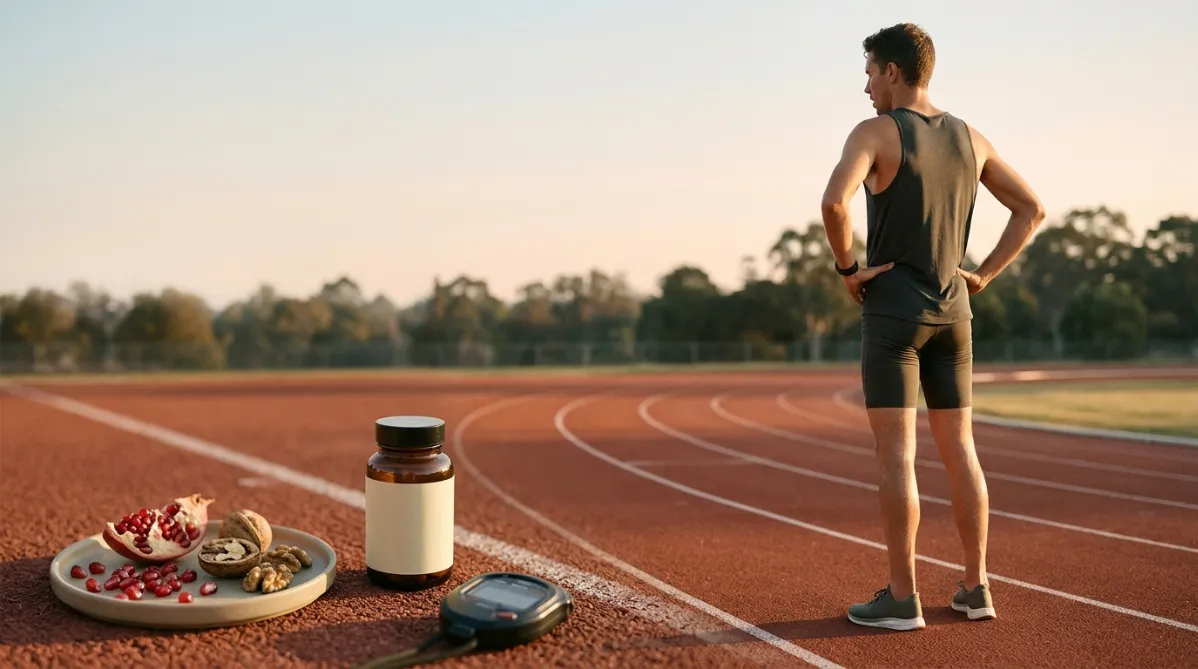
A wide landscape editorial photograph of a lone male distance runner, seen from behind in soft three-quarter profile, pausing on a red-clay outdoor running track at golden hour. He wears a minimalist charcoal singlet and fitted shorts, with a faint sheen of sweat on his calves and shoulders. His hands rest loosely on his hips as he catches his breath, and the white lane lines curve gracefully into the distance. Low amber sunlight rakes across the track and casts long, soft shadows. A hazy line of trees and a pale peach sky blur into creamy bokeh behind him.

In the lower foreground, slightly out of focus, a small matte ceramic dish holds a few pomegranate seeds and halved walnuts, a nod to the natural food sources of urolithin A. Beside it sits a minimalist amber glass supplement bottle with a plain cream label, and a stopwatch lies face-up on the track's edge. The stopwatch is blurred just enough to read as an object, not a number.

The palette is warm and earthy, with terracotta, burnt orange, soft cream, and muted sage green. The look is refined and contemporary, like a high-end wellness or sports-science magazine, with natural film-like grain, shallow depth of field, and gentle contrast. The composition follows the rule of thirds. The runner sits in the right third, the still life anchors the lower left, and open negative space in the upper left leaves room for a headline overlay. The mood is calm and thoughtful, suggesting recovery, measured results, and quiet scientific skepticism rather than hype. No text, no logos, no futuristic elements.
nutrition

Urolithine A maakte elitehardlopers niet sneller – maar verminderde spierschade

BY DR. GYMBRO ·

Urolithine A wordt vaak geprezen als een ‘mitochondria‑supplement’. In een studie met elite‑mannelijke hardlopers (VO₂max ≈ 66 mL·kg⁻¹·min⁻¹) bleek het de 3000 m‑tijd niet te verbeteren, maar wel de spierschade‑marker CK en de waargenomen inspanning te verlagen. De VO₂max steeg 5,4 % in de UA‑groep versus 3,6 % bij placebo, een verschil dat statistisch niet significant was. Hieronder lees je wat 1000 mg per dag gedurende vier weken wel en niet deed en welke kanttekeningen je moet meenemen bij kleine steekproeven en industriële betrokkenheid.

A wide, softly lit editorial still life on a pale warm-gray concrete surface, shot from a slightly elevated three-quarter angle. In the center-left, two matte ceramic scoops sit side by side. One holds fine ivory whey powder, the other holds slightly coarser, pale golden collagen peptide powder. A small, elegant dusting of both powders spills between them and blends into a soft swirl. Behind them, three minimalist cream and sage-green supplement tubs with no legible text stand in a staggered row, with a frosted glass shaker bottle of creamy liquid beside them.

On the right, a brushed-steel barbell plate and a compact chalk-dusted kettlebell rest slightly out of focus, suggesting resistance training. Pale wisps of chalk hang in the air. A folded charcoal gym towel and a pair of worn leather lifting straps lie in the foreground. A single cross-section of a clean white bone model, a stylized vertebra, rests on a small oak block at the far right. It subtly signals the bone-density theme without looking clinical.

Natural window light enters from the left, casting long, gentle shadows and a warm highlight on the powders. The palette is muted and modern: oatmeal, bone white, sage green, soft charcoal, and touches of warm amber. Shallow depth of field keeps the scoops tack-sharp and melts the background into creamy blur. Leave generous negative space in the upper right for headline overlay. The overall feel is a premium health and science journal cover: clean, tactile, minimalist, with fine film-like grain and a calm, editorial mood.
nutrition

Whey + collage overtreft whey alleen met een knal

BY DR. GYMBRO ·

Het combineren van 30 g whey met 10 g collage leverde betere resultaten op dan alleen whey, alleen collage of placebo in een nieuw 8‑weekse onderzoek bij weerstandstraining. De stack voegde 2,66 kg spiermassa toe (BIA), vergrootte de botmineralendichtheid van de lumbale wervelkolom en verbeterde squat‑, bench‑press‑kracht en bot‑turnover‑markers. Collage alleen beïnvloedde het bot, whey alleen de spier. Met slechts 40 deelnemers, ongelijke eiwitdoseringen en een opvallend grote BMD‑sprong is er echter een kanttekening.

A bright, modern editorial still life on a clean, softly lit kitchen countertop of pale ash wood. In the foreground, a tall glass of creamy off-white protein shake sits beside a small ceramic spoon holding a mound of fine white powder. Next to it is a minimalist matte-white scoop and a small glass dish with a few pinches of powder. Scattered nearby are a few natural elements: a halved banana, a handful of raw almonds, and a sprig of fresh green herbs for a splash of color.

In the soft-focus midground, an older woman in her late 60s with silver-gray hair, wearing a sage-green linen shirt, smiles gently as she lifts a glass. Her face is slightly blurred and warm, bathed in natural window light. Beside her, slightly further back and out of focus, an older man in a navy sweater leans on the counter, a neutral presence that subtly contrasts with her. A wide window behind them floods the scene with soft morning light, with sheer curtains and a few leafy houseplants.

The color palette is muted and fresh: warm cream, soft sage, pale peach, and light oak, with a touch of terracotta from a small ceramic bowl. Shallow depth of field, creamy bokeh, subtle film-like grain, and gentle shadows give it a contemporary lifestyle-magazine feel. Composition follows the rule of thirds, with the shake and powder on the left third and open negative space on the right for headline overlay. The mood is calm, optimistic, and health-focused, polished like a trendy wellness journal cover, with no text, no logos, and no futuristic or sci-fi elements.
nutrition

3 g HMB + 40 g Whey: De verrassende boost werkt bij vrouwen, maar niet bij mannen

BY DR. GYMBRO ·

Een eerdere veronderstelling was dat een spieropbouwende aanvulling vooral oudere mannen ten goede zou komen. Een recente tracer‑studie toonde het tegenovergestelde: 3 g calcium‑HMB in een whey‑shake van 40 g verhoogde de spiereiwitsynthese bij oudere vrouwen, maar niet bij mannen. Bovendien verminderde HMB de latere spierafbraak in de gehele groep. Omdat het een acute drie‑uurstudie met slechts 24 deelnemers betrof, levert dit geen bewijs voor langdurige spiergroei. Hieronder vind je dosering, timing, voor wie het geschikt is en wie beter kan afzien.

A wide, bright editorial photograph of a male athlete captured mid-jump in a minimalist, sunlit indoor training studio with pale concrete floors and tall windows. He is suspended at the peak of a plyometric box jump, knees tucked, with soft natural light and gentle motion blur at his feet. In the foreground, slightly out of focus, sits a small matte amber glass jar with a plain cream label, its lid resting beside it. Next to it are a few creamy white capsules spilled on a light oak wooden plyo box. A clear glass of water and a folded gray towel sit nearby.

The color palette is fresh and modern: warm off-white, sage green, soft sand, and touches of muted terracotta. A few green leaves of a potted fiddle-leaf plant in the corner add an organic feel. Shadows are long and soft, and the atmosphere is calm, clean, and health-focused, like a high-end wellness magazine spread.

The composition follows the rule of thirds. The jumping figure sits on the right third, and the supplement jar and capsules anchor the lower left. Negative space in the upper left leaves room for a headline overlay. The depth of field is shallow with a creamy bokeh background, shot on a 50mm lens with a subtle film-like grain. The overall look is crisp, airy, and contemporary, a lifestyle science journal cover aesthetic with no text, no logos, and no futuristic elements.
recovery

Deze probiotische stam vermindert spierschade na 100 maximale sprongen

BY DR. GYMBRO ·

Een nieuwe gerandomiseerde studie suggereert dat de probiotische stam *Lactiplantibacillus plantarum* GKK1 de gevolgen van een zware plyometrische training kan verzachten. Na vier weken inname van 1,0 × 10¹¹ CFU per dag verloren de mannen in de supplementengroep minder sprongkracht, kracht en Wingate‑prestaties dan de placebogroep. Ook spierschade‑markeringen zoals CK, myoglobine, hs‑CRP, TBARS en urine‑3‑methylhistidine waren gunstiger. De studie is echter klein, beperkt tot ongetrainde mannen en werd uitgevoerd door auteurs die verbonden zijn aan de fabrikant. Hieronder staan de resultaten en voor wie ze mogelijk relevant zijn.

This page is available in