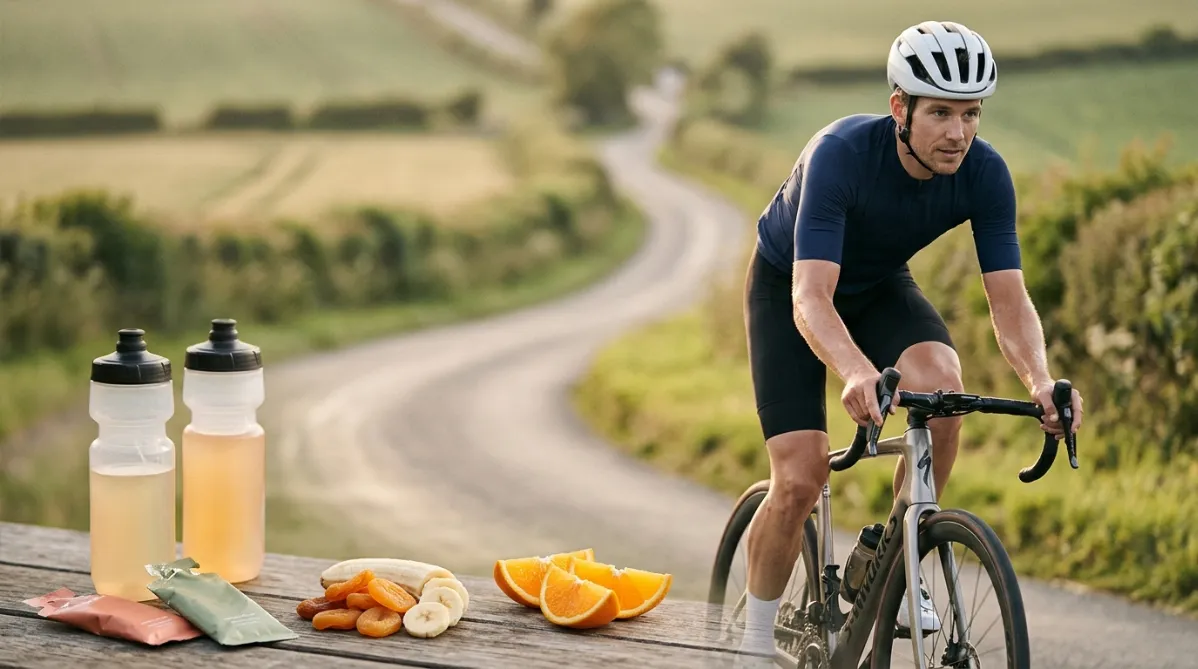
Everyone assumes more fuel on the bike means more glycogen saved. A new randomized trial suggests that story is incomplete. Cyclists who took in 100 grams of carbohydrate per hour were measurably faster at the end of a brutal four-hour ride than those who took in 60 grams. Their muscle glycogen, though, looked about the same.
The study comes from the University of Southern Denmark and appears in Medicine & Science in Sports & Exercise (2026). It adds to the case that high-carb fueling does more than top up the tank.
The Study: What Did They Actually Do?
- Design: Randomized, double-blind, crossover.
- Participants: 15 trained male cyclists and triathletes.
- Prep: A carbohydrate-enriched diet for 24 hours before each trial.
- The ride: 240 minutes of prolonged intermittent cycling at 60% of each rider's fresh 15-minute time-trial mean power, interspersed with high-intensity intervals.
- The test: A 15-minute time trial (TT) after the ride, compared with a fresh-state 15-minute TT.
- The variable: 60 g carbohydrate per hour (CHO60) versus 100 g per hour (CHO100), delivered through drinks and gels in a 1:0.8 glucose:fructose ratio.
- Measures: Muscle biopsies from the vastus lateralis before and after the ride, plus whole-body carbohydrate oxidation and blood glucose.
The crossover design means every rider did both conditions, which makes the comparison cleaner. Neither the athletes nor the researchers knew which condition was which.
The Headline Result: Less Fade After 4 Hours
The researchers were measuring "durability," meaning how much performance drops after prolonged work. Both conditions caused a drop in 15-minute TT performance, but the size differed:
- CHO60: about -9.3% (± 2.0)
- CHO100: about -6.4% (± 1.7)
- Difference: statistically significant (P = 0.025)
In absolute terms, mean power in the final time trial was 9 W higher with 100 g/h than with 60 g/h (P = 0.028). Nine watts is modest on paper. Late in a long race, though, it can decide who holds a wheel and who gets dropped.
The Plot Twist: Glycogen Didn't Explain It
The obvious guess is that more carbs meant less muscle glycogen burned. The biopsies didn't show that. Glycogen fell substantially in both conditions, and post-ride levels were statistically similar:
- CHO60: 192 ± 99 mmol·kg⁻¹ dry weight
- CHO100: 209 ± 111 mmol·kg⁻¹ dry weight
- P = 0.56
The spread between individuals was large, so this is a "no detectable difference" result, not proof of zero effect. Still, the authors conclude that 100 g/h improved durability without altering muscle glycogen utilization.
What Did Change: Whole-Body Carb Oxidation
What the higher intake did change was how well the body kept burning carbohydrate as the ride went on:
- CHO60: 2.6 ± 0.6 g·min⁻¹ at the start, falling to 1.9 ± 0.4 g·min⁻¹
- CHO100: 2.6 ± 0.4 g·min⁻¹ at the start, falling only to 2.3 ± 0.5 g·min⁻¹
- Condition × time interaction: P = 0.047
Blood glucose stayed stable in both conditions (about 5.6 to 5.7 mmol·L⁻¹ with CHO60 and 6.0 to 6.1 mmol·L⁻¹ with CHO100). So the 60 g/h group wasn't suffering hypoglycemia. The edge with 100 g/h came from somewhere other than rescuing blood sugar.
The paper's data point toward the extra ingested carbohydrate staying available as fuel and sustaining carbohydrate oxidation late in the ride. Beyond that, the mechanism is unproven. Any explanation involving the brain, the gut or other tissues would be speculation, not a finding.
What This Means for You
Who it's for
- Riders and triathletes doing long sessions or races of roughly 3 hours or more. The protocol here was 4 hours, and the benefit appeared at the end.
- Athletes whose performance late in an event matters, such as a final climb, a breakaway or a sprint finish.
- Gut-trained athletes who already tolerate high carbohydrate intakes.
The dose
- Target 100 g of carbohydrate per hour, versus the 60 g/h comparison.
- Use glucose and fructose at about 1:0.8, as in the study. Check the labels of your drinks and gels for the ratio; many sports products are built around this blend.
- Split the total across drink mix and gels, as the study did, rather than relying on one source.
Timing
- The study delivered carbohydrate steadily per hour across the four-hour ride. Aim for regular small doses, not big, infrequent hits.
- The riders also began with a carbohydrate-enriched diet over the previous 24 hours. Don't skip your pre-event loading.
Train your gut
- Going from 60 to 100 g/h overnight is a recipe for stomach trouble. Raise your intake in steps over several weeks of long sessions and rehearse race-day products.
- If you can't comfortably reach 100 g/h, a well-tolerated lower dose beats a high dose that makes you sick.
Who should skip it (for now)
- Anyone doing sessions well under about 2 to 3 hours. This study doesn't test shorter efforts.
- Athletes with persistent gastrointestinal problems on high carbohydrate intakes. Get individualized advice first.
- Anyone with a medical condition affecting carbohydrate handling should talk to a clinician or dietitian.
The Caveats
This is a strong design with a small sample: 15 men, all trained cyclists or triathletes. The results can't be applied directly to women, older athletes, recreational riders or other sports. The comparison was 60 versus 100 g/h only, so it can't tell you whether 80 g/h captures most of the benefit. The glycogen data also varied widely between riders, which limits how firmly that null result can be read.
Even so, the study makes a useful point for riders who treat 60 g/h as a ceiling. Fuel can help a long ride in ways that a glycogen measurement doesn't show. If you race beyond three hours and your gut is trained, 100 g/h at a 1:0.8 glucose:fructose ratio is worth a serious test in training.