Dr. Gymbro
A wide, editorial-style still life shot from a slightly elevated angle on a pale oatmeal-colored linen surface in soft, diffused morning light. At the center, a shallow matte ceramic bowl in warm terracotta holds a small mound of fine, golden-tan ashwagandha root powder. Beside it lie a few gnarled, dried ashwagandha roots and a sprig of green leaves with tiny orange-red berries in their papery husks. To the left, a minimalist amber glass supplement bottle sits with a few capsules spilled beside it, label blank and clean. A wooden scoop rests on the surface, dusted with powder.

On the right side of the frame, a pair of sleek, muted sage-green running shoes sits slightly off-center. A folded cream towel and a stainless steel water bottle sit just behind them, with a single brushed-steel kettlebell partly out of focus in the background to hint at strength training without dominating the scene. The running shoes and the botanical elements share equal visual weight, suggesting the endurance theme.

A thin, curved line of scattered powder sweeps across the linen from the bowl toward the shoes, like a gentle path or track. Soft shadows fall to the left, and a warm sunbeam crosses the surface and picks out the texture of the powder and the roots.

The palette is restrained and modern: warm terracotta, sage green, cream, soft gold, and touches of charcoal. The background is a blurred pale plaster wall with a hint of a window shadow. Shallow depth of field, crisp focus on the bowl and roots, and generous negative space in the upper left for a headline. Contemporary wellness magazine aesthetic, calm, natural, tactile, high-end lifestyle photography, no text, no people, no futuristic elements.
Science & Research

Ashwagandha's Surprise: It Helps Endurance More Than Strength

Dr. Gymbro · · 4 min read

The Hook: You Probably Bought It for the Wrong Goal

Ashwagandha is often marketed as a strength and muscle booster. A new meta-analysis suggests the most consistent payoff may be somewhere else: aerobic endurance.

The paper, published in Nutrients in 2026 by researchers at Shaanxi Normal University and Sichuan Agricultural University, pooled randomized controlled trials of oral Withania somnifera and its effect on objective exercise performance. The results are promising, but they come with caveats you should know before spending money.

What the Researchers Actually Did

This was a systematic review and three-level meta-analysis. The team searched PubMed, Web of Science, the Cochrane Library, Embase, and SPORTDiscus from inception to 1 April 2026. They included randomized controlled trials comparing oral ashwagandha with placebo or control and reporting objective performance outcomes.

The final pool was modest: 13 trials, 599 participants, and 79 effect sizes. A three-level model lets researchers handle trials that report several outcomes without treating each one as independent. The team also reported 95% prediction intervals, GRADE certainty ratings, subgroup analyses, and dose and duration meta-regressions.

Participants were mostly young adults or athletes. Four trials were male-only, one was female-only, three were mixed-sex, and five did not fully report sex composition.

The Headline Number

Across all performance outcomes, ashwagandha improved results on average, with a Hedges' g of 0.47 (95% CI 0.25 to 0.69, p < 0.001). That is a moderate pooled effect.

The authors also flagged two cautions:

  • Heterogeneity was substantial (I² = 60%), so results varied meaningfully between studies.
  • The 95% prediction interval ran from -0.40 to 1.33. It crosses zero, so a future trial in a different context could plausibly find no benefit, or even a small negative effect.

The average looks good, but it does not guarantee a result for every lifter or athlete.

The Twist: Endurance Beat Strength

Exercise type was the clearest moderator of the effect (P_between = 0.006). The findings split like this:

  • Aerobic endurance: the most consistent evidence, with g = 0.54 (95% CI 0.22 to 0.85, p = 0.002).
  • Strength: effects were positive, but the authors described them as uncertain.
  • Power and muscular endurance: too little evidence to draw conclusions.

The strength result is not negative. The data are simply less certain, and the "strength supplement" label is not as well supported as the endurance signal. If you want to build your bench press, this paper does not give you a confident green light. If you run, cycle, or row, the case is stronger.

The Dose Sweet Spot: 500-600 mg/Day

The authors identified 500-600 mg/day of extract as the most evidence-supported dose range. They stress that the dose analyses were hypothesis-generating, meaning they point to a pattern worth testing rather than proving an optimal dose.

The meta-regressions covered both dose and duration. The abstract does not give a specific timing protocol, such as pre-workout versus evening, so this paper cannot tell you when to take it. It also does not tell you which formulation is best. The authors list formulation standardization as a gap for future research.

Practical Takeaways

Who it may suit

  • Endurance-focused athletes and recreational runners, cyclists, and swimmers curious about a supplement with a research signal.
  • Young adults and athletes, who made up most of the sample.

A reasonable approach based on this paper

  • Stay within the 500-600 mg/day extract range, as that is where the evidence clusters.
  • Check your product label for how much extract you are getting, since the authors point to formulation differences.
  • Track an objective measure, such as a time trial or a repeatable test, so you can see whether it works for you.

Who should be cautious or skip it

  • Anyone buying it mainly for strength or power gains. The evidence here is uncertain or sparse.
  • Anyone outside the studied population. Most data come from young adults and athletes, and the paper does not establish effects in older adults, adolescents beyond one athlete cohort, or other groups.
  • People with medical conditions, those on medication, or those who are pregnant. The paper does not address these groups, and the authors call for better adverse-event monitoring in future trials. This is general caution, not a finding from the study, so talk to a clinician first.

Limitations You Should Not Ignore

The authors are candid about the weaknesses:

  1. Small evidence base. Thirteen trials and 599 people is not large, especially once split across outcome types.
  2. Moderate-to-high heterogeneity. An I² of 60% and a prediction interval crossing zero limit how confidently the average applies to any one situation.
  3. Hypothesis-generating dose findings. The 500-600 mg/day range is a lead, not a verdict.
  4. Incomplete reporting. Five trials did not fully report sex composition, so sex-specific conclusions are limited.
  5. Sparse data for power and muscular endurance.

The authors say future trials should be preregistered, adequately powered, double-blind, formulation-standardized, and sex-stratified. They also call for rigorous blinding checks, mechanistic endpoints, adverse-event monitoring, and sport-specific performance tests. The authors declared no conflicts of interest.

The Bottom Line

This meta-analysis suggests oral ashwagandha may improve selected exercise-performance outcomes, with the best evidence for aerobic endurance and a possible sweet spot of 500-600 mg/day. The strength claims that dominate supplement marketing are less certain. Treat ashwagandha as a promising, still-maturing option for endurance athletes, not a proven strength booster.
Original study

Read the original research on pubmed.ncbi.nlm.nih.gov →

This article summarizes published research for general information. It is not medical advice.

DG

Written by

Dr. Gymbro

Dr. Gymbro writes for Dr. Gymbro: science-backed fitness, nutrition & performance.

Related Articles

A landscape editorial photograph of a lone runner's hands resting on a weathered wooden table beside a small white ceramic dish of fine white powder and a clear glass of water, shot in soft morning light. A slim matte aluminum energy drink can, unbranded with a minimalist pale sage-green label, stands slightly out of focus in the background, with a single scoop of powder dusted lightly on the tabletop. A pair of worn running shoes and a folded gray towel sit at the edge of the frame. Through a large window behind them, a blurred misty trail winds through green trees at sunrise, with warm golden light spilling across the scene.

The color palette is calm and modern: creamy off-white, sage green, warm honey gold, and soft charcoal. The composition follows the rule of thirds, with the dish and glass in the lower left third and generous negative space on the right for a title overlay. The depth of field is shallow, with a crisp focus on the powder's delicate texture and tiny glints of light on the glass rim. The mood is clean, thoughtful, and quietly energetic, like a contemporary health and science magazine feature. Natural grain, subtle film-like softness, and gentle shadows give it an authentic lifestyle-editorial look. There are no text, logos, or futuristic elements, only tactile, real-world materials like wood, ceramic, glass, cotton, and metal.
nutrition

The Energy Drink Ingredient That Boosts Endurance on Its Own

BY DR. GYMBRO ·

Everyone talks about caffeine, but the other ingredient on the energy drink can may be quietly doing its own work. A 2018 meta-analysis of 10 studies found that isolated taurine improved endurance performance (Hedges' g = 0.40), and a single dose appeared to be enough. Neither dose (1–6 g) nor supplementation length changed the effect in a meaningful way. The catch is a small evidence base and wide confidence intervals, so this is a promising signal, not a guarantee. Here's what the study found and how to try taurine sensibly.

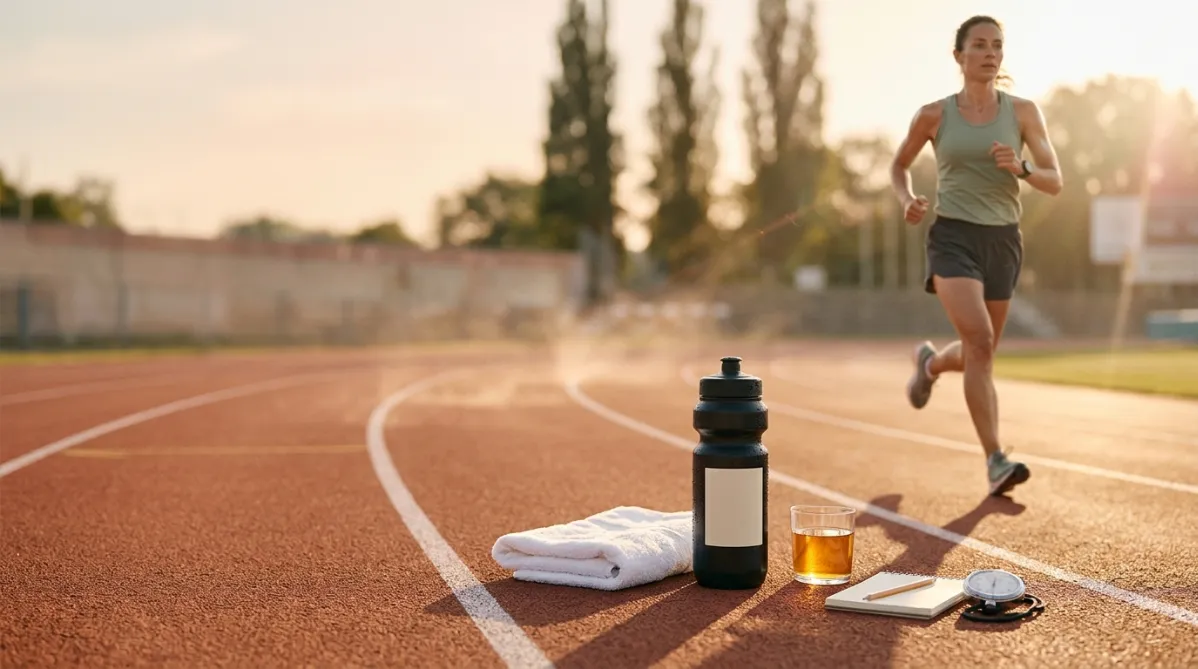
A sunlit outdoor running track in late afternoon, shot from a low angle with shallow depth of field. In the foreground, a matte black bottle with a minimal off-white label sits on the edge of a warm terracotta-colored track lane, beside a folded white towel and a small glass of amber liquid catching golden light. Condensation beads on the bottle. A faint heat shimmer rises from the track surface and softens the background.

In the midground, slightly out of focus, a lean athlete in a sage-green tank top and charcoal shorts runs on a treadmill-like stretch of track, a thin sheen of sweat on their shoulders, their expression focused and calm. Their motion is gently blurred, suggesting endurance and rhythm. Long soft shadows stretch across the lane lines.

The background fades into hazy peach, apricot, and pale yellow tones, with the suggestion of tall trees and a distant stadium wall. Warm sun flare enters from the upper right, creating a subtle glow and a few soft light streaks across the frame.

Subtle editorial touches: a small notebook with a pencil and a stopwatch rest beside the bottle, hinting at data and timing without any text legible. The color palette is warm and muted, with terracotta, cream, sage, and charcoal accents, and a fine film-like grain. The composition leaves open negative space on the left third for a headline overlay. The overall mood is clean, modern, and health-journal inspired, natural and aspirational, with a calm scientific curiosity rather than hype.
nutrition

Ketone Drinks in the Heat: Longer Endurance and Sharper Memory?

BY DR. GYMBRO ·

Ketone drinks are supposed to be for fat-burning biohackers, but a new heat-stress trial suggests they might also help you finish stronger. In 17 trained men, ketone monoester plus caffeine extended time to exhaustion to 8.9 minutes versus 7.0 with carbs plus caffeine, after 90 minutes of loaded treadmill work at 34 °C. Working-memory accuracy on the 1-back task improved too, while heart rate and core temperature didn't differ meaningfully. But 2-back, reaction time and the hit-and-avoid task showed no benefit, and the study was small, male-only and single-session. Here's what the data show, and what they don't.

A wide, editorial-style flat lay photographed from above on a pale warm-gray linen surface in soft natural window light. At the center, a small open amber glass jar tips gently onto its side, spilling a few cream-colored capsules across the fabric. Next to the jar sits a loose arrangement of fresh mushrooms: a cluster of golden-tan reishi with glossy, lacquered caps, a few slender white enoki stems, a halved shiitake showing its pale gills, and a curl of turkey tail with concentric bands of rust, cream, and charcoal. A small wooden scoop holds a pile of fine beige mushroom powder.

On the left third of the frame, a matte black sports watch with a minimal face lies beside a folded sage-green running shirt and a pair of lightweight off-white running shoes, hinting at athletic training without showing a person. A slim white notebook with a single pencil rests nearby, open to a blank page with a faint hand-drawn line graph trending upward, in thin graphite strokes.

On the right side, a pair of clear glass beakers and a single small petri dish with a soft amber-tinted liquid add a subtle laboratory note, kept calm and organic. A single sprig of dried herbs and a few scattered oat-colored grains add texture.

The palette is earthy and refined: oatmeal, soft sage, terracotta, warm amber, and charcoal accents against the muted neutral background. Shadows are soft and diffused, with a gentle highlight on the glass and the glossy reishi cap. The composition leaves generous negative space in the upper right for a headline overlay. Shallow depth of field blurs the edges slightly, while the central mushrooms and capsules stay crisp. The overall feel is modern, clean, and trendy, like a wellness and science magazine cover, with tactile natural textures, minimal styling, and a quiet sense of curiosity and skepticism.
science research

A Mushroom Capsule Lifted VO2max 14.8%—But There's a Big Catch

BY DR. GYMBRO ·

A mushroom capsule, 40 days, and a 14.8% rise in VO2max sounds almost too good to be true. In this new Antioxidants paper, 50 young male athletes taking 320 mg/day of a beta-glucan-rich multi-mushroom extract improved from 46.26 to 53.12 mL/kg/min. The big catch is that there was no placebo group, no randomization and no blinding, and the athletes kept training throughout. Cell experiments on rat heart cells add a hypoxia-related hint, but they tested single compounds, not the capsule. Here's what the study found, what it can't tell us, and who should think twice.

A bright, minimalist flat-lay photograph of two supplement scoops on a pale warm-gray stone surface, shot from directly above in soft natural window light. On the left, a matte ceramic scoop holds fine white creatine monohydrate powder, heaped in a clean mound. On the right, a second scoop of the same shape holds slightly coarser off-white beta-alanine powder, with a small, deliberate gap between the two. Each scoop sits in its own soft shadow, which suggests separation rather than combination. Between them, a thin brushed-brass ruler or a single slim line of fine powder runs across the surface and subtly divides the composition.

Around the scoops, a few restrained props in a muted editorial palette of sage green, cream, terracotta, and soft charcoal: a small glass jar with a minimalist label that has no readable text, a folded linen napkin, a single sprig of eucalyptus, and a stainless-steel shaker bottle softly out of focus in the upper corner. A few loose powder grains are scattered naturally across the stone. A small stack of blank cream index cards with a pencil rests in the lower right, hinting at research and note-taking without any legible writing.

The composition follows a clean rule-of-thirds layout, with generous negative space on the right third for headline overlay. The lighting is gentle and diffused, with long, soft shadows falling to the lower left. The color grading is calm and slightly desaturated, with creamy highlights and a subtle film-like grain. The overall look is a modern wellness and science journal cover, with an airy, trustworthy, contemporary editorial feel, shallow depth of field, and crisp detail on the powders.
nutrition

Creatine + Beta-Alanine: The Stack Bonus Researchers Couldn't Find

BY DR. GYMBRO ·

The creatine plus beta-alanine stack is marketed as a performance power couple, but a new network meta-analysis of 52 randomized trials found no synergy between them. Creatine alone significantly improved sprint, jump, repeated-sprint and upper-body endurance outcomes versus placebo. Beta-alanine's effects were non-significant or context-specific, and the combo added nothing beyond creatine. Here's what the study did, where it falls short, and what it means for your supplement budget.

This page is available in