Four days of a red-pigment antioxidant, and a group of young men rode about 13 minutes longer at a hard, fixed intensity. That is the headline from a 2025 randomized controlled trial in BMC Sports Science, Medicine & Rehabilitation. It tested astaxanthin, the ketocarotenoid that gives salmon and krill their color. The result is striking, but the study is small, so it needs careful reading.
The Hook: 72 Minutes vs 85 Minutes
In the trial, time to exhaustion (TTE) averaged 85.41 ± 4.42 minutes after astaxanthin and 72.11 ± 2.24 minutes after placebo. That gap is roughly 13 minutes, or about 18% longer. The statistics were strong for a study this size (P < 0.001, partial eta squared = 0.71), which indicates a large effect.
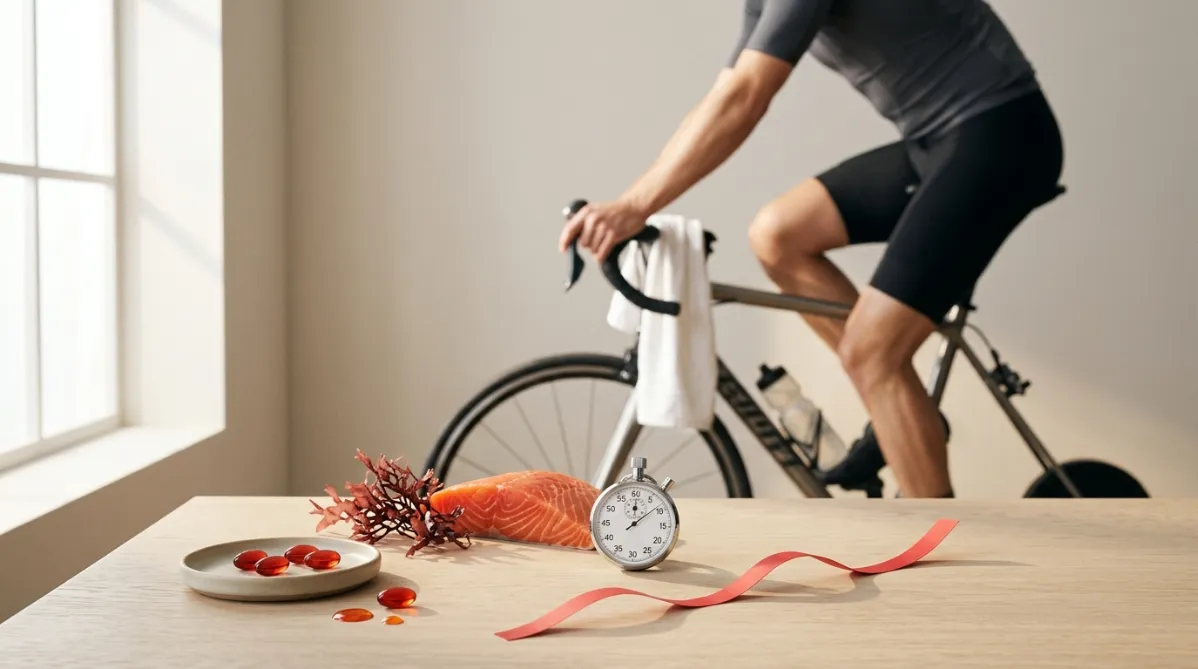
The riding was not easy either. Participants cycled at 75% of VO2max until they could not continue. That is hard, sustained work, and it is the kind of effort where small physiological advantages can show up as minutes on the clock.
Dose and Protocol: Short, Sharp, and High
The researchers, led by Tsao Jung-Piao and Cheng I-Shiung, enrolled ten physically active men averaging 22.5 years old. The design was randomized, placebo-controlled, and crossover, so each participant could be compared against himself. Participants took either a placebo or 28 mg of astaxanthin per day for 4 days. The exhaustive ride took place on day 4.
Blood and gas samples were collected before, during, and immediately after exercise. They tracked muscle damage, inflammation, oxidative stress, and fuel use.
The dose is the detail to notice. Many over-the-counter astaxanthin softgels contain much less per serving, and daily intakes in supplement marketing are often well below 28 mg. Anyone hoping to copy this protocol with a standard bottle would need to check labels carefully. Taking multiples of a product is not automatically a safe or equivalent substitute for the trial conditions, and this study does not establish a long-term safety profile. The four-day loading window is also unusually short for a compound often sold for weeks or months of use.
Muscle Damage and Oxidative Stress: What the Biomarkers Showed
Performance was not the only change. The researchers measured markers of exercise-induced tissue stress.
- Creatine kinase (CK) and lactate dehydrogenase (LDH): Both rise when muscle cells leak after strenuous exercise. Astaxanthin significantly (P < 0.05) reduced these exhaustive-exercise increases. A significant time-by-treatment interaction for CK (P = 0.039, η²p = 0.217) suggests astaxanthin may have attenuated muscle damage.
- Malondialdehyde (MDA): This marker of lipid peroxidation rose during and immediately after exercise. Astaxanthin substantially inhibited that rise (P < 0.05), consistent with its reputation as a potent antioxidant.
- Inflammation: Tumor necrosis factor-alpha and C-reactive protein did not respond to either the supplement or the exercise challenge. The effect here appears tied to oxidative and muscle-leakage markers, not to a broad anti-inflammatory action.
- Substrate utilization: Fuel use during and after exercise looked similar in both trials. The longer ride was therefore not obviously explained by a shift toward burning more fat or carbohydrate, which leaves the mechanism an open question.
- Mood: Astaxanthin had no adverse effect on the profile of mood states.
Why This Might Matter for Endurance Athletes
The authors frame astaxanthin as a possible nutritional ergogenic aid. The logic is that prolonged high-intensity effort generates reactive oxygen species, which can damage muscle membranes and contribute to fatigue. A lipid-soluble antioxidant that sits in cell membranes could, in theory, protect them. The lower MDA, CK, and LDH readings fit that story.
The data do not prove that story, though. The inflammation markers stayed flat and fuel use did not change, so the pathway from antioxidant effect to 13 extra minutes is not demonstrated. Antioxidants can also be a double-edged sword in training, since some reactive oxygen signaling helps drive adaptation. This trial measured one acute exercise bout, not training adaptations over weeks, so it cannot speak to that concern.
Practical Takeaways
- The signal is promising, not settled. A large TTE improvement with supporting biomarker changes is encouraging for a short protocol.
- Check the dose. The trial used 28 mg/day, which is high relative to many commercial softgels. Compare the label to the study before assuming you are getting the same exposure.
- The window was brief. Four days is a loading-style protocol, which makes it interesting for event preparation. Whether longer use does more, less, or the same is not answered here.
- Expect the finding to be specific. It applies to hard endurance cycling. Nothing in this study supports claims about strength, muscle gain, or body composition.
Limitations You Should Not Ignore
The biggest caveat is sample size: ten participants. Small trials can produce large, unstable effect sizes, and the very tight standard deviations for TTE should be treated cautiously until others reproduce them. The group was also young, physically active men, so the results may not carry over to women, older adults, or elite endurance athletes. Only one exercise model was tested, a single exhaustive ride at 75% VO2max, and the supplement was taken for just four days.
There is also the practical matter of time to exhaustion itself. TTE tests are sensitive to motivation and pacing, and they do not always match the outcome of a real race or time trial. Larger, preregistered replications that include women and trained athletes would clarify how far these findings travel.
Bottom Line
This trial gives astaxanthin a credible early case as a short-term endurance aid, with about 18% longer time to exhaustion and lower markers of muscle damage and lipid peroxidation. It is still a ten-person study at a dose above what many supplements provide. Treat it as a strong reason for follow-up research, not as a proven performance protocol.