Dr. Gymbro
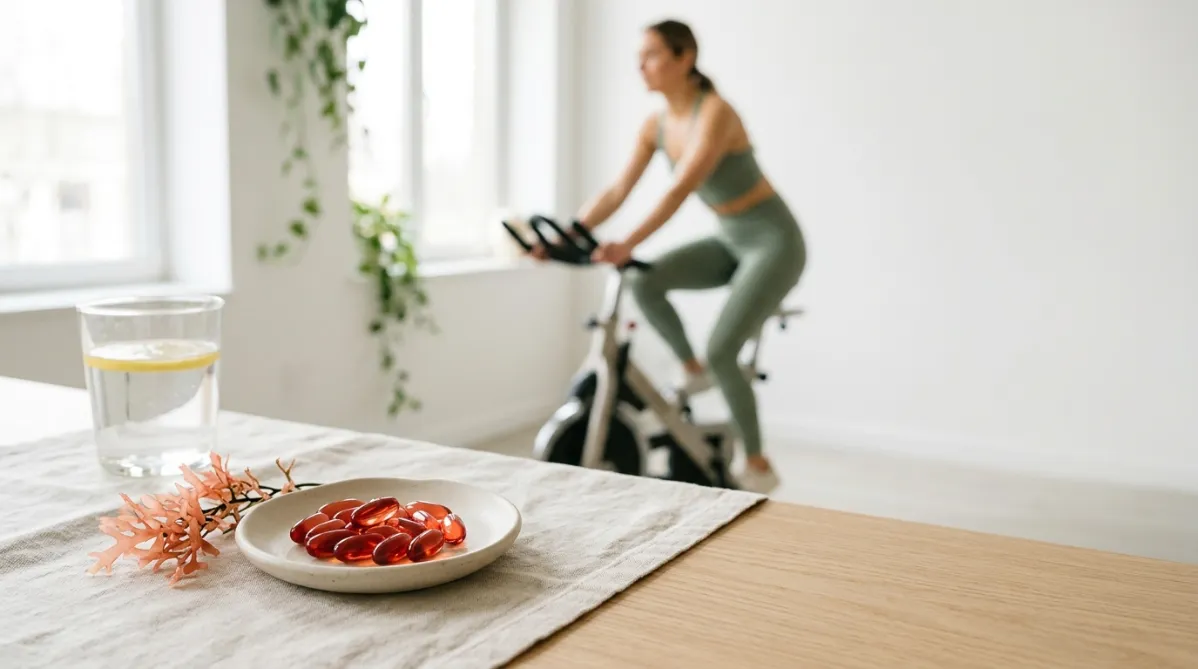
A wide, airy editorial photograph shot in soft morning light. In the foreground, a small matte ceramic dish holds a few deep coral-red softgel capsules, and a sprig of pink-orange wild salmon-toned microalgae sits beside it as a subtle nod to the nutrient's natural source. The capsules catch a warm glint and lie on a pale oatmeal linen cloth over a light oak surface. A glass of water with a thin lemon slice sits slightly out of focus nearby.

In the soft-focus background, a woman in sage-green athletic wear cycles on a stationary bike in a bright, minimalist studio with large windows, white walls, and a few trailing green plants. Her posture is relaxed and steady, which suggests moderate effort and calm breathing. Her face is turned slightly away from the camera, and the background blur is creamy and shallow.

The palette is restrained and modern: warm coral and salmon accents against cream, soft sage, pale wood, and diffused daylight. A gentle diagonal composition leads from the capsules at lower left toward the cyclist at upper right, with generous negative space on the right third for headline overlay. The style is clean and contemporary, like a wellness or science journal: natural film-like grain, subtle depth of field, and no text, graphs, or lab equipment. The mood is calm, healthy, and quietly credible.
Nutrition

Astaxanthin Shifted Women's Fuel Burn Toward Fat With Zero Extra Effort

Dr. Gymbro · · 3 min read

The Surprise: Same Effort, Different Fuel

Imagine pedaling at the same pace, with the same heart rate, the same blood lactate and the same perceived effort, while your body quietly leans more on fat for fuel. That is what a new randomized, double-blind, placebo-controlled crossover trial reported in women who took the carotenoid astaxanthin for two weeks. It does not prove fat loss, but it is one of the more interesting supplement findings aimed specifically at female exercisers.

The study, published in the Journal of Dietary Supplements (2026) by Barker, Starkey, O'Neal and Waldman, tested 12 mg per day of astaxanthin (AX). The result was a lower respiratory exchange ratio (RER) during submaximal cycling than with placebo.

What Is Astaxanthin, and Why Women?

Astaxanthin is a lipid-soluble carotenoid, the same family of pigments that gives some seafood its reddish color. Earlier studies testing whether it boosts fat oxidation during submaximal exercise were done mostly in men, and the results were mixed.

The researchers reasoned that females already rely more on fat oxidation during exercise. That could make women a group more likely to respond to a supplement that nudges fuel use toward lipids. This trial tested that idea directly.

How the Trial Worked

Twenty recreationally active females (average age 22 ± 2 years) completed an initial VO2max test to establish their maximum power output (Wmax). They then entered a counterbalanced crossover design:

  • Two weeks of astaxanthin (12 mg/day) or placebo
  • Two-week washout
  • Two weeks of the other condition

After each supplementation block, participants cycled continuously for 30 minutes. The ride had six 5-minute stages, starting at 40% of Wmax and rising in 5% steps to 65%. Data were collected during the final minute of each stage.

The Headline Result: Lower RER

RER is a gas-exchange marker. Lower values point toward more fat being burned, and higher values toward more carbohydrate. Across the whole ride, RER was significantly lower after astaxanthin than after placebo (main effect of supplement, p = 0.04). RER also rose with intensity, as expected (p < 0.001).

The authors interpret this as a shift toward a more lipid-dominant fuel preference during submaximal cycling.

The Plot Twist: Nothing Else Changed

Heart rate, blood lactate and rating of perceived exertion did not differ between astaxanthin and placebo at any intensity (all p > 0.05). The fuel mix appeared to shift without any measurable change in cardiovascular strain, metabolic stress or how hard the exercise felt.

The authors suggest the RER change occurred independently of systemic physiological or psychological stress. They also state plainly that the cellular mechanisms remain to be worked out.

Practical Takeaways

Dose: The study used 12 mg per day for two weeks. There is no evidence here for higher doses or longer use.

Timing with food: Astaxanthin is fat-soluble, so taking it with a meal that contains some fat is a sensible practical approach. The abstract does not test meal timing or composition, so treat this as a common-sense inference rather than a finding.

Who it might suit: The data apply to young, recreationally active women doing steady, moderate-intensity cardio. That includes female endurance and cardio trainees who want to improve fat use at submaximal paces.

What to expect: Do not expect a visible body-composition change from this paper. It measured fuel use during a ride, not weight, fat mass or performance.

Caveats You Need to Know

  • Small sample. Only 20 participants, all young and recreationally active, so the results may not apply to older women, trained athletes or men.
  • Fuel-use marker only. RER is an indirect estimate of substrate use. The study reported no fat-loss, body-composition or performance data.
  • Main effect only. There was no significant supplement × intensity interaction (p = 0.14). The data show lower RER overall, but they do not show that the effect is larger or smaller at particular intensities. The authors' wording about "specific submaximal intensities" should be read with that in mind.
  • Short duration. Two weeks of supplementation and a single exercise session per condition say nothing about long-term outcomes.
  • Mechanism unknown. Why astaxanthin changes fuel use here is unexplained.

Bottom Line

This is a promising, early-stage human result: 12 mg/day of astaxanthin for two weeks lowered RER during moderate cycling in active young women, with no change in heart rate, lactate or perceived effort. A shift in fuel use is not the same as burning more total fat or losing body fat. Larger and longer trials that track body composition and performance are needed before anyone calls astaxanthin a fat-loss tool. For now it is an interesting candidate for women who do steady-state cardio and want to experiment with a well-tolerated, fat-soluble supplement.
Original study

Read the original research on pubmed.ncbi.nlm.nih.gov →

This article summarizes published research for general information. It is not medical advice.

DG

Written by

Dr. Gymbro

Dr. Gymbro writes for Dr. Gymbro: science-backed fitness, nutrition & performance.

Related Articles

A softly lit, minimalist flat-lay composition in landscape format on a pale warm-beige linen surface. Three matching ceramic espresso cups in matte cream glaze sit in a graduated row from left to right. The first is filled a quarter of the way with dark, glossy coffee, the second halfway, and the third nearly to the brim. Fine wisps of steam curl up from each. The first cup is the clear focal point, sharply in focus and gently highlighted by a soft beam of morning window light. The other two sit slightly softer in the depth of field, which suggests that more is not necessarily better.

Beside the cups, a few scattered roasted coffee beans catch the light with a subtle sheen. A slim sage-green running shoe sits at the upper right edge of the frame, partly cropped, with its laces casually trailing. A small sprig of eucalyptus and a folded sheet of off-white paper with faint, minimal hand-drawn tick marks add an editorial, journal-like feel. In the lower left, a simple brass measuring spoon rests on the linen.

The palette is calm and modern: warm creams, soft terracotta accents, deep espresso browns, and muted sage green. Long, gentle shadows fall diagonally across the surface. The light is diffused and natural, with a slight film-like grain and a shallow depth of field. The overall look is clean, airy, and contemporary, like a health and wellness magazine feature or a trendy science-and-lifestyle blog. There is generous negative space on the right side of the frame for title overlay. The image has no text, no people, and no futuristic or technical elements, only an elegant, tactile, still-life mood that suggests balance, moderation, and mindful fitness.
science research

Caffeine Fat Burn: Why 3 mg/kg Beat the 9 mg/kg Mega-Dose

BY DR. GYMBRO ·

Think a bigger caffeine hit means more fat burned? A small randomized trial in overweight and obese young women found the opposite. Caffeine at 3 and 5 mg/kg raised fat oxidation during FATmax walking, while 9 mg/kg added nothing. Only 3 mg/kg avoided the rise in heart rate and blood pressure seen at higher doses. With just 11 participants and a single session per dose, the findings are promising but far from final.

A wide, landscape editorial photograph with soft natural morning light. In the foreground, a rustic matte ceramic bowl rests on a pale oak wooden table, filled with vivid deep-green spirulina powder heaped in a gentle mound. A small wooden spoon dusted with the powder lies beside it, and a few scattered green flecks dust the surface. Next to the bowl sits a clear glass of water with a swirl of emerald green just blending in, catching sunlight and casting soft green-tinted shadows.

In the middle ground, slightly out of focus, a pair of worn running shoes in muted sage and cream tones sits on the edge of the table, laces loosely undone. A simple analog stopwatch with a clean white face lies beside them, its hands frozen at a moment suggesting a close finish. A folded linen towel in warm oatmeal tone drapes casually nearby.

The background is a softly blurred outdoor setting seen through a large window: a quiet tree-lined running path at dawn, with golden-hazy light, dewy greenery, and a faint mist. The color palette is calm and modern: deep emerald, sage, cream, warm wood, and touches of soft gold. The composition leaves generous negative space on the right side for headline text, with a shallow depth of field, crisp detail on the powder texture, and a clean, minimalist, lifestyle-magazine aesthetic. Subtle film-like grain, natural shadows, and a fresh, healthy, energetic mood. No people, no text, no logos.
nutrition

Spirulina Helped Runners Last 32% Longer—Here's the Catch

BY DR. GYMBRO ·

Runners who took spirulina for four weeks lasted about 32% longer in an all-out effort after a brutal two-hour run. The same study found a 10.9% jump in fat oxidation and higher levels of the antioxidant glutathione. But before you stock up, there's a catch: only nine men took part, and the real-world gain was roughly 39 seconds. Here's what the research shows, why it might work, and how to try it safely.

recovery

Tart Cherry Cut Marathon Inflammation 37%, But Legs Felt the Same

BY DR. GYMBRO ·

A new marathon trial found tart cherry powder cut a key inflammation marker, hs-CRP, by roughly 37% compared with placebo. But the runners' strength, jump performance, soreness and muscle damage (CK) recovered no faster. The study tested a lesser-studied Vistula cultivar in 35 runners over a 7-day protocol, with the marathon on day 5. It was funded by an ingredient supplier, and the sample was small. Here is what it means if you're an endurance racer wondering whether lower inflammation is worth it when your legs feel the same.

supplements

Ecdysterone for Fat Loss? 30 mg Cut Arm Fat More Than Placebo

BY DR. GYMBRO ·

Ecdysterone is known as a natural anabolic, but a 12-week trial put it up against fat and blood sugar instead. Men taking 30 mg/day of asparagus-derived 20E while lifting three times a week lost more arm fat than those on placebo, and their fat oxidation, fasting insulin and insulin sensitivity moved in the right direction. The catch is a tiny sample of 10 per group, with most changes appearing only within the supplement group. Here's what held up against placebo, what didn't, and how to avoid underdosed products if you're tempted to try it.

This page is available in