Dr. Gymbro
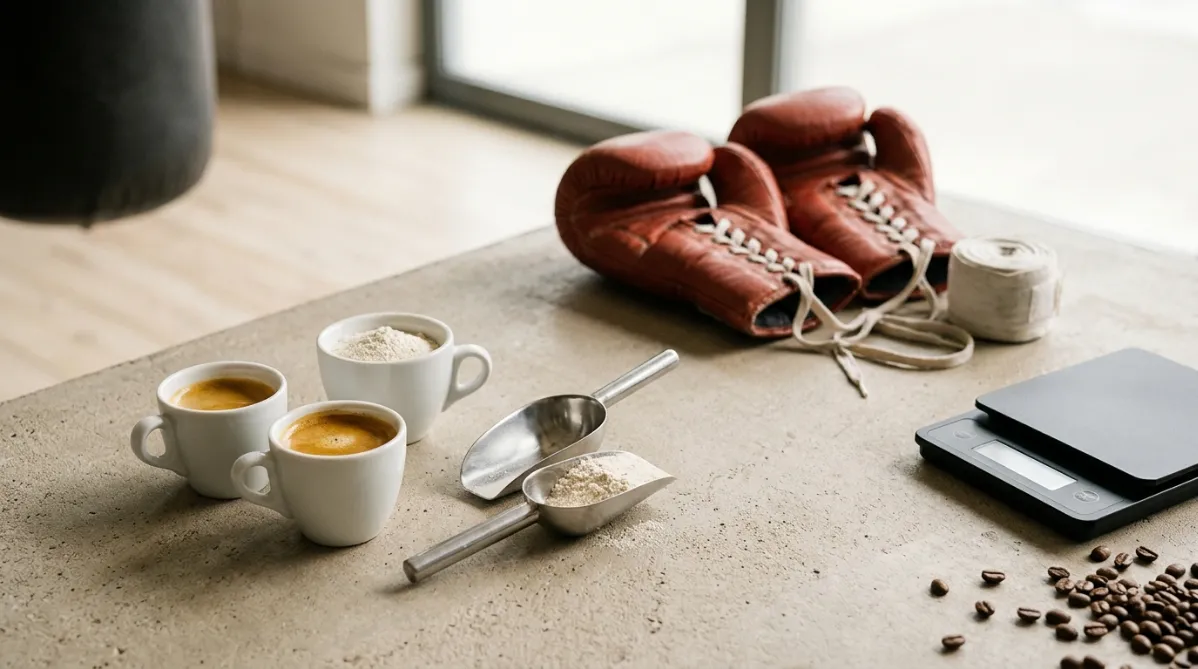
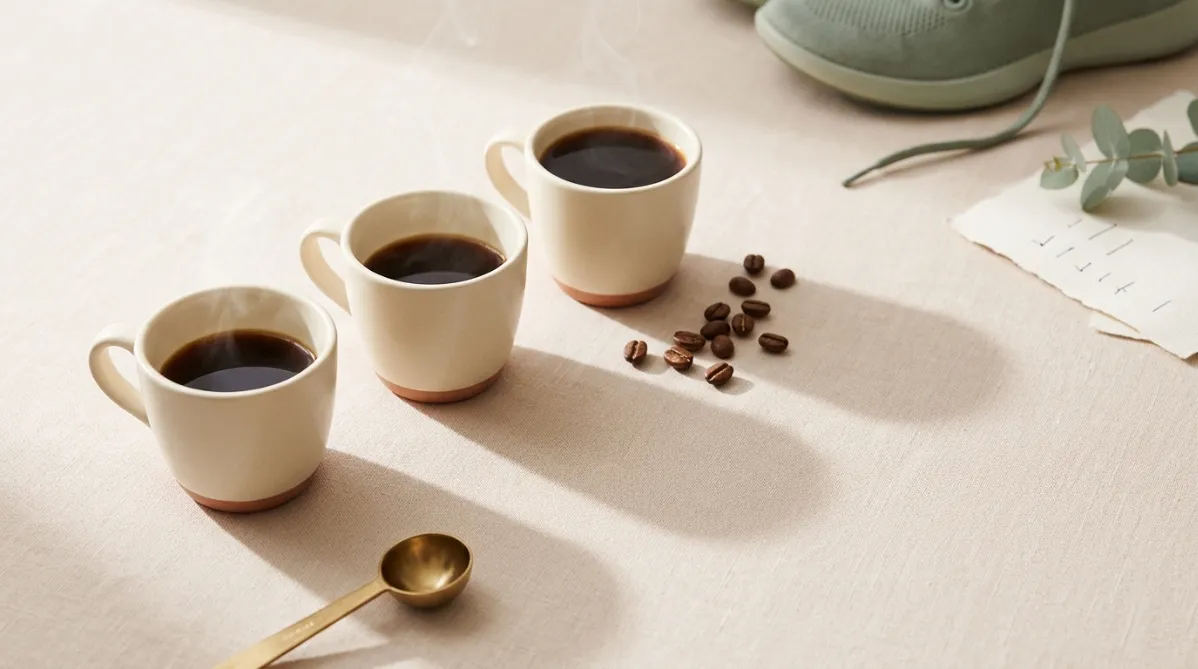
A softly lit, minimalist flat-lay composition in landscape format on a pale warm-beige linen surface. Three matching ceramic espresso cups in matte cream glaze sit in a graduated row from left to right. The first is filled a quarter of the way with dark, glossy coffee, the second halfway, and the third nearly to the brim. Fine wisps of steam curl up from each. The first cup is the clear focal point, sharply in focus and gently highlighted by a soft beam of morning window light. The other two sit slightly softer in the depth of field, which suggests that more is not necessarily better.

Beside the cups, a few scattered roasted coffee beans catch the light with a subtle sheen. A slim sage-green running shoe sits at the upper right edge of the frame, partly cropped, with its laces casually trailing. A small sprig of eucalyptus and a folded sheet of off-white paper with faint, minimal hand-drawn tick marks add an editorial, journal-like feel. In the lower left, a simple brass measuring spoon rests on the linen.

The palette is calm and modern: warm creams, soft terracotta accents, deep espresso browns, and muted sage green. Long, gentle shadows fall diagonally across the surface. The light is diffused and natural, with a slight film-like grain and a shallow depth of field. The overall look is clean, airy, and contemporary, like a health and wellness magazine feature or a trendy science-and-lifestyle blog. There is generous negative space on the right side of the frame for title overlay. The image has no text, no people, and no futuristic or technical elements, only an elegant, tactile, still-life mood that suggests balance, moderation, and mindful fitness.
Science & Research

Caffeine Fat Burn: Why 3 mg/kg Beat the 9 mg/kg Mega-Dose

Dr. Gymbro · · 3 min read

You'd expect tripling your caffeine dose to triple the fat-burning payoff. A new randomized trial suggests the opposite: the biggest dose did the least for fat oxidation, and the smallest dose that worked was the one that spared the heart.

The Study in 30 Seconds

Researchers led by Gong, publishing in the Journal of the International Society of Sports Nutrition, tested caffeine in a small group of overweight or obese, sedentary female college students. Eleven participants (average age 20.2, BMI 26.36 kg/m²) completed four sessions: placebo (cellulose) or caffeine at 3, 5, or 9 mg per kg of body weight (PubMed 42120324).

Each session had 60 minutes of seated rest, then 40 minutes of treadmill walking at FATmax, the intensity where the body burns the most fat. Indirect calorimetry tracked fuel use. Blood pressure, heart rate, and fingertip perfusion index (PI) tracked the cardiovascular response.

The Headline Finding: More Was Not Better

Both 3 and 5 mg/kg increased fat oxidation compared with placebo and with the 9 mg/kg dose (p < 0.05). The 9 mg/kg dose gave no added metabolic benefit, according to the authors.

Carbohydrate oxidation moved in the same direction. It was lower with 5 mg/kg than with placebo. Both the 3 and 5 mg/kg doses showed lower carbohydrate oxidation than the 9 mg/kg dose. Put simply, the moderate doses shifted fuel use toward fat, and the highest dose did not.

Caffeine did not change resting heart rate or substrate oxidation. The fat-burning effect showed up during exercise, not while sitting still.

The Catch: Your Heart Noticed

The cardiovascular data is where the story changes.

  • 3 mg/kg: no significant cardiovascular effects during exercise.
  • 5 mg/kg: significantly higher heart rate and blood pressure during exercise.
  • 9 mg/kg: also significantly higher heart rate and blood pressure.
  • All caffeine doses: PI decreased (p < 0.05). PI is a fingertip measure of peripheral perfusion.

The authors concluded that 3 mg/kg offers the best balance between stimulating fat oxidation and keeping cardiovascular strain down in this population. The 5 mg/kg dose raised fat oxidation too, but at the cost of extra cardiovascular strain.

Practical Takeaways

Dose. The tested sweet spot was 3 mg/kg. As an illustration, a 70 kg person would get about 210 mg of caffeine. The 5 mg/kg dose works out to about 350 mg, and the 9 mg/kg dose to about 630 mg. That is simple arithmetic, not a figure from the paper.

Timing. In the protocol, participants rested for 60 minutes after taking the capsule before a 40-minute walk. That is the only timing the data supports. The abstract does not say whether participants were fasted, so "fasted cardio" is not something this study can confirm.

Intensity. The exercise was walking at FATmax, a measured, moderate-intensity zone. The results should not be assumed to apply to hard intervals or long endurance sessions.

Who it may suit. The findings apply to sedentary, overweight or obese young women doing acute, low-intensity exercise. That is the group tested.

Who should be cautious or skip it. The abstract does not test people with heart or blood pressure problems. Because 5 and 9 mg/kg raised heart rate and blood pressure during exercise, anyone with hypertension or a cardiac condition, or anyone sensitive to caffeine, should talk to a clinician before experimenting. Skipping the higher doses is a sensible reading of this data for everyone.

Reality Check: What This Study Can't Tell You

This is a very small trial. Eleven participants is not enough to say the result holds across populations, and the data comes from one group of young women. Men, athletes, older adults, and people who use caffeine habitually were not studied, and the abstract does not mention habitual caffeine intake.

The study is also acute. It measured a single session, not weeks of training. Higher fat oxidation during a 40-minute walk does not mean more body fat lost over time, and the paper does not claim that. Fuel use during exercise is not the same as fat loss outcomes.

The PI drop across all caffeine doses is worth noting, but the abstract does not explain what it means clinically. Treat it as a signal that caffeine had measurable vascular effects, not as proof of harm.

Bottom Line

In this small randomized trial, 3 mg/kg of caffeine gave a fat-oxidation boost over placebo without the heart rate and blood pressure rise seen at higher doses. The 9 mg/kg dose added no metabolic benefit. The study supports a modest, body-weight-based dose rather than a bigger one, while leaving open questions about long-term results and other populations.

Source: Gong et al., Journal of the International Society of Sports Nutrition. DOI: 10.1080/15502783.2026.2670558.
Original study

Read the original research on pubmed.ncbi.nlm.nih.gov →

This article summarizes published research for general information. It is not medical advice.

DG

Written by

Dr. Gymbro

Dr. Gymbro writes for Dr. Gymbro: science-backed fitness, nutrition & performance.

Related Articles

A sunlit, minimalist kitchen counter in a modern home, photographed from a slightly elevated three-quarter angle with soft natural morning light spilling in from a window on the left. In the center sits a matte white ceramic mug of black coffee with a thin curl of steam, beside a small glass jar of deep magenta beetroot powder with a wooden scoop resting on the lid. A scattering of fine crimson powder dusts the pale oak surface in an artful, casual swirl. Nearby, a halved raw beetroot reveals vivid concentric rings of purple and pink, next to a few roasted coffee beans and a neatly folded charcoal gym towel. In the soft-focus background, a pair of clean white running shoes and a stainless steel water bottle sit on a floating shelf, hinting at a pre-workout routine. A single sprig of green beet leaves adds a fresh accent.

The color palette is warm and editorial: creamy neutrals, espresso browns, and rich beet magenta, with gentle highlights and long soft shadows. The composition has generous negative space on the right side for headline text, shallow depth of field, and a crisp, tactile texture on the ceramic, powder, and wood grain. The mood is calm, health-conscious, and contemporary, like a lifestyle feature in a premium wellness magazine or a trendy nutrition journal. Clean, balanced, natural, with subtle film-like grain and a slightly muted, high-end finish.
science research

Pre-Workout Caffeine Stiffens Arteries. Beetroot Powder Offset It

BY DR. GYMBRO ·

A new randomized crossover trial found that a pre-workout-sized dose of caffeine (6 mg/kg) raised markers of arterial stiffness within 2.5 hours. Adding a beetroot powder with 400 mg of nitrate brought those markers back to placebo levels. Blood pressure and endothelial function did not change, so this is a subtle effect rather than a red flag. The study involved just 24 healthy young adults and a single dose, leaving big questions about long-term use and older or hypertensive people. Here is what the data show, what they do not, and how to think about it if you rely on caffeine before training.

A sunlit outdoor running track in late afternoon, shot from a low angle with shallow depth of field. In the foreground, a matte black bottle with a minimal off-white label sits on the edge of a warm terracotta-colored track lane, beside a folded white towel and a small glass of amber liquid catching golden light. Condensation beads on the bottle. A faint heat shimmer rises from the track surface and softens the background.

In the midground, slightly out of focus, a lean athlete in a sage-green tank top and charcoal shorts runs on a treadmill-like stretch of track, a thin sheen of sweat on their shoulders, their expression focused and calm. Their motion is gently blurred, suggesting endurance and rhythm. Long soft shadows stretch across the lane lines.

The background fades into hazy peach, apricot, and pale yellow tones, with the suggestion of tall trees and a distant stadium wall. Warm sun flare enters from the upper right, creating a subtle glow and a few soft light streaks across the frame.

Subtle editorial touches: a small notebook with a pencil and a stopwatch rest beside the bottle, hinting at data and timing without any text legible. The color palette is warm and muted, with terracotta, cream, sage, and charcoal accents, and a fine film-like grain. The composition leaves open negative space on the left third for a headline overlay. The overall mood is clean, modern, and health-journal inspired, natural and aspirational, with a calm scientific curiosity rather than hype.
nutrition

Ketone Drinks in the Heat: Longer Endurance and Sharper Memory?

BY DR. GYMBRO ·

Ketone drinks are supposed to be for fat-burning biohackers, but a new heat-stress trial suggests they might also help you finish stronger. In 17 trained men, ketone monoester plus caffeine extended time to exhaustion to 8.9 minutes versus 7.0 with carbs plus caffeine, after 90 minutes of loaded treadmill work at 34 °C. Working-memory accuracy on the 1-back task improved too, while heart rate and core temperature didn't differ meaningfully. But 2-back, reaction time and the hit-and-avoid task showed no benefit, and the study was small, male-only and single-session. Here's what the data show, and what they don't.

A landscape editorial photograph with a modern, clean magazine feel, shot on a pale warm-gray concrete surface in soft natural window light from the left. In the foreground, two matte white ceramic espresso cups sit side by side. The left cup holds a small amount of dark espresso with golden crema. The right cup is filled twice as high. Beside them, two small stainless steel scoops hold fine coffee-colored powder, one half full and one heaped, suggesting a dose comparison without any text or labels. A pair of worn red leather boxing gloves rests slightly out of focus behind the cups, laces loosely draped, with a white hand wrap rolled neatly beside them. A minimalist digital kitchen scale in matte black sits at the edge of the frame, with a few roasted coffee beans scattered across the surface. In the soft-focus background, a boxing gym corner appears: a hanging heavy bag in muted charcoal, pale wood plank flooring, and a tall window with diffused morning light. The palette is warm cream, espresso brown, brick red, and soft slate gray, with gentle shadows and a shallow depth of field. The composition follows the rule of thirds, with the cups and scoops in the lower left third and open negative space on the right for headline overlay. The look is tactile and refined, like a high-end health and performance journal. It has natural grain, subtle contrast, and a calm, confident mood. There are no people, no text, no logos, and no futuristic elements.
nutrition

Doubling Your Caffeine Barely Helped Boxers—Here's What Did

BY DR. GYMBRO ·

Think a double scoop of pre-workout means double the performance? A new crossover trial in 15 competitive boxers compared 3 mg/kg and 6 mg/kg of caffeine, and the bigger dose was not consistently better. Both doses raised jump height and power at 60 minutes, while 6 mg/kg only pulled ahead on a few outcomes like ballistic push-up power and knee torque. Here is the mg-per-kg conversion for common body weights, the timing the data supports, and the honest caveats, including that punching itself was never tested.

A wide, landscape editorial photograph with soft natural morning light. In the foreground, a rustic matte ceramic bowl rests on a pale oak wooden table, filled with vivid deep-green spirulina powder heaped in a gentle mound. A small wooden spoon dusted with the powder lies beside it, and a few scattered green flecks dust the surface. Next to the bowl sits a clear glass of water with a swirl of emerald green just blending in, catching sunlight and casting soft green-tinted shadows.

In the middle ground, slightly out of focus, a pair of worn running shoes in muted sage and cream tones sits on the edge of the table, laces loosely undone. A simple analog stopwatch with a clean white face lies beside them, its hands frozen at a moment suggesting a close finish. A folded linen towel in warm oatmeal tone drapes casually nearby.

The background is a softly blurred outdoor setting seen through a large window: a quiet tree-lined running path at dawn, with golden-hazy light, dewy greenery, and a faint mist. The color palette is calm and modern: deep emerald, sage, cream, warm wood, and touches of soft gold. The composition leaves generous negative space on the right side for headline text, with a shallow depth of field, crisp detail on the powder texture, and a clean, minimalist, lifestyle-magazine aesthetic. Subtle film-like grain, natural shadows, and a fresh, healthy, energetic mood. No people, no text, no logos.
nutrition

Spirulina Helped Runners Last 32% Longer—Here's the Catch

BY DR. GYMBRO ·

Runners who took spirulina for four weeks lasted about 32% longer in an all-out effort after a brutal two-hour run. The same study found a 10.9% jump in fat oxidation and higher levels of the antioxidant glutathione. But before you stock up, there's a catch: only nine men took part, and the real-world gain was roughly 39 seconds. Here's what the research shows, why it might work, and how to try it safely.

This page is available in