Dr. Gymbro
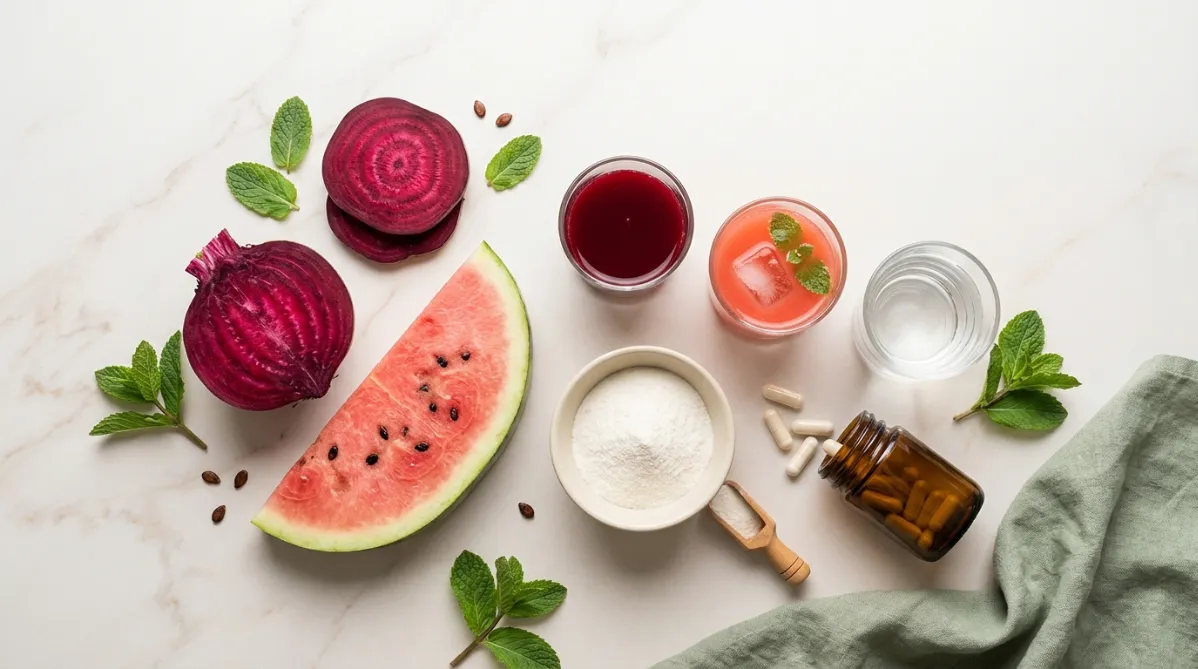
A bright, editorial flat-lay photograph shot from directly above on a pale warm-white marble surface with soft diffused morning light. In the center-left, a halved deep magenta beetroot sits beside a thick wedge of watermelon with vivid pink-red flesh and a crisp green rind. A few scattered black watermelon seeds add contrast. To the right, a small matte ceramic bowl holds fine white citrulline powder, with a minimal wooden scoop resting beside it. Next to it, a few loose off-white capsules spill from a small amber glass jar. Three small glass tumblers in a neat diagonal row hold beetroot juice, watermelon juice, and clear water, each catching soft highlights. Thin sprigs of mint and a few sliced rounds of beetroot showing concentric ruby rings are arranged organically around the edges. A folded linen napkin in muted sage green adds a calm, textural accent. The palette is magenta, coral pink, sage green, and cream, with gentle natural shadows and shallow depth of field at the edges. The composition leaves clean negative space in the upper right for title text. The mood is fresh, modern, and clean, like a contemporary health and nutrition magazine cover, with crisp detail, subtle grain, and a refined, minimalist styling.
Recovery

Beetroot vs Watermelon vs Citrulline: Who Wins Soreness Day 2?

Dr. Gymbro · · 4 min read

You hammered legs on Monday. By Wednesday you are descending stairs like a newborn giraffe. Supplement shelves promise relief: beetroot shots, watermelon juice, citrulline malate tubs, arginine pills. A new network meta-analysis tried to rank them head to head for delayed onset muscle soreness (DOMS). The answer changes depending on which day you ask, and nobody beat placebo by day three.

Here is what the paper found, and, just as important, how shaky it is.

The Quick Scoreboard

The study, published in Frontiers in Nutrition (2026), pooled 19 randomized, placebo-controlled trials with 356 healthy adults. Results are standardized mean differences (SMDs) versus placebo, where negative means less soreness.

  • 24 hours: Watermelon plus added citrulline (SMD -0.97, 95% CI -1.64 to -0.31) and beetroot-derived nitrate (SMD -0.67, 95% CI -1.14 to -0.20) both significantly reduced DOMS.
  • 48 hours: Beetroot nitrate was the only intervention with a significant benefit (SMD -1.18, 95% CI -1.91 to -0.45).
  • 72 hours: No active intervention differed significantly from placebo.

The source is the PubMed record (PMID 42959749) and the DOI link.

What Was Actually Compared

The authors grouped nitric oxide (NO) precursors into four "nodes": beetroot-derived nitrate, watermelon-derived citrulline, synthetic or isolated amino acid precursors (L-arginine and citrulline malate lumped together), and watermelon plus added citrulline. Note the lumping. Citrulline malate and L-arginine were not analyzed separately, so the paper cannot tell you which of those two performed better than the other.

The rationale is that these compounds may boost nitric oxide availability, which could influence blood flow and recovery after hard or unfamiliar exercise. The paper tests whether soreness differs, not whether that mechanism is responsible.

Day 1: Watermelon Plus Citrulline Takes the Crown

At 24 hours, watermelon combined with added citrulline posted the largest effect of any option. It was also the only intervention to show a statistically significant advantage over the isolated amino acid group (L-arginine and citrulline malate) in the head-to-head comparisons. That is the headline for anyone who assumed the pills would beat the fruit.

But context matters. Evidence for differences between active treatments was described as limited, and this was the single such contrast that reached significance. Watermelon-derived citrulline alone did not show a significant benefit versus placebo at 24 hours in the reported results.

Day 2: Beetroot Is the Last One Standing

By 48 hours, the field thinned out. Beetroot nitrate was the only intervention still separating from placebo, with the biggest effect in the paper (SMD -1.18). If your soreness peaks around day two, which is common for DOMS, this is the finding that stands out.

There is a caveat. The authors report that the beetroot estimate was sensitive to some restrictions related to the exercise-induced muscle damage model used in the trials. In plain terms, the result shifted depending on which kinds of damage protocols were included, so it is not rock solid.

Day 3: Nothing Beat Placebo

At 72 hours, no active supplement differed significantly from placebo. Either soreness had largely resolved on its own, the trials lacked power, or the supplements simply do not help late in recovery. The paper does not settle which. The honest takeaway is that none of these options showed a measurable edge by day three.

Beetroot Only Helped Trained People

In subgroup analysis, beetroot nitrate significantly reduced DOMS versus placebo in trained participants but not in untrained ones. That is a surprise, since untrained people often get the worst soreness. Subgroup analyses are typically exploratory and based on fewer studies, so treat this as a hypothesis, not a rule.

Why You Should Be Skeptical

The authors themselves say the sparse network, substantial heterogeneity, and low certainty of evidence "preclude firm clinical conclusions." Ranking probabilities (SUCRA) were labeled exploratory. All trials were in healthy adults, so the findings do not extend to clinical populations. Trials differed in how they induced muscle damage, in dose, and in duration, and the paper summary does not give a single recommended dose or timing protocol.

Practical Takeaways

Dose and timing: The abstract does not specify optimal doses or timing, so this review cannot tell you exactly how much to take or when. Follow the product label or the protocol of the individual trials, and treat any precise number you see online with caution.

Who might consider it:

  • Trained lifters or athletes curious about beetroot nitrate for day-two soreness
  • Anyone wanting a food-based option, since both beetroot and watermelon are whole-food sources

Who should be cautious or skip it:

  • Untrained beginners expecting beetroot to fix their first brutal leg day, since the benefit was not significant in that subgroup
  • Anyone hoping a supplement helps at day three, since nothing beat placebo then
  • People on blood pressure medication or with medical conditions should check with a clinician before adding nitrate or amino acid supplements. This is general caution, not a finding of the paper.

The Bottom Line

The comparison is tantalizing: watermelon plus citrulline looked best at 24 hours and beat isolated amino acid pills, beetroot nitrate was the only one still working at 48 hours, and by 72 hours it was a wash. But with low-certainty evidence from a sparse network, this is a guide for further research, not a recipe for guaranteed recovery. Sleep, protein, and gradual training progression still do the heavy lifting.
Original study

Read the original research on pubmed.ncbi.nlm.nih.gov →

This article summarizes published research for general information. It is not medical advice.

DG

Written by

Dr. Gymbro

Dr. Gymbro writes for Dr. Gymbro: science-backed fitness, nutrition & performance.

Related Articles

A wide, editorial-style flat lay photographed from above on a pale warm-gray concrete surface, lit by soft natural window light with gentle long shadows. On the left, two matte ceramic bowls in muted sage green and cream sit side by side. One holds fine white crystalline powder, the other holds slightly coarser off-white powder. Between them, a small brass measuring scoop rests on the surface, dusted with powder. Behind the bowls, two simple amber glass jars with minimal cream labels and no legible text stand slightly out of focus.

On the right side, a pair of chalk-dusted black hex dumbbells and a worn leather lifting strap curve across the frame. A folded charcoal gym towel sits beneath them. A rumpled matte-black shaker bottle lies on its side near the top edge. A slice of watermelon, the natural source of citrulline, sits on a small white ceramic plate in the lower center. Its vivid coral-pink flesh and dark seeds add a saturated pop of color against the neutral palette. A few loose watermelon seeds and a scattering of white powder dust trail across the surface toward the dumbbells, tying the composition together.

In the lower left corner, an open notebook with blank cream pages holds a slim silver pen and a minimalist analog stopwatch. A thin line of hand-drawn tally marks suggests counted reps, with no readable words or numbers.

The palette is restrained and contemporary: warm grays, sage, cream, charcoal, and amber, with the watermelon's coral-pink as the single bright accent. The mood is calm, clean, and precise, like a modern wellness or science-journal feature. Shallow depth of field keeps the powder bowls and watermelon crisp while the background items soften slightly. Generous negative space across the upper center leaves room for a headline overlay. The photograph looks high-end and tactile, with a subtle film-grain finish.
nutrition

L-Citrulline vs Citrulline Malate: The Upper-Body Endurance Twist

BY DR. GYMBRO ·

Everyone argues over whether plain L-citrulline or citrulline malate is the better buy, but a new six-week trial found something more interesting. Both forms beat placebo for upper-body reps to failure, and both raised nitric oxide metabolite responses. The catch: neither form improved 1RM strength, and the leg results were only a trend. With just 33 trained men in the study, this is a promising signal rather than a verdict. Here's what the doses, timing questions, and fine print mean for your training.

A wide landscape editorial photograph of a lone male distance runner, seen from behind in soft three-quarter profile, pausing on a red-clay outdoor running track at golden hour. He wears a minimalist charcoal singlet and fitted shorts, with a faint sheen of sweat on his calves and shoulders. His hands rest loosely on his hips as he catches his breath, and the white lane lines curve gracefully into the distance. Low amber sunlight rakes across the track and casts long, soft shadows. A hazy line of trees and a pale peach sky blur into creamy bokeh behind him.

In the lower foreground, slightly out of focus, a small matte ceramic dish holds a few pomegranate seeds and halved walnuts, a nod to the natural food sources of urolithin A. Beside it sits a minimalist amber glass supplement bottle with a plain cream label, and a stopwatch lies face-up on the track's edge. The stopwatch is blurred just enough to read as an object, not a number.

The palette is warm and earthy, with terracotta, burnt orange, soft cream, and muted sage green. The look is refined and contemporary, like a high-end wellness or sports-science magazine, with natural film-like grain, shallow depth of field, and gentle contrast. The composition follows the rule of thirds. The runner sits in the right third, the still life anchors the lower left, and open negative space in the upper left leaves room for a headline overlay. The mood is calm and thoughtful, suggesting recovery, measured results, and quiet scientific skepticism rather than hype. No text, no logos, no futuristic elements.
nutrition

Urolithin A Didn't Make Elite Runners Faster—But Cut Muscle Damage

BY DR. GYMBRO ·

Urolithin A has been marketed as a "mitochondria supplement," so researchers tested it on elite male runners with a VO2max around 66. It did not make them faster over 3000 m. It did lower the muscle-damage marker CK and the athletes' perceived effort after racing. VO2max rose 5.4% in the UA group versus 3.6% on placebo, but that difference was not statistically significant. Here is what 1000 mg a day for four weeks did and didn't do, and what to keep in mind about the small samples and industry ties.

A wide, editorial-style still life shot from a slightly elevated angle on a pale oak laboratory-meets-kitchen countertop, bathed in soft, diffused morning window light. In the center, two small matte ceramic bowls sit side by side: one holds fine white creatine powder, the other holds slightly coarser off-white L-arginine crystals. A brushed steel scoop rests beside each. Between and slightly behind them stands a clear glass shaker bottle filled with a cloudy, pale liquid, catching a gentle highlight. In the foreground, a minimalist analog stopwatch lies on the wood surface, its face crisp and legible, next to a folded sheet of off-white paper with a hand-drawn simple bar chart in charcoal pencil, with one tall bar and a few shorter ones, no text or numbers. In the soft-focus background, a blurred gym-style window view shows a pale running track and a muted sage-green hedge, suggesting sprinting and athletic testing without any people. Eighteen small smooth stones or white pills are arranged in a neat loose arc across the lower edge of the frame, a subtle nod to the small sample size, with one stone set slightly apart. The color palette is calm and modern: warm cream, bone white, soft sage, muted terracotta accents from a small clay dish, and thin touches of brushed metal. Shadows are long and gentle, the depth of field shallow, with a fine film-like grain. The composition leaves generous negative space on the left third for a title overlay. The mood is clean, thoughtful, and trustworthy, like a contemporary health and science journal cover, with no futuristic elements, no glowing effects, and no text.
nutrition

Creatine Plus L-Arginine Added ~99 W Peak Power. Here's the Catch

BY DR. GYMBRO ·

A new crossover trial found that taking creatine and L-arginine together an hour before testing raised peak sprint power by about 99 W over placebo. The stack also beat each supplement alone on peak power and countermovement jump height. But the researchers couldn't prove the two work synergistically, and the study had only 18 men. Here's what the numbers show, how the doses worked, and who should be cautious.

A wide, bright editorial photograph of a male athlete captured mid-jump in a minimalist, sunlit indoor training studio with pale concrete floors and tall windows. He is suspended at the peak of a plyometric box jump, knees tucked, with soft natural light and gentle motion blur at his feet. In the foreground, slightly out of focus, sits a small matte amber glass jar with a plain cream label, its lid resting beside it. Next to it are a few creamy white capsules spilled on a light oak wooden plyo box. A clear glass of water and a folded gray towel sit nearby.

The color palette is fresh and modern: warm off-white, sage green, soft sand, and touches of muted terracotta. A few green leaves of a potted fiddle-leaf plant in the corner add an organic feel. Shadows are long and soft, and the atmosphere is calm, clean, and health-focused, like a high-end wellness magazine spread.

The composition follows the rule of thirds. The jumping figure sits on the right third, and the supplement jar and capsules anchor the lower left. Negative space in the upper left leaves room for a headline overlay. The depth of field is shallow with a creamy bokeh background, shot on a 50mm lens with a subtle film-like grain. The overall look is crisp, airy, and contemporary, a lifestyle science journal cover aesthetic with no text, no logos, and no futuristic elements.
recovery

This Probiotic Strain Cut Muscle Damage After 100 Max Jumps

BY DR. GYMBRO ·

A new randomized trial suggests a specific probiotic, L. plantarum GKK1, may soften the blow of a brutal plyometric session. After four weeks at 1.0 × 10^11 CFU per day, 48 untrained men did 100 maximal jumps and the supplemented group lost less jump, strength, and Wingate performance than placebo. Muscle damage markers like CK and myoglobin, plus hs-CRP, TBARS, and urinary 3-methylhistidine, also looked better. But the study is small, limited to untrained men, and involves authors from the strain's manufacturer. Here is what the data show and who might actually benefit.

This page is available in