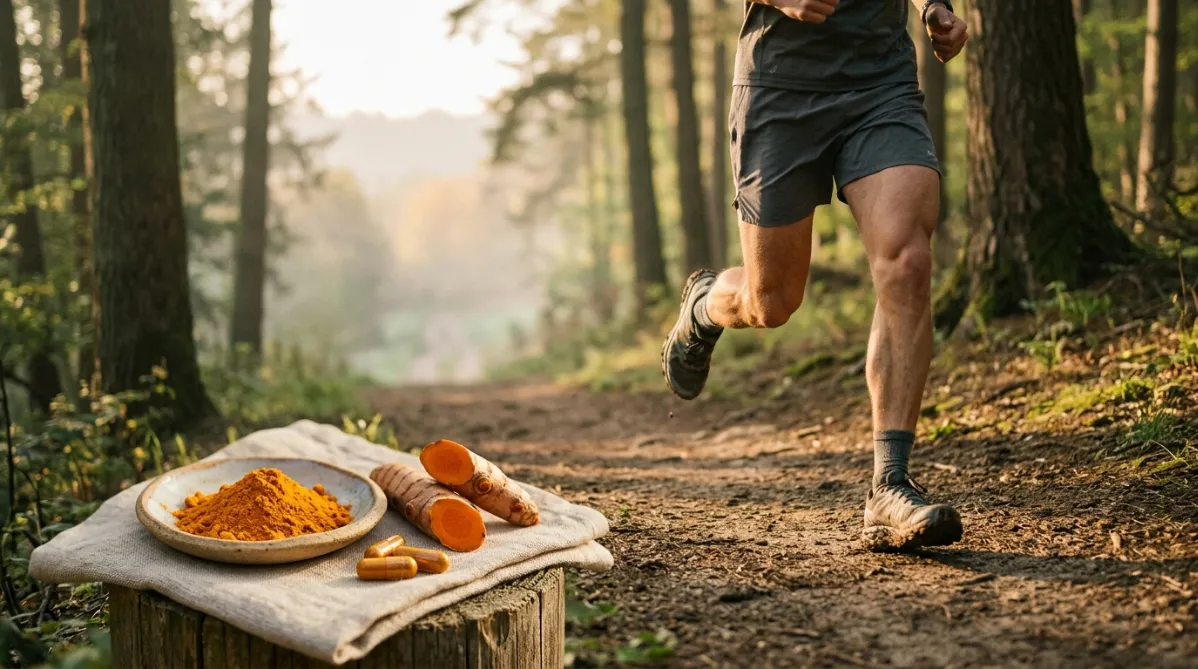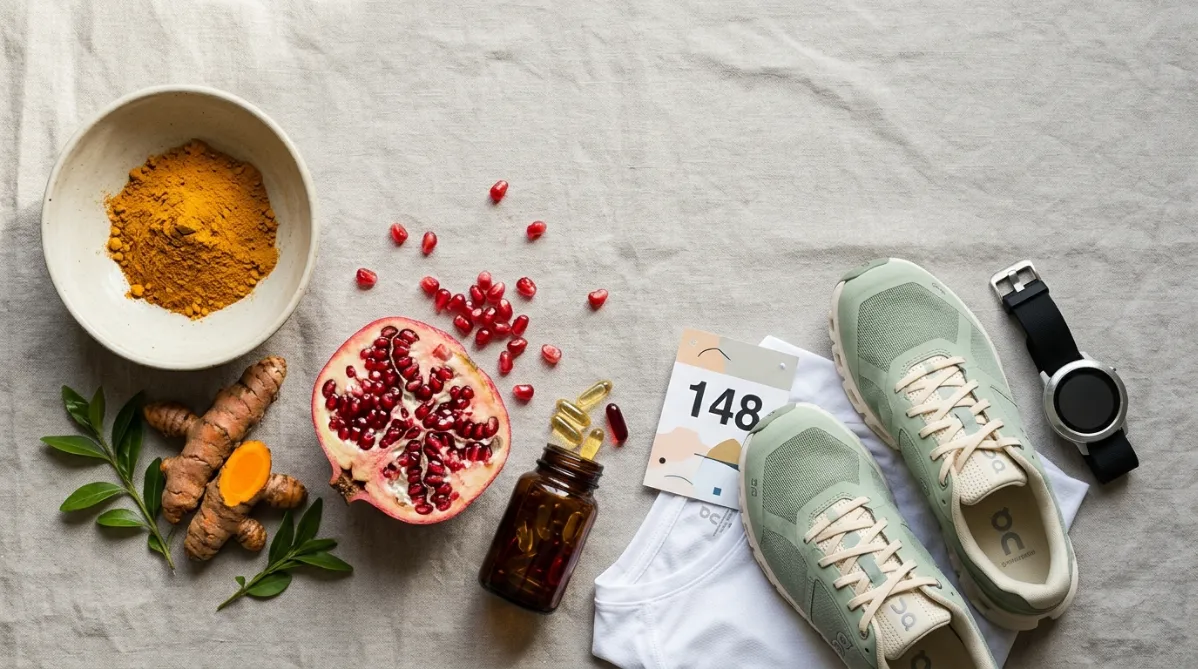
Twenty-seven runners. One half marathon. Twenty-eight days of either a curcumin-and-pomegranate capsule or a placebo. Then researchers looked at what the race did to 774 immune-related genes in the blood. The supplement group's genetic response looked different. Before you rush to the supplement aisle, though, you need to know what this study did and did not measure.
The Headline Numbers
The study, published in Genes & Nutrition in 2026 by Brian McFarlin and colleagues, tested a branded polyphenol blend called Restoridyn, made by Verdure Sciences. It combines standardized curcuminoids with pomegranate ellagitannins. The full paper is open access at https://doi.org/10.1186/s12263-026-00825-9.
Two figures stand out:
- At 2 hours post-race: the average differential expression change in the supplement group reflected 25% less suppression of immune pathways than in the placebo group.
- At 4 hours post-race: the average change reflected a 232% enhancement of activation in pathways tied to recovery.
Those are the numbers a headline writer loves. They are also averages of gene-expression shifts, not a measure of how runners felt or performed.
How the Study Worked
Participants were randomized to the blend (1,000 mg per day, n = 13) or a placebo (n = 14) for 28 days before running a half marathon. Blood was drawn before the race (PRE), then 2 hours (2H) and 4 hours (4H) afterward. The team extracted RNA and analyzed the expression of 774 mRNAs mapped to 40 immune response pathways using a standardized panel.
This is a molecular snapshot of the innate immune system's reaction to prolonged exertion. It is not a trial of whether the runners recovered faster.
What Changed at 2 Hours
Hard, long exercise tends to push immune signaling around. Some pathways switch on and others get suppressed. At the 2-hour mark, the supplement group showed a more muted pattern:
- Attenuated activation: T-cell activation and NK cell cytotoxicity.
- Blunted activation: Type 1 interferon signaling.
- Reduced suppression: JAK-STAT, inflammatory signaling, lipid metabolism, and stress response/DNA damage pathways.
In plain terms, the blend appeared to take the edge off the immediate genetic shock of the race, with less dramatic swings in either direction.
What Changed at 4 Hours
This is where the 232% figure comes from. At 4 hours, the supplement group showed greater activation across interferon signaling, JAK-STAT, growth signaling, apoptosis regulation, metabolic recovery, mTOR/nutrient sensing, and transcriptional regulation. Those are the kinds of pathways associated with cleanup, repair, and returning to baseline.
The authors interpret this as improved immune responsiveness after a long event, which may translate to faster resolution of inflammation and return to normal function. The word to underline is may. The paper shows a gene-expression pattern consistent with that idea. It does not show that the runners actually recovered faster.
The Honest Caveats
This is where the clickbait has to stop and the fine print begins.
- Biomarkers, not outcomes. The study measured mRNA expression. It did not report soreness, muscle damage, or race performance as outcomes.
- Small sample. With 13 people on the supplement and 14 on placebo, the findings are exploratory and need replication in larger groups.
- Short window. Blood was sampled only up to 4 hours post-race, so we don't know what happened over the following days.
- Percentages are averages. The 25% and 232% figures summarize average differential expression changes across pathways. They are not a 232% improvement in recovery.
- Branded product. Restoridyn is a Verdure Sciences product, and the results apply to that specific blend. Check the paper's disclosures for funding and competing interests, and don't assume plain curcumin powder or pomegranate juice would do the same.
- Runners only. The authors suggest broader implications for other physical stressors, but that is a hypothesis, not a finding.
The introduction of the paper notes that similar blends have previously been reported to improve recovery through reduced muscle injury and optimized inflammation. This study adds a molecular layer to that story, but it doesn't close the loop.
Practical Takeaways
Dose and timing used in the study: 1,000 mg per day of the standardized curcuminoid and pomegranate ellagitannin blend, taken for 28 days leading up to the race. The paper's design doesn't tell us whether a shorter loading period would work, or whether taking it after the race adds anything.
Who might find it interesting: endurance athletes, especially those preparing for long events, who want to try an evidence-informed supplement and accept that the evidence is still early. Researchers and coaches tracking recovery science will also want to follow this line of work.
Who should be cautious or skip it: anyone looking for a proven performance or soreness fix, because this study didn't test either. This is general caution rather than something the paper tested: people who are pregnant, have gallbladder or bleeding concerns, or take blood thinners or other medications should talk to a clinician before starting concentrated curcumin or polyphenol supplements.
Smart approach: treat this as a promising signal, not a recovery guarantee. Sleep, carbohydrate and protein intake, and sensible training load remain the proven foundations of recovery.
The Bottom Line
The curcumin-pomegranate blend measurably changed how runners' immune genes responded to a half marathon, with less suppression at 2 hours and stronger activation of recovery-linked pathways at 4 hours. That is a real and interesting result. What it doesn't yet prove is that you'll feel better, bounce back sooner, or run faster. The next step is larger trials that pair these gene-level readouts with the outcomes athletes actually care about.
Source: McFarlin BK, Paschall AL, McFarlin MA, et al. Genes & Nutrition, 2026. https://doi.org/10.1186/s12263-026-00825-9