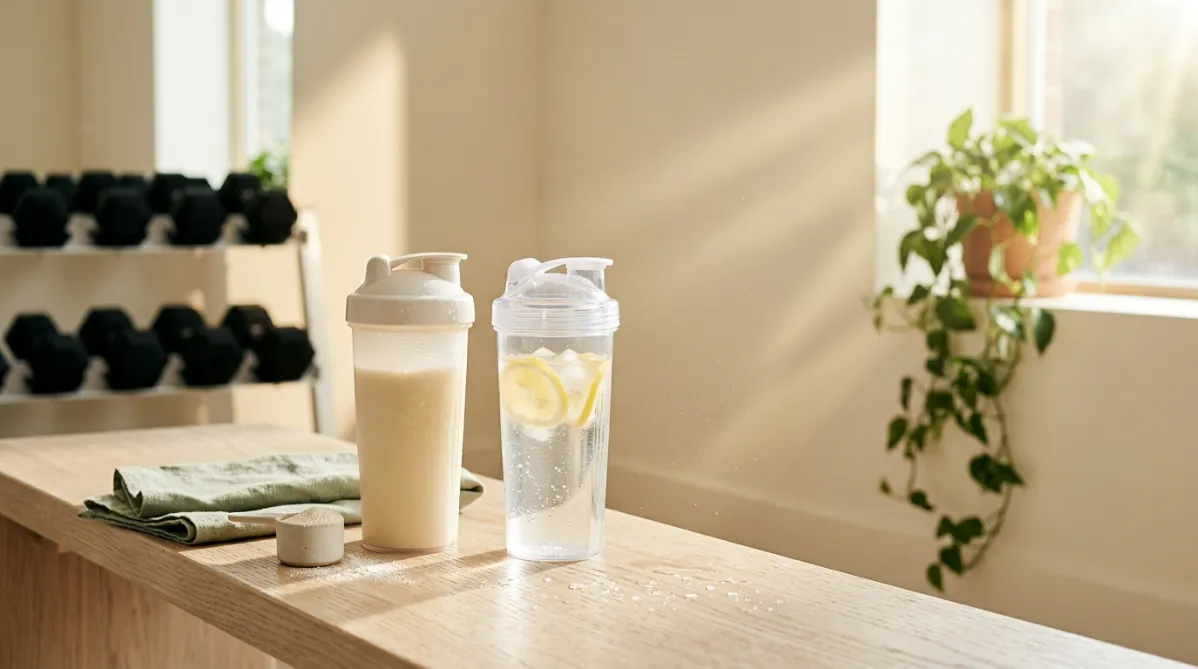
You nailed the workout, grabbed 45 g of whey, and downed it within minutes. But if you finished the session parched, a new randomized trial suggests that shake may not have delivered its amino acids as efficiently as you assumed.
The Big Finding: Dehydration Blunted the Amino Acid Surge
Researchers led by Xin and colleagues published the trial in Nutrients (2026) under the title "Exercise-Induced Dehydration Limits the Effectiveness of Post-Exercise Whey Protein Supplementation in Healthy Young Men." (PubMed | DOI: 10.3390/nu18193267)
The headline result: when men lost about 2.2% of body mass during exercise without replacing fluids, their blood amino acid response to whey was weaker 60 minutes after ingestion. Compared with both the half-replacement and full-replacement trials, the dehydrated trial showed lower concentrations of:
- Total amino acids
- Branched-chain amino acids (BCAAs)
- Leucine
- Isoleucine
- Glutamine
Whey still raised amino acid levels in every trial. The issue was a blunted early response, not a failed shake.
How the Study Worked
Thirteen healthy young men completed three partially crossover trials, each designed to produce a different level of hydration:
| Trial | Fluid replacement | Measured body mass loss |
|---|---|---|
| DEH | None | 2.20 ± 0.19% |
| EUH_50% | 50% of losses | 1.18 ± 0.30% |
| EUH | 100% of losses | 0.27 ± 0.35% |
Within 5 minutes of finishing exercise, participants drank 45 g of whey protein dissolved in 450 mL of water. Researchers measured serum amino acids before exercise, right after exercise, and at 60 and 120 minutes after ingestion.
The abstract highlights the 60-minute difference. It does not report a dehydration penalty at other timepoints, so the safest reading is that the early amino acid response took the hit.
Why This Matters for Your Recovery
Post-workout protein is a staple of recovery routines. This study asks a question many lifters never consider: does your hydration status change what you get out of the shake? According to the authors, inadequate fluid intake during exercise may compromise the efficacy of whey supplementation for recovery.
However, this study measured blood amino acid levels, not muscle protein synthesis, muscle growth, or strength. Lower circulating leucine at 60 minutes is a meaningful signal, but it doesn't prove you'll build less muscle. The paper doesn't show that, and you shouldn't assume it.
Practical Takeaways
The tips below on hydration go beyond the trial itself. They reflect general sports-nutrition practice, not findings from this paper.
Dose and timing (from the study): 45 g of whey in 450 mL of water, consumed within 5 minutes after exercise. That is a fairly large dose, so you don't need to copy it exactly. The point is that hydration status mattered at that dose and timing.
Hydration habits worth adopting:
- Start hydrated. Drink fluids in the hours before training rather than playing catch-up afterward.
- Sip during the session. The study's contrast was no fluid replacement versus partial or full replacement. Drinking during exercise is the clear lever.
- Weigh yourself before and after. A rough rule of thumb is that each kilogram lost is about a liter of fluid. Aim to keep losses small. The ~2% mark in this study is where the amino acid response dipped.
- Don't rely on the shake for rehydration. Even 450 mL of shake liquid is unlikely to cover a big sweat deficit. Drink additional fluids.
- Check urine color as a rough everyday gauge of hydration.
Who Should Care Most
This matters most for people who train in heat, do long or high-sweat sessions, or habitually skip water during workouts and then rely on a shake to drive recovery. The study population was healthy young men, so that's where the evidence applies.
Who Should Be Cautious or Skip the Takeaways
- Women, older adults, and adolescents: These groups weren't studied, so the findings may not apply.
- People with kidney disease or medical fluid restrictions: Talk to a clinician before changing fluid or protein intake.
- Anyone with a milk allergy or whey intolerance: Whey isn't appropriate.
- Light exercisers who barely sweat: If you lose almost no body mass, you're closer to the well-hydrated trials than the dehydrated one.
Honest Limitations
- Small sample: Only 13 participants.
- Surrogate outcome: Serum amino acids, not muscle building or performance.
- Short window: Measurements ran only 120 minutes after ingestion.
- Single protein dose and type: Results may not generalize to other doses or sources.
- Mechanism unclear: The abstract doesn't establish why dehydration blunted the response, so any explanation is speculation.
The Bottom Line
In this trial, losing about 2.2% of body mass without replacing fluids was associated with a weaker early amino acid response to 45 g of whey. The fix is simple and cheap: drink during training so you finish the session closer to your starting weight. It won't turn a shake into magic, but it may help you get what you paid for.
Source: Xin Z, Gao M, Wu X, See M, Cheng P, Yan Y. Nutrients. 2026. PubMed 42884718 · DOI