Dr. Gymbro
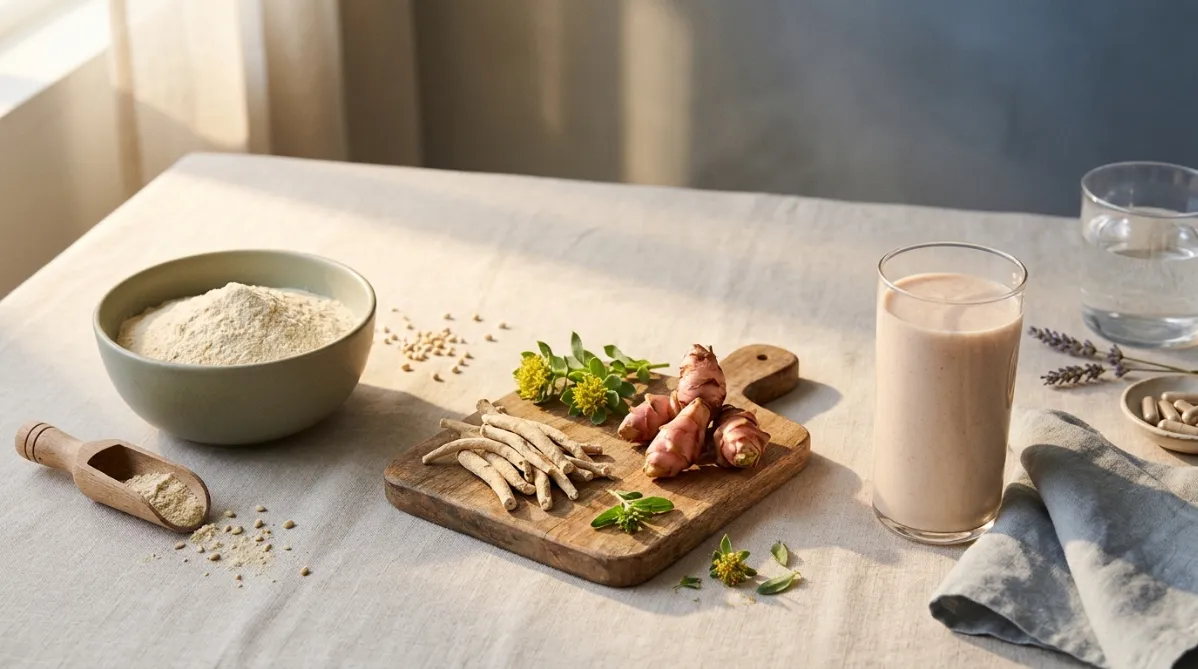
A calm, softly lit flat-lay on a pale oat-colored linen surface, shot from slightly above in a wide landscape composition. On the left, a matte ceramic bowl holds fine cream-colored plant protein powder, with a wooden scoop resting beside it and a few loose dusty-beige grains scattered across the linen. In the center, a small rustic wooden board displays dried ashwagandha roots, pale tan and gnarled, next to a few fresh rhodiola rhizomes with rosy-pink and coppery tones, and a few small sprigs of green leaves and tiny yellow-gold rhodiola flowers. On the right, a tall glass of creamy pale-blush smoothie sits next to a folded soft gray-blue cotton napkin, with a tumbler of water in the background. A delicate sprig of dried lavender and a small ceramic dish of capsules add subtle texture. Morning window light enters from the upper left, casting long, gentle shadows and a warm golden glow across the scene, with a faint hint of dusk-blue in the shadows to suggest restful sleep. The palette is muted and earthy: sage green, warm cream, dusty rose, soft terracotta, and touches of slate blue. The background is softly blurred with shallow depth of field, leaving generous negative space in the upper right for headline text. The style is editorial wellness photography, like a modern lifestyle journal, minimal, organic, tactile, and refined, with natural textures, subtle film grain, and a serene, restorative mood. No text, no people, no futuristic elements.
Recovery

Ashwagandha + Rhodiola + Proteína: Reducción del 56 % de los Problemas de Sueño

Dr. Gymbro · · 4 min read

Ashwagandha + Rhodiola + Proteína: Reducción del 56 % de los Problemas de Sueño

El sueño es la herramienta de recuperación más económica que tienes a mano, y la mayoría de nosotros no somos buenos durmiendo. Un reciente ensayo aleatorizado investigó si una proteína vegetal combinada con dos adaptógenos populares podría mejorar este aspecto en 30 días. En el grupo que recibió la combinación, la dificultad para dormir disminuyó un 56 %, la somnolencia diurna un 60 % y la puntuación total de sueño mejoró un 58 %. El estudio probó el producto como un conjunto, por lo que ningún ingrediente por sí solo recibe el mérito. A continuación, lo que encontró el estudio y lo que no puede afirmarse.

Resultado principal: una ventaja de 3,7 veces sobre el placebo

El artículo, publicado en Plant Foods for Human Nutrition, describe un ensayo aleatorizado, doble ciego y controlado con placebo. Se inscribieron 100 adultos de 35 a 70 años, distribuidos equitativamente entre un grupo activo (VERUM) y un grupo placebo. Este es un estudio en humanos, no en roedores ni en cultivos celulares.

En el grupo activo, los autores reportaron:

  • Dificultad para dormir: bajó un 56 % (p < 0.001; d de Cohen = 0.91)
  • Somnolencia diurna: bajó un 60 % (p < 0.001; d = 0.85)
  • Puntuación total de sueño: mejoró un 58 % (p < 0.001; d = 0.96)

La mejora de la puntuación total fue 3,7 veces mayor que la observada con placebo. Los tamaños del efecto cercanos a 0,9 se consideran grandes, por lo que los autores los califican de clínicamente relevantes. No se reportaron eventos adversos.

Qué contenía realmente la mezcla

El grupo activo tomó dos cosas cada día durante 30 días:

  • Proteína vegetal, 27 g/día, obtenida de aislado de guisante, arroz y cáñamo.
  • Tabletas de adaptógeno: Rhodiola rosea 300 mg + Withania somnifera (ashwagandha) KSM‑66® 500 mg.

El sueño se evaluó con el Sleep Quality Questionnaire (SQQ), una herramienta validada que los participantes completaron a diario. Los datos se analizaron mediante modelos mixtos longitudinales y pruebas no paramétricas.

Gran advertencia: no se puede atribuir el mérito a un solo ingrediente

Al tratarse de un producto combinado, el ensayo no comparó la proteína sola, la ashwagandha sola ni la rhodiola sola. Por tanto, no es posible determinar si el beneficio provino de uno, del otro o de la interacción entre ambos. Los autores señalan que cada componente ha mostrado efectos positivos en estudios previos, pero su combinación aún está poco explorada. Considérese evidencia para la mezcla, no un veredicto sobre suplementos aislados.

Ángulo de fase, explicado sencillamente

Los investigadores también midieron el ángulo de fase mediante bioimpedancia. Un dispositivo de bioimpedancia envía una corriente eléctrica diminuta e inofensiva a través del cuerpo y mide cómo los tejidos la resisten y retrasan. Las membranas celulares sanas actúan como pequeñas baterías que almacenan carga; el desplazamiento de fase es el ángulo que se registra.

Un ángulo de fase más alto suele interpretarse como señal de células más sanas y estructuradas. Los investigadores querían saber si una mejora del sueño y del suplemento se reflejaría a nivel celular.

Los cambios en el ángulo de fase fueron mínimos en ambos grupos. El beneficio observado se limitó a los cuestionarios de sueño; el marcador de salud celular no mostró variaciones apreciables en el periodo de 30 días.

Lee la letra pequeña

Varias limitaciones son importantes antes de pasar a la sección de suplementos:

  • Abandono: 77 participantes completaron la prueba de bioimpedancia (38 VERUM, 39 PLACEBO). Sólo 61 completaron las evaluaciones de sueño (32 VERUM, 29 PLACEBO). Es una pérdida significativa respecto a los 100 iniciales.
  • Sueño auto‑reportado: El SQQ es un cuestionario, no un estudio de polisomnografía ni un dispositivo portátil. Las valoraciones subjetivas pueden verse influidas por expectativas, aunque el control con placebo y el cegamiento ayudan a mitigarlo.
  • Duración corta: El ensayo duró 30 días, por lo que los efectos a largo plazo son desconocidos.
  • Población no atlética: La edad media fue 47,8 ± 8,2 años; el resumen no describe a los participantes como atletas ni como personas que entrenan habitualmente en el gimnasio.
  • Conflictos de interés: Un autor está afiliado a Unifarco SPA, una empresa del sector. Los autores declaran no tener intereses conflictivos y el protocolo fue aprobado por un comité de ética hospitalario en Sevilla.

Conclusiones prácticas

Dosis usadas: 27 g/día de proteína vegetal (aislado de guisante, arroz y cáñamo), 300 mg de Rhodiola rosea y 500 mg de ashwagandha KSM‑66®, todos ingeridos diariamente durante 30 días.

Momento de la toma: El artículo no especifica cuándo del día se consumió la proteína ni las tabletas. Cualquier indicación como “tómalo 30 minutos antes de acostarte” sería una conjetura. Lo que el estudio respalda es la constancia a lo largo de los 30 días.

A quién podría interesar: La evidencia se aplica a adultos de mediana edad (35‑70 años) con problemas de sueño. Deportistas estresados que sufren de sueño deficiente podrían encontrar la información pertinente, aunque el ensayo no incluyó a este subgrupo ni evaluó niveles de estrés ni estado de entrenamiento.

A quién debe tener cautela: El resumen no aborda interacciones con medicamentos ni poblaciones especiales. Si estás embarazada, tomas sedantes, medicación para tiroides, presión arterial, inmunosupresores o presentas alguna condición médica, consulta a un profesional antes de añadir adaptógenos.

Conclusión

En un ensayo humano doble ciego, controlado con placebo y con 100 participantes, una combinación de proteína vegetal, rhodiola y ashwagandha mejoró notablemente el sueño auto‑reportado en 30 días, sin eventos adversos reportados. Los números principales son mejoras del 56 %, 60 % y 58 %, y una ventaja de 3,7 veces sobre placebo. El estudio no puede aislar qué ingrediente produjo el efecto, no alteró el ángulo de fase y no evaluó específicamente a levantadores. Es prometedor, pero no definitivo; se necesita replicación con mayor tamaño, mayor duración y comparaciones ingrediente por ingrediente.
Original study

Read the original research on pubmed.ncbi.nlm.nih.gov →

This article summarizes published research for general information. It is not medical advice.

DG

Written by

Dr. Gymbro

Dr. Gymbro writes for Dr. Gymbro: science-backed fitness, nutrition & performance.

Related Articles

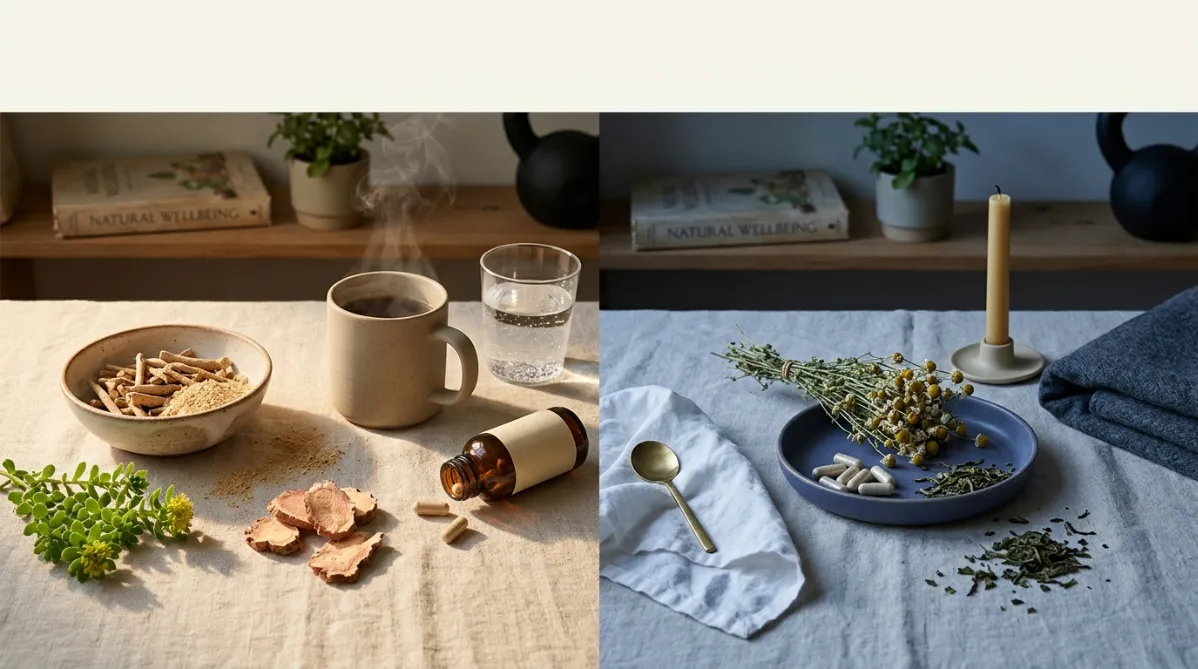
A landscape editorial still life shot from slightly above on a pale oat-colored linen surface, lit by soft morning window light with gentle long shadows. On the left, in warm golden sunlight, sits a small ceramic bowl of dried ashwagandha root pieces and a scatter of fine tan powder. Beside it are a few rough, rosy-gold slices of Rhodiola rosea root and a sprig of tiny succulent-like green leaves with yellow blossoms. A matte sand-colored stoneware mug of steaming tea and a simple glass of water stand nearby. A small amber glass bottle with a minimal unbranded label tips out two capsules.

The right side of the frame is cooler and bluer, as if dusk is arriving. It holds a muted indigo ceramic dish with a few pale capsules, a small bundle of dried chamomile flowers (the source of apigenin), and a few green tea leaves. A slim, unlit beeswax candle and a folded charcoal wool blanket suggest evening. The warm and cool halves meet softly in the center, where a rumpled white cotton napkin sits beneath a small brass spoon.

In the background, out of focus, a wooden shelf holds a worn paperback, a small potted plant, and the edge of a kettlebell in matte black, hinting at an active lifestyle. Subtle film grain, shallow depth of field, and a muted palette of cream, terracotta, sage green, and deep indigo give it a clean, modern wellness-magazine feel. Leave generous negative space in the upper third for a headline overlay. No text, no logos, no people.
recovery

Ashwagandha + Rhodiola funcionó. El stack nocturno para dormir no lo hizo.

BY DR. GYMBRO ·

Un nuevo ensayo de cuatro brazos sorprende a la comunidad de suplementos. En 103 adultos sanos y activos, una combinación matutina de 600 mg de ashwagandha y 300 mg de *Rhodiola rosea* se asoció con menor estrés percibido, mejor calidad del sueño y mejor estado de ánimo. El popular stack nocturno de magnesio L‑treonato, L‑teanina y apigenina no aportó nada, y combinar ambos pareció empeorar el afecto positivo. Aquí presentamos los hallazgos, sus limitaciones (solo dos semanas, grupos pequeños) y cómo los atletas podrían aplicarlos.

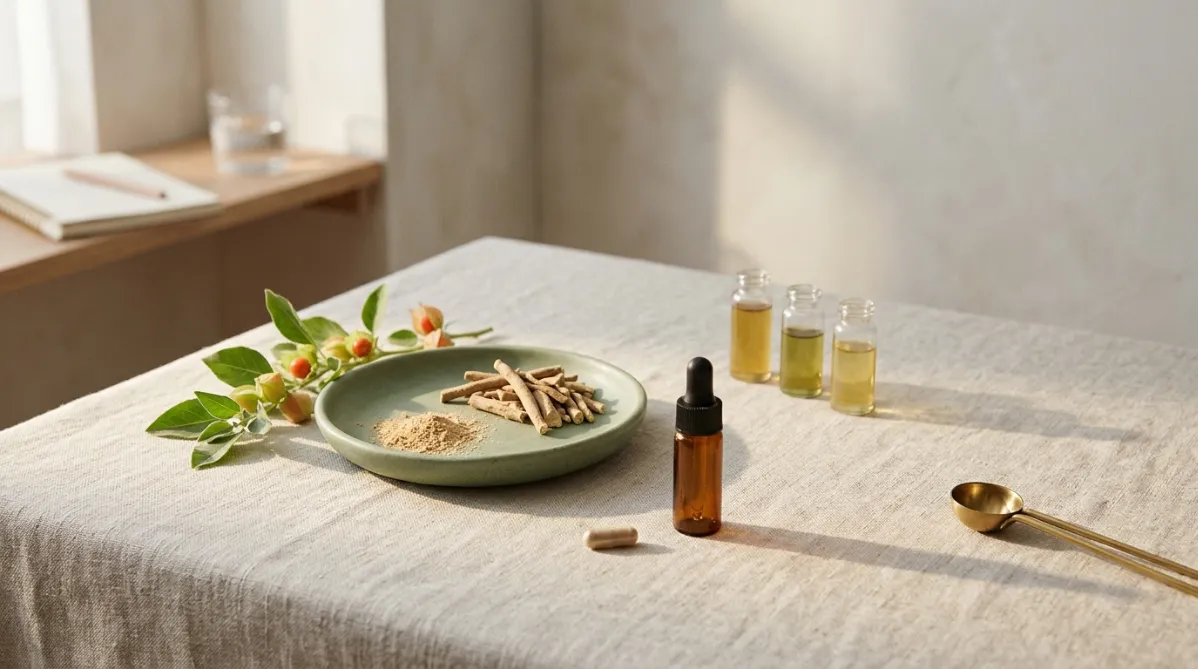
A softly lit, minimalist editorial still life on a pale oat-colored linen surface, shot from a slightly elevated three-quarter angle. In the center-left, a small handmade ceramic dish in matte sage green holds a modest pile of dried ashwagandha root pieces and a scattering of fine tan powder. A few fresh ashwagandha sprigs, with delicate green leaves and small orange-red berries in papery husks, rest beside it. In front, a single tiny capsule sits alone on the linen, with a slim glass dropper bottle in amber tint just behind it, suggesting a very small dose. To the right, a neat row of three small glass vials stands slightly out of focus, their contents a muted gold, hinting at comparison without any labels or text. A delicate brass measuring spoon lies at the edge of the frame, catching a thin highlight.

Soft morning window light falls from the upper left, casting long, gentle shadows and a warm glow across the textures: rough linen weave, matte ceramic, glossy glass, and the powdery root. The color palette is calming and earthy, with sage green, warm cream, soft terracotta, amber, and touches of muted coral from the berries. In the background, a blurred, airy room with a pale plaster wall and a hint of a wooden shelf holding a notebook and a small glass of water, adding a quiet wellness-journal atmosphere. Shallow depth of field, crisp focus on the dish and capsule, and generous negative space on the right third of the frame for headline overlay. The overall mood is calm, thoughtful, and slightly skeptical, like a contemporary health and science magazine feature, with natural, realistic photography, fine grain, and subtle film-like color grading.
science research

Solo 30 mg de Ashwagandha reducen el estrés en 4 semanas: el truco

BY DR. GYMBRO ·

La mayoría de los ensayos con ashwagandha utilizan entre 250 y 600 mg al día, pero este estudio probó solo 30 mg durante 28 días en 60 adultos estresados. El grupo que tomó ashwagandha informó menos estrés y su cortisol salival se mantuvo estable frente a un estrés de laboratorio, mientras que el grupo placebo mostró un aumento. Sin embargo, los valores p rondan entre 0,04 y 0,047, el análisis por protocolo no fue significativo y la mayoría de los demás resultados no mostraron diferencias. Además, el fabricante del extracto financió el estudio. Aquí se explica lo que los datos respaldan, a quién podría ayudar y lo que no prueban.

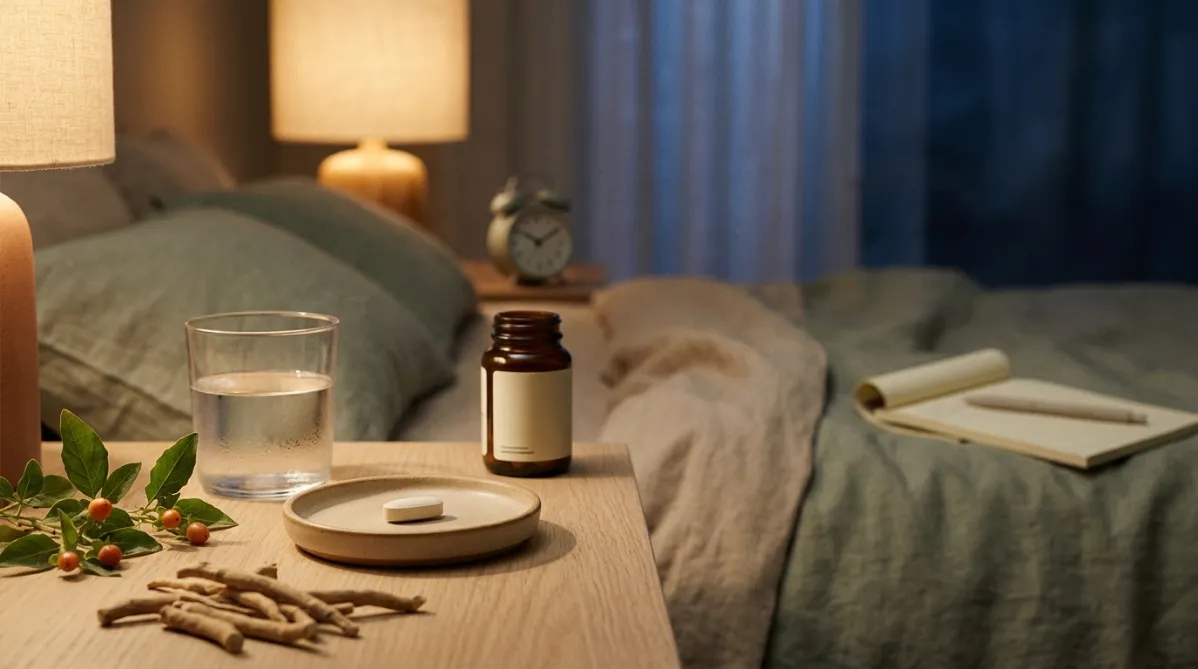
A soft, editorial still life photographed in a calm bedside setting at dusk, in landscape format. On a pale oak nightstand sits a single smooth, off-white oval caplet resting on a small matte ceramic dish in warm oatmeal tones. Next to it is a half-full glass of water with delicate condensation. Behind them, a small amber glass supplement bottle with a minimal cream label stands slightly out of focus. A few dried ashwagandha roots and a sprig of green leaves with small orange-red berries are arranged loosely across the wood grain in the foreground, adding an organic, botanical feel.

The background is a softly blurred bedroom with linen bedding in muted sage and sand tones. A warm lamp with a paper shade casts a golden glow from the left. Through a sheer curtain, deep blue twilight hints at evening. The light is gentle and directional, with long soft shadows and a subtle film-grain texture.

A small analog alarm clock with a muted face sits in the blurred distance, suggesting nighttime without dominating the scene. To the right, a folded cream notepad and a slim pen suggest research and note-taking, adding a quiet editorial touch. The composition follows the rule of thirds, with the caplet and dish in the lower-left third and generous negative space on the right for headline overlay.

The palette is earthy and restrained: sage green, warm beige, soft terracotta, and muted navy. The mood is thoughtful, trustworthy, and wellness-focused, like a modern health journal or a minimalist lifestyle magazine. Shallow depth of field with a crisp focus on the caplet, shot at eye level with an 85mm lens aesthetic, and high-end, natural, and tactile.
science research

Una cápsula de ashwagandha tomada por la noche supera al placebo: lo que debes saber antes de comprar

BY DR. GYMBRO ·

En un ensayo doble ciego con 226 participantes, una cápsula de ashwagandha tomada una vez al día después de comer, preferiblemente por la noche, superó al placebo en estrés, ansiedad y bienestar mental durante ocho semanas. Las diferencias alcanzaron p < 0,0001 tanto en los análisis por intención de tratar como por protocolo, y no se reportaron eventos adversos graves ni relacionados con el fármaco. No obstante, el resumen no indica la dosis ni el tipo de extracto, y dos de los autores están vinculados al fabricante. A continuación se muestra lo que el estudio revela, lo que omite y a quién conviene ser más crítico antes de probarlo.

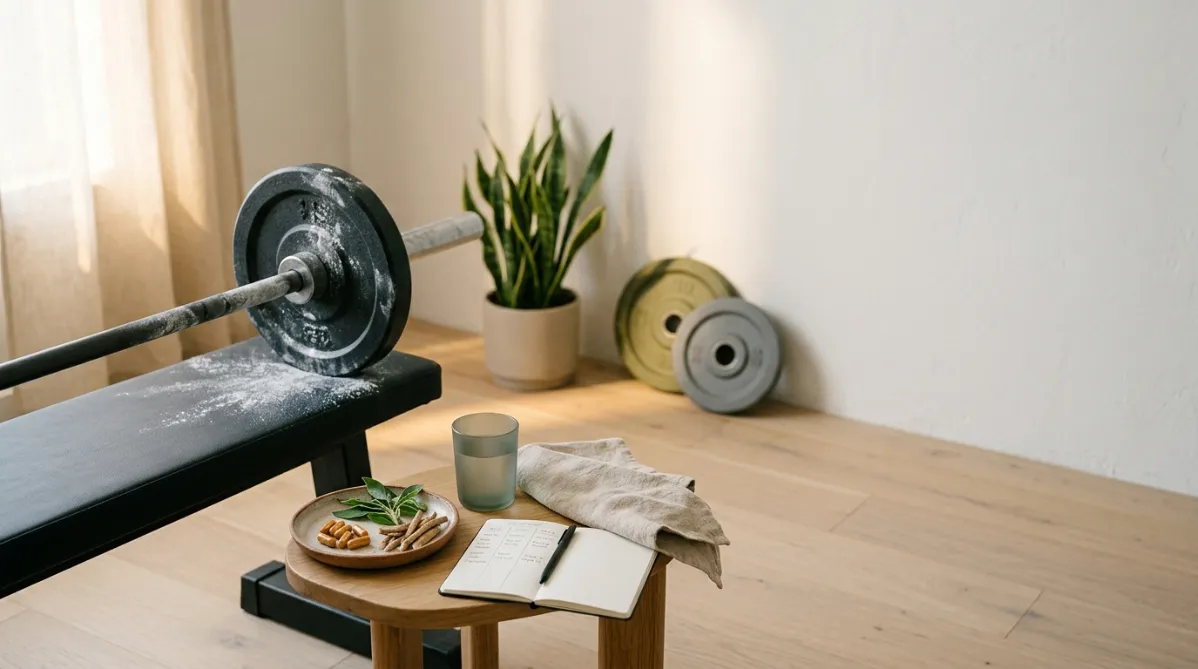
A wide landscape editorial photograph of a modern, softly lit home gym corner with pale oak flooring and a matte white wall. In the foreground, a chalk-dusted barbell rests across a minimalist bench, shot at a low angle with shallow depth of field. On a small natural-wood side table beside it sits a ceramic dish holding a few amber-colored capsules, a handful of dried ashwagandha roots, and a few green leaves. A matte glass of water and a folded linen towel sit nearby. A slim open notebook with a pen lies next to the dish, suggesting careful reading and note-taking, with blurred handwritten columns that suggest comparison, but no legible text.

Soft morning window light enters from the left, casting long, gentle shadows and a warm golden glow across the scene. The palette is muted and earthy: sage green, warm sand, cream, charcoal gray, and touches of terracotta. A single potted green plant in the background adds texture. Two weight plates in stacked, muted tones lean against the wall, slightly out of focus.

The composition follows the rule of thirds, with the barbell and supplement dish on the left and generous negative space on the right for headline overlay. The mood is calm, trustworthy, and analytical, like a contemporary health and science magazine cover. Crisp detail, natural film-like grain, subtle color grading, and a clean, uncluttered, premium lifestyle feel. No people, no text, no logos, no futuristic elements.
supplements

Ashwagandha SR duplicó las ganancias en press de banca en 90 días: lea la letra pequeña

BY DR. GYMBRO ·

Una cápsula de ashwagandha de liberación sostenida, tomada una vez al día, duplicó aproximadamente las ganancias en press de banca frente al placebo en un ensayo aleatorizado de 90 días. Los participantes que tomaron 300 mg de AshwaSR añadieron 15,31 kg a su 1‑RM, frente a 7,33 kg con placebo. Sin embargo, el aumento de testosterona en los hombres no superó al del placebo, el estudio fue financiado por el desarrollador del producto y los valores de VO2máx parecen inusualmente altos. A continuación se muestra lo que realmente evidencia el ensayo, la dosis utilizada, a quién podría convenir y a quién debería evitarlo.

This page is available in