Dr. Gymbro
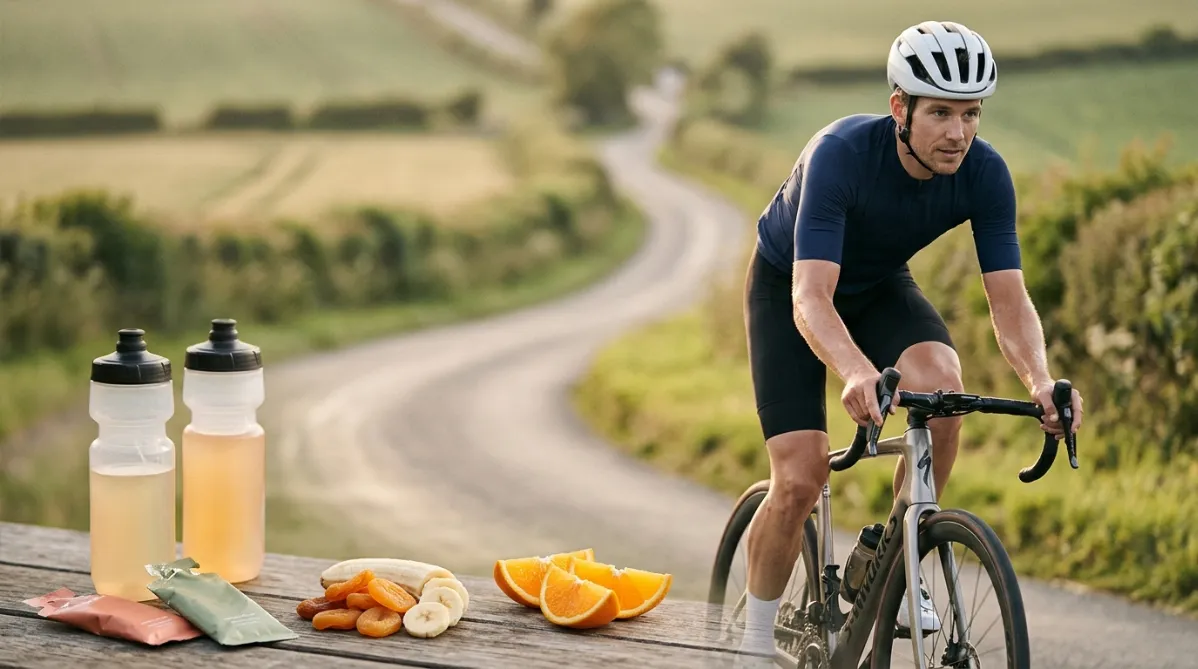
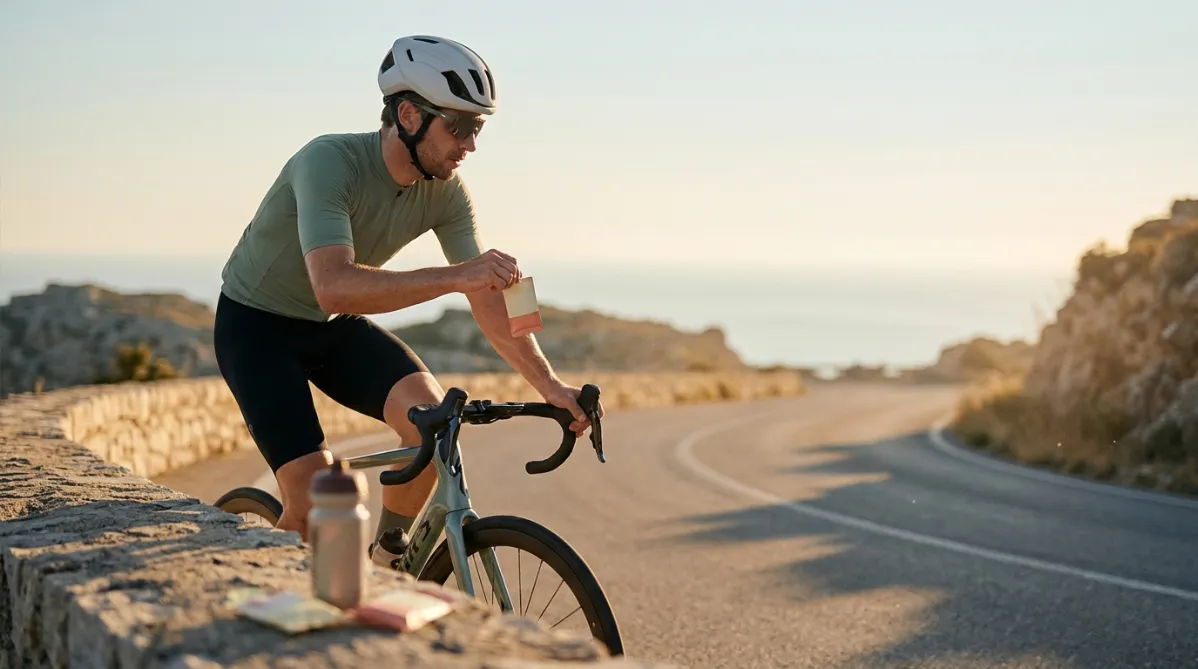
A cyclist in mid-ride, photographed from a low three-quarter side angle on a quiet country road at golden hour, wearing a matte navy jersey and a white helmet, with soft warm light catching the sweat on his forearms. His expression is calm and focused. The road bends gently through rolling green fields, and the background is softly blurred with creamy bokeh.

In the foreground on the left, a styled flat-lay-inspired still life sits on a weathered wooden surface and blends into the scene. It includes two clear water bottles with pale citrus-tinted liquid, a few torn energy gel packets in muted coral and sage, and a small pile of dried apricots and sliced banana. A handful of glossy orange slices adds a bright accent. The shallow depth of field keeps the cyclist sharp in the middle distance while the foreground items are gently softened.

The color palette is warm and editorial: soft peach, muted terracotta, sage green, cream, and deep navy. The light is natural and golden, with long, gentle shadows and a slight film-grain texture, like a high-end lifestyle or sports-science magazine spread. The composition follows the rule of thirds, with the cyclist on the right third and open negative space in the upper left, suitable for headline overlay.

The mood is energetic yet thoughtful, clean and modern, and the photograph feels authentic rather than staged. There are no logos, no readable text, and no futuristic or sci-fi elements. The overall look is crisp, airy, and refined, in the style of a contemporary health and performance journal cover.
Nutrition

시간당 100 g 탄수화물 섭취가 사이클리스트를 더 빠르게 만들었지만—당이 원인은 아니었다

Coach Ryan · · 4 min read

시간당 100 g 탄수화물 섭취가 사이클리스트를 더 빠르게 만들었지만—당이 원인은 아니었다

요약

힘든 4시간 라이드 후, 시간당 100 g 탄수화물을 섭취한 사이클리스트는 60 g을 섭취한 사람보다 파워 손실이 적었다. 그런데 두 그룹의 근육 글리코겐 양은 거의 동일했다. 15명의 훈련된 남성(사이클리스트·트라이애슬론 선수)을 대상으로 한 무작위, 이중 맹검, 크로스오버 연구는 글리코겐 절약을 넘어선 무언가가 작용함을 보여준다. 여기서는 실험 수치, 1:0.8 포도당·프럭토스 프로토콜, 그리고 실제 적용 방법을 살펴본다. 또한 이 전략을 피해야 할 대상과, 남성만을 대상으로 한 작은 표본이 왜 중요한지도 다룬다.


모두가 "더 많은 연료 = 더 많은 글리코겐 보존"이라고 생각한다. 그러나 덴마크 남부대학(University of Southern Denmark)에서 수행한 최신 무작위 시험은 이야기가 여기서 끝나지 않음을 보여준다. 시간당 100 g 탄수화물을 섭취한 사이클리스트는 60 g만 섭취한 사람보다 4시간이라는 혹독한 라이드 말미에 현저히 높은 파워를 유지했다. 하지만 두 그룹의 근육 글리코겐량은 거의 차이가 없었다.

이 연구는 Medicine & Science in Sports & Exercise(2026)에 게재되었으며, 고탄수화물 연료 공급이 단순히 연료 탱크를 채우는 수준을 넘어선다는 점을 강조한다.

연구 개요: 실제로 무슨 일을 했나요?

  • 설계: 무작위, 이중 맹검, 크로스오버
  • 참가자: 훈련된 남성 사이클리스트·트라이애슬론 선수 15명
  • 전처리: 각 시험 전 24시간 동안 고탄수화물 식단을 섭취
  • 라이드: 각 라이더의 새로운 15분 타임 트라이얼 평균 파워의 60% 수준으로 240분(4시간) 동안 페이스를 유지, 고강도 인터벌 포함
  • 테스트: 라이드 직후 15분 타임 트라이얼(TT) 수행, 완전 회복 후 다시 15분 TT 실시
  • 조건: 시간당 60 g 탄수화물(CHO60) vs. 시간당 100 g 탄수화물(CHO100), 음료와 젤을 1:0.8 포도당:프럭토스 비율로 제공
  • 측정 항목: 라이드 전·후 대퇴외측근(생검)에서 근육 글리코겐, 전신 탄수화물 산화량, 혈당 수치

크로스오버 설계 덕분에 모든 라이더가 두 조건을 모두 경험했으며, 연구진과 참가자 모두 어떤 조건인지 알지 못했다는 점이 결과의 신뢰도를 높였다.

헤드라인 결과: 4시간 후 피로 감소

연구진은 "내구성"을 15분 TT 성능 감소율로 평가했다. 두 조건 모두 성능이 떨어졌지만 감소 폭에는 차이가 있었다.

  • CHO60: ‑9.3 % (± 2.0)
  • CHO100: ‑6.4 % (± 1.7)
  • 차이: 통계적으로 유의 (P = 0.025)

절대값으로 보면 마지막 타임 트라이얼에서 평균 파워는 CHO100이 CHO60보다 9 W 높았다 (P = 0.028). 9 W는 작은 수치처럼 보이지만, 레이스 막바지에서는 휠을 잡는 사람과 뒤처지는 사람을 가르는 결정적 요인이 될 수 있다.

반전: 글리코겐이 설명되지 않는다

당연히 예상되는 설명은 "더 많은 탄수화물 = 근육 글리코겐 소모 감소"이다. 하지만 근육 생검 결과는 그와 달렸다. 두 조건 모두 라이드 후 글리코겐이 크게 감소했으며, 차이는 통계적으로 의미가 없었다.

  • CHO60: 192 ± 99 mmol·kg⁻¹ (건조 중량 기준)
  • CHO100: 209 ± 111 mmol·kg⁻¹
  • P = 0.56

개인 간 변동이 커서 "차이가 탐지되지 않는다"는 것이 "효과가 전혀 없다"는 증거는 아니다. 그럼에도 저자들은 100 g/h 섭취가 근육 글리코겐 이용에 변화를 주지 않으면서 내구성을 향상시켰다고 결론짓는다.

바뀐 점: 전신 탄수화물 산화량

높은 섭취량이 바꾼 것은 라이드가 진행될수록 몸이 탄수화물을 지속적으로 연소하는 능력이었다.

  • CHO60: 시작 시 2.6 ± 0.6 g·min⁻¹ → 마지막엔 1.9 ± 0.4 g·min⁻¹
  • CHO100: 시작 시 2.6 ± 0.4 g·min⁻¹ → 마지막엔 2.3 ± 0.5 g·min⁻¹
  • 조건 × 시간 상호작용: P = 0.047

혈당은 두 조건 모두 안정적이었다 (CHO60: 5.65.7 mmol·L⁻¹, CHO100: 6.06.1 mmol·L⁻¹). 따라서 60 g/h 그룹이 저혈당으로 고생한 것은 아니다. 100 g/h가 제공한 이점은 혈당 유지 외의 다른 메커니즘에서 온다.

논문 데이터는 추가 섭취된 탄수화물이 연료로 남아 라이드 후반부에 탄수화물 산화를 유지한다는 점을 시사한다. 구체적인 메커니즘—예를 들어 뇌, 장, 기타 조직과의 연관—은 아직 증명되지 않았다. 따라서 현재는 추정에 머물러 있다.

여러분에게 의미하는 바

적용 대상

  • 3시간 이상의 긴 세션·경기에 참여하는 라이더·트라이애슬론 선수. 연구에서는 4시간 라이드를 사용했으며, 효과는 라이드 말미에 나타났다.
  • 경기 후반부에 파워가 중요한 사람(최종 등반, 브레이크어웨이, 스프린트 피니시 등).
  • 고탄수화물 섭취에 이미 적응한, 장기간 트레이닝을 해온 선수.

섭취량

  • 시간당 100 g 탄수화물을 목표로 한다. 비교는 60 g/h였다.
  • 포도당:프럭토스 비율 1:0.8을 유지한다. 대부분의 스포츠 음료·젤 라벨에 이 비율이 적용되어 있다.
  • 총량을 하나의 제품에 집중하기보다 음료와 젤을 조합해 나눠 섭취한다(연구와 동일한 방식).

타이밍

  • 연구에서는 4시간 전체에 걸쳐 시간당 고르게 탄수화물을 공급했다. 큰 한 번에 먹기보다 작은 양을 자주 섭취하는 것이 핵심이다.
  • 또한 라이드 전 24시간 동안 탄수화물 풍부 식단을 유지했다. 사전 로딩을 빼먹지 말자.

장 트레이닝(gut training)

  • 60 g/h에서 바로 100 g/h로 늘리면 위장 문제가 발생할 가능성이 높다. 몇 주에 걸쳐 점진적으로 양을 늘리고, 레이스 당일에 사용할 제품을 미리 시험해 보자.
  • 100 g/h를 편하게 섭취하지 못한다면, 소화가 잘 되는 낮은 용량을 유지하는 것이 위장 장애를 일으키는 고용량보다 낫다.

현재는 건너뛰는 것이 나을 사람

  • 2~3시간 이하의 짧은 세션. 이 연구는 짧은 노력에 대한 데이터를 제공하지 않는다.
  • 고탄수화물 섭취 시 지속적으로 위장 문제가 발생하는 선수. 먼저 개인 맞춤 조언을 구하라.
  • 당뇨병·대사질환 등 탄수화물 대사가 어려운 사람은 반드시 의료진·영양사와 상의해야 한다.

한계점

연구 설계는 견고하지만 표본이 작다: 훈련된 남성 15명만 포함됐다. 결과를 여성, 고령자, 레크레이션 라이더 또는 다른 종목에 그대로 적용하기는 어렵다. 또한 비교는 60 g/h vs. 100 g/h뿐이어서, 80 g/h가 어느 정도 효과가 있는지는 알 수 없다. 글리코겐 데이터도 개인별 변동이 크므로 ‘차이 없음’ 결과를 절대적인 증거로 보기엔 무리가 있다.

그럼에도 이 연구는 60 g/h를 상한선으로 여기던 라이더들에게 중요한 시사점을 제공한다. 탄수화물 공급은 글리코겐 수치가 보여주지 못하는 방식으로 장거리 라이딩을 돕는다. 3시간 이상 레이스를 하면서 장 트레이닝이 된 사람이라면, 1:0.8 포도당·프럭토스 비율의 시간당 100 g 전략을 트레이닝 중에 시험해 볼 가치가 충분히 있다.
Original study

Read the original research on pubmed.ncbi.nlm.nih.gov →

This article summarizes published research for general information. It is not medical advice.

CR

Written by

Coach Ryan

Coach Ryan writes for Dr. Gymbro: science-backed fitness, nutrition & performance.

Related Articles

A cyclist in profile, riding a sleek road bike along a quiet coastal road in warm golden-hour light, shot from a low side angle with a shallow depth of field. The rider wears a muted sage-green jersey, black bib shorts, a matte white helmet, and sunglasses. Their face shows calm, focused fatigue, with a faint sheen of sweat on the forearms. One hand is lifted slightly from the handlebars, holding a small, unbranded matte gel packet in soft cream and coral tones, just before opening it. The road curves gently behind them toward a hazy, softly blurred horizon of pale sea and distant hills, with long amber shadows stretching across the asphalt.

In the foreground, slightly out of focus, a few gel sachets and a bike bottle rest on a weathered stone wall at the left edge of the frame, adding editorial depth. Fine dust and sunlight glow in the air. The palette is warm and restrained: butter yellow, soft peach, sage, and slate blue, with gentle film-like grain. The composition leaves open negative space in the upper right, a pale gradient sky, for headline overlay. The overall look is a modern, minimalist sports-science magazine photograph: natural, premium, and clean, with realistic textures, cinematic but understated color grading, and no text, logos, or graphics.
nutrition

중간 구간에 섭취한 Bicarb 젤, 3시간 사이클링 테스트에서 12 W 증가

BY DR. GYMBRO ·

경기 전이 아니라 경기 중에 탄산수소나트(베이킹소다)를 섭취하는 것이 최적일 수도 있다. 11명의 훈련된 사이클리스트를 대상으로 한 무작위 교차 실험에서, 3시간 라이딩 후 12분 타임‑트라이얼 파워가 탄수화물만 섭취했을 때보다 12 W 높게 나타났다. 위장 증상은 두 군 간에 차이가 없었으며, 스프린트와 2분 구간에서는 유의미한 향상이 보이지 않았다. 샘플 규모가 작고 제품은 MNSTRY가 제공했다는 점을 유념해야 한다.

A wide editorial still life on a pale, warm-toned concrete surface in soft morning window light. In the center-left, a shallow matte ceramic bowl holds a small pile of bright red coffee cherries with glossy skins, a few sliced open to reveal pale mucilage and paired green-tan beans. Beside it, a small glass dish of fine, golden-brown powdered extract with a tiny wooden scoop resting on its edge. A sprig of coffee plant leaves, deep green and waxy, arcs across the foreground.

On the right side, slightly out of focus, a sleek road cyclist's handlebar and a matte black water bottle lean against a light plaster wall, suggesting athletic training without showing a person. A minimalist analog stopwatch with a clean white face and thin black hands sits in the mid-ground, angled toward the camera, its hands paused near the fifteen-minute mark. A folded linen cloth in oatmeal beige and a single small espresso cup with a thin crema ring add quiet texture.

The color palette is restrained and modern: cherry red, sage green, cream, soft terracotta, and charcoal accents. Light comes from the left, casting long, gentle shadows with a subtle warm glow and a hint of dust in the air. Shallow depth of field with crisp focus on the cherries and stopwatch, creamy bokeh in the background. Composition leaves open negative space in the upper right for a headline overlay. The overall feel is a clean, trendy health-and-science magazine cover: tactile, natural, minimal, and calm, shot in a 16:9 landscape frame with fine film-like grain and true-to-life tones.
nutrition

커피 체리 추출물: 200 mg 카페인으로 사이클링 출력 4.6% 상승

BY DR. GYMBRO ·

전체 커피 체리 추출물에서 얻은 200 mg 수준의 저용량 카페인이 훈련된 사이클리스트들의 15분 타임트라이얼에서 작업량을 4.6% 증가시켰습니다. 하지만 근육 글리코겐 재합성 속도가 빨라진다는 흔한 생각은 실험 결과와 맞지 않았습니다. 이 무작위, 이중 맹검, 교차 설계 시험은 12명의 사이클리스트를 대상으로 했으며, 산업계 자금 지원을 받았고 순수 카페인 대비군은 없었습니다. 데이터가 보여주는 점, 보여주지 못하는 점, 그리고 시도해볼 만한 사람은 누구인지 정리했습니다.

A wide, editorial-style flat lay photographed from above on a pale warm-gray linen surface in soft natural window light. At the center, a small open amber glass jar tips gently onto its side, spilling a few cream-colored capsules across the fabric. Next to the jar sits a loose arrangement of fresh mushrooms: a cluster of golden-tan reishi with glossy, lacquered caps, a few slender white enoki stems, a halved shiitake showing its pale gills, and a curl of turkey tail with concentric bands of rust, cream, and charcoal. A small wooden scoop holds a pile of fine beige mushroom powder.

On the left third of the frame, a matte black sports watch with a minimal face lies beside a folded sage-green running shirt and a pair of lightweight off-white running shoes, hinting at athletic training without showing a person. A slim white notebook with a single pencil rests nearby, open to a blank page with a faint hand-drawn line graph trending upward, in thin graphite strokes.

On the right side, a pair of clear glass beakers and a single small petri dish with a soft amber-tinted liquid add a subtle laboratory note, kept calm and organic. A single sprig of dried herbs and a few scattered oat-colored grains add texture.

The palette is earthy and refined: oatmeal, soft sage, terracotta, warm amber, and charcoal accents against the muted neutral background. Shadows are soft and diffused, with a gentle highlight on the glass and the glossy reishi cap. The composition leaves generous negative space in the upper right for a headline overlay. Shallow depth of field blurs the edges slightly, while the central mushrooms and capsules stay crisp. The overall feel is modern, clean, and trendy, like a wellness and science magazine cover, with tactile natural textures, minimal styling, and a quiet sense of curiosity and skepticism.
science research

버섯 캡슐이 VO2max를 14.8% 올렸다—하지만 큰 문제점이 있다

BY DR. GYMBRO ·

버섯 캡슐을 40일간 섭취해 VO2max가 14.8% 상승했다는 이야기는 매우 놀라울 수 있다. 최신 *Antioxidants* 논문에 따르면, 베타‑글루칸이 풍부한 멀티버섯 추출물 320 mg을 하루에 복용한 20대 남성 운동선수 50명의 VO2max가 46.26 → 53.12 mL/kg/min으로 늘어났다. 그러나 이 연구는 위약군이 없고, 무작위 배정·블라인드도 적용되지 않았으며, 참가자들은 평소 훈련을 그대로 지속했다. 세포 실험은 쥐 심근세포를 이용한 별도 화합물 테스트에 지나지 않는다. 따라서 결과를 해석할 때는 신중할 필요가 있다.

Wide landscape editorial photograph of a mountain biker mid-ride on a dusty red-orange singletrack trail in the South African Western Cape, golden hour light raking across the scene. The rider is in sharp focus on the right third of the frame, wearing a weathered cycling kit with a race number plate on the handlebars, dust kicking up from the rear tire. Behind them, rolling hills covered in fynbos shrubland and silhouetted protea plants fade into soft, hazy blue mountains. Warm amber sunlight creates long shadows and a soft rim light around the rider and bike.

In the lower left foreground, slightly out of focus, a small minimalist glass vial and a clear water bottle sit on a flat sun-bleached rock, with a few drops of liquid catching the light. Next to them, a simple matte paper notecard and a pencil suggest data collection, with no legible text. The vial and bottle are clean, understated, and modern, with no branding.

The color palette is earthy and refined: terracotta, ochre, sage green, dusty teal sky, and cream highlights. The composition uses shallow depth of field, a generous negative space in the upper left sky for headline overlay, and subtle film grain. The mood is contemplative, skeptical, and quietly sophisticated, like a feature photograph from a high-end outdoor sports and science magazine. Natural, candid, cinematic, shot on a 50mm lens with soft contrast and muted saturation. No futuristic elements, no glowing effects, no molecular graphics, no text.
science research

케톤 IQ, 케이프 에픽 레이스에서 케톤 수치는 올렸지만 다른 효과는 없었다

BY DR. GYMBRO ·

8일간 진행된 케이프 에픽 레이스에서 라이더들은 케톤 IQ를 하루 두 번 섭취해 혈중 케톤 농도가 약 1 mM에 도달했지만, 피로도·심박수·반응 시간·회복 정도는 위약군과 차이가 없었습니다. 실제 레이스 환경에서 R‑1,3‑부탄디올을 테스트한 이번 이중 맹검 연구는 온화한 케토시스가 회복에 도움을 주지 않으며, 부탄디올을 케톤 에스터와 혼동하면 안 된다고 강조합니다.

This page is available in