Dr. Gymbro
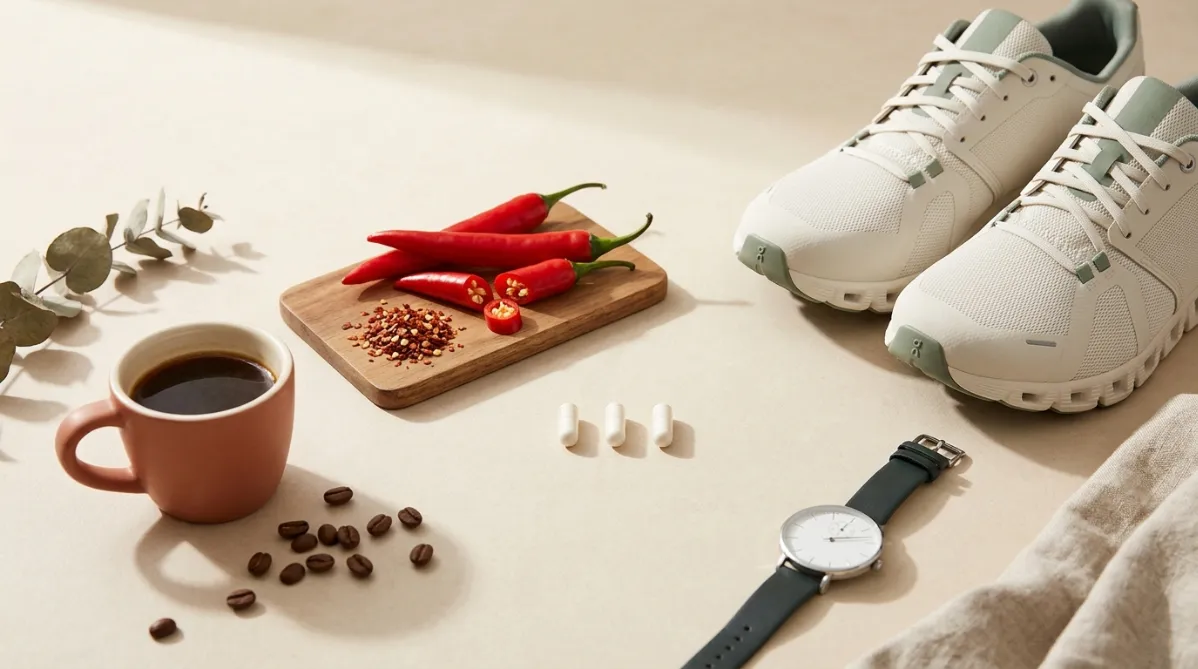
A wide, editorial-style flat lay on a warm, matte cream stone surface, shot from slightly above in soft natural morning light. On the left, a ceramic espresso cup in muted terracotta holds dark coffee, with a few roasted coffee beans scattered beside it. In the center, a small wooden board holds three bright red chili peppers, one sliced open to show pale seeds, next to a small pile of coarse red pepper flakes. On the right, a pair of minimalist off-white running shoes with sage green accents rests at an angle, and a slim stopwatch with a clean white face lies in front of them. Three small matte white capsules sit in a neat row at the center of the composition, a quiet nod to the placebo and the active doses. Soft shadows fall to the lower right. A sprig of dried eucalyptus and a folded linen cloth in oatmeal tones add texture at the edges. The palette is warm and restrained: terracotta, chili red, cream, sage, and charcoal brown, with a gentle pop of red as the focal accent. The depth of field is shallow, so the foreground beans are slightly soft and the chilies and capsules stay crisp. The mood is clean, modern, and magazine-like, in the style of a contemporary health and science journal. There is no text, no people, and no logos, and plenty of negative space on the upper left and right edges leaves room for a headline overlay.
Nutrition

Cafeïne + Capsaïcine verslaat placebo op 10 km; capsaisin alleen werkt niet

Coach Ryan · · 4 min read

Iedereen zoekt een extra voorsprong vóór een hardloopwedstrijd. Een recent menselijk onderzoek testte een combinatie die meer weg heeft van een durfopdracht dan van een gewoon supplement: cafeïne gestapeld met capsaïcine, de stof die chilipepers laten branden. Het opvallende resultaat? Deze combinatie was de enige conditie die een placebo versloeg over een afstand van 10 km, terwijl capsaïcine op zichzelf geen effect had. De details zijn belangrijk, dus lees ze voordat je iets koopt.

Opzet: 20 lopers, vier proefcondities

De studie, gepubliceerd in 2026 in European Journal of Applied Physiology door een Braziliaans onderzoeksteam, had een gerandomiseerde, dubbel‑blinde, placebogecontroleerde crossover‑opzet – elk individu fungeerde als eigen controle.

  • Deelnemers: 20 lopers (van de 27 ingeschreven) voltooiden alle vier de condities. Gemiddelde leeftijd ≈ 32 jaar; 8 vrouwen, 12 mannen.
  • Protocol: Elke loper liep een zelfgekozen 10‑km‑race 45 minuten na inname van één van de vier supplementen:
    • Cafeïne (CAF): 6 mg/kg
    • Capsaïcine (CAP): 0,35 mg/kg
    • Cafeïne + capsaïcine (CAF+CAP)
    • Placebo

“Zelfgekozen tempo” betekent dat de lopers hun eigen inspanning bepaalden, net als in een echte race, in plaats van op een laboratorium‑ingestelde intensiteit. De onderzoekers registreerden finishtijd, hartslag, bloedlactaat, waargenomen inspanning (RPE) en subjectieve reacties zoals vitaliteit en eventuele bijwerkingen.

Resultaten: Wie bleek te winnen?

De combinatie (CAF+CAP) was de enige conditie die significant sneller liep dan placebo (Tukey‑gecorrigeerde p = 0,048; Dunnett‑gecorrigeerde p = 0,028). Caféïne alleen en capsaïcine alleen bereikten die drempel niet.

Statistisch model:

  • Cafeïne had een significant hoofdeffect op de finishtijd (p = 0,0049).
  • Capsaïcine had geen hoofdeffect.
  • Er was geen interactie tussen cafeïne en capsaïcine (caféïne × capsaïcine), dus er is geen bewijs voor een synergetisch effect.

In gewone taal: het effect werd volledig gedreven door de cafeïne. De combinatie behaalde wellicht de statistische drempel doordat de kleine groep zich op een bepaalde manier gedroeg; de data tonen niet dat de chili‑verbinding iets heeft toegevoegd.

Overige bevindingen: lactaat, vitaliteit, inspanning

  • Bloedlactaat was hoger na CAF+CAP dan in alle andere condities – een mogelijke aanwijzing dat lopers harder pushten, maar de oorzaak blijft onduidelijk.
  • Waargenomen vitaliteit steeg bij beide cafeïne‑condities.
  • Hartslag en RPE (Rate of Perceived Exertion) verschilden niet tussen de condities, behalve een klein verschil tussen cafeïne en capsaïcine alleen.

Kortom, de combinatie maakte het hardlopen niet makkelijker; lopers liepen sneller zonder dat zij zich inspannender voelden.

Bijwerkingen

Condities met cafeïne gingen gepaard met vaker kortdurende nadelige effecten:

  • Slapeloosheid
  • Angst
  • Hoofdpijn
  • Tachycardie (bonzend hart)

Als je al gevoelig bent voor een gewone kop koffie, kan deze dosis een flink “kick‑up” geven.

Dosis in concrete cijfers

De studie doseerde per kilogram lichaamsgewicht. Voor een 75 kg (≈ 165 lb) loper betekent dit:

  • Cafeïne: 6 mg/kg ≈ 450 mg (ongeveer 4‑5 koppen gezette koffie, afhankelijk van de sterkte). Dit overschrijdt de 400 mg/dag die onder andere de FDA als algemene bovengrens voor gezonde volwassenen aangeeft.
  • Capsaïcine: 0,35 mg/kg ≈ 26 mg. Etiketten van capsaïcine‑producten variëren sterk, controleer dus altijd het werkelijke milligram­gehalte.

Veel onderzoeken gebruiken lagere cafeïnedoses (≈ 3 mg/kg). De hoge dosis in deze proef kan de overdraagbaarheid naar een gematigde inname beperken.

Praktische lessen

  1. Timing: De supplementen werden 45 minuten voor de start ingenomen. Test die timing eerst tijdens trainingsruns, niet op de racedag.
  2. Test eerst: Probeer elke nieuwe dosis tijdens een gewone training. Een zo hoge cafeïnedosis kan maagklachten, zenuwachtigheid of een piekende hartslag veroorzaken.
  3. Jacht niet op capsaïcine: Omdat capsaïcine alleen geen prestatieverbetering opleverde en er geen interactie werd aangetoond, is cafeïne de enige werkzame stof. Een eenvoudige cafeïnestrategie levert waarschijnlijk het grootste deel van de winst.
  4. Let op de slaap: Slapeloosheid werd veelgemeld. Avondraces of late trainingen kunnen je nachtrust verstoren.

Voor wie het interessant kan zijn, en voor wie het beter niet is

Mogelijk de moeite waard (met voorzichtigheid): Gezonde, cafeïnetolerante lopers die 10 km‑races lopen, hun reactie op cafeïne kennen en een hoge dosis willen testen in de training.

Vermijden of eerst met een arts overleggen:

  • Personen met angst, paniek of slapeloosheidsklachten
  • Mensen met hartritmestoornissen, hoge bloeddruk of andere cardiovasculaire aandoeningen
  • Lopers die migraine of hoofdpijn krijgen van cafeïne
  • Zwangere lopers en iedereen die geneesmiddelen gebruikt die kunnen interageren met stimulerende middelen
  • Lopers die last hebben van een brandend maag-darmkanaal bij pittige stoffen

Beperkingen

  • Kleine steekproef: Slechts 20 personen voltooiden alle vier de condities.
  • Recreatieve deelnemers: De resultaten gelden mogelijk niet voor elite‑atleten of zeer getrainde racers.
  • Enkel één sessie per conditie: Geen inzicht in train‑to‑train‑variabiliteit.
  • Geen statistisch significant voordeel van de combo boven cafeïne alleen.

De bevindingen moeten nog worden gerepliceerd voordat ze als algemeen advies kunnen gelden.

Conclusie

Cafeïne is hier de bewezen prestatie‑booster; capsaïcine leverde geen eigen effect en vertoonde geen synergie. De hoge dosis van 6 mg/kg is fors en gaat gepaard met reële bijwerkingen. Als je het wilt uitproberen, doe dat eerst in de training en verwacht niet dat de chili‑verbinding de prestaties draagt. Dit artikel is puur informatief en vormt geen medisch advies.
Original study

Read the original research on pubmed.ncbi.nlm.nih.gov →

This article summarizes published research for general information. It is not medical advice.

CR

Written by

Coach Ryan

Coach Ryan writes for Dr. Gymbro: science-backed fitness, nutrition & performance.

Related Articles

A sunlit outdoor running track in late afternoon, shot from a low angle with shallow depth of field. In the foreground, a matte black bottle with a minimal off-white label sits on the edge of a warm terracotta-colored track lane, beside a folded white towel and a small glass of amber liquid catching golden light. Condensation beads on the bottle. A faint heat shimmer rises from the track surface and softens the background.

In the midground, slightly out of focus, a lean athlete in a sage-green tank top and charcoal shorts runs on a treadmill-like stretch of track, a thin sheen of sweat on their shoulders, their expression focused and calm. Their motion is gently blurred, suggesting endurance and rhythm. Long soft shadows stretch across the lane lines.

The background fades into hazy peach, apricot, and pale yellow tones, with the suggestion of tall trees and a distant stadium wall. Warm sun flare enters from the upper right, creating a subtle glow and a few soft light streaks across the frame.

Subtle editorial touches: a small notebook with a pencil and a stopwatch rest beside the bottle, hinting at data and timing without any text legible. The color palette is warm and muted, with terracotta, cream, sage, and charcoal accents, and a fine film-like grain. The composition leaves open negative space on the left third for a headline overlay. The overall mood is clean, modern, and health-journal inspired, natural and aspirational, with a calm scientific curiosity rather than hype.
nutrition

Ketondranken in de hitte: langer uithoudingsvermogen en scherper geheugen?

BY DR. GYMBRO ·

Ketondranken worden vaak gezien als een hulpmiddel voor vetverbrandende biohackers, maar een nieuwe hitte‑stressstudie suggereert dat ze je ook sterker kunnen laten finishen. Bij 17 getrainde mannen verlengde keton‑monoester plus cafeïne de tijd tot uitputting tot 8,9 minuten tegenover 7,0 minuten met koolhydraten plus cafeïne, na een 90‑minuten‑intensieve loopbandtraining bij 34 °C. Het werkgeheugen verbeterde eveneens bij de 1‑back‑taak, terwijl hartslag en kerntemperatuur nauwelijks verschilden. De studie is echter klein, uitsluitend mannelijk en éénmalig, waardoor de resultaten met voorzichtigheid moeten worden geïnterpreteerd.

A landscape editorial photograph with a modern, clean magazine feel, shot on a pale warm-gray concrete surface in soft natural window light from the left. In the foreground, two matte white ceramic espresso cups sit side by side. The left cup holds a small amount of dark espresso with golden crema. The right cup is filled twice as high. Beside them, two small stainless steel scoops hold fine coffee-colored powder, one half full and one heaped, suggesting a dose comparison without any text or labels. A pair of worn red leather boxing gloves rests slightly out of focus behind the cups, laces loosely draped, with a white hand wrap rolled neatly beside them. A minimalist digital kitchen scale in matte black sits at the edge of the frame, with a few roasted coffee beans scattered across the surface. In the soft-focus background, a boxing gym corner appears: a hanging heavy bag in muted charcoal, pale wood plank flooring, and a tall window with diffused morning light. The palette is warm cream, espresso brown, brick red, and soft slate gray, with gentle shadows and a shallow depth of field. The composition follows the rule of thirds, with the cups and scoops in the lower left third and open negative space on the right for headline overlay. The look is tactile and refined, like a high-end health and performance journal. It has natural grain, subtle contrast, and a calm, confident mood. There are no people, no text, no logos, and no futuristic elements.
nutrition

Dubbel zo veel cafeïne hielp boksers nauwelijks — dit werkte wel

BY DR. GYMBRO ·

Denk je dat een dubbele schep pre‑workout je prestaties automatisch verdubbelt? Een nieuwe crossover‑studie met 15 competitieve boksers vergeleek 3 mg/kg met 6 mg/kg cafeïne en toonde aan dat de hogere dosis niet consequent beter was. Beide dosissen verhoogden de spronghoogte en kracht na 60 minuten, maar 6 mg/kg leverde alleen bij enkele uitkomsten – zoals de ballistic push‑up en knie‑torque – een extra voorsprong. Hieronder vind je een mg‑per‑kg‑omrekening voor veelvoorkomende lichaamsgewichten, de door de data ondersteunde timing, en enkele kanttekeningen, onder meer dat er geen effect op daadwerkelijke stoten is getest.

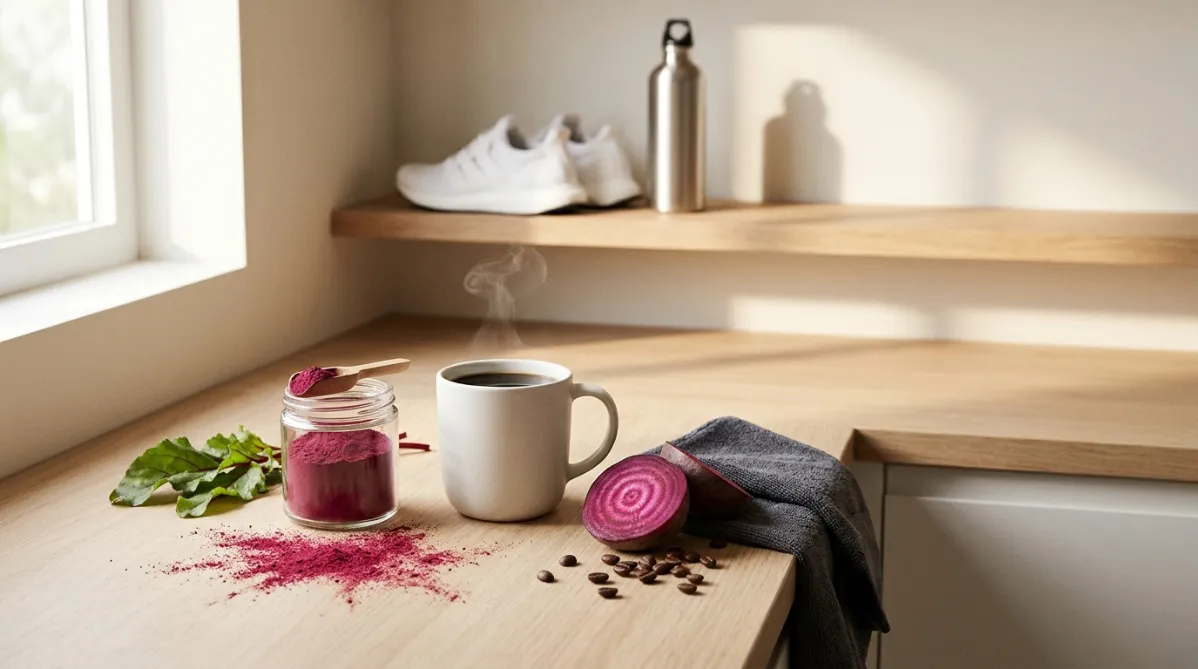
A sunlit, minimalist kitchen counter in a modern home, photographed from a slightly elevated three-quarter angle with soft natural morning light spilling in from a window on the left. In the center sits a matte white ceramic mug of black coffee with a thin curl of steam, beside a small glass jar of deep magenta beetroot powder with a wooden scoop resting on the lid. A scattering of fine crimson powder dusts the pale oak surface in an artful, casual swirl. Nearby, a halved raw beetroot reveals vivid concentric rings of purple and pink, next to a few roasted coffee beans and a neatly folded charcoal gym towel. In the soft-focus background, a pair of clean white running shoes and a stainless steel water bottle sit on a floating shelf, hinting at a pre-workout routine. A single sprig of green beet leaves adds a fresh accent.

The color palette is warm and editorial: creamy neutrals, espresso browns, and rich beet magenta, with gentle highlights and long soft shadows. The composition has generous negative space on the right side for headline text, shallow depth of field, and a crisp, tactile texture on the ceramic, powder, and wood grain. The mood is calm, health-conscious, and contemporary, like a lifestyle feature in a premium wellness magazine or a trendy nutrition journal. Clean, balanced, natural, with subtle film-like grain and a slightly muted, high-end finish.
science research

Pre‑workout cafeïne verhardt slagaders; bietpoeder neutraliseert dit

BY DR. GYMBRO ·

Een gerandomiseerde cross‑over studie toonde aan dat een pre‑workout‑dosis cafeïne (6 mg/kg) binnen 2,5 uur de markers van arteriële stijfheid laat stijgen. Het toevoegen van bietpoeder met 400 mg nitraat zette die markers terug naar placebonaamwaarden. Bloeddruk en endotheliale functie bleven onveranderd, waardoor het een subtiel effect is zonder rode vlaggen. De studie omvatte slechts 24 gezonde jonge volwassenen en één enkele dosis, waardoor er grote vragen blijven over langdurig gebruik en de effecten bij oudere of hypertensieve personen. Hier volgt wat de data laten zien, wat ze niet laten zien, en hoe je de resultaten moet interpreteren als je vóór de training op cafeïne vertrouwt.

A landscape editorial photograph of a lone runner's hands resting on a weathered wooden table beside a small white ceramic dish of fine white powder and a clear glass of water, shot in soft morning light. A slim matte aluminum energy drink can, unbranded with a minimalist pale sage-green label, stands slightly out of focus in the background, with a single scoop of powder dusted lightly on the tabletop. A pair of worn running shoes and a folded gray towel sit at the edge of the frame. Through a large window behind them, a blurred misty trail winds through green trees at sunrise, with warm golden light spilling across the scene.

The color palette is calm and modern: creamy off-white, sage green, warm honey gold, and soft charcoal. The composition follows the rule of thirds, with the dish and glass in the lower left third and generous negative space on the right for a title overlay. The depth of field is shallow, with a crisp focus on the powder's delicate texture and tiny glints of light on the glass rim. The mood is clean, thoughtful, and quietly energetic, like a contemporary health and science magazine feature. Natural grain, subtle film-like softness, and gentle shadows give it an authentic lifestyle-editorial look. There are no text, logos, or futuristic elements, only tactile, real-world materials like wood, ceramic, glass, cotton, and metal.
nutrition

Het energiedrank‑ingrediënt dat de uithouding alleen verbetert

BY DR. GYMBRO ·

Iedereen praat over cafeïne, maar het tweede bestanddeel van energiedrankjes kan stilletjes zijn eigen werk doen. Een meta‑analyse uit 2018 van tien onderzoeken liet zien dat geïsoleerde taurine de uithoudingsprestaties verbetert (Hedges’ g = 0,40) en dat één enkele dosis al voldoende lijkt. Noch de hoeveelheid (1‑6 g) noch de duur van inname beïnvloedde het effect merkbaar. Het bewijs blijft beperkt en de betrouwbaarheidsintervallen breed – een veelbelovende aanwijzing, geen garantie. Hieronder vind je wat de studie aantoonde en hoe je taurine verstandig kunt uitproberen.

This page is available in