Dr. Gymbro
A wide, editorial-style still life shot from a slightly elevated angle on a pale oak gym bench, bathed in soft morning window light. In the center sits a matte ceramic cup of black coffee with delicate steam curling upward, flanked by a small white scoop of coffee beans and two identical glass vials, one filled with a few grains of fine powder and one empty, hinting at dose comparison. Next to the cup rests a pair of worn white boxing hand wraps, loosely coiled, and a slim black stopwatch with its face softly visible. In the foreground, a minimalist notebook lies open with blurred handwritten numbers and a simple pen sketch of a bar graph with bars of equal height, subtle and unreadable, suggesting a null result without any legible text. A small brass kitchen scale sits to the side with a few coffee beans on its tray.

In the soft-focus background, a boxing gym interior is visible: a hanging heavy bag in muted charcoal, exposed brick wall painted off-white, and tall windows casting long diagonal light across the floor. The color palette is warm and restrained: cream, sand, espresso brown, soft charcoal, with a single accent of muted terracotta orange in the hand wraps and a faint sage green in the notebook cover. Shallow depth of field with creamy bokeh, fine film grain, and gentle shadows give it a contemporary lifestyle-magazine and wellness-journal feel. The composition leaves generous negative space on the left third for headline overlay. Clean, calm, trendy, and tactile, with natural textures like wood grain, ceramic glaze, and cotton fabric. No people, no text, no futuristic elements.
Science & Research

Koffie met lage cafeïnedosis gaf elite vechters geen sprintboost

Dr. Gymbro · · 4 min read

Je dacht dat een pre‑workout kopje koffie je sprintvermogen een boost gaf. In een recent crossover‑onderzoek met nationale vechtsporters leverde één tot twee koppen cafeïnehoudende koffie helemaal geen verbetering in herhaalde sprintprestaties. Voordat je de espressomachine weggooit, is het de moeite waard de details te bekijken.

De kern van het onderzoek: niets beweegt

Een team onder leiding van Birol en collega‑onderzoekers, gepubliceerd in Scientific Reports (DOI: 10.1038/s41598-026-72577-w, trial‑registratie NCT07596511), onderzocht of een lage dosis cafeïne via gewone koffie de prestaties bij herhaalde sprints en de bijdrage van de verschillende energiesystemen beïnvloedt.

Resultaat: geen statistisch significante verschillen tussen de condities voor één enkele prestatie‑variabele (alle p‑waarden > 0,05). Dit omvat piek‑vermogen, gemiddeld vermogen, vermoeidheidsindex, waargenomen inspanning, Δ‑lactaat en maximale hartslag. Ook de geschatte bijdragen van het aerobe, glycolytische en fosfageensysteem verschilden niet significant.

Opzet van de studie

Het design is degelijk; hieronder een overzicht van wat er precies is gedaan:

  • Deelnemers: 15 mannelijke vechtsporters op nationaal niveau (gemiddelde leeftijd 20,4 jaar, lichaamsgewicht 68,1 kg).
  • Opzet: dubbelblind, placebogecontroleerd, gerandomiseerd crossover‑design.
  • Sessies: drie experimenten met 48 uur tussen elke sessie.
  • Condities: koffie met 1,5 mg/kg cafeïne, koffie met 3 mg/kg cafeïne en cafeïnevrije koffie als placebo.
  • Test: een protocol van herhaalde korte sprints op een cycle‑ergometer, gestart één uur na inname van de koffie.

Er werd geen capsule‑conditie getest, dus dit is geen vergelijking koffie‑tegen‑capsule. De vraag was beperkt: wat doet lage‑dosiscafeïnekoffie vergeleken met decaf?

De doseermath: hoeveel is ‘lage dosis’ eigenlijk?

Voor de gemiddelde sporter in dit onderzoek (68,1 kg) komen de doseringen neer op ongeveer:

  • 1,5 mg/kg ≈ 100 mg cafeïne
  • 3 mg/kg ≈ 200 mg cafeïne

Dat komt neer op één tot twee koppen koffie, afhankelijk van sterkte. Met andere woorden: een realistische ochtend‑ of pre‑sessiedosis, geen absurd laboratoriumprotocol.

Waarom andere studies andere resultaten laten zien

De meeste onderzoeken naar cafeïne en sportprestaties gebruiken anhydrous cafeïne‑capsules, meestal tussen 3 en 13 mg/kg. Doses van ≥ 3 mg/kg laten doorgaans een ergogeen effect zien. Capsules leveren een nauwkeurige, gestandaardiseerde dosis. Koffie daarentegen is een variabel leveringssysteem; er is weinig bekend over doses van ≤ 3 mg/kg wanneer ze als koffie worden ingenomen – hoewel dit precies is wat atleten in de praktijk drinken.

De huidige studie weerlegt de capsule‑literatuur niet; hij vult een gat: het lage einde van het dose‑spectrum in de vorm die sporters daadwerkelijk gebruiken.

Cijfers achter het nulresultaat

Effectgroottes voor de prestatie‑variabelen waren minimaal (partial η² ≤ 0,01). Met andere woorden: cafeïne verklaarde nauwelijks variatie in de sprintresultaten van deze groep.

De geschatte energie‑systeembijdragen toonden middel‑tot‑grote effectgroottes, maar deze waren niet statistisch significant. Met slechts 15 deelnemers is het moeilijk om hier een definitief oordeel over te vellen – het kan ruis zijn of een trend die in een grotere studie zichtbaar wordt.

Kanttekening: geen bewijs dat cafeïne faalt

Dit is een klein nulresultaat en kent enkele beperkingen:

  • Steekproefgrootte: 15 atleten beperken de statistische power; een nulresultaat bewijst niet dat er geen effect bestaat.
  • Populatie: enkel jonge, mannelijke nationale vechtsporters. Toekomstige onderzoeken moeten ook vrouwen en andere sportdisciplines includeren.
  • Enkel protocol: één fiets‑gebaseerde herhaalde sprinttest, één tijdswindow (een uur na inname).
  • Dosisbereik: de 3 mg/kg conditie ligt aan de onderkant van het bereik waar capsule‑studies normaal gesproken voordelen rapporteren.

Praktische implicaties voor jou

Wil je een meetbaar prestatie‑effect: de bredere literatuur ondersteunt een dosis van 3–6 mg/kg cafeïne 30–60 minuten vóór inspanning. Voor een sporter van 68 kg betekent dit 200–400 mg. De 3 mg/kg conditie in deze studie zit net onder dat window en leverde geen effect.

Dosis en timing:

  • Bereken je dosis op basis van lichaamsgewicht in plaats van "koppen", omdat de cafeïnekracht van koffie sterk varieert.
  • Als je op koffie vertrouwt, besef dan dat het cafeïnegehalte minder voorspelbaar is dan een gelabelde capsule of tablet.
  • Test elke dosis eerst in de training voordat je hem op wedstrijddag gebruikt.

Voor wie dit relevant is:

  • Atleten die een betrouwbaar, kwantificeerbaar ergogeen effect zoeken en bereid zijn om te doseren op basis van gewicht.
  • Iedereen die koffie lekker vindt voor alertheid en focus. Dit voordeel werd in het onderzoek niet gemeten, dus het wordt niet uitgesloten.

Voor wie voorzichtig moet zijn of beter kan overslaan:

  • Regelmatig zware gebruikers: sporters die al veel cafeïne innemen profiteren mogelijk weinig van een bescheiden dosis; wees realistisch over wat één kop voor je doet.
  • Slaapproblemen of avondtrainers: een prestatie‑voordeel weegt niet op tegen een verstoring van de slaap, wat herstel en de training van de volgende dag belemmert. Cafeïne laat‑in‑de‑avond kan de aanpassingen ondermijnen.
  • Gevoelig voor tremoren, angst of hartkloppingen: hogere doses verhogen de kans op bijwerkingen.

Conclusie

Bij 15 elite‑vechters leverden 100 mg en 200 mg cafeïne uit koffie geen verbetering in herhaalde sprintprestaties of verandering in de geschatte bijdrage van de energiesystemen vergeleken met decaf. Het onderzoek biedt een realiteitscheck op de veronderstelling dat elke kop koffie automatisch je sprints verbetert, maar het blijft een kleine studie en geen definitief oordeel over cafeïne. Als je een echt ergogeen effect zoekt, wijzen sterkere bewijzen op hogere, op gewicht gebaseerde doses die 30–60 minuten van tevoren worden ingenomen. Houd je koffie vooral voor de alertheid en het plezier – dit onderzoek geeft geen reden om die te laten varen.
Original study

Read the original research on doi.org →

This article summarizes published research for general information. It is not medical advice.

DG

Written by

Dr. Gymbro

Dr. Gymbro writes for Dr. Gymbro: science-backed fitness, nutrition & performance.

Related Articles

A wide editorial still life on a pale, warm-toned concrete surface in soft morning window light. In the center-left, a shallow matte ceramic bowl holds a small pile of bright red coffee cherries with glossy skins, a few sliced open to reveal pale mucilage and paired green-tan beans. Beside it, a small glass dish of fine, golden-brown powdered extract with a tiny wooden scoop resting on its edge. A sprig of coffee plant leaves, deep green and waxy, arcs across the foreground.

On the right side, slightly out of focus, a sleek road cyclist's handlebar and a matte black water bottle lean against a light plaster wall, suggesting athletic training without showing a person. A minimalist analog stopwatch with a clean white face and thin black hands sits in the mid-ground, angled toward the camera, its hands paused near the fifteen-minute mark. A folded linen cloth in oatmeal beige and a single small espresso cup with a thin crema ring add quiet texture.

The color palette is restrained and modern: cherry red, sage green, cream, soft terracotta, and charcoal accents. Light comes from the left, casting long, gentle shadows with a subtle warm glow and a hint of dust in the air. Shallow depth of field with crisp focus on the cherries and stopwatch, creamy bokeh in the background. Composition leaves open negative space in the upper right for a headline overlay. The overall feel is a clean, trendy health-and-science magazine cover: tactile, natural, minimal, and calm, shot in a 16:9 landscape frame with fine film-like grain and true-to-life tones.
nutrition

Koffie‑kersextract: 200 mg cafeïne verhoogde fietsprestatie met 4,6 %

BY DR. GYMBRO ·

Een lage dose van 200 mg cafeïne uit een geheel koffie‑kersextract hielp getrainde wielrenners om 4,6 % meer werk te leveren in een tijdrit van 15 minuut. Maar het populaire idee dat het de glycogeen‑herstel versnelt, bleek niet te kloppen. Deze gerandomiseerde, dubbelblinde cross‑over studie betrof slechts 12 wielrenners en werd gefinancierd door de industrie, zonder een zuivere cafeïne‑vergelijkingsgroep. Hier zie je wat de data laten zien, wat ze niet laten zien, en voor wie het interessant kan zijn.

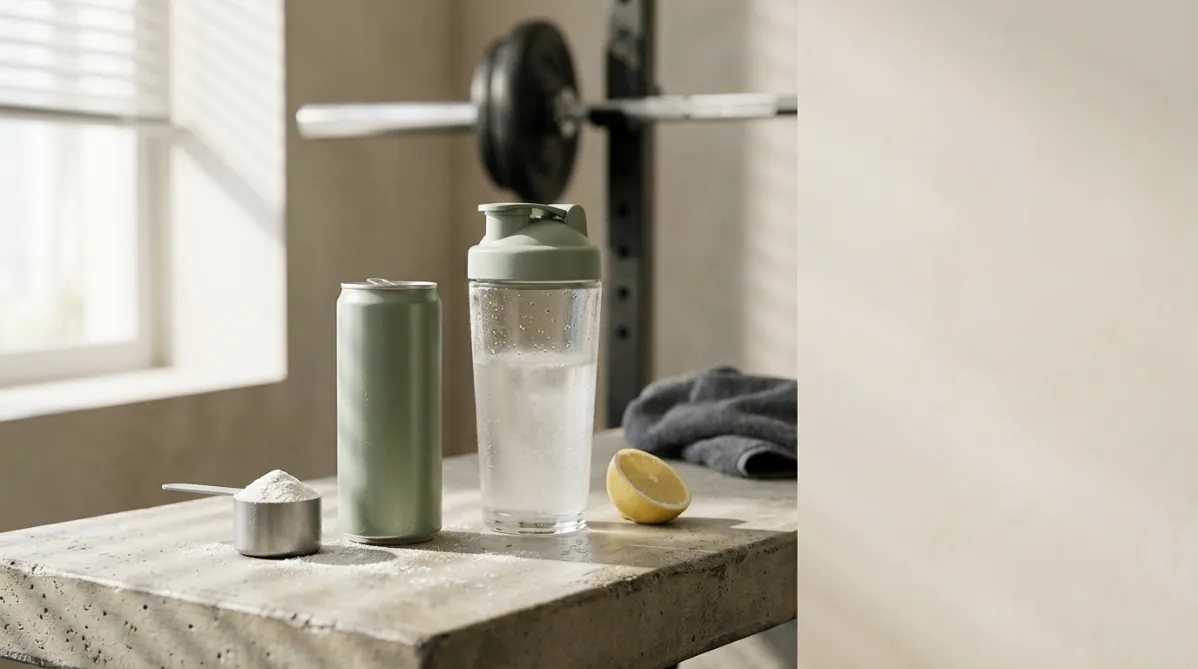
A sleek aluminum energy drink can and a matte scoop of white pre-workout powder sit side by side on a pale concrete gym bench, lit by soft morning window light. The can is slim and minimalist, with a muted sage green label and no legible text. Beside it is a clear glass shaker half full of cloudy, lightly frothy liquid with condensation beading on its surface. A few fine grains of powder are scattered across the bench, catching the light. Behind them, slightly out of focus, a stainless steel barbell rests on a rack, and a folded charcoal gym towel sits at the edge of the frame.

The color palette is warm neutral: oatmeal, soft gray, and sage, with a single accent of pale citrus yellow from a halved lemon wedge placed near the glass. A thin, elegant shadow from the window blinds falls diagonally across the scene, giving it an editorial, magazine-style rhythm. The composition leaves generous negative space on the right third of the frame, a smooth blurred wall in warm off-white, suitable for headline text overlay.

The shot is a low-angle, shallow depth-of-field product-style photograph, as if taken with an 85mm lens at f/2. The foreground objects are tack sharp and the background melts into creamy blur. The mood is calm, clean, and modern, like a wellness or science journal feature. Subtle film grain and gentle contrast add a tactile, contemporary lifestyle feel. There are no people, no logos, and no futuristic or sci-fi elements, just a quiet, considered still life that suggests the choice between a canned drink and a scooped supplement.
nutrition

Je energiedrank werkt misschien als pre‑workout — met één kanttekening

BY DR. GYMBRO ·

Cafeïne en taurine staan vaak naast elkaar in energiedranken en pre‑workouts, maar levert dat echt een prestatie‑boost op? Een nieuwe meta‑analyse van 11 gerandomiseerde studies (234 deelnemers) toonde een bescheiden verbetering in piekvermogen en tijd tot uitputting, plus een lager ervaren inspanningsniveau. De hartslag bleef onveranderd en het resultaat voor reactietijd was te inconsistent om te vertrouwen. Het grote probleem: de onderzoeken waren klein en kunnen niet aantonen of taurine iets extra’s biedt bovenop cafeïne.

A landscape editorial photograph with a modern, clean magazine feel, shot on a pale warm-gray concrete surface in soft natural window light from the left. In the foreground, two matte white ceramic espresso cups sit side by side. The left cup holds a small amount of dark espresso with golden crema. The right cup is filled twice as high. Beside them, two small stainless steel scoops hold fine coffee-colored powder, one half full and one heaped, suggesting a dose comparison without any text or labels. A pair of worn red leather boxing gloves rests slightly out of focus behind the cups, laces loosely draped, with a white hand wrap rolled neatly beside them. A minimalist digital kitchen scale in matte black sits at the edge of the frame, with a few roasted coffee beans scattered across the surface. In the soft-focus background, a boxing gym corner appears: a hanging heavy bag in muted charcoal, pale wood plank flooring, and a tall window with diffused morning light. The palette is warm cream, espresso brown, brick red, and soft slate gray, with gentle shadows and a shallow depth of field. The composition follows the rule of thirds, with the cups and scoops in the lower left third and open negative space on the right for headline overlay. The look is tactile and refined, like a high-end health and performance journal. It has natural grain, subtle contrast, and a calm, confident mood. There are no people, no text, no logos, and no futuristic elements.
nutrition

Dubbel zo veel cafeïne hielp boksers nauwelijks — dit werkte wel

BY DR. GYMBRO ·

Denk je dat een dubbele schep pre‑workout je prestaties automatisch verdubbelt? Een nieuwe crossover‑studie met 15 competitieve boksers vergeleek 3 mg/kg met 6 mg/kg cafeïne en toonde aan dat de hogere dosis niet consequent beter was. Beide dosissen verhoogden de spronghoogte en kracht na 60 minuten, maar 6 mg/kg leverde alleen bij enkele uitkomsten – zoals de ballistic push‑up en knie‑torque – een extra voorsprong. Hieronder vind je een mg‑per‑kg‑omrekening voor veelvoorkomende lichaamsgewichten, de door de data ondersteunde timing, en enkele kanttekeningen, onder meer dat er geen effect op daadwerkelijke stoten is getest.

A wide, editorial-style flat lay photographed from slightly above on a pale oak gym bench with a soft matte finish. On the left, a small white ceramic cup of black coffee sits on a matching saucer, with a thin curl of steam rising and catching warm window light. Beside it is a second, slightly larger handleless stoneware mug in muted sage green, also filled with coffee, so the pair suggests one to two cups. In the center-right foreground rests a sleek matte-black steel barbell plate, partly overlapping a brushed-steel dumbbell with fine knurling. A folded charcoal gym towel and a clean white chalk-dusted wrist strap lie casually to one side. A small scatter of whole roasted coffee beans spills across the bench in front of the cups, glossy and deep brown. Near the bottom edge, a minimalist analog kitchen scale in soft cream with a thin black needle hints at precise dosing, without any readable numbers or text.

Soft morning sunlight streams in from the upper left, creating long, gentle shadows and a warm golden glow against cool neutral tones. The background is a softly blurred, airy home gym or boutique training studio with out-of-focus squat rack uprights, pale concrete walls, and a leafy green plant in a terracotta pot adding a touch of organic color. The palette is restrained and modern: warm cream, espresso brown, charcoal, sage green, and hints of brushed silver. Shallow depth of field keeps the cups and beans tack sharp while the background melts into creamy bokeh. The composition leaves generous negative space on the right third for a title overlay, with a balanced, calm, premium magazine feel, like a contemporary wellness and sports science journal. High-resolution, natural color grading, subtle film grain, realistic textures on ceramic, steel, and coffee crema.
nutrition

Hoeveel cafeïne voor gewichtheffen? Een meta‑analyse toont aan dat 1–2 mg/kg nog steeds werkt

BY DR. GYMBRO ·

De gebruikelijke aanbeveling voor cafeïne vóór het gewichtheffen is 3–6 mg per kilogram lichaamsgewicht, wat neerkomt op meerdere koppen koffie of een flinke schep pre‑workout. Een meta‑analyse uit 2022 van 12 onderzoeken liet zien dat al doses van 0,9–2 mg/kg de spierkracht (d ≈ 0,17), spieruithouding (d ≈ 0,21) en gemiddelde staaf‑snelheid (d ≈ 0,56) verbeteren. Voor de gemiddelde lifter komt dat overeen met één tot twee koppen koffie. De effecten zijn bescheiden en komen uit acute, één‑sessie‑studies, maar ze suggereren dat je met minder cafeïne een vergelijkbaar voordeel kunt behalen.

This page is available in