Dr. Gymbro
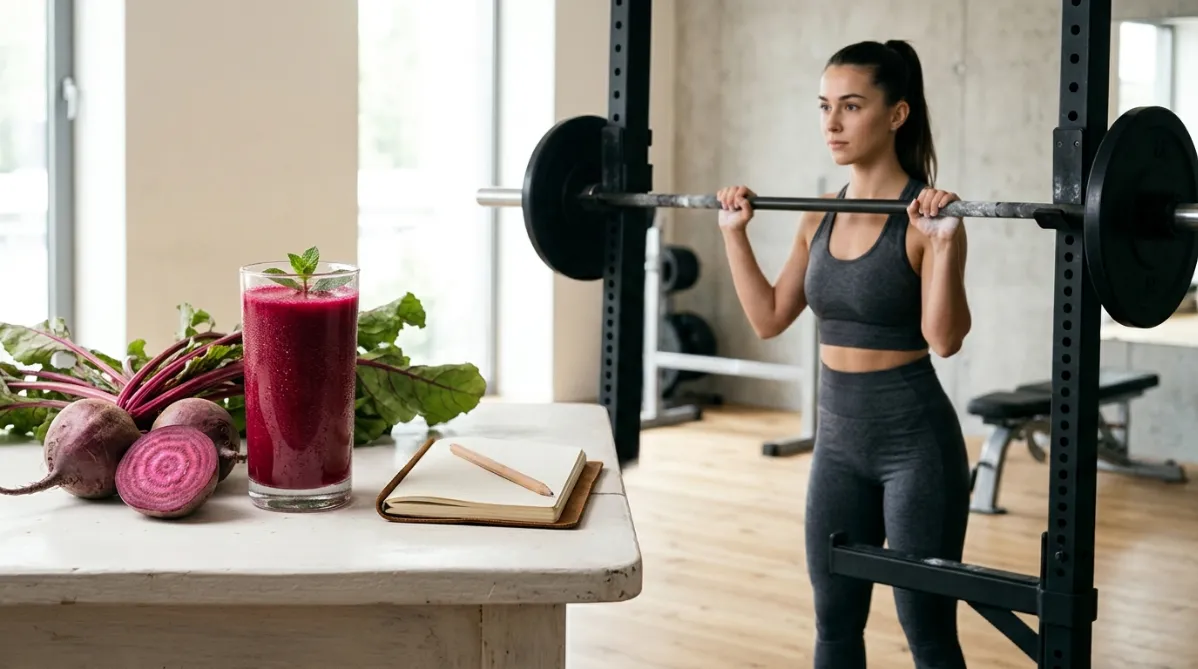
A wide, editorial-style photograph of a bright, modern gym corner softened by morning window light. In the foreground, a rustic matte-white ceramic table holds a tall clear glass of deep magenta beetroot juice, beads of condensation on the glass, a few fresh whole beetroots with leafy crimson-veined stems beside it, and one beetroot sliced in half to reveal its vivid concentric purple-pink rings. Next to the glass sits a small, neat notebook with a pencil, suggesting a research note, with no legible text. Behind the table, slightly out of focus, a young woman lifter with a tidy ponytail and a fitted charcoal training set stands at a barbell resting on a squat rack, chalk-dusted hands gripping the bar, calm and focused expression. A loaded bench with a bar is visible further back, with matte black plates and a light wooden floor. The palette is restrained and trendy: warm off-white, soft concrete gray, muted sage green accents from the beet leaves, and a bold beetroot magenta as the focal color. Shallow depth of field with a creamy bokeh background, natural side lighting casting long gentle shadows, subtle film grain. Composition follows the rule of thirds, with the juice and beets on the left third and the lifter on the right, leaving clean negative space in the upper area for a headline overlay. Mood is thoughtful, clean, and slightly skeptical, like a contemporary health and science journal cover. Realistic photography style, high-end magazine look, no text, no logos, no futuristic elements.
Nutrition

Beetroot Juice Failed Women Lifters—and Even Slowed the Bench

Dr. Gymbro · · 3 min read

You've seen the hype: beetroot juice, the purple pre-workout that supposedly turns blood vessels into superhighways and your bar speed into a rocket. A new randomized trial in resistance-trained women just put that promise under the bar. The result? No squat benefit at all, and a small dip in bench press power at one load.

What the researchers actually tested

A team led by researchers at Pepperdine University, with collaborators at the University of Virginia, McMaster, Birmingham City and Loughborough, published the study in the European Journal of Applied Physiology (2026). Eighteen resistance-trained women took part in a randomized, double-blinded, crossover design. Each woman did both conditions, which makes the comparison cleaner than comparing two separate groups.

The two drinks were:

  • Placebo (PL): nitrate-depleted beetroot juice with negligible nitrate.
  • Beetroot juice (BR): nitrate-rich juice delivering about 6.7 mmol of nitrate, which is roughly 415 mg.

Both were consumed 2.5 hours before exercise, a timing window commonly used in nitrate research.

The workout: fast, light-to-moderate, explosive

This was not a max-strength test. Participants performed one set of three explosive repetitions of the barbell back squat and the bench press at 55%, 60% and 65% of their one-rep max, with two minutes of passive rest between sets. A linear transducer measured peak and mean power and velocity on every set. The setup targets the kind of fast, powerful efforts nitrate is often claimed to help.

The headline: squat did nothing

For the back squat, there were no differences between conditions on any variable (all P > 0.05). Beetroot juice did not improve power or velocity at any of the three loads. The authors conclude that acute nitrate ingestion does not improve back squat performance in this group.

The twist: bench got slightly worse at 60%

Bench press was also null across the board, with one exception. At 60% of 1RM, beetroot juice came out worse than placebo:

  • Mean power: 201 ± 61 W with BR vs. 206 ± 61 W with placebo (P = 0.047, gz = -0.48)
  • Mean velocity: 0.68 ± 0.08 m/s with BR vs. 0.70 ± 0.08 m/s with placebo (P = 0.049, gz = -0.50)

That's a gap of about 5 watts and 0.02 m/s. Both P values barely cleared the 0.05 line, and the effect appeared at one load only. The 55% and 65% bench sets showed no difference. With this many outcomes measured, a borderline result like this could easily be a statistical fluke. The authors don't claim nitrate hurts lifters. They say more research is needed to determine whether nitrate has an ergolytic (performance-reducing) effect in resistance-trained women.

How to read this honestly

This is human data, not animal or cell work, but it has limits. The sample was small (18 women), the dose was a single acute serving, and only three light-to-moderate loads and three-rep sets were tested. It tells us nothing about heavy maximal lifts, high-rep sets to failure, or weeks of daily supplementation. The authors declared no conflicts of interest.

Practical takeaways

Dose and timing used in the study: about 6.7 mmol nitrate (roughly 415 mg), taken 2.5 hours before training. Check your product's label, since nitrate content varies widely between juices and shots.

Who probably shouldn't bother: if you're a woman lifting for strength and power in the squat and bench, this study gives you no reason to expect a pre-workout boost from beetroot juice. At best it did nothing, and at one bench load it was slightly worse.

Who might still benefit: this study can't answer that, because it didn't test endurance or sprint work. Nitrate research has historically centered on aerobic and high-intensity endurance performance, so athletes in those areas may still have reason to experiment. Treat that as background context rather than a finding from this paper.

Smart way to experiment: if you like beetroot juice, don't change the rest of your routine. Try it on a few training days, track bar speed or perceived performance, and compare against days without it. If it's not helping, you're just paying for an expensive purple drink.

The bottom line

Beetroot juice isn't a magic pre-workout for women's barbell power. In this trial, it produced no squat gains and a small, single-load bench decline that deserves replication before anyone draws big conclusions. The bigger lesson is that a supplement's strong reputation in one sport doesn't automatically carry over to the lifting platform.

Original study

Read the original research on pubmed.ncbi.nlm.nih.gov →

This article summarizes published research for general information. It is not medical advice.

DG

Written by

Dr. Gymbro

Dr. Gymbro writes for Dr. Gymbro: science-backed fitness, nutrition & performance.

Related Articles

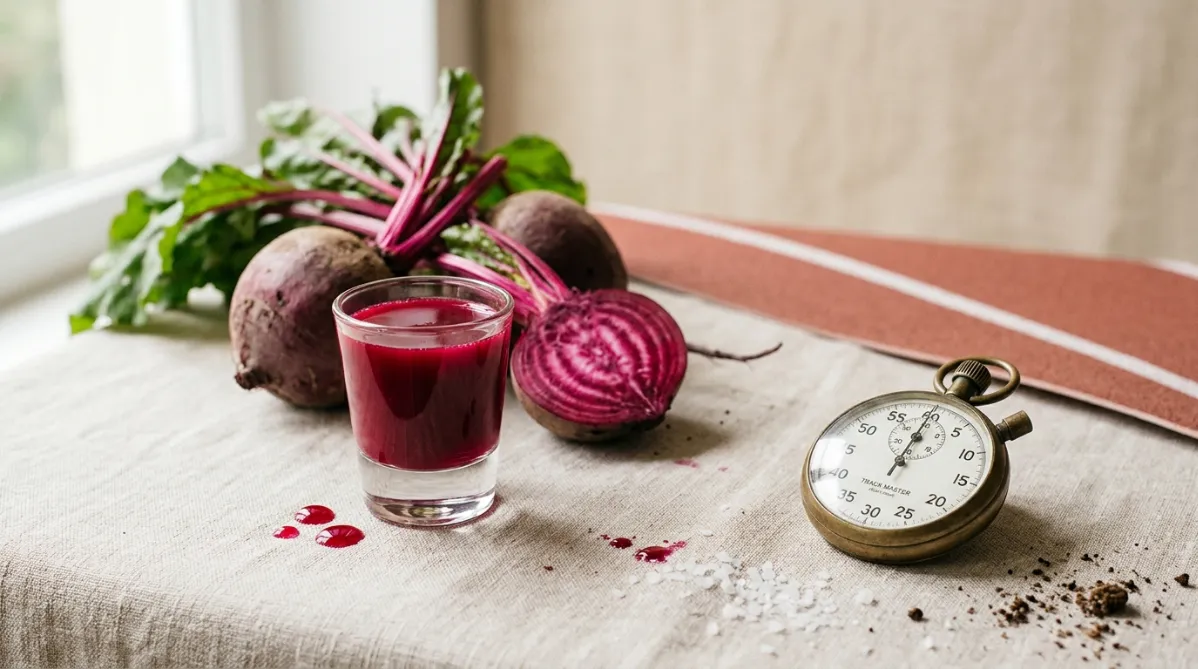
A wide editorial still life on a clean, pale oatmeal-colored linen surface, lit by soft natural window light from the left. In the center-left, a small clear glass shot glass filled with deep magenta-crimson beetroot juice catches a glowing highlight, with a few droplets beaded on the surface beside it. Behind it sit two whole beetroots with their leafy stems, the skins a dusty burgundy and the stems a vivid pink-red, and one beetroot sliced in half to reveal concentric rings of magenta and soft pink. To the right, a vintage-style brass stopwatch rests at an angle on the linen, its white face crisp and its hands frozen, slightly out of focus in the foreground edge. A faint curve of a sprinting track lane, in muted terracotta with thin white lines, sweeps diagonally across the blurred background, hinting at a running track without showing any people. Scattered across the surface are a few small, delicate beet-colored splashes and a light dusting of coarse sea salt. The palette is restrained and modern: warm cream, terracotta, dusty rose, deep magenta, and touches of sage green from the leaves. Shallow depth of field and a gentle film-like grain give it a contemporary lifestyle-magazine feel. The composition leaves generous negative space on the upper right for title overlay. Minimalist, tactile, calm, and sophisticated, in the style of a high-end health and science journal's editorial photography, 16:9 landscape.
nutrition

Beetroot Juice Boosted Nitrite 35x, But Sprinters Got No Faster

BY DR. GYMBRO ·

Beetroot juice sent salivary nitrite soaring about 35-fold in trained sprinters, which sounds like the start of a performance miracle. Then the stopwatch came out. In a randomized, double-blind, placebo-controlled study of 12 male sprinters, a 70 mL shot of beetroot juice didn't improve 60 m or 100 m times, jump height, or most measures of muscle function. Here is what was tested, what the study can't tell us, and who should save their money.

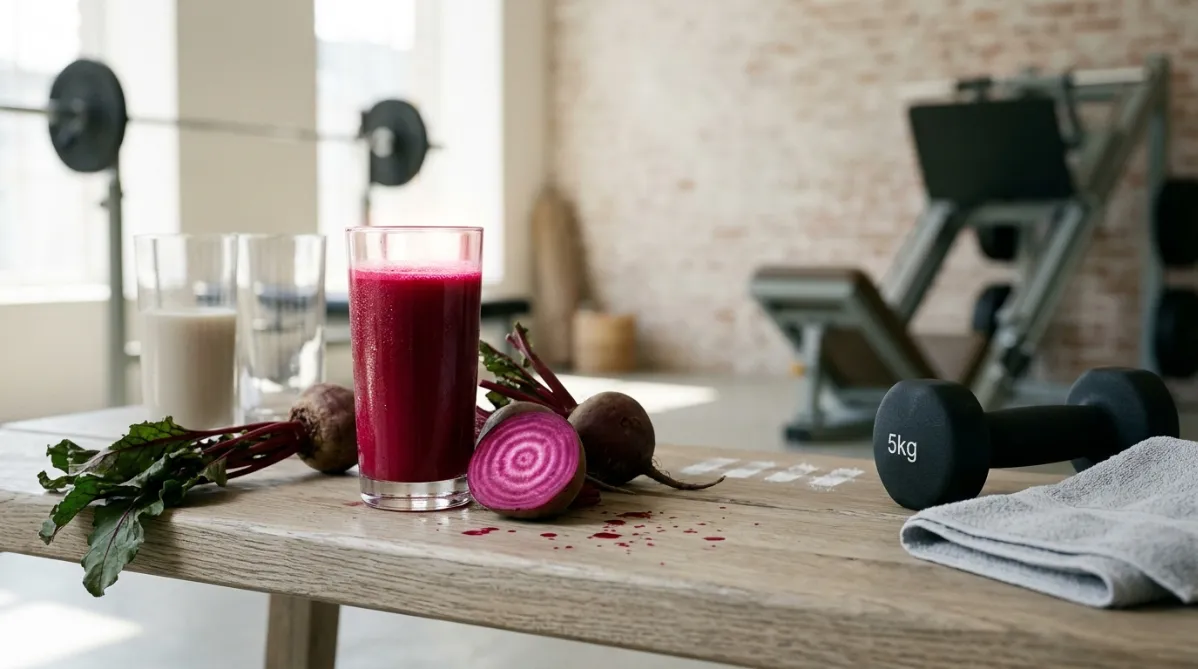
A wide, editorial-style still life photographed on a pale warm-gray concrete surface in soft, diffused morning window light. On the left side, a tall clear glass filled with deep magenta-crimson beetroot juice sits beside two halved raw beetroots, their concentric rings of vivid fuchsia and purple clearly visible, with a few small green-and-red-veined leaves draped casually nearby. On the right side, a matching clear glass of cloudy white creatine solution rests next to a small matte ceramic bowl heaped with fine white powder and a minimal wooden scoop, a light dusting of powder scattered across the surface. In the center, between the two sides, a simple matte black barbell grip and a single chalk-dusted weight plate edge rise into the frame at a low angle, hinting at lifting without showing a person. The composition is split in a balanced, symmetrical way, with a subtle vertical shadow line dividing the saturated magenta tones on the left from cool, neutral whites and creams on the right. The background is softly blurred with a muted sage-green and oatmeal-toned wall, with plenty of negative space at the top for a headline overlay. Shallow depth of field, crisp focus on the glasses' condensation droplets and the textured beetroot flesh. The color palette is limited and refined: magenta, cream, charcoal, and soft sage. The mood is clean, modern, and health-journal chic, like a contemporary wellness magazine cover, with natural shadows, a tactile matte finish, and subtle film-like grain. No text, no logos, no futuristic elements.
nutrition

Beetroot Juice vs Creatine: Who Wins for Lifting in 72 Hours?

BY DR. GYMBRO ·

A new randomized crossover trial pitted beetroot juice against creatine over about 72 hours of supplementation in novice lifters. Creatine was the one credited with more bench press reps at 80% 1RM, while beetroot juice led on bar velocity, muscle oxygenation, peak heart rate and HRV recovery. The abstract doesn't report doses or timing, so we flag what's missing. Here's the full scorecard and who might choose which supplement.

A wide, editorial-style still life photographed in soft natural window light, set on a pale oak gym bench or a light concrete surface. In the center foreground, a tall clear glass of deep magenta-crimson beetroot juice catches the light, with a faint luminous glow along its rim and condensation beading on the outside. Two other glasses sit slightly behind it, one holding a pale, neutral-colored liquid and one empty. They suggest the placebo and no-treatment conditions without any labels. Beside the glasses, a halved raw beetroot shows concentric rings of vivid fuchsia and violet. A few whole beets with their leafy stems and dark green and burgundy leaves are scattered casually nearby.

On the right side of the frame, slightly out of focus, a matte black women's-size dumbbell and a neatly folded light gray towel rest on the bench. Behind them, the soft blur of a minimalist, airy training space includes a barbell rack and a leg press machine in muted tones. The background is bright and neutral, in warm off-white, soft sand, and light gray, so the magenta of the juice is the dominant accent color.

A small, restrained motif of four evenly spaced chalk marks or four small round weight plates arranged in a neat row on the bench hints at the "four sets" of the trial. A few drops of beet juice have splashed onto the surface, forming a tasteful organic pattern.

The composition follows the rule of thirds, with the glass of juice on the left third and open negative space on the right for headline text. Shallow depth of field, crisp focus on the glass and beet, subtle film-like grain, and a calm, modern, trendy magazine aesthetic. The palette is magenta, deep burgundy, sage green, cream, and soft gray. The mood is quiet, skeptical, and scientific without any laboratory imagery, with clean lines and an elegant, minimal feel.
supplements

Beetroot Juice Didn't Add a Single Rep for Resistance-Trained Women

BY DR. GYMBRO ·

Beetroot juice is hyped as a natural rep booster, but a new double-blind crossover trial in resistance-trained women found no benefit at all. Sixteen participants drank nitrate-rich juice (12.8 mmol), a placebo or nothing before four sets of bench press and leg press to failure. Total reps, perceived exertion, heart rate, blood pressure and lactate were statistically unchanged. The findings don't bury beetroot for good, but they suggest nitrate's ergogenic effect may be limited for this population and this protocol.

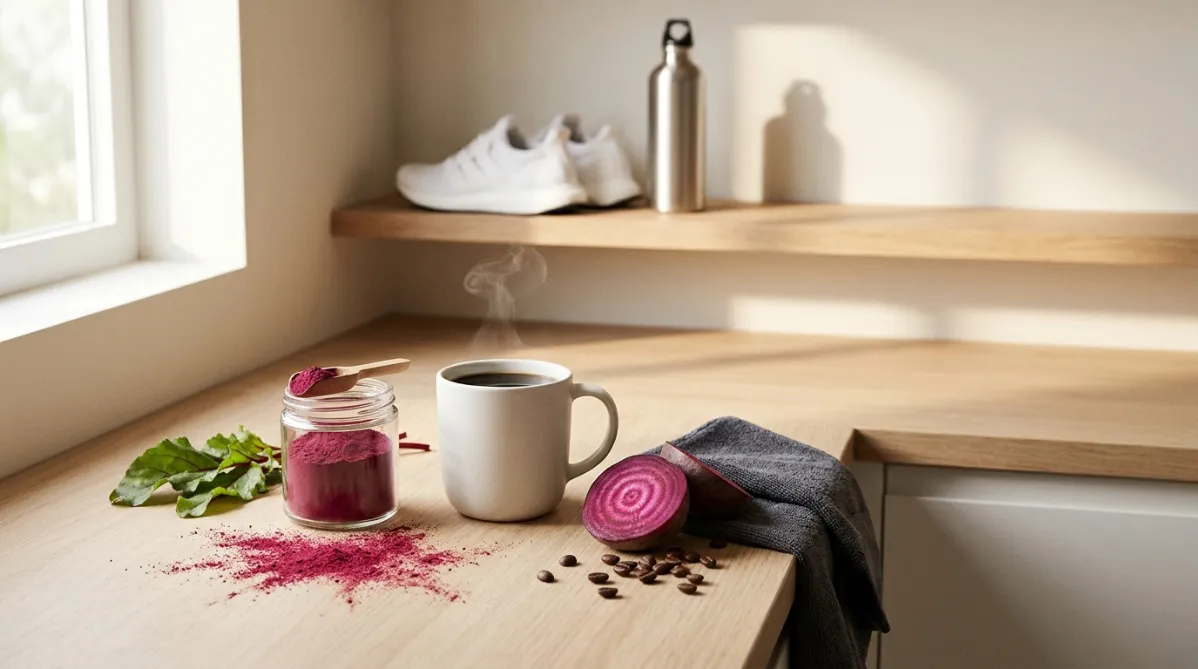
A sunlit, minimalist kitchen counter in a modern home, photographed from a slightly elevated three-quarter angle with soft natural morning light spilling in from a window on the left. In the center sits a matte white ceramic mug of black coffee with a thin curl of steam, beside a small glass jar of deep magenta beetroot powder with a wooden scoop resting on the lid. A scattering of fine crimson powder dusts the pale oak surface in an artful, casual swirl. Nearby, a halved raw beetroot reveals vivid concentric rings of purple and pink, next to a few roasted coffee beans and a neatly folded charcoal gym towel. In the soft-focus background, a pair of clean white running shoes and a stainless steel water bottle sit on a floating shelf, hinting at a pre-workout routine. A single sprig of green beet leaves adds a fresh accent.

The color palette is warm and editorial: creamy neutrals, espresso browns, and rich beet magenta, with gentle highlights and long soft shadows. The composition has generous negative space on the right side for headline text, shallow depth of field, and a crisp, tactile texture on the ceramic, powder, and wood grain. The mood is calm, health-conscious, and contemporary, like a lifestyle feature in a premium wellness magazine or a trendy nutrition journal. Clean, balanced, natural, with subtle film-like grain and a slightly muted, high-end finish.
science research

Pre-Workout Caffeine Stiffens Arteries. Beetroot Powder Offset It

BY DR. GYMBRO ·

A new randomized crossover trial found that a pre-workout-sized dose of caffeine (6 mg/kg) raised markers of arterial stiffness within 2.5 hours. Adding a beetroot powder with 400 mg of nitrate brought those markers back to placebo levels. Blood pressure and endothelial function did not change, so this is a subtle effect rather than a red flag. The study involved just 24 healthy young adults and a single dose, leaving big questions about long-term use and older or hypertensive people. Here is what the data show, what they do not, and how to think about it if you rely on caffeine before training.

This page is available in