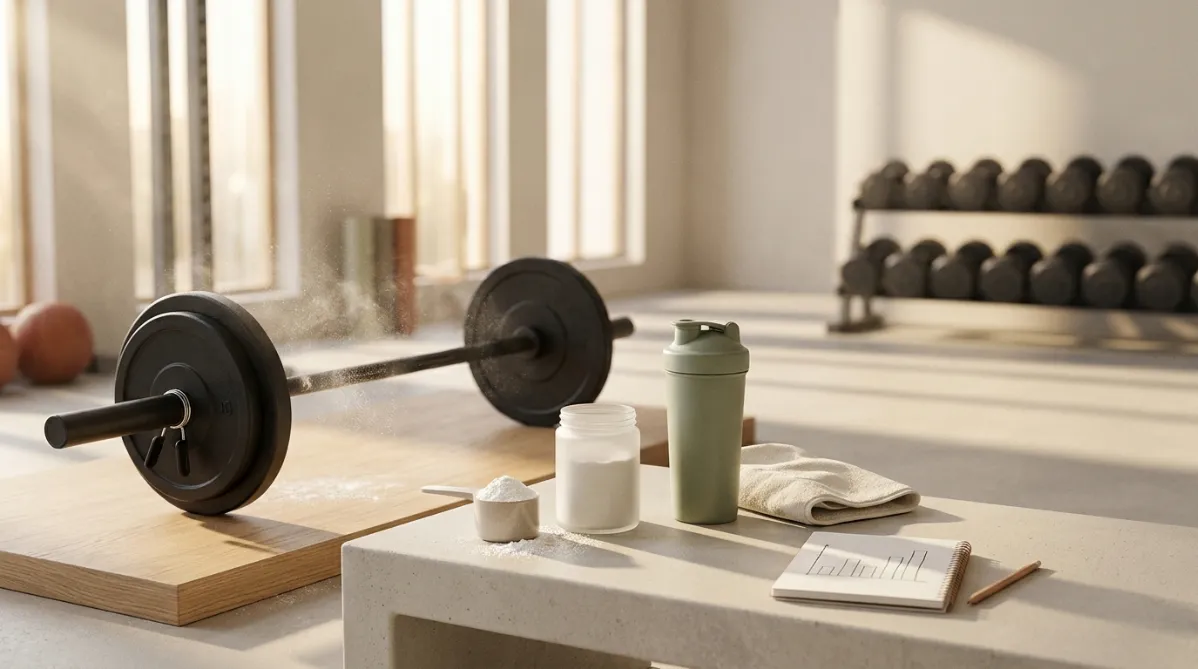
Creatine monohydrate is among the most studied supplements in sports nutrition, yet women past menopause have rarely been the focus. A 2026 systematic review and meta-analysis in the Journal of the International Society of Sports Nutrition (JISSN) now offers the clearest picture so far. It also contains a catch: the benefits appeared when the dose and the training were right, and not when they weren't.
What the Researchers Did
The team, led by Naddafha with Antonio, Kreider and Stout, searched MEDLINE, Embase, Scopus, Web of Science, SPORTDiscus and Cochrane CENTRAL from 2000 to August 2025. They included only randomized, placebo-controlled trials in postmenopausal women, with creatine given with or without resistance training (RT). Primary analyses required interventions of at least 6 weeks.
Seven randomized controlled trials qualified, enrolling 608 women with a mean age of about 62. Trial duration ranged from 12 to 104 weeks, with a median of 38 weeks. Outcomes were DXA-measured lean mass, one-repetition maximum (1RM) strength, bone mineral density, physical function and safety. Screening and data extraction were done in duplicate, and bias was assessed with Cochrane RoB 2.
The Headline Numbers
For lean mass (5 trials, n = 338), creatine beat placebo by a mean difference of +0.37 kg (95% CI +0.05 to +0.69; I² = 25%). For leg-press 1RM (3 trials, n = 111), the mean difference was +7.5 kg (95% CI +2.2 to +12.8; I² = 0%).
These are modest gains, and the authors call them "small but meaningful." One caution is that the 95% prediction interval for lean mass ran from -0.10 to +0.84 kg. That means a future trial could plausibly find no benefit, so the average effect should not be read as a guarantee.
The Dose Catch
The most practical finding concerns how creatine was used. Benefits were evident when creatine at 5 g per day or more was combined with resistance training. Trials using 3 g per day or less without resistance training showed no measurable effect.
This matters because many people take a small daily scoop and skip the gym, expecting results. In this evidence base, that pairing did nothing detectable. The result fits what is known about creatine's mechanism. It helps muscles regenerate energy during hard efforts, so it works best as an amplifier of training and does little as a standalone pill.
The analysis cannot fully separate dose from training. Both variables were bundled together in the trials, and the dose and duration meta-regression was exploratory. The honest reading is that the effective combination was 5 g or more plus lifting, and that the data cannot show which element did more of the work.
Bone Density Did Not Change
Menopause brings declining bone density as well as muscle loss, so many hoped creatine might help the skeleton too. Overall, bone mineral density was unchanged. The authors conclude that effects on bone remain unclear. Women taking creatine for bone health should not expect results from this evidence, and those with osteoporosis concerns still need standard care, adequate calcium and vitamin D, and a clinician's guidance.
Safety Findings
Adverse events were mild and similar to placebo. Renal indices were unchanged. That is reassuring, since kidney worries are the most common objection to creatine. Even so, women with existing kidney disease or those taking medications that affect renal function should speak with a physician before starting, because the trials generally enrolled otherwise healthy participants.
Limits of the Evidence
Risk of bias was mostly rated "some concerns." Only one large, preregistered, double-blind RCT was at low risk. The review itself was not prospectively registered, though the data and supplementary materials were later deposited on OSF. Several authors also disclosed ties to creatine research and industry-supported organizations, including Kreider's role on the Creatine for Health Scientific Advisory Board supported by Alzchem, and Antonio's position as CEO of the ISSN, which occasionally receives funding from creatine companies. The authors declared no conflict related to this work, but readers should weigh that context.
Practical Takeaways
- Dose: The benefits were seen at 5 g per day or more. Doses of 3 g per day or less without training showed no effect.
- Pair it with resistance training: Creatine alone, without lifting, did not show measurable gains.
- Set realistic expectations: About +0.37 kg of lean mass and +7.5 kg on leg-press 1RM are small, real improvements, not dramatic transformations.
- Do not count on bone benefits: Bone density did not change.
- Safety: Side effects matched placebo and kidney markers held steady in the trials reviewed.
For postmenopausal women already lifting, 5 g of creatine monohydrate daily looks like a low-risk way to add a little extra. For those not training, the greater return likely comes from starting resistance exercise first.