Dr. Gymbro
A wide, editorial-style photograph of a wrestler in mid-preparation inside a bright, minimalist training hall with pale wooden floors and soft natural light from tall windows. The athlete, seen from the side and slightly from behind, grips a loaded barbell at hip height in a deadlift-style setup. Chalk dust hangs in the air, and the muscles of the back and forearms are tensed. A navy and white wrestling singlet contrasts with the warm, neutral tones of the room. In the foreground, slightly out of focus, sits a small matte ceramic dish holding a pile of fine white taurine powder beside a clear glass of water. Next to it are a sleek stopwatch and a folded white towel on a low wooden bench. The stopwatch hints at the 60-minute timing without showing legible numbers. In the soft background, a wrestling mat in muted terracotta and cream is visible, along with a few blurred teammates stretching. The palette is calm and modern: warm beige, off-white, deep navy, and a single accent of coral orange in the mat edge and a small detail on the stopwatch. The lighting is golden-hour side light with gentle shadows, giving the chalk particles a subtle glow. The composition follows the rule of thirds, with the wrestler on the right and the powder and glass on the lower left, leaving clean negative space in the upper left for a headline overlay. The depth of field is shallow, with crisp focus on the athlete's hands and the bar and a creamy bokeh background. The overall look is a contemporary health-and-science magazine cover: refined, realistic, grounded, and athletic, with no futuristic elements and no text or logos.
Nutrition

Taurine Plus a PAPE Warm-Up Boosted Wrestlers' Peak Power by 16.8%

Dr. Gymbro · · 4 min read

Taurine is the ingredient on the side of nearly every energy drink can, and most lifters never think about it. A new double-blind crossover trial in elite wrestlers suggests it may deserve a closer look, at least when it is paired with a heavy warm-up.

The study, published in the Journal of the International Society of Sports Nutrition, tested taurine combined with a post-activation performance enhancement (PAPE) protocol. Here is what the paper found, and what it didn't.

The Headline Numbers

Twenty elite male wrestlers took part. Compared with the placebo-plus-PAPE session and the control session, the taurine-plus-PAPE session produced:

  • Peak power output up 16.76% (p = 0.048)
  • Relative power (per kg of body mass) up 22.24% (p = 0.028)
  • Lower post-test blood lactate (p < 0.05)
  • Better countermovement jump (CMJ) performance after exercise (p < 0.05), which the authors read as less neuromuscular fatigue

Those are large numbers for an acute, single-session intervention. Note, though, that the peak power p-value of 0.048 only just clears the conventional threshold. Treat it as a promising signal, not a settled result.

What Is PAPE, and Why Pair It With Taurine?

PAPE is the short-term boost in muscular strength and responsiveness that can follow high-intensity muscle contractions. In plain terms, you do something heavy, rest briefly, and then perform better on an explosive task than you would have cold.

The researchers wanted to know whether a supplement could add to that effect. Taurine was a reasonable candidate because it is widely used in sport supplements and energy drinks. The authors' conclusion points to a synergistic effect, though the design has a limit worth knowing about (see below).

How the Study Worked

Each wrestler completed three sessions in a crossover design:

  1. CON: no supplement and no PAPE protocol
  2. PAPE + placebo: PAPE protocol with a sucrose placebo
  3. PAPE + taurine: PAPE protocol with taurine

The PAPE protocol was 3 sets of 8 reps of squats and hip thrusts at 85% of one-rep max. Taurine or placebo was taken 60 minutes before the protocol. Five minutes after the PAPE work, athletes did the Wingate anaerobic test (a 30-second all-out cycling effort). CMJ was measured before the Wingate, immediately after, and five minutes after.

Dose and Timing: What We Can Actually Say

Timing: the supplement was taken 60 minutes before the PAPE protocol, and the Wingate followed about five minutes after the lifting. So the whole sequence runs: supplement, wait an hour, heavy lifting, short rest, explosive effort.

Dose: the abstract available here does not report the taurine dose, and I won't guess at it. Check the full text (PMC13162555) for the exact amount. As general context outside this paper, sport studies on taurine commonly use gram-range doses, but that is not a substitute for the dose used in this trial.

Who This Might Help

The participants were highly trained male wrestlers, and the authors frame the benefit for athletes in explosive, anaerobic sports. Reasonable candidates for experimenting would be:

  • Combat sport athletes
  • Sprinters and jumpers
  • Team-sport athletes who rely on repeated high-power efforts

The study did not test recreational lifters, women, or older adults. Extending the results to them is speculation.

Who Should Skip It or Be Cautious

  • Anyone expecting energy-drink magic. The trial used a taurine supplement, not an energy drink. Caffeine and other ingredients were not part of the test, so the study says nothing about how a commercial drink would perform.
  • People who won't do the heavy warm-up. The benefit was observed in the PAPE-plus-taurine condition. There was no taurine-only arm, so we can't say taurine would help without the PAPE protocol.
  • Beginners. Three sets of 8 at 85% of 1RM in squats and hip thrusts is demanding, and for an unconditioned lifter it could cause fatigue instead of potentiation.
  • People with medical conditions or on medication. Talk to a clinician before starting any new supplement.

Caveats You Should Know

Small sample. Twenty athletes is a typical size for elite-athlete research, but it limits how far the findings generalize.

No taurine-only condition. The comparison between PAPE + taurine and PAPE + placebo suggests taurine added something on top of PAPE. But without a taurine-without-PAPE session, the word "synergy" is the authors' interpretation, not something the design directly tests.

Acute effects only. This was a single-session test. It tells us nothing about long-term training adaptations or chronic supplementation.

Mechanism not tested. You will often see explanations for how taurine might work, such as effects on muscle calcium handling or reduced oxidative stress. Much of that evidence comes from animal and lab studies, and this trial did not measure those mechanisms. The paper reports performance, lactate, and jump outcomes, not why they changed.

Lactate is a clue, not a verdict. Lower post-test lactate was interpreted as better metabolic recovery, but lactate is an indirect marker and the abstract doesn't give details on timing or magnitude.

Practical Takeaways

  1. Timing: take taurine about an hour before your potentiation work, as in the study.
  2. Warm-up: the protocol was 3x8 squats and hip thrusts at 85% 1RM, followed by about five minutes of rest before the explosive effort.
  3. Dose: look up the exact figure in the full paper before copying anything.
  4. Expectations: this is one small, acute, promising trial in elite wrestlers. It is a good hypothesis to test in your own training, not proof of a guaranteed 17% power jump.

If you try it, change one variable at a time and log your results. Independent replication, ideally with a taurine-only arm and a more diverse set of athletes, would tell us whether this combination is a real edge.
Original study

Read the original research on pubmed.ncbi.nlm.nih.gov →

This article summarizes published research for general information. It is not medical advice.

DG

Written by

Dr. Gymbro

Dr. Gymbro writes for Dr. Gymbro: science-backed fitness, nutrition & performance.

Related Articles

A sleek aluminum energy drink can and a matte scoop of white pre-workout powder sit side by side on a pale concrete gym bench, lit by soft morning window light. The can is slim and minimalist, with a muted sage green label and no legible text. Beside it is a clear glass shaker half full of cloudy, lightly frothy liquid with condensation beading on its surface. A few fine grains of powder are scattered across the bench, catching the light. Behind them, slightly out of focus, a stainless steel barbell rests on a rack, and a folded charcoal gym towel sits at the edge of the frame.

The color palette is warm neutral: oatmeal, soft gray, and sage, with a single accent of pale citrus yellow from a halved lemon wedge placed near the glass. A thin, elegant shadow from the window blinds falls diagonally across the scene, giving it an editorial, magazine-style rhythm. The composition leaves generous negative space on the right third of the frame, a smooth blurred wall in warm off-white, suitable for headline text overlay.

The shot is a low-angle, shallow depth-of-field product-style photograph, as if taken with an 85mm lens at f/2. The foreground objects are tack sharp and the background melts into creamy blur. The mood is calm, clean, and modern, like a wellness or science journal feature. Subtle film grain and gentle contrast add a tactile, contemporary lifestyle feel. There are no people, no logos, and no futuristic or sci-fi elements, just a quiet, considered still life that suggests the choice between a canned drink and a scooped supplement.
nutrition

Your Energy Drink May Work Like a Pre-Workout—With One Catch

BY DR. GYMBRO ·

Caffeine and taurine sit side by side in energy drinks and pre-workouts, but does the pair actually boost performance? A new meta-analysis of 11 randomized trials (234 participants) found moderate improvements in peak power and time to exhaustion, plus lower perceived effort. Heart rate didn't budge, and the reaction-time result was too inconsistent to trust. The catch is that the studies were small and can't show whether taurine adds anything beyond caffeine. Here's what the data say, and who should think twice.

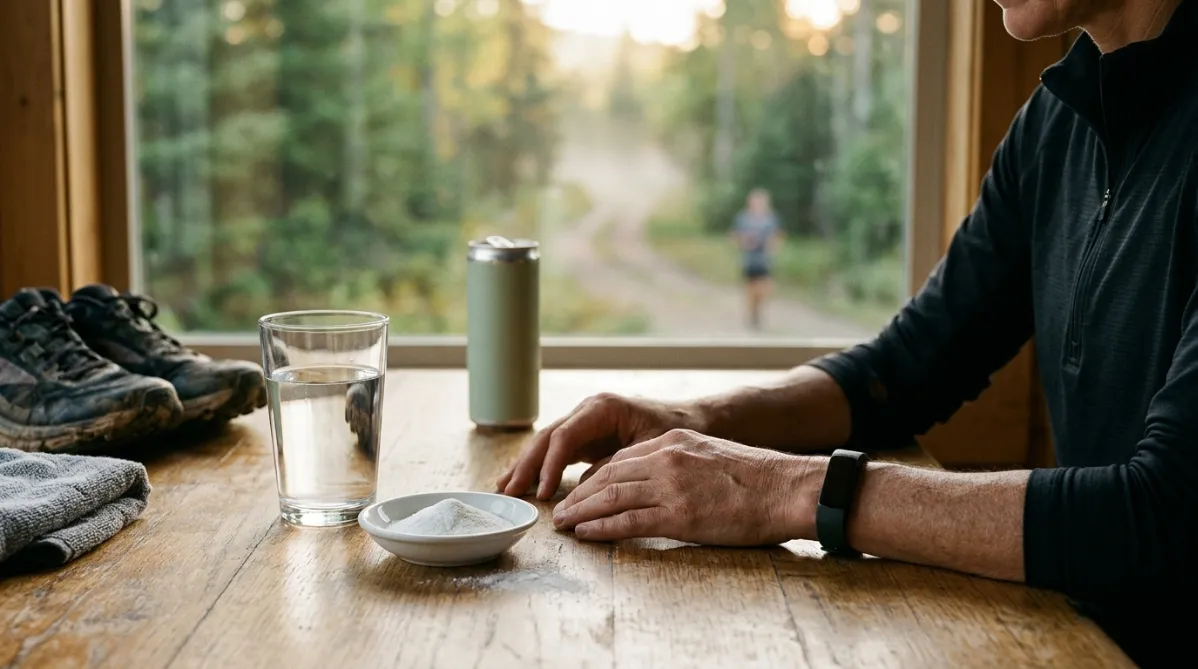
A landscape editorial photograph of a lone runner's hands resting on a weathered wooden table beside a small white ceramic dish of fine white powder and a clear glass of water, shot in soft morning light. A slim matte aluminum energy drink can, unbranded with a minimalist pale sage-green label, stands slightly out of focus in the background, with a single scoop of powder dusted lightly on the tabletop. A pair of worn running shoes and a folded gray towel sit at the edge of the frame. Through a large window behind them, a blurred misty trail winds through green trees at sunrise, with warm golden light spilling across the scene.

The color palette is calm and modern: creamy off-white, sage green, warm honey gold, and soft charcoal. The composition follows the rule of thirds, with the dish and glass in the lower left third and generous negative space on the right for a title overlay. The depth of field is shallow, with a crisp focus on the powder's delicate texture and tiny glints of light on the glass rim. The mood is clean, thoughtful, and quietly energetic, like a contemporary health and science magazine feature. Natural grain, subtle film-like softness, and gentle shadows give it an authentic lifestyle-editorial look. There are no text, logos, or futuristic elements, only tactile, real-world materials like wood, ceramic, glass, cotton, and metal.
nutrition

The Energy Drink Ingredient That Boosts Endurance on Its Own

BY DR. GYMBRO ·

Everyone talks about caffeine, but the other ingredient on the energy drink can may be quietly doing its own work. A 2018 meta-analysis of 10 studies found that isolated taurine improved endurance performance (Hedges' g = 0.40), and a single dose appeared to be enough. Neither dose (1–6 g) nor supplementation length changed the effect in a meaningful way. The catch is a small evidence base and wide confidence intervals, so this is a promising signal, not a guarantee. Here's what the study found and how to try taurine sensibly.

A wide, softly lit editorial photograph of a modern minimalist gym corner, shot at golden hour with warm light streaming through large frosted windows. In the foreground, a matte white scoop of fine creatine powder rests on a pale oak bench beside a clear glass shaker bottle half-filled with water. A small pile of loose white powder dusts the wood surface. Just behind them, a matte black barbell loaded with charcoal bumper plates rests on a squat rack, slightly out of focus, with chalk dust floating in the sunbeams.

On the bench, a simple analog wall-style clock or a sleek minimalist wristwatch lies face up, hinting at timing without being the main focus. Next to it sits a slim open notebook with a pencil and a few hand-drawn tally marks and neat columns, suggesting tracked training data. A folded sage-green towel sits at the edge of the frame.

The color palette is calm and sophisticated: cream, warm oak, soft sage green, charcoal, and a touch of terracotta. The shallow depth of field gives creamy bokeh in the background, where the soft silhouette of a lifter in neutral athletic wear chalks their hands near the rack, rendered anonymously and without a visible face.

The composition follows a rule-of-thirds layout, with the powder and shaker in the lower left third and open negative space on the right, suitable for headline overlay. The mood is clean, focused, and quietly motivated, like a premium health and science journal feature. The lighting is natural and diffused, with gentle shadows, subtle film grain, and true-to-life textures. Shot on a 50mm lens at f/2, with crisp detail on the powder and a high-end lifestyle magazine finish.
nutrition

Creatine Before Training Won This Timing Test—But There's a Catch

BY DR. GYMBRO ·

Does it matter when you take your creatine? A new randomized crossover pilot trial in Nutrients says the pre-workout window may have an edge: 0.1 g/kg of creatine monohydrate before training was linked to more total load lifted in the bench press and back squat than placebo or no supplement. Taking it during or after training didn't show the same advantage, and no differences appeared in jumping, mood, cognition, or soreness. But the study had only 11 men and tested a single dose, and the authors call it exploratory. Here's the exact dose, what the data show, and who should be cautious.

A wide, editorial-style still life photographed in soft natural window light on a pale oatmeal-colored linen surface. In the center-left, a small matte ceramic dish holds a modest pile of vivid red dried chili peppers and a few sliced fresh chilies, their glossy seeds catching the light. Beside it sits a minimalist amber glass capsule bottle without a label, with two translucent capsules spilled onto the linen, along with a tiny brass measuring spoon holding a pinch of fine orange-red powder.

On the right side of the frame, slightly out of focus, a worn black barbell rests across a wooden gym box, with a chalk-dusted steel plate leaning nearby. A small cloud of white chalk dust hangs delicately in the air, backlit by the light. A folded gray cotton gym towel and a simple stainless steel water bottle sit in the soft background.

In the foreground, a minimalist white notebook lies open with a clean hand-drawn line graph in thin black ink, with a small red dot marking one point. A mechanical pencil rests across the page.

The palette is warm and restrained: terracotta red, burnt orange, cream, charcoal, and muted sage green accents from a single leafy chili plant stem. Shallow depth of field, subtle film grain, gentle shadows, generous negative space at the top of the frame for a title overlay. Modern health and science journal aesthetic, calm, clean, tactile, and slightly moody, like a magazine feature on sports nutrition. No people, no text, no logos.
nutrition

Phenylcapsaicin Pre-Workout Boosted CrossFit Squats and Cut Soreness

BY DR. GYMBRO ·

A chili-derived compound called phenylcapsaicin just went through a triple-blind crossover trial with 50 CrossFit athletes. A single 2.5 mg dose taken 45 minutes before training improved post-session squat load and reps, reduced jump-height loss, and lowered soreness at 24 and 48 hours. But it did nothing for the WOD itself, and lactate, RPE, and heart rate didn't budge. Two authors also advise a supplement brand, and the study only covers a single acute dose. Here is what the data show, what they don't, and who might actually want to try it.

This page is available in