Dr. Gymbro
A wide, softly lit editorial photograph of a modern minimalist gym corner, shot at golden hour with warm light streaming through large frosted windows. In the foreground, a matte white scoop of fine creatine powder rests on a pale oak bench beside a clear glass shaker bottle half-filled with water. A small pile of loose white powder dusts the wood surface. Just behind them, a matte black barbell loaded with charcoal bumper plates rests on a squat rack, slightly out of focus, with chalk dust floating in the sunbeams.

On the bench, a simple analog wall-style clock or a sleek minimalist wristwatch lies face up, hinting at timing without being the main focus. Next to it sits a slim open notebook with a pencil and a few hand-drawn tally marks and neat columns, suggesting tracked training data. A folded sage-green towel sits at the edge of the frame.

The color palette is calm and sophisticated: cream, warm oak, soft sage green, charcoal, and a touch of terracotta. The shallow depth of field gives creamy bokeh in the background, where the soft silhouette of a lifter in neutral athletic wear chalks their hands near the rack, rendered anonymously and without a visible face.

The composition follows a rule-of-thirds layout, with the powder and shaker in the lower left third and open negative space on the right, suitable for headline overlay. The mood is clean, focused, and quietly motivated, like a premium health and science journal feature. The lighting is natural and diffused, with gentle shadows, subtle film grain, and true-to-life textures. Shot on a 50mm lens at f/2, with crisp detail on the powder and a high-end lifestyle magazine finish.
Nutrition

Creatine Before Training Won This Timing Test—But There's a Catch

Dr. Gymbro · · 4 min read

You've heard that creatine works. But does it matter when you take it? A new randomized crossover pilot trial in Nutrients put that question to the test, and the pre-workout dose came out on top. Before you rearrange your supplement routine, read the fine print: this is a tiny, single-dose study.

The Big Finding: Pre-Workout Creatine Lifted More

Researchers led by Ben Maaoui compared creatine taken before, during, or after a resistance session against a placebo and a no-supplement control. The study is titled "Acute Creatine Ingestion Before Resistance Training Enhances Strength Performance More than Ingestion During or After Training: A Randomized Crossover Pilot Trial."

The headline numbers from the abstract:

  • Bench press: significant effect of condition (F = 4.91, ηp² = 0.33, p = 0.035)
  • Back squat: significant effect of condition (F = 33.22, ηp² = 0.77, p < 0.001)
  • In both lifts, performance was greater with pre-exercise creatine (CrB) than with placebo or control (p < 0.05)

Performance was measured as the total external load lifted (kg) across six sets at 80% of 1-RM for each exercise. The authors conclude that pre-exercise creatine was associated with greater acute strength performance than the other timing conditions. The abstract reports the post hoc comparisons against placebo and control explicitly, so those are the firmest numbers to quote.

The Exact Dose and Timing From the Paper

The protocol was simple:

  • Dose: 0.1 g per kg of body mass of creatine monohydrate (or placebo)
  • Timing that won: before the strength session
  • Loading phase: none. The authors describe pre-exercise ingestion "without loading phase."

That 0.1 g/kg works out to roughly 8 g for an 80 kg (176 lb) person. That figure is our arithmetic, not a number from the paper. The abstract doesn't say how many minutes before training the pre-exercise dose was taken, so check the full text before copying the protocol to the minute.

What the Study Design Looked Like

Eleven physically active men (average age 26.09 ± 4.39 years) completed five conditions in a randomized, placebo-controlled crossover format:

  1. Creatine before exercise (CrB)
  2. Creatine during exercise (CrD)
  3. Creatine after exercise (CrF)
  4. Placebo (PL)
  5. No-supplement control

Each person served as their own comparison, which helps in a small sample. Every condition included a standardized session of bench press and back squat.

What Didn't Change

It's easy to oversell a result like this, so here is what the abstract says did not differ across conditions:

  • Countermovement jump performance
  • Cognitive performance (digit cancelation test)
  • Mood (POMS)
  • Perceived exertion (RPE)
  • Perceived recovery (PRS)
  • Delayed-onset muscle soreness (DOMS)
  • The remaining biochemical markers

So the benefit was specific to the loaded strength work. There was no sign of a jump, brain, mood, or soreness effect.

The Blood Marker Wrinkles

Two markers did shift:

  • Creatine kinase (a muscle damage marker) was higher in the post-exercise creatine condition than in control (p = 0.013) and placebo (p = 0.041).
  • Creatinine was lower in the pre-exercise condition than in during-exercise (p = 0.033), post-exercise (p = 0.003), and control (p = 0.021).

The abstract doesn't say what these shifts mean, and we shouldn't invent a story for them. They were measured after a single session, so treat them as curiosities for follow-up research, not as evidence of harm or benefit.

Practical Takeaways

Who this might be relevant for: Physically active, resistance-trained-style lifters who already use creatine monohydrate or are considering it. If you're deciding when to take your daily scoop, this is a small data point in favor of taking it before training. Pre-workout is also an easy habit to build.

Who should be cautious or skip it:

  • Anyone with kidney disease or renal concerns. The study tracked creatinine and other renal markers, but an 11-person acute trial can't establish safety for people with medical conditions. Talk to a clinician first.
  • Women, older adults, and adolescents. The participants were all young, active men, so the findings can't be assumed to apply to other groups.
  • People hoping for a jump, mood, or soreness benefit. None showed up here.

The Catch: Small, Acute, and Exploratory

The authors say plainly that the findings are exploratory and need to be confirmed "with a higher sample size and robust placebo/control structures." Key limitations:

  • Only 11 participants. The word "pilot" is in the title for a reason.
  • Single-dose, acute design. The study asked what happens in one session after one dose. It did not test weeks of daily supplementation, which is how creatine is normally used.
  • Short-term performance only. There were no long-term strength, muscle, or body composition outcomes.
  • Placebo and control structure. The authors themselves call for stronger versions in future work.

There's also a conceptual caveat. Creatine's well-established benefits come from raising muscle stores over time through consistent intake. An acute pre-workout boost is a separate and more surprising claim, which is exactly why it needs replication before anyone treats it as settled.

Bottom Line

In this pilot, 0.1 g/kg of creatine monohydrate taken before a heavy session was associated with more total load lifted in the bench press and back squat than placebo or no supplement. Taking it during or after training didn't show the same advantage. If you already take creatine, moving your dose to before training is low-risk and consistent with this early finding. But it's a hypothesis-generating result from 11 men and one dose, not a new rule of lifting.

Source: Maaoui B, et al. "Acute Creatine Ingestion Before Resistance Training Enhances Strength Performance More than Ingestion During or After Training: A Randomized Crossover Pilot Trial." Nutrients. DOI: 10.3390/nu18111789. PubMed: https://pubmed.ncbi.nlm.nih.gov/42280432/
Original study

Read the original research on pubmed.ncbi.nlm.nih.gov →

This article summarizes published research for general information. It is not medical advice.

DG

Written by

Dr. Gymbro

Dr. Gymbro writes for Dr. Gymbro: science-backed fitness, nutrition & performance.

Related Articles

A modern editorial still life photographed from a slightly elevated angle on a pale, matte stone surface in soft natural window light. On the left, a heaping mound of fine white creatine monohydrate powder spills from a matte ceramic scoop, with a few crisp grains scattered across the surface. In the center, a small, minimalist amber glass capsule bottle sits tipped on its side, with a handful of off-white capsules spilling out. The label is blank and clean. On the right, a neat row of three clear glass lab-style vials rests on a slim oak tray. The vials hold different amounts of white powder: the first nearly empty, the second slightly fuller, the third filled almost to the brim. This quietly suggests the difference in dose and result. Beside the tray lies a simple stainless steel measuring spoon and a folded sheet of cream paper with soft, abstract bar-chart lines in muted sage green and terracotta. The lines are hand-drawn and unlabeled.

Behind the objects, slightly out of focus, a lean athletic forearm in a gray linen sleeve rests on the edge of the surface, one hand loosely holding a matte shaker bottle. This hints at a training context without showing a face. A single sprig of eucalyptus in the corner adds a soft organic touch.

The palette is warm neutral: bone white, oatmeal, soft sage, muted terracotta, and touches of amber. Shadows are gentle and long, with a shallow depth of field that gives creamy bokeh in the background. The mood is calm, clean, and trustworthy, like a premium health and science journal's feature spread, with generous negative space at the top and right for headline overlay. The composition is wide, balanced, and uncluttered, with subtle film-like grain and a natural, true-to-life color grade. No text, no logos, no futuristic elements.
nutrition

Kre-Alkalyn's Label Dose Didn't Lift Muscle Creatine, Biopsies Show

BY DR. GYMBRO ·

Buffered creatine like Kre-Alkalyn promises better absorption, lower doses and less bloating. A double-blind Texas A&M trial put that to the test with actual muscle biopsies in 36 trained lifters over 28 days. At the label dose of 1.5 g/day, muscle creatine barely moved, while monohydrate raised it clearly more. Strength, body composition and side effects showed no advantage for the buffered product. Here is what the numbers show and how to dose creatine instead.

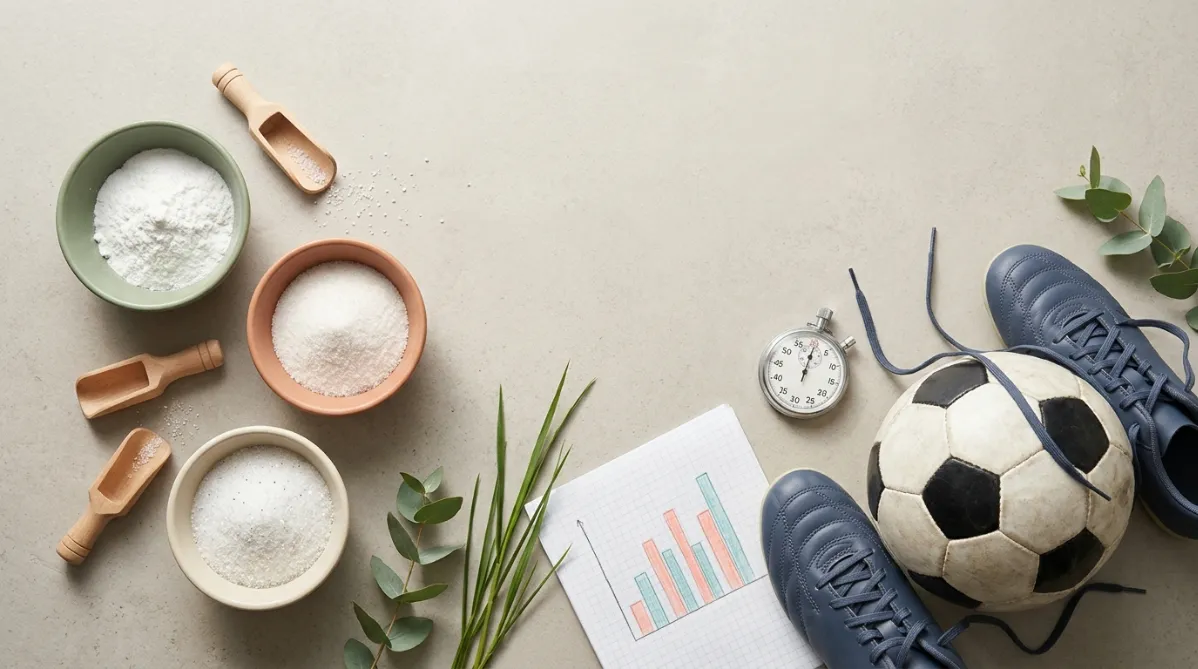
A wide, editorial-style flat lay photographed from above on a pale warm-gray concrete surface, lit by soft natural window light with gentle shadows. On the left, three small matte ceramic bowls in sage green, soft terracotta, and cream, each holding a different white crystalline powder. The textures vary subtly: fine and powdery, slightly granular, and glittery with tiny crystalline flecks. Beside them rest three minimalist wooden scoops, a few scattered grains catching the light. In the center-right, a worn classic black-and-white soccer ball sits slightly off-frame, partially cropped by the edge, with a pair of muted navy cleats resting nearby, laces loosely draped. A small stopwatch with a brushed-steel finish and a folded sheet of graph paper with a hand-drawn bar chart in soft coral and teal pencil add a subtle sense of data and measurement. A few blades of fresh-cut grass and a sprig of eucalyptus add organic accents. The palette is calm and modern: warm neutrals, sage, terracotta, and muted navy, with one pop of coral. The composition leaves generous negative space in the upper right for headline text. The mood is clean, curious, and trustworthy, like a contemporary health and science journal. Shallow depth of field, crisp focus on the powders, with the soccer elements slightly softer. High-end editorial photography, 16:9 landscape.
science research

Creatine HCl Beat Monohydrate in Soccer Players—Don't Toss Yours Yet

BY DR. GYMBRO ·

A new randomized trial in 40 soccer players found that creatine HCl and ethyl ester out-gained plain monohydrate on jump, sprint, agility and peak power after just four weeks. Every creatine form beat placebo, but the "fancy" versions pulled further ahead on the explosive measures. Before you swap tubs, though, the study has just 10 athletes per group, no reported doses in the abstract, and a result that clashes with earlier research. Here is what it showed, what it did not, and how to think about it.

A wide, landscape editorial photograph shot from slightly above, showing a rustic matte-white ceramic bowl of dried tribulus terrestris, spiky star-shaped seed pods in warm tan and khaki tones, with a few fresh green trailing vines and tiny yellow flowers draped beside it. The bowl sits at the left third of the frame on a pale ash-wood table. Scattered nearby are two identical sets of plain, unlabeled amber supplement capsules, one pile slightly apart from the other, hinting at a placebo comparison. To the right, slightly out of focus, a worn leather rugby ball rests next to a chalk-dusted steel barbell plate and a folded charcoal-gray athletic towel.

Soft diffused natural light streams in from a window on the left, creating gentle long shadows and a calm, clean atmosphere. The background is a muted sage-green and cream gradient with a shallow depth of field, leaving generous negative space on the right side for title overlay. A small, minimal notebook with a pencil and a simple balance scale made of brushed brass sits subtly in the midground, suggesting scientific scrutiny without any laboratory clutter.

The color palette is earthy and refined: sage green, sand, warm amber, charcoal, and off-white. The style is modern lifestyle-magazine photography, crisp textures, subtle film grain, and a high-end wellness journal feel. The composition is balanced, uncluttered, and minimalist, with a quiet, thoughtful mood that conveys skepticism and evidence-based inquiry. No text, no logos, no people, no futuristic or sci-fi elements.
science research

Tribulus Terrestris Flopped in Elite Rugby Players: 5-Week Trial

BY DR. GYMBRO ·

Tribulus terrestris is marketed as a natural testosterone booster that builds muscle in under a month. So researchers tested it on elite rugby league players in a double-blind trial. Everyone got stronger and gained fat-free mass, but the placebo group did just as well. The supplement also didn't change the urinary T/E ratio. Here's what the study found, its limits, and where your money is better spent.

A landscape editorial photograph of a clean, sunlit kitchen-counter or light oak table, shot from slightly above at a gentle angle. Three small matte ceramic bowls in muted sage green, warm sand, and soft white sit in a loose row. Each holds a different fine white powder, and each has a small wooden scoop resting beside it. The middle bowl is slightly closer to the camera and sharper in focus, with a faint dusting of powder spilling onto the surface. In the soft-focus background, a stainless steel shaker bottle and a half-peeled orange sit beside a folded linen napkin, suggesting citrus without being literal. A single lemon wedge sits near the left bowl, and a small dried apricot sits near the right, a subtle visual nod to citrate and pyruvate.

In the background, a blurred athletic scene: a running shoe resting on a wooden bench and a small notebook with a pen, suggesting a training log. Soft diffused morning light enters from the left through a window and casts long, gentle shadows. The palette is warm neutrals, creamy whites, soft greens, and a hint of terracotta orange. The look is a modern wellness magazine with a shallow depth of field, a fine-grain film feel, and generous negative space on the right third of the frame for title text. The mood is calm, trustworthy, and scientific yet approachable, with no text, labels, or logos.
nutrition

Creatine Pyruvate vs Citrate: One Form Kept Force Up Longer

BY DR. GYMBRO ·

Two fancy creatine forms beat placebo in a 28-day trial, but one kept muscle force elevated through all ten all-out intervals while the other faded. Creatine pyruvate raised force in every interval (p < 0.001), whereas creatine citrate's benefit disappeared by the sixth interval. Only pyruvate also improved relaxation velocity and resting oxygen consumption. Before you ditch your tub, there's a major catch: the study had no creatine monohydrate group. Here's what the numbers show, what they can't, and how to choose.

This page is available in