Dr. Gymbro
A wide, softly lit editorial photograph of a modern minimalist gym corner, shot at golden hour with warm light streaming through large frosted windows. In the foreground, a matte white scoop of fine creatine powder rests on a pale oak bench beside a clear glass shaker bottle half-filled with water. A small pile of loose white powder dusts the wood surface. Just behind them, a matte black barbell loaded with charcoal bumper plates rests on a squat rack, slightly out of focus, with chalk dust floating in the sunbeams.

On the bench, a simple analog wall-style clock or a sleek minimalist wristwatch lies face up, hinting at timing without being the main focus. Next to it sits a slim open notebook with a pencil and a few hand-drawn tally marks and neat columns, suggesting tracked training data. A folded sage-green towel sits at the edge of the frame.

The color palette is calm and sophisticated: cream, warm oak, soft sage green, charcoal, and a touch of terracotta. The shallow depth of field gives creamy bokeh in the background, where the soft silhouette of a lifter in neutral athletic wear chalks their hands near the rack, rendered anonymously and without a visible face.

The composition follows a rule-of-thirds layout, with the powder and shaker in the lower left third and open negative space on the right, suitable for headline overlay. The mood is clean, focused, and quietly motivated, like a premium health and science journal feature. The lighting is natural and diffused, with gentle shadows, subtle film grain, and true-to-life textures. Shot on a 50mm lens at f/2, with crisp detail on the powder and a high-end lifestyle magazine finish.
Nutrition

Kreatin vor dem Training gewinnt den Zeittest – aber es hat einen Haken

Dr. Gymbro · · 4 min read

Kreatin vor dem Training gewinnt den Zeittest – aber es hat einen Haken

Du hast sicherlich schon gehört, dass Kreatin wirkt. Aber spielt das Timing eine Rolle? Eine neue randomisierte Crossover‑Pilotstudie im Fachjournal Nutrients hat genau diese Frage untersucht – und die Prä‑Workout‑Dosis kam dabei als Sieger heraus. Bevor du deinen Supplement‑Plan änderst, das Kleingedruckte: Es handelt sich um eine winzige, Einzeldosis‑Studie.

Die Kernbotschaft: Prä‑Workout‑Kreatin erhöht das gehobene Gesamtgewicht

Forscher unter der Leitung von Ben Maaoui verglichen die Einnahme von Kreatin vor, während und nach einer Krafttrainings‑Session mit einem Placebo und einer Kontrollgruppe ohne Supplement. Die Studie trägt den Titel "Acute Creatine Ingestion Before Resistance Training Enhances Strength Performance More than Ingestion During or After Training: A Randomized Crossover Pilot Trial".

Wichtigste Zahlen aus dem Abstract

  • Bankdrücken: signifikanter Effekt der Bedingung (F = 4,91, ηp² = 0,33, p = 0,035)
  • Kreuzheben: signifikanter Effekt der Bedingung (F = 33,22, ηp² = 0,77, p < 0,001)
  • Bei beiden Übungen war die Leistung mit Prä‑Exercise‑Kreatin (CrB) besser als mit Placebo oder Kontrolle (p < 0,05)

Die Leistung wurde als das gesamte externe Gewicht (kg) gemessen, das über sechs Sätze bei 80 % des 1‑RM pro Übung gehoben wurde. Die Autoren schließen, dass Kreatin vor dem Training mit einer höheren akuten Kraftleistung verbunden war als die anderen Zeitpunkte. Da die Nachtest‑Vergleiche ausdrücklich gegen Placebo und Kontrolle angegeben werden, gelten diese Zahlen als die robustesten zum Zitieren.

Dosis und Timing, die in der Studie funktionierten

Das Protokoll war simpel:

  • Dosis: 0,1 g pro kg Körpergewicht Kreatin‑Monohydrat (oder Placebo)
  • Timing, das gewann: vor der Kraftsession
  • Ladephase: keine – die Autoren beschreiben die Einnahme als „ohne Ladephase“

0,1 g/kg entsprechen bei einer 80‑kg‑Person etwa 8 g. Das Papier nennt keine andere Menge. Im Abstract wird nicht angegeben, wie viele Minuten vor dem Training die Dosis eingenommen wurde – prüfe den Volltext, bevor du das Protokoll exakt nachahmst.

Studiendesign im Überblick

Elf körperlich aktive Männer (Durchschnittsalter 26,1 ± 4,4 Jahre) absolvierten fünf Bedingungen in einem randomisierten, placebokontrollierten Crossover‑Design:

  1. Kreatin vor dem Training (CrB)
  2. Kreatin während des Trainings (CrD)
  3. Kreatin nach dem Training (CrF)
  4. Placebo (PL)
  5. Keine‑Supplement‑Kontrolle

Jeder Teilnehmer diente als eigener Vergleich – bei einer so kleinen Stichprobe besonders wertvoll. Jede Bedingung beinhaltete eine standardisierte Einheit Bankdrücken und Kreuzheben.

Was sich nicht veränderte

Der Abstract zeigt, dass zwischen den Bedingungen keine Unterschiede bestanden bei:

  • Countermovement‑Sprungleistung
  • Kognitive Leistung (Ziffern‑Streich‑Test)
  • Stimmung (POMS)
  • Wahrgenommene Anstrengung (RPE)
  • Wahrgenommene Regeneration (PRS)
  • Verzögert einsetzender Muskelkater (DOMS)
  • Weitere biochemische Marker

Der Nutzen beschränkte sich also auf die belastete Kraftarbeit. Es gab keinen Hinweis auf Verbesserungen bei Sprung, Gehirn, Stimmung oder Muskelkater.

Blutmarker – ein kurzer Blick

Zwei Marker zeigten Veränderungen:

  • Creatinkinase (ein Marker für Muskelschädigung) war im Post‑Exercise‑Kreatin‑Zustand höher als in der Kontrolle (p = 0,013) und dem Placebo (p = 0,041).
  • Kreatinin war im Prä‑Exercise‑Zustand niedriger als bei Einnahme während des Trainings (p = 0,033), nach dem Training (p = 0,003) und in der Kontrolle (p = 0,021).

Der Abstract erklärt nicht, was diese Verschiebungen bedeuten. Die Messungen erfolgten nach einer einzigen Sitzung – also eher Kuriositäten für Folgestudien, nicht Beweis für Schaden oder Nutzen.

Praktische Erkenntnisse

Für wen das relevant sein könnte: Aktive, krafttrainierende Personen, die bereits Kreatin‑Monohydrat nutzen oder darüber nachdenken. Wenn du überlegst, wann du deinen täglichen Löffel nimmst, ist dies ein kleiner Hinweis darauf, es vorzugsweise vor dem Training zu dosieren. Prä‑Workout lässt sich zudem leicht in den Trainings‑Alltag integrieren.

Wer vorsichtig sein sollte

  • Menschen mit Nierenproblemen oder anderen renal‑bezogenen Bedenken. Die Studie beobachtete Kreatinin‑ und andere Nierenmarker, aber ein 11‑Personen‑Akut‑Trial kann keine Sicherheit für Patienten garantieren. Konsultiere vorher einen Arzt.
  • Frauen, ältere Erwachsene und Jugendliche. Alle Probanden waren junge, aktive Männer – die Ergebnisse lassen sich nicht ohne Weiteres auf andere Gruppen übertragen.
  • Alle, die nach einem Sprung‑, Stimmungs‑ oder Muskelkater‑Benefit suchen. Keiner dieser Effekte zeigte sich.

Der Haken: Klein, akut und explorativ

Die Autoren betonen ausdrücklich, dass die Befunde explorativ sind und mit einer größeren Stichprobe sowie einem robusteren Placebo‑/Kontroll‑Design bestätigt werden müssen. Wesentliche Limitationen:

  • Nur 11 Teilnehmende. Der Begriff „Pilot“ im Titel hat einen Grund.
  • Einzeldosis‑, akutes Design. Die Studie untersuchte, was nach einer einzigen Dosis in einer einzigen Session passiert. Sie testete nicht die übliche, wochenlange tägliche Supplementierung.
  • Kurzfristige Leistungsdaten only. Es gab keine langfristigen Messungen zu Kraftzuwachs, Muskelmasse oder Körperzusammensetzung.
  • Placebo‑ und Kontroll‑Struktur. Die Autoren fordern selbst stärkere Designs in zukünftigen Arbeiten.

Ein konzeptueller Hinweis: Die gut belegten Vorteile von Kreatin beruhen darauf, die Muskelreserven über die Zeit durch konsequente Einnahme zu erhöhen. Ein akuter Prä‑Workout‑Boost ist ein separater, überraschender Anspruch – genau deshalb braucht er Replikation, bevor er als gesichert gilt.

Fazit

In diesem Pilot zeigte 0,1 g/kg Kreatin‑Monohydrat vor einer schweren Einheit einen Zusammenhang mit einem höheren Gesamtgewicht beim Bankdrücken und Kreuzheben im Vergleich zu Placebo oder keiner Supplementierung. Während oder nach dem Training brachte die Einnahme denselben Vorteil nicht. Wenn du bereits Kreatin nutzt, ist die Verschiebung der Dosis auf den Moment vor dem Training ein risikoarmes Vorgehen, das mit diesem frühen Befund übereinstimmt. Dennoch bleibt es ein hypothesis‑generierendes Ergebnis aus 11 Männern und einer einzigen Dosis – kein neuer Grundsatz für das Krafttraining.

Quelle: Maaoui B, et al. "Acute Creatine Ingestion Before Resistance Training Enhances Strength Performance More than Ingestion During or After Training: A Randomized Crossover Pilot Trial." Nutrients. DOI: 10.3390/nu18111789. PubMed: https://pubmed.ncbi.nlm.nih.gov/42280432/
Original study

Read the original research on pubmed.ncbi.nlm.nih.gov →

This article summarizes published research for general information. It is not medical advice.

DG

Written by

Dr. Gymbro

Dr. Gymbro writes for Dr. Gymbro: science-backed fitness, nutrition & performance.

Related Articles

A modern editorial still life photographed from a slightly elevated angle on a pale, matte stone surface in soft natural window light. On the left, a heaping mound of fine white creatine monohydrate powder spills from a matte ceramic scoop, with a few crisp grains scattered across the surface. In the center, a small, minimalist amber glass capsule bottle sits tipped on its side, with a handful of off-white capsules spilling out. The label is blank and clean. On the right, a neat row of three clear glass lab-style vials rests on a slim oak tray. The vials hold different amounts of white powder: the first nearly empty, the second slightly fuller, the third filled almost to the brim. This quietly suggests the difference in dose and result. Beside the tray lies a simple stainless steel measuring spoon and a folded sheet of cream paper with soft, abstract bar-chart lines in muted sage green and terracotta. The lines are hand-drawn and unlabeled.

Behind the objects, slightly out of focus, a lean athletic forearm in a gray linen sleeve rests on the edge of the surface, one hand loosely holding a matte shaker bottle. This hints at a training context without showing a face. A single sprig of eucalyptus in the corner adds a soft organic touch.

The palette is warm neutral: bone white, oatmeal, soft sage, muted terracotta, and touches of amber. Shadows are gentle and long, with a shallow depth of field that gives creamy bokeh in the background. The mood is calm, clean, and trustworthy, like a premium health and science journal's feature spread, with generous negative space at the top and right for headline overlay. The composition is wide, balanced, and uncluttered, with subtle film-like grain and a natural, true-to-life color grade. No text, no logos, no futuristic elements.
nutrition

Kre‑Alkalyns empfohlene Dosis erhöht Muskelkreatin nicht – Biopsien zeigen es

BY DR. GYMBRO ·

Gepufferte Kreatinprodukte wie Kre‑Alkalyn kosten mehr, versprechen eine bessere Aufnahme, geringere Dosen und weniger Aufblähen. In einer doppelblinden Studie der Texas A&M wurde das mit echten Muskelbiopsien bei 36 trainierten Kraftsportlern über 28 Tage geprüft. Bei der empfohlenen Menge von 1,5 g/Tag zeigte das Muskel‑Kreatin fast keinen Anstieg, während reines Kreatin‑Monohydrat deutlich mehr bewirkte. Kraft, Körperzusammensetzung und Nebenwirkungen zeigten keinen Vorteil für das gepufferte Produkt.

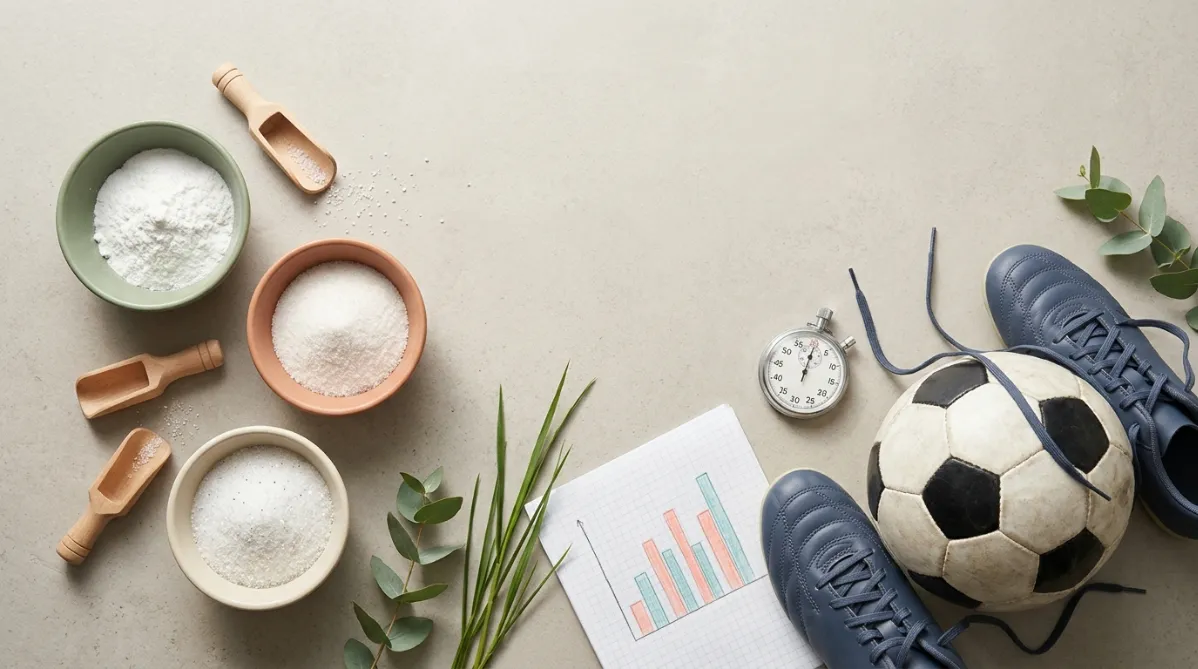
A wide, editorial-style flat lay photographed from above on a pale warm-gray concrete surface, lit by soft natural window light with gentle shadows. On the left, three small matte ceramic bowls in sage green, soft terracotta, and cream, each holding a different white crystalline powder. The textures vary subtly: fine and powdery, slightly granular, and glittery with tiny crystalline flecks. Beside them rest three minimalist wooden scoops, a few scattered grains catching the light. In the center-right, a worn classic black-and-white soccer ball sits slightly off-frame, partially cropped by the edge, with a pair of muted navy cleats resting nearby, laces loosely draped. A small stopwatch with a brushed-steel finish and a folded sheet of graph paper with a hand-drawn bar chart in soft coral and teal pencil add a subtle sense of data and measurement. A few blades of fresh-cut grass and a sprig of eucalyptus add organic accents. The palette is calm and modern: warm neutrals, sage, terracotta, and muted navy, with one pop of coral. The composition leaves generous negative space in the upper right for headline text. The mood is clean, curious, and trustworthy, like a contemporary health and science journal. Shallow depth of field, crisp focus on the powders, with the soccer elements slightly softer. High-end editorial photography, 16:9 landscape.
science research

Creatin‑HCl schlägt Monohydrat bei Fußballspielern – Wirf es nicht gleich weg

BY DR. GYMBRO ·

Eine neue randomisierte Studie mit 40 Fußballspielern zeigte, dass Creatin‑HCl und Creatin‑Ethyl‑Ester nach nur vier Wochen größere Sprung‑, Sprint‑, Agilitäts‑ und Spitzenleistungsgewinne erzielten als das klassische Monohydrat. Alle Creatin‑Varianten übertrafen das Placebo, aber die teureren Formen lagen bei den explosiven Tests vorne. Die Studie ist jedoch klein (je 10 Teilnehmende), Dosisangaben fehlen im Abstract, und das Ergebnis steht im Widerspruch zu früheren Befunden. Hier ein Überblick, was die Untersuchung tatsächlich zeigte, was nicht und wie die Ergebnisse zu interpretieren sind.

A wide, landscape editorial photograph shot from slightly above, showing a rustic matte-white ceramic bowl of dried tribulus terrestris, spiky star-shaped seed pods in warm tan and khaki tones, with a few fresh green trailing vines and tiny yellow flowers draped beside it. The bowl sits at the left third of the frame on a pale ash-wood table. Scattered nearby are two identical sets of plain, unlabeled amber supplement capsules, one pile slightly apart from the other, hinting at a placebo comparison. To the right, slightly out of focus, a worn leather rugby ball rests next to a chalk-dusted steel barbell plate and a folded charcoal-gray athletic towel.

Soft diffused natural light streams in from a window on the left, creating gentle long shadows and a calm, clean atmosphere. The background is a muted sage-green and cream gradient with a shallow depth of field, leaving generous negative space on the right side for title overlay. A small, minimal notebook with a pencil and a simple balance scale made of brushed brass sits subtly in the midground, suggesting scientific scrutiny without any laboratory clutter.

The color palette is earthy and refined: sage green, sand, warm amber, charcoal, and off-white. The style is modern lifestyle-magazine photography, crisp textures, subtle film grain, and a high-end wellness journal feel. The composition is balanced, uncluttered, and minimalist, with a quiet, thoughtful mood that conveys skepticism and evidence-based inquiry. No text, no logos, no people, no futuristic or sci-fi elements.
science research

Tribulus Terrestris schlägt bei Elite‑Rugbyspielern fehl: 5‑Wochen‑Studie

BY DR. GYMBRO ·

Tribulus terrestris wird als natürlicher Testosteron‑Booster angepriesen, der in wenigen Wochen Muskelmasse und Kraft bringen soll. In einer doppelblinden Studie mit 22 australischen Elite‑Rugby‑League‑Spielern zeigte sich jedoch, dass weder Kraft noch fettfreie Masse stärker wuchsen als in der Placebo‑Gruppe – und das Urin‑T/E‑Verhältnis blieb unverändert. Das Ergebnis wirft ein kritisches Licht auf die gängigen Werbeversprechen.

A landscape editorial photograph of a clean, sunlit kitchen-counter or light oak table, shot from slightly above at a gentle angle. Three small matte ceramic bowls in muted sage green, warm sand, and soft white sit in a loose row. Each holds a different fine white powder, and each has a small wooden scoop resting beside it. The middle bowl is slightly closer to the camera and sharper in focus, with a faint dusting of powder spilling onto the surface. In the soft-focus background, a stainless steel shaker bottle and a half-peeled orange sit beside a folded linen napkin, suggesting citrus without being literal. A single lemon wedge sits near the left bowl, and a small dried apricot sits near the right, a subtle visual nod to citrate and pyruvate.

In the background, a blurred athletic scene: a running shoe resting on a wooden bench and a small notebook with a pen, suggesting a training log. Soft diffused morning light enters from the left through a window and casts long, gentle shadows. The palette is warm neutrals, creamy whites, soft greens, and a hint of terracotta orange. The look is a modern wellness magazine with a shallow depth of field, a fine-grain film feel, and generous negative space on the right third of the frame for title text. The mood is calm, trustworthy, and scientific yet approachable, with no text, labels, or logos.
nutrition

Creatin‑Pyruvat vs. Creatin‑Citrat: Eine Form hielt die Kraft länger hoch

BY DR. GYMBRO ·

Zwei ausgefallene Creatin‑Formen übertrafen das Placebo in einer 28‑Tage‑Studie, doch nur eine hielt die Muskelkraft über alle zehn Maximal‑Intervalle hinweg aufrecht, während die andere nachließ. Creatin‑Pyruvat steigerte die Kraft in jedem Intervall (p < 0,001), bei Creatin‑Citrat war der Nutzen bereits beim sechsten Intervall verschwunden. Nur Pyruvat verbesserte zudem die Entspannungsgeschwindigkeit und den Ruhe‑Sauerstoffverbrauch. Bevor du dein Creatin‑Pulver gegen die schicker klingende Alternative austauschst, solltest du den entscheidenden Haken kennen: Die Studie hatte keine Creatin‑Monohydrat‑Gruppe. Hier erfährst du, was die Zahlen zeigen, was sie nicht zeigen können und wie du dich entscheiden solltest.

This page is available in