Dr. Gymbro
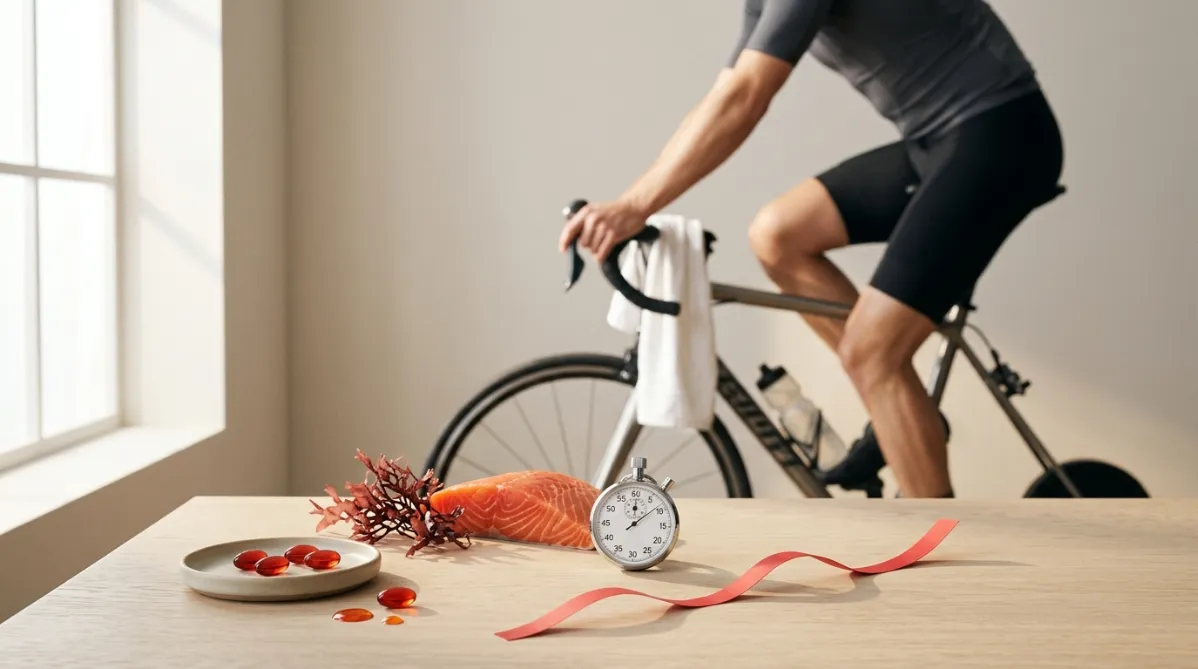
A cyclist's legs mid-pedal on a stationary road bike, shot in a bright, airy, minimalist studio with a soft warm-grey backdrop. In the foreground on a pale oak table sits a small ceramic dish holding four deep coral-red softgel capsules, with a few translucent droplets of red-orange oil glistening beside them. Beside the dish is a sprig of dried red microalgae-toned seaweed and a halved wild salmon fillet, its coral flesh echoing the capsule color. Behind the table, slightly out of focus, a cyclist in a fitted charcoal jersey and matte black shorts rides a bike on an indoor trainer. Only the torso and legs are visible, with no face. A white towel hangs over the handlebars and a clear water bottle catches the light.

Soft diffused morning light streams from a large window on the left, creating long gentle shadows and a subtle golden-hour glow on the skin and the glossy capsules. The palette is restrained and editorial: warm cream, sand, soft grey and charcoal, with vivid coral-red as the single accent color. A minimalist analog stopwatch with a clean white face sits on the table, its hands near the 85-minute mark. A thin, elegant line-graph shape is subtly suggested by a curved strip of red ribbon lying on the table, rising from left to right to hint at the performance gain without any text.

The composition follows the rule of thirds, with the capsules and stopwatch in the lower left and the cyclist's motion-blurred legs sweeping across the right. Shallow depth of field, crisp macro detail on the capsules, and a fine film-like grain. The overall feel is a modern health and science magazine cover: clean, calm, sophisticated, and natural, with negative space in the upper area for a headline. There are no futuristic elements, no glowing effects, no laboratory equipment, and no text or logos. Landscape 16:9 format.
Nutrition

La astaxantina, tras 4 días, incrementó el tiempo hasta el agotamiento en ciclismo de 72 a 85 minutos en un pequeño ensayo

Dr. Gymbro · · 5 min read

Cuatro días de un antioxidante pigmentado de color rojo y un grupo de hombres jóvenes pedaleó alrededor de 13 minutos más en una intensidad fija y exigente. Ese es el titular de un ensayo controlado aleatorizado de 2025 publicado en BMC Sports Science, Medicine & Rehabilitation. El estudio probó la astaxantina, el cetocarotenoide que da color al salmón y al kril. El resultado es llamativo, pero el estudio es pequeño, por lo que requiere una lectura cuidadosa.

El gancho: 72 minutos vs 85 minutos

En el ensayo, el tiempo hasta el agotamiento (TTE) promedió 85,41 ± 4,42 minutos tras la astaxantina y 72,11 ± 2,24 minutos con placebo. Esa diferencia es de aproximadamente 13 minutos, o un 18 % más. Las estadísticas fueron fuertes para un estudio de este tamaño (P < 0,001, η² parcial = 0,71), lo que indica un efecto grande.

El ciclismo tampoco fue fácil. Los participantes pedaleaban al 75 % del VO2 máx hasta que no pudieron continuar. Ese es un trabajo sostenido y exigente, y es el tipo de esfuerzo donde pequeñas ventajas fisiológicas pueden traducirse en minutos en el cronómetro.

Dosis y protocolo: corto, intenso y alto

Los investigadores, liderados por Tsao Jung‑Piao y Cheng I‑Shiung, reclutaron diez hombres físicamente activos con una edad media de 22,5 años. El diseño fue aleatorizado, controlado con placebo y cruzado, de modo que cada participante sirvió como su propio control. Los sujetos tomaron ya sea un placebo o 28 mg de astaxantina al día durante 4 días. La prueba exhaustiva se realizó el día 4.

Se recogieron muestras de sangre y gases antes, durante y justo después del ejercicio. Se monitorizaron daño muscular, inflamación, estrés oxidativo y uso de sustratos.

La dosis es el detalle a notar. Muchas cápsulas blandas de astaxantina de venta libre contienen mucho menos por porción, y las ingestas diarias promocionadas en suplementos suelen estar muy por debajo de los 28 mg. Quien desee reproducir este protocolo con un envase estándar tendría que revisar cuidadosamente las etiquetas. Multiplicar la dosis de un producto no equivale automáticamente a una sustitución segura o equivalente a las condiciones del ensayo, y este estudio no establece un perfil de seguridad a largo plazo. La ventana de carga de cuatro días también es inusualmente corta para un compuesto que normalmente se vende para semanas o meses de uso.

Daño muscular y estrés oxidativo: lo que mostraron los biomarcadores

El rendimiento no fue el único cambio. Los investigadores midieron marcadores de estrés tisular inducido por el ejercicio.

  • Creatina quinasa (CK) y lactato deshidrogenasa (LDH): Ambos aumentan cuando las fibras musculares se dañan tras un esfuerzo intenso. La astaxantina redujo significativamente (P < 0,05) esos incrementos provocados por el ejercicio exhaustivo. Una interacción tiempo‑tratamiento significativa para CK (P = 0,039, η²p = 0,217) sugiere que la astaxantina pudo haber atenuado el daño muscular.
  • Malondialdehído (MDA): Este marcador de peroxidación lipídica se elevó durante y justo después del ejercicio. La astaxantina inhibió sustancialmente esa subida (P < 0,05), coherente con su reputación de potente antioxidante.
  • Inflamación: El factor de necrosis tumoral‑alpha (TNF‑α) y la proteína C‑reactiva (PCR) no respondieron ni al suplemento ni al desafío de ejercicio. El efecto parece ligado a los marcadores de oxidación y de daño muscular, no a una acción antiinflamatoria general.
  • Utilización de sustratos: El consumo de combustible durante y después del ejercicio fue similar en ambas pruebas. Por lo tanto, el mayor tiempo de pedaleo no se explica evidentemente por un cambio en la quema de grasa o carbohidrato, lo que deja el mecanismo como una cuestión abierta.
  • Estado de ánimo: La astaxantina no tuvo efecto adverso sobre el perfil de estados de ánimo.

Por qué podría importar a los atletas de resistencia

Los autores presentan la astaxantina como una posible ayuda ergogénica nutricional. La lógica es que un esfuerzo prolongado a alta intensidad genera especies reactivas de oxígeno, que pueden dañar las membranas musculares y contribuir a la fatiga. Un antioxidante liposoluble que se aloja en las membranas celulares podría, en teoría, protegerlas. Los valores más bajos de MDA, CK y LDH encajan con esa hipótesis.

Los datos no prueban esa historia, sin embargo. Los marcadores inflamatorios se mantuvieron sin cambios y el uso de combustible no varió, de modo que la vía desde el efecto antioxidante hasta los 13 minutos extra no se demostró. Los antioxidantes también pueden ser una espada de doble filo en el entrenamiento, ya que algunas señales de oxígeno reactivo favorecen la adaptación. Este ensayo midió una única sesión aguda de ejercicio, no adaptaciones al entrenamiento a lo largo de semanas, por lo que no puede abordar esa preocupación.

Conclusiones prácticas

  • La señal es prometedora, no definitiva. Una gran mejora del TTE acompañada de cambios biomarcadores de apoyo es alentadora para un protocolo corto.
  • Revisa la dosis. El ensayo utilizó 28 mg/día, que es alta en comparación con muchas cápsulas blandas comerciales. Compara la etiqueta con el estudio antes de asumir que obtienes la misma exposición.
  • La ventana fue breve. Cuatro días constituyen un protocolo de carga, lo que lo hace interesante para la preparación de una competición. No se responde aquí si un uso más prolongado produce más, menos o lo mismo.
  • Ten en cuenta la especificidad. Los resultados se aplican a ciclismo de resistencia intenso. Nada en este estudio respalda afirmaciones sobre fuerza, aumento muscular o composición corporal.

Limitaciones que no debes ignorar

La mayor advertencia es el tamaño de la muestra: diez participantes. Los ensayos pequeños pueden producir tamaños de efecto grandes pero inestables, y las desviaciones estándar muy ajustadas para el TTE deben tomarse con cautela hasta que otros los reproduzcan. El grupo también era de hombres jóvenes y físicamente activos, por lo que los resultados pueden no extrapolarse a mujeres, adultos mayores o atletas de élite. Sólo se probó un modelo de ejercicio, una única sesión exhaustiva al 75 % del VO2 máx, y el suplemento se tomó apenas cuatro días.

Además, está la cuestión práctica del propio tiempo hasta el agotamiento. Las pruebas de TTE son sensibles a la motivación y al pacing, y no siempre coinciden con los resultados de una carrera real o una contrarreloj. Replicaciones más amplias y preregistradas que incluyan a mujeres y atletas entrenados aclararían hasta dónde llegan estos hallazgos.

Conclusión final

Este ensayo otorga a la astaxantina un caso temprano creíble como ayuda de corta duración para la resistencia, con un aumento de alrededor del 18 % en el tiempo hasta el agotamiento y menores marcadores de daño muscular y peroxidación lipídica. Sigue siendo un estudio de diez personas a una dosis superior a la que ofrecen muchos suplementos. Considéralo como una fuerte razón para investigaciones de seguimiento, no como un protocolo de rendimiento ya demostrado.
Original study

Read the original research on pubmed.ncbi.nlm.nih.gov →

This article summarizes published research for general information. It is not medical advice.

DG

Written by

Dr. Gymbro

Dr. Gymbro writes for Dr. Gymbro: science-backed fitness, nutrition & performance.

Related Articles

A wide editorial still life shot from a slightly elevated angle on a pale ash-wood bench in a bright, airy training hall. In the center sits a small matte ceramic dish holding a few translucent coral-red softgel capsules, their glossy surfaces catching soft window light. Beside the dish rests a folded white taekwondo dobok with a black belt loosely coiled on top. A sprig of fresh red microalgae-toned seaweed and a halved blood orange add natural color accents. A clean glass of water with subtle condensation stands to one side.

In the softly blurred background, the silhouette of a martial artist in a white uniform stretches near tall windows, with diffused morning light streaming across a sprung wooden floor. A pair of red and blue sparring gloves hangs on a minimal wall hook. Thin, elegant shadows stretch across the bench.

The palette is restrained and modern: warm off-white, soft sand, muted charcoal, with a vivid coral-red accent pulled from the capsules. Shallow depth of field, crisp focus on the capsules and dish, creamy bokeh behind. Natural, gentle lighting with a subtle film-like grain, reminiscent of a contemporary wellness and science magazine cover. Generous negative space on the left third of the frame for headline text. Calm, precise, and quietly athletic in mood, with no text, logos, or futuristic elements.
science research

12 mg de astaxantina durante 28 días: daño muscular y agotamiento en atletas de combate

BY DR. GYMBRO ·

Un ensayo aleatorizado evaluó 12 mg diarios de astaxantina en jóvenes atletas masculinos de taekwondo. Tras 28 días, el grupo que recibió el suplemento presentó una evolución de la creatina quinasa muy distinta a la del placebo, así como mayor actividad de SOD y tendencias a menores niveles de MDA y a menor agotamiento emocional y físico. No obstante, los hallazgos sobre burnout fueron solo exploratorios y no mostraron interacción grupo × tiempo en ninguna subescala. El estudio, pequeño y centrado en biomarcadores, no evaluó el rendimiento. Aquí se explica qué demuestran los datos, qué no, y a quién le puede interesar.

Wide landscape editorial photograph of a mountain biker mid-ride on a dusty red-orange singletrack trail in the South African Western Cape, golden hour light raking across the scene. The rider is in sharp focus on the right third of the frame, wearing a weathered cycling kit with a race number plate on the handlebars, dust kicking up from the rear tire. Behind them, rolling hills covered in fynbos shrubland and silhouetted protea plants fade into soft, hazy blue mountains. Warm amber sunlight creates long shadows and a soft rim light around the rider and bike.

In the lower left foreground, slightly out of focus, a small minimalist glass vial and a clear water bottle sit on a flat sun-bleached rock, with a few drops of liquid catching the light. Next to them, a simple matte paper notecard and a pencil suggest data collection, with no legible text. The vial and bottle are clean, understated, and modern, with no branding.

The color palette is earthy and refined: terracotta, ochre, sage green, dusty teal sky, and cream highlights. The composition uses shallow depth of field, a generous negative space in the upper left sky for headline overlay, and subtle film grain. The mood is contemplative, skeptical, and quietly sophisticated, like a feature photograph from a high-end outdoor sports and science magazine. Natural, candid, cinematic, shot on a 50mm lens with soft contrast and muted saturation. No futuristic elements, no glowing effects, no molecular graphics, no text.
science research

Ketone IQ elevó los cuerpos cetónicos en el Cape Epic, pero no hizo nada más

BY DR. GYMBRO ·

Los ciclistas que compitieron en los ocho días del Cape Epic tomaron Ketone IQ dos veces al día y alcanzaron alrededor de 1 mM de cetonas en sangre, pero su fatiga, frecuencia cardíaca, tiempo de reacción y recuperación fueron idénticos a los del grupo placebo. El ensayo doble ciego evaluó R‑1,3‑butanodiol en condiciones reales de carrera, no en laboratorio. Los autores señalan que la leve cetosis no fue eficaz y advierten que el butanodiol no debe confundirse con los ésteres de cetona. Con solo 18 participantes, el estudio tiene limitaciones, pero constituye un dato sobrio para quien piense en invertir en una costosa bebida cetogénica para recuperarse.

A cyclist in mid-ride, photographed from a low three-quarter side angle on a quiet country road at golden hour, wearing a matte navy jersey and a white helmet, with soft warm light catching the sweat on his forearms. His expression is calm and focused. The road bends gently through rolling green fields, and the background is softly blurred with creamy bokeh.

In the foreground on the left, a styled flat-lay-inspired still life sits on a weathered wooden surface and blends into the scene. It includes two clear water bottles with pale citrus-tinted liquid, a few torn energy gel packets in muted coral and sage, and a small pile of dried apricots and sliced banana. A handful of glossy orange slices adds a bright accent. The shallow depth of field keeps the cyclist sharp in the middle distance while the foreground items are gently softened.

The color palette is warm and editorial: soft peach, muted terracotta, sage green, cream, and deep navy. The light is natural and golden, with long, gentle shadows and a slight film-grain texture, like a high-end lifestyle or sports-science magazine spread. The composition follows the rule of thirds, with the cyclist on the right third and open negative space in the upper left, suitable for headline overlay.

The mood is energetic yet thoughtful, clean and modern, and the photograph feels authentic rather than staged. There are no logos, no readable text, and no futuristic or sci-fi elements. The overall look is crisp, airy, and refined, in the style of a contemporary health and performance journal cover.
nutrition

100 g de carbohidratos por hora mantuvieron más rápidos a los ciclistas — y no fue por el glucógeno

BY COACH RYAN ·

A las cuatro horas de una salida exigente, los ciclistas que ingirieron 100 g de carbohidratos por hora perdieron menos potencia que los que consumieron 60 g. La sorpresa: su glucógeno muscular quedó prácticamente sin cambios. Este estudio aleatorizado, doble ciego y cruzado con 15 hombres entrenados sugiere que hay algo más allá del ahorro de glucógeno. Desglosamos los números, el protocolo 1:0,8 de glucosa‑fructosa y cómo aplicarlo.

A bright, airy editorial photograph shot from above at a slight angle, showing a tall clear glass of deep violet blueberry smoothie on a pale oak wooden table. The smoothie has a creamy, velvety texture with a few lighter swirls, and a small cluster of fresh blueberries with dusty blue skins rests on the rim of the glass. A matte white ceramic bowl of whole blueberries sits to the left, with a few berries scattered naturally across the tabletop. A folded linen napkin in soft oatmeal tones and a stainless steel straw add subtle texture.

In the softly blurred background, a rolled-up sage green yoga mat leans against a light wall next to a pair of clean white running shoes and a small pair of brushed-metal dumbbells. A sliver of warm morning sunlight enters from the left window, casting gentle diagonal shadows and a golden glow across the table, with soft highlights on the glass and the berries' surface bloom.

The color palette is fresh and modern: deep indigo and violet from the smoothie, balanced by cream, warm beige, soft sage green, and touches of white. The composition follows the rule of thirds, with the glass placed on the right third and generous negative space on the left, suitable for headline overlay. Shallow depth of field, crisp focus on the glass and berries, creamy bokeh in the background. The mood is calm, healthy, and aspirational, like a contemporary wellness magazine or a trendy health journal website. Natural, realistic, high-end food and lifestyle photography style, 16:9 landscape format, clean and uncluttered.
nutrition

El batido de arándanos ayudó a piernas adoloridas a recuperar la fuerza más rápido

BY DR. GYMBRO ·

Diez mujeres, 300 contracciones excéntricas del cuádriceps y un batido de arándanos. En este ensayo cruzado aleatorizado la bebida de frutos rojos aceleró la recuperación de la fuerza isométrica máxima en 60 horas (p = 0,047), mientras que un placebo con la misma capacidad antioxidante no lo hizo. El hallazgo sugiere que el beneficio no se debe solo a los antioxidantes. Sólo una variable alcanzó significación y la muestra fue muy pequeña, por lo que la evidencia es prometedora pero no concluyente. A continuación, se describe cómo se diseñó el estudio, qué resultados se obtuvieron y cómo puedes aplicarlo en tus entrenamientos de piernas.

This page is available in