Dr. Gymbro
←

#taekwondo

1 article
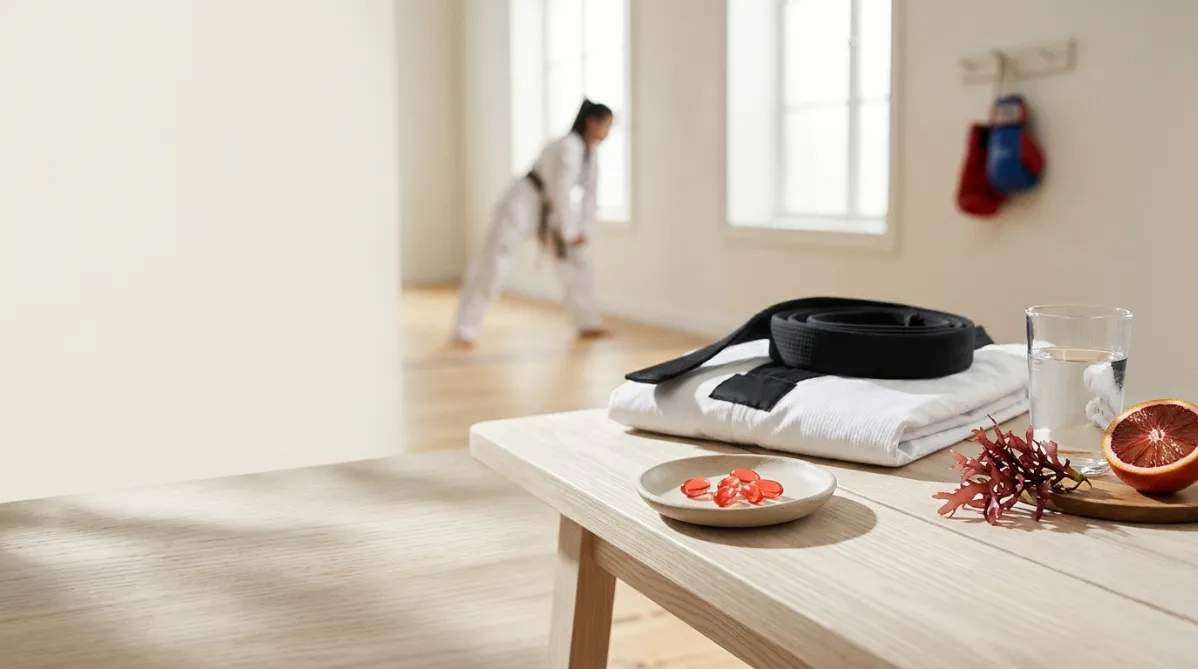
A wide editorial still life shot from a slightly elevated angle on a pale ash-wood bench in a bright, airy training hall. In the center sits a small matte ceramic dish holding a few translucent coral-red softgel capsules, their glossy surfaces catching soft window light. Beside the dish rests a folded white taekwondo dobok with a black belt loosely coiled on top. A sprig of fresh red microalgae-toned seaweed and a halved blood orange add natural color accents. A clean glass of water with subtle condensation stands to one side.

In the softly blurred background, the silhouette of a martial artist in a white uniform stretches near tall windows, with diffused morning light streaming across a sprung wooden floor. A pair of red and blue sparring gloves hangs on a minimal wall hook. Thin, elegant shadows stretch across the bench.

The palette is restrained and modern: warm off-white, soft sand, muted charcoal, with a vivid coral-red accent pulled from the capsules. Shallow depth of field, crisp focus on the capsules and dish, creamy bokeh behind. Natural, gentle lighting with a subtle film-like grain, reminiscent of a contemporary wellness and science magazine cover. Generous negative space on the left third of the frame for headline text. Calm, precise, and quietly athletic in mood, with no text, logos, or futuristic elements.
science research

12 mg d'astaxanthine pendant 28 jours : dommages musculaires et épuisement chez les combattants

BY DR. GYMBRO ·

Un essai randomisé a évalué l’effet de 12 mg d'astaxanthine par jour pendant 28 jours chez de jeunes athlètes masculins pratiquant le taekwondo. Le groupe supplémenté a présenté une évolution de la créatine kinase différente de celle du placebo, des niveaux de SOD plus élevés et des signaux exploratoires d’une diminution du MDA ainsi que d’une fatigue émotionnelle et physique réduite. Les résultats concernant le burnout restent préliminaires, sans interaction groupe × temps sur les sous‑échelles. L’étude était petite, se limitait à des biomarqueurs et ne mesurait pas la performance. Voici ce que les données prouvent, ce qu’elles ne prouvent pas, et qui devrait s’en préoccuper.

This page is available in