Dr. Gymbro
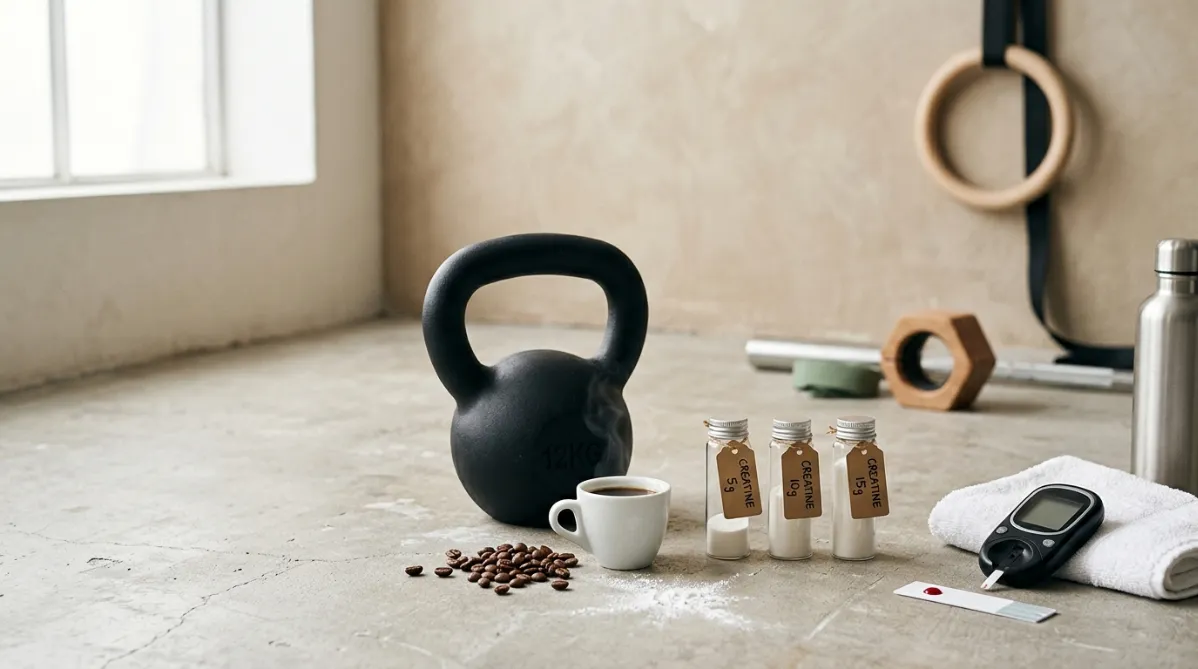
A wide, editorial-style still life photographed in soft natural window light, set on a pale concrete gym floor with a warm oatmeal-toned wall behind it. In the center foreground, a matte black kettlebell sits beside a white ceramic espresso cup filled with dark coffee, a thin wisp of steam rising. Next to the cup, three small glass vials of increasing fill levels stand in a neat row, containing fine white powder, each tied with a small kraft paper tag. Scattered nearby are a few roasted coffee beans and a pinch of chalk dust that catches the light.

On the right side, a minimalist glucose meter with a small blank screen rests next to a folded white towel and a stainless steel water bottle. A single drop of bright crimson blood on a clean test strip adds a subtle focal accent. A wooden barbell collar and a loop of gymnastic rings hang softly out of focus in the background, suggesting a CrossFit box without showing any people.

The palette is warm and restrained: cream, charcoal, terracotta, and muted sage green, with one pop of coral red from the droplet. The composition uses generous negative space on the left third for headline overlay, a shallow depth of field, and gentle long shadows falling across the floor. The mood is calm, clean, and modern, like a premium health and science magazine cover: crisp textures, subtle film grain, natural color grading, and a slightly elevated three-quarter camera angle in landscape 16:9 format.
Nutrition

6 or 9 mg/kg Caffeine Before CrossFit? Your Blood Sugar Notices

Dr. Gymbro · · 4 min read

The Surprise Hiding in the Blood Work

You might expect a big hit of pre-workout caffeine to scramble your blood: cell counts, minerals, the lot. A new randomized trial suggests the picture is much quieter than that. Of everything researchers measured around a CrossFit workout, only blood glucose clearly responded to caffeine, and only at the higher doses.

The study, published in the Journal of the International Society of Sports Nutrition (2026), comes from Główka, Podgórski, Malik, Nowaczyk and Durkalec-Michalski. You can find it on PubMed or via its DOI.

How the Trial Worked

The design was strong. It was a randomized, double-blind, placebo-controlled crossover trial, so each athlete tried every condition. Twenty-six moderately trained CrossFit athletes took one of four things:

  • Placebo
  • 3 mg/kg caffeine (low)
  • 6 mg/kg caffeine (medium)
  • 9 mg/kg caffeine (high)

Each dose was taken 70 minutes before a 17-minute CrossFit workout. The team tracked hematological (blood cell) and biochemical markers across time points. The trial is registered as NCT03822663.

For scale, in an 80 kg athlete those doses work out to roughly 240 mg, 480 mg and 720 mg of caffeine. That is my arithmetic, not a figure from the paper.

The Headline Finding: Glucose Jumps at 6 and 9 mg/kg

The authors found significant treatment × time point interactions only for glucose. The medium (6 mg/kg) and high (9 mg/kg) doses produced significantly greater post-exercise glucose elevations than both baseline and the placebo visits.

The low dose of 3 mg/kg is not listed among the conditions that differed from placebo. The abstract does not describe how big the glucose differences were in clinical terms, and it does not say whether they matter for performance or health. So the finding is that glucose responded differently at higher doses, not that those doses are harmful.

What Caffeine Did Not Do

The null results matter just as much for practical decisions:

  • Blood cell indices: Exercise was the main driver of hematological changes. The researchers saw no caffeine-specific modulation.
  • Phosphates: Levels rose over time, especially after exercise. Once the baseline visit was excluded in a sensitivity analysis, no treatment effect remained.
  • Calcium: Changes followed time, not caffeine.
  • Magnesium: It stayed stable.

The authors conclude that acute caffeine "selectively influences post-exercise glucose responses," while hematological variables and most biochemical markers stay unaffected.

So How Much Caffeine Do CrossFitters Actually Need?

This paper can't answer that on its own. The abstract reports blood markers, not workout scores, so it doesn't tell us whether 9 mg/kg beats 3 mg/kg for performance. What it does tell us is that going higher shows up in glucose, and not in the other markers they measured.

Here is a cautious way to apply it.

Dose: The lowest dose tested, 3 mg/kg, was the one without a clear glucose signal. If you're already getting the alertness or drive you want at that level, this study gives you no blood-marker reason to climb to 6 or 9 mg/kg.

Timing: The trial gave caffeine 70 minutes before a short, 17-minute workout. That's a reasonable template if you want to replicate the conditions studied.

Who it may suit: Healthy, moderately trained athletes similar to the participants, who already tolerate caffeine and want a data-backed range to work within.

Who should be careful or skip the big doses:

  • People managing blood sugar, such as those with diabetes or prediabetes, or anyone told to monitor glucose. Talk to a clinician first. The study didn't test these groups.
  • Anyone sensitive to caffeine, or with heart rhythm, blood pressure, anxiety or sleep problems. The paper didn't examine these, but they are standard reasons for caution.
  • Pregnant athletes and adolescents, who generally have lower recommended caffeine limits.

One piece of outside context: public health bodies like the FDA and EFSA commonly cite about 400 mg a day as a safe limit for most healthy adults. A 9 mg/kg dose would exceed that for most people. That guidance isn't from this study, but it's a good reason to treat the highest dose with respect.

Caveats You Should Know

  • Small sample: 26 moderately trained athletes is a modest group, and results may not carry over to elite athletes or beginners.
  • Acute dosing only: The trial tested single doses, not habitual use over weeks.
  • Single workout format: A 17-minute CrossFit session may not represent longer or different training.
  • Human trial, not animal: That is a strength, but the abstract doesn't report performance, perceived effort or side effects, so those questions remain open.
  • Mineral nuance: The phosphate finding depended on the analysis approach, so it shouldn't be over-read.

The Bottom Line

More caffeine didn't rewrite athletes' blood profiles, apart from glucose. At 6 and 9 mg/kg, post-exercise glucose rose more than on placebo, while the blood cell, calcium and magnesium results stayed largely unchanged. If you use caffeine before CrossFit, this study supports starting low, around 3 mg/kg, taken about an hour before training. Treat higher doses as something to test cautiously, not as a default upgrade.

Sources: PubMed 42924484 | DOI: 10.1080/15502783.2026.2740805
Original study

Read the original research on pubmed.ncbi.nlm.nih.gov →

This article summarizes published research for general information. It is not medical advice.

DG

Written by

Dr. Gymbro

Dr. Gymbro writes for Dr. Gymbro: science-backed fitness, nutrition & performance.

Related Articles

A wide, editorial-style still life photographed in soft natural window light on a pale oatmeal-colored linen surface. In the center-left, a small matte ceramic dish holds a modest pile of vivid red dried chili peppers and a few sliced fresh chilies, their glossy seeds catching the light. Beside it sits a minimalist amber glass capsule bottle without a label, with two translucent capsules spilled onto the linen, along with a tiny brass measuring spoon holding a pinch of fine orange-red powder.

On the right side of the frame, slightly out of focus, a worn black barbell rests across a wooden gym box, with a chalk-dusted steel plate leaning nearby. A small cloud of white chalk dust hangs delicately in the air, backlit by the light. A folded gray cotton gym towel and a simple stainless steel water bottle sit in the soft background.

In the foreground, a minimalist white notebook lies open with a clean hand-drawn line graph in thin black ink, with a small red dot marking one point. A mechanical pencil rests across the page.

The palette is warm and restrained: terracotta red, burnt orange, cream, charcoal, and muted sage green accents from a single leafy chili plant stem. Shallow depth of field, subtle film grain, gentle shadows, generous negative space at the top of the frame for a title overlay. Modern health and science journal aesthetic, calm, clean, tactile, and slightly moody, like a magazine feature on sports nutrition. No people, no text, no logos.
nutrition

Phenylcapsaicin Pre-Workout Boosted CrossFit Squats and Cut Soreness

BY DR. GYMBRO ·

A chili-derived compound called phenylcapsaicin just went through a triple-blind crossover trial with 50 CrossFit athletes. A single 2.5 mg dose taken 45 minutes before training improved post-session squat load and reps, reduced jump-height loss, and lowered soreness at 24 and 48 hours. But it did nothing for the WOD itself, and lactate, RPE, and heart rate didn't budge. Two authors also advise a supplement brand, and the study only covers a single acute dose. Here is what the data show, what they don't, and who might actually want to try it.

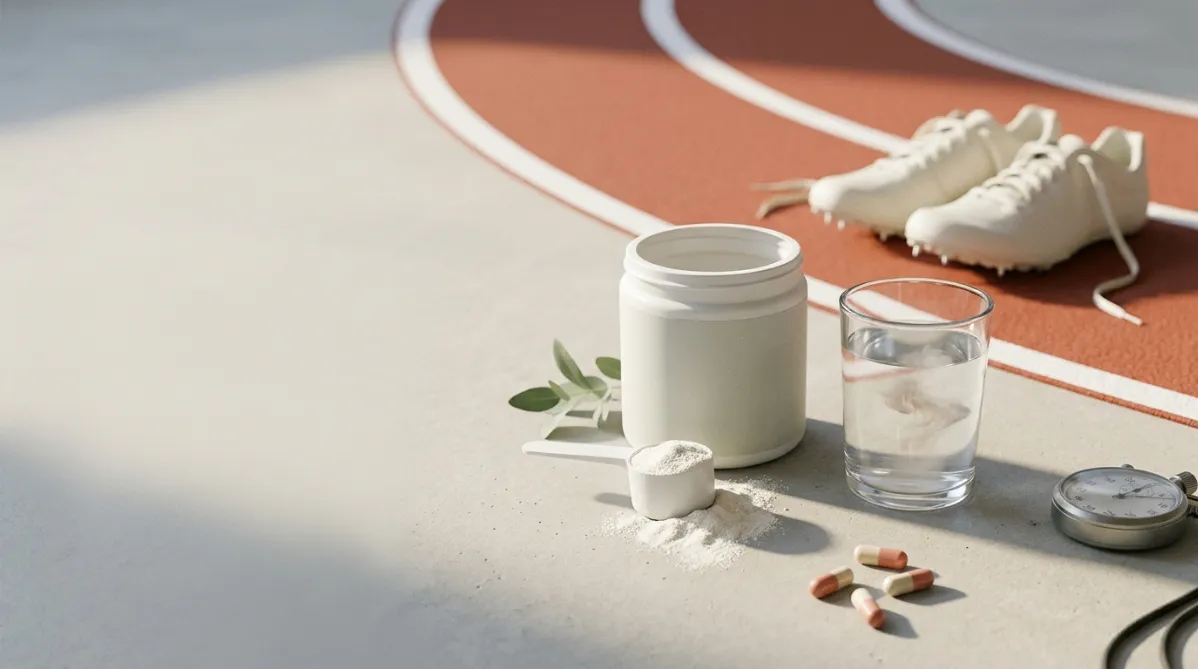
A wide, editorial-style still life photographed on a pale warm-gray concrete surface in soft morning window light. In the center sits an open, matte white supplement tub with a scoop resting beside it, a small mound of fine white powder spilling onto the surface. Next to it is a clear glass of water with a faint cloudy swirl of dissolved powder. A few loose capsules in muted coral and cream tones are scattered casually in the foreground. Behind them, slightly out of focus, is a clean running track lane in terracotta red with crisp white lines curving across the background. A pair of minimalist off-white sprint spikes rests on the edge of the track, laces loosely undone. A stopwatch with a brushed metal casing lies partially in frame at the right, its face reading a blurred, indistinct time.

The composition uses generous negative space on the left third, leaving a calm area of soft gray and cream for headline text. Shadows are long, gentle, and slightly cool, contrasting with the warm terracotta of the track. The palette is restrained: terracotta, bone white, soft sage green accents from a small leaf sprig tucked near the tub, and charcoal gray details. Shallow depth of field with a crisp focus on the scoop and powder, creamy bokeh behind. The mood is thoughtful, skeptical, and calm, like a modern wellness or science journal cover. Subtle film grain, natural color grading, and a tactile, tangible feel, with no text, no logos, and no futuristic elements.
nutrition

Beta-Alanine Is in Every Pre-Workout. Sprint Data Says It May Not Work

BY DR. GYMBRO ·

Beta-alanine is in almost every pre-workout, and the tingles make it feel like it's working. A 2026 multilevel meta-analysis of 17 randomized controlled trials found no benefit for repeated sprint ability, whether measured by mean performance, peak performance or fatigue decrement. Dose, duration and training status didn't change the picture. The authors suggest repeated sprints are limited by phosphocreatine recovery rather than acidosis, which is what beta-alanine targets. Here's who may still benefit, who can skip it, and what the study can't tell us.

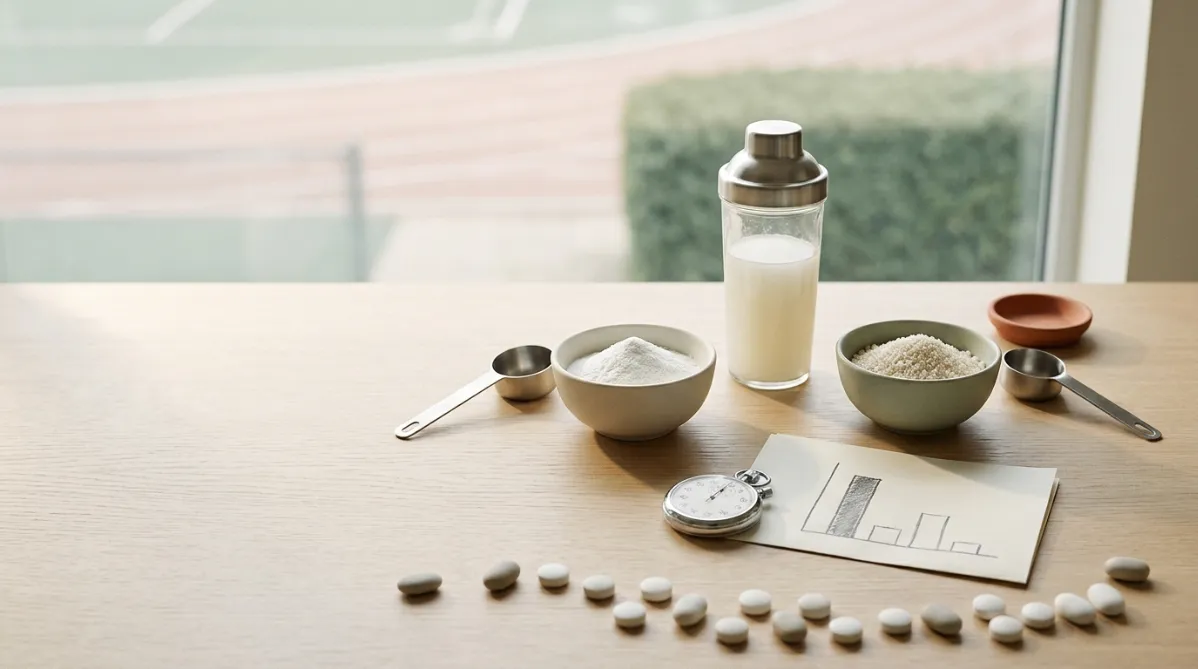
A wide, editorial-style still life shot from a slightly elevated angle on a pale oak laboratory-meets-kitchen countertop, bathed in soft, diffused morning window light. In the center, two small matte ceramic bowls sit side by side: one holds fine white creatine powder, the other holds slightly coarser off-white L-arginine crystals. A brushed steel scoop rests beside each. Between and slightly behind them stands a clear glass shaker bottle filled with a cloudy, pale liquid, catching a gentle highlight. In the foreground, a minimalist analog stopwatch lies on the wood surface, its face crisp and legible, next to a folded sheet of off-white paper with a hand-drawn simple bar chart in charcoal pencil, with one tall bar and a few shorter ones, no text or numbers. In the soft-focus background, a blurred gym-style window view shows a pale running track and a muted sage-green hedge, suggesting sprinting and athletic testing without any people. Eighteen small smooth stones or white pills are arranged in a neat loose arc across the lower edge of the frame, a subtle nod to the small sample size, with one stone set slightly apart. The color palette is calm and modern: warm cream, bone white, soft sage, muted terracotta accents from a small clay dish, and thin touches of brushed metal. Shadows are long and gentle, the depth of field shallow, with a fine film-like grain. The composition leaves generous negative space on the left third for a title overlay. The mood is clean, thoughtful, and trustworthy, like a contemporary health and science journal cover, with no futuristic elements, no glowing effects, and no text.
nutrition

Creatine Plus L-Arginine Added ~99 W Peak Power. Here's the Catch

BY DR. GYMBRO ·

A new crossover trial found that taking creatine and L-arginine together an hour before testing raised peak sprint power by about 99 W over placebo. The stack also beat each supplement alone on peak power and countermovement jump height. But the researchers couldn't prove the two work synergistically, and the study had only 18 men. Here's what the numbers show, how the doses worked, and who should be cautious.

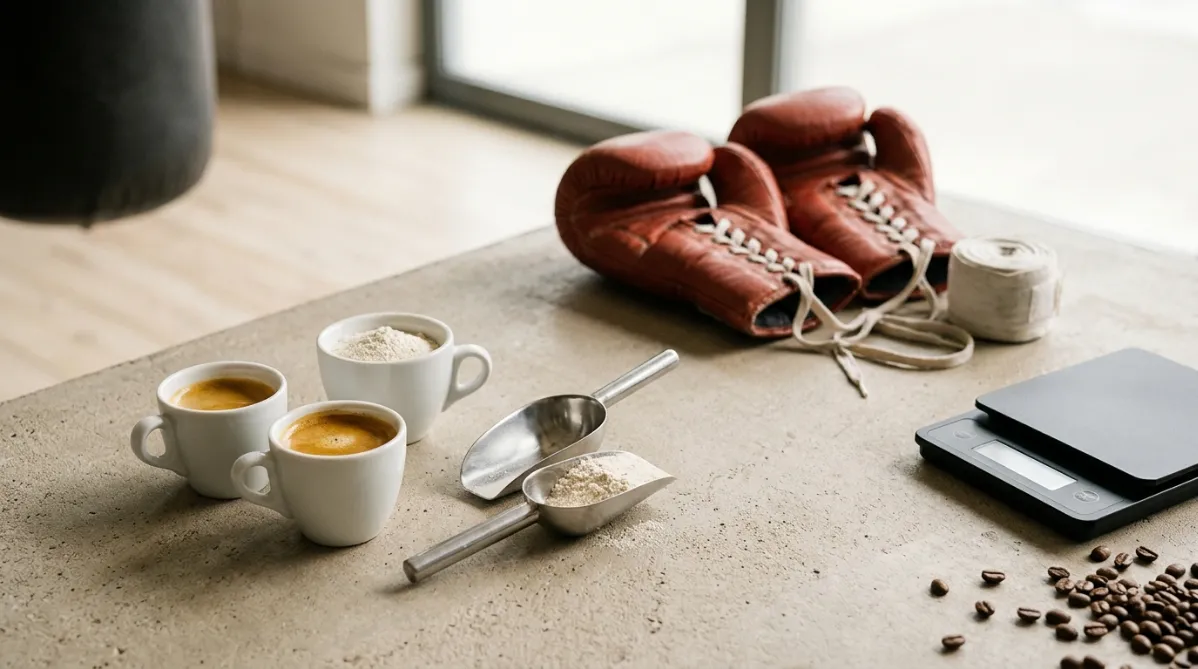
A landscape editorial photograph with a modern, clean magazine feel, shot on a pale warm-gray concrete surface in soft natural window light from the left. In the foreground, two matte white ceramic espresso cups sit side by side. The left cup holds a small amount of dark espresso with golden crema. The right cup is filled twice as high. Beside them, two small stainless steel scoops hold fine coffee-colored powder, one half full and one heaped, suggesting a dose comparison without any text or labels. A pair of worn red leather boxing gloves rests slightly out of focus behind the cups, laces loosely draped, with a white hand wrap rolled neatly beside them. A minimalist digital kitchen scale in matte black sits at the edge of the frame, with a few roasted coffee beans scattered across the surface. In the soft-focus background, a boxing gym corner appears: a hanging heavy bag in muted charcoal, pale wood plank flooring, and a tall window with diffused morning light. The palette is warm cream, espresso brown, brick red, and soft slate gray, with gentle shadows and a shallow depth of field. The composition follows the rule of thirds, with the cups and scoops in the lower left third and open negative space on the right for headline overlay. The look is tactile and refined, like a high-end health and performance journal. It has natural grain, subtle contrast, and a calm, confident mood. There are no people, no text, no logos, and no futuristic elements.
nutrition

Doubling Your Caffeine Barely Helped Boxers—Here's What Did

BY DR. GYMBRO ·

Think a double scoop of pre-workout means double the performance? A new crossover trial in 15 competitive boxers compared 3 mg/kg and 6 mg/kg of caffeine, and the bigger dose was not consistently better. Both doses raised jump height and power at 60 minutes, while 6 mg/kg only pulled ahead on a few outcomes like ballistic push-up power and knee torque. Here is the mg-per-kg conversion for common body weights, the timing the data supports, and the honest caveats, including that punching itself was never tested.

This page is available in