Dr. Gymbro
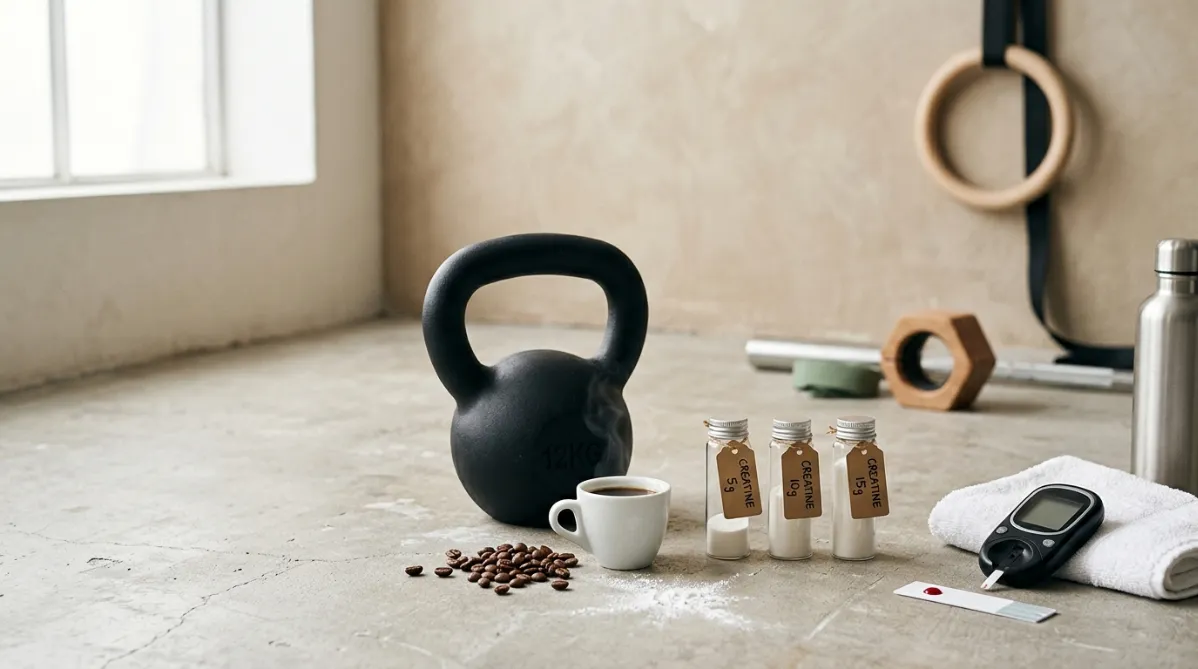
A wide, editorial-style still life photographed in soft natural window light, set on a pale concrete gym floor with a warm oatmeal-toned wall behind it. In the center foreground, a matte black kettlebell sits beside a white ceramic espresso cup filled with dark coffee, a thin wisp of steam rising. Next to the cup, three small glass vials of increasing fill levels stand in a neat row, containing fine white powder, each tied with a small kraft paper tag. Scattered nearby are a few roasted coffee beans and a pinch of chalk dust that catches the light.

On the right side, a minimalist glucose meter with a small blank screen rests next to a folded white towel and a stainless steel water bottle. A single drop of bright crimson blood on a clean test strip adds a subtle focal accent. A wooden barbell collar and a loop of gymnastic rings hang softly out of focus in the background, suggesting a CrossFit box without showing any people.

The palette is warm and restrained: cream, charcoal, terracotta, and muted sage green, with one pop of coral red from the droplet. The composition uses generous negative space on the left third for headline overlay, a shallow depth of field, and gentle long shadows falling across the floor. The mood is calm, clean, and modern, like a premium health and science magazine cover: crisp textures, subtle film grain, natural color grading, and a slightly elevated three-quarter camera angle in landscape 16:9 format.
Nutrition

¿6 o 9 mg/kg de cafeína antes de CrossFit? Lo que notas en tu glucosa

Dr. Gymbro · · 4 min read

La sorpresa oculta en los análisis de sangre

Quizás esperes que una dosis alta de cafeína pre‑entrenamiento altere tus valores sanguíneos: recuentos celulares, minerales y demás. Un nuevo ensayo aleatorio sugiere que la realidad es mucho más tranquila. De todo lo que los investigadores midieron alrededor de una sesión de CrossFit, solo la glucosa en sangre respondió claramente a la cafeína, y solo en las dosis más elevadas.

El estudio, publicado en el Journal of the International Society of Sports Nutrition (2026), es obra de Główka, Podgórski, Malik, Nowaczyk y Durkalec‑Michalski. Puedes encontrarlo en PubMed o mediante su DOI.

Cómo se llevó a cabo el ensayo

El diseño fue robusto: ensayo aleatorio, doble ciego, con control placebo y diseño cruzado, de modo que cada atleta probó todas las condiciones. Veintiséis atletas de CrossFit con entrenamiento moderado recibieron una de cuatro opciones:

  • Placebo
  • 3 mg/kg de cafeína (baja)
  • 6 mg/kg de cafeína (media)
  • 9 mg/kg de cafeína (alta)

Cada dosis se tomó 70 minutos antes de un entrenamiento de CrossFit de 17 minutos de duración. El equipo siguió marcadores hematológicos (células sanguíneas) y bioquímicos en varios momentos. El ensayo está registrado como NCT03822663.

Para ponerlo en perspectiva, en un atleta de 80 kg esas dosis equivalen aproximadamente a 240 mg, 480 mg y 720 mg de cafeína. Este cálculo es mío, no forma parte del artículo.

El hallazgo principal: la glucosa se eleva con 6 y 9 mg/kg

Los autores hallaron interacciones significativas entre tratamiento y tiempo solo para la glucosa. Las dosis media (6 mg/kg) y alta (9 mg/kg) produjeron elevaciones post‑entrenamiento de glucosa significativamente mayores que la línea base y que el placebo.

La dosis baja de 3 mg/kg no se distinguió del placebo. El resumen no describe cuán grandes fueron esas diferencias en términos clínicos, ni indica si afectan al rendimiento o a la salud. Por tanto, la conclusión es que la glucosa responde de forma distinta a dosis más altas, no que esas dosis sean nocivas.

Lo que la cafeína no hizo

Los resultados nulos son igual de importantes para la práctica:

  • Índices hematológicos: El ejercicio fue el principal motor de los cambios en la sangre; no se observó modulación específica por la cafeína.
  • Fosfatos: Los niveles aumentaron con el tiempo, sobre todo después del ejercicio. Cuando se excluyó la visita de línea base en un análisis de sensibilidad, desapareció cualquier efecto del tratamiento.
  • Calcio: Los cambios siguieron la línea temporal, no la cafeína.
  • Magnesio: Se mantuvo estable.

Los autores concluyen que la cafeína aguda "influye selectivamente en la respuesta de glucosa post‑entrenamiento", mientras que las variables hematológicas y la mayoría de los marcadores bioquímicos permanecen sin efecto.

Entonces, ¿cuánta cafeína necesita realmente un CrossFitter?

Este artículo no puede responderlo por sí solo. El resumen reporta marcadores sanguíneos, no puntuaciones de entrenamiento, así que no indica si 9 mg/kg supera a 3 mg/kg en desempeño. Lo que sí muestra es que dosis más altas se reflejan en la glucosa y no en los demás marcadores medidos.

A continuación, una forma cautelosa de aplicar la información.

Dosis: La dosis más baja probada, 3 mg/kg, fue la que no mostró una señal clara en glucosa. Si ya obtienes la alerta o el impulso que buscas con esa cantidad, este estudio no te da razón basada en marcadores sanguíneos para subir a 6 o 9 mg/kg.

Momento: El ensayo administró la cafeína 70 minutos antes de un entrenamiento corto de 17 minutos. Esa es una plantilla razonable si deseas replicar las condiciones estudiadas.

A quién le puede convenir: Atletas sanos, con entrenamiento moderado, similares a los participantes, que ya toleran la cafeína y buscan un rango respaldado por datos.

A quién debería ser cauteloso o evitar las dosis altas:

  • Personas que manejan su glucosa, como diabéticos, prediabéticos o quienes deben monitorizarla. Consulten a un profesional antes. El estudio no incluyó a estos grupos.
  • Quienes son sensibles a la cafeína o presentan problemas de ritmo cardíaco, presión arterial, ansiedad o sueño. El artículo no los evaluó, pero son razones habituales para la precaución.
  • Atletas embarazadas y adolescentes, que generalmente tienen límites de cafeína más bajos.

Un dato externo: organismos de salud pública como la FDA y la EFSA suelen citar alrededor de 400 mg al día como límite seguro para adultos sanos. Una dosis de 9 mg/kg superaría ese límite para la mayoría. Esa guía no proviene del estudio, pero es una razón para tratar la dosis máxima con respeto.

Limitaciones que debes conocer

  • Muestra pequeña: 26 atletas de nivel moderado es un grupo modesto; los resultados pueden no extrapolarse a atletas élite o principiantes.
  • Dosis aguda únicamente: El ensayo evaluó dosis únicas, no uso habitual durante semanas.
  • Formato de entrenamiento único: Una sesión de CrossFit de 17 minutos puede no representar entrenamientos más largos o diferentes.
  • Ensayo humano, no animal: Eso es una fortaleza, pero el resumen no informa desempeño, esfuerzo percibido ni efectos secundarios, por lo que esas preguntas siguen abiertas.
  • Matiz mineral: El hallazgo sobre fosfatos dependió del enfoque analítico, por lo que no debe sobreinterpretarse.

Conclusión

Más cafeína no reescribió el perfil sanguíneo de los atletas, salvo por la glucosa. Con 6 y 9 mg/kg, la glucosa post‑entrenamiento aumentó más que con placebo, mientras que los resultados de células sanguíneas, calcio y magnesio se mantuvieron prácticamente sin cambios. Si usas cafeína antes de CrossFit, este estudio respalda comenzar con una dosis baja, alrededor de 3 mg/kg, aproximadamente una hora antes del entrenamiento. Trata las dosis más altas como algo a probar con cautela, no como una mejora automática.

Fuentes: PubMed 42924484 | DOI: 10.1080/15502783.2026.2740805
Original study

Read the original research on pubmed.ncbi.nlm.nih.gov →

This article summarizes published research for general information. It is not medical advice.

DG

Written by

Dr. Gymbro

Dr. Gymbro writes for Dr. Gymbro: science-backed fitness, nutrition & performance.

Related Articles

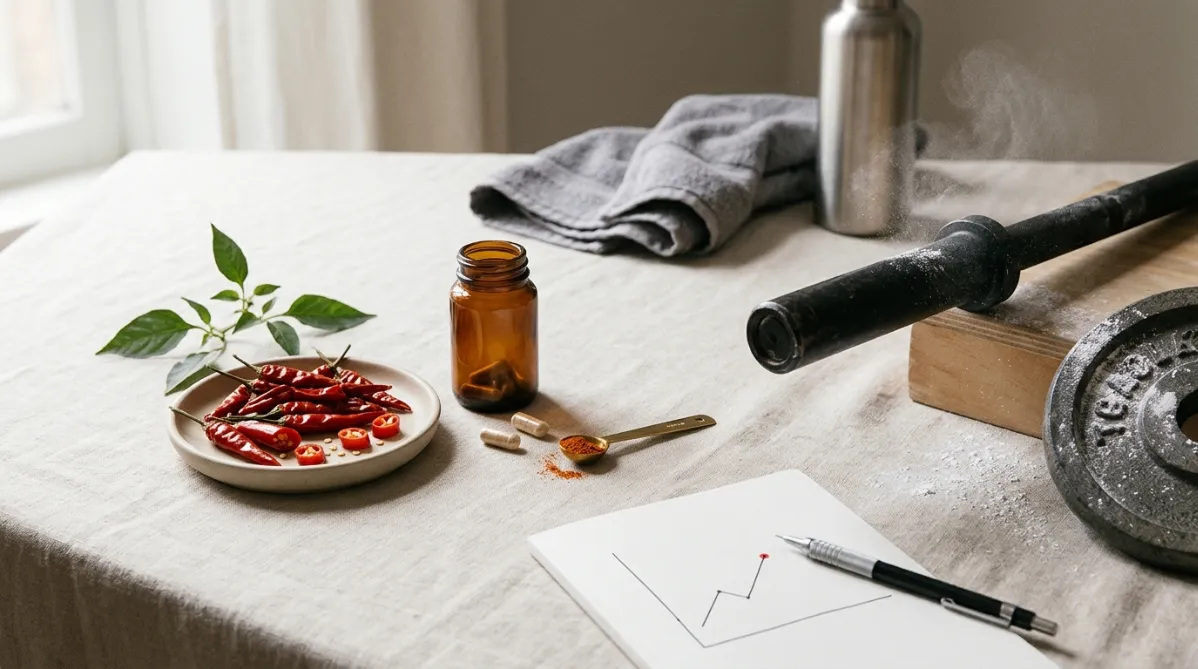
A wide, editorial-style still life photographed in soft natural window light on a pale oatmeal-colored linen surface. In the center-left, a small matte ceramic dish holds a modest pile of vivid red dried chili peppers and a few sliced fresh chilies, their glossy seeds catching the light. Beside it sits a minimalist amber glass capsule bottle without a label, with two translucent capsules spilled onto the linen, along with a tiny brass measuring spoon holding a pinch of fine orange-red powder.

On the right side of the frame, slightly out of focus, a worn black barbell rests across a wooden gym box, with a chalk-dusted steel plate leaning nearby. A small cloud of white chalk dust hangs delicately in the air, backlit by the light. A folded gray cotton gym towel and a simple stainless steel water bottle sit in the soft background.

In the foreground, a minimalist white notebook lies open with a clean hand-drawn line graph in thin black ink, with a small red dot marking one point. A mechanical pencil rests across the page.

The palette is warm and restrained: terracotta red, burnt orange, cream, charcoal, and muted sage green accents from a single leafy chili plant stem. Shallow depth of field, subtle film grain, gentle shadows, generous negative space at the top of the frame for a title overlay. Modern health and science journal aesthetic, calm, clean, tactile, and slightly moody, like a magazine feature on sports nutrition. No people, no text, no logos.
nutrition

Fenilcapsaicina como pre‑entreno potencia sentadillas en CrossFit y reduce el dolor muscular

BY DR. GYMBRO ·

Un compuesto derivado del chile, la fenilcapsaicina, fue evaluado en un ensayo cruzado triple ciego con 50 atletas de CrossFit. Una única dosis de 2,5 mg tomada 45 minutos antes del entrenamiento incrementó la carga y el número de repeticiones en sentadillas, redujo la caída del salto y disminuyó el dolor muscular a las 24 y 48 h. No tuvo efecto alguno sobre el WOD, ni sobre lactato, RPE o frecuencia cardíaca. Dos de los autores son asesores de una marca de suplementos, y el estudio solo cubre una dosis aguda. A continuación se explica qué demuestran los datos, qué no y a quién podría interesar probarlo.

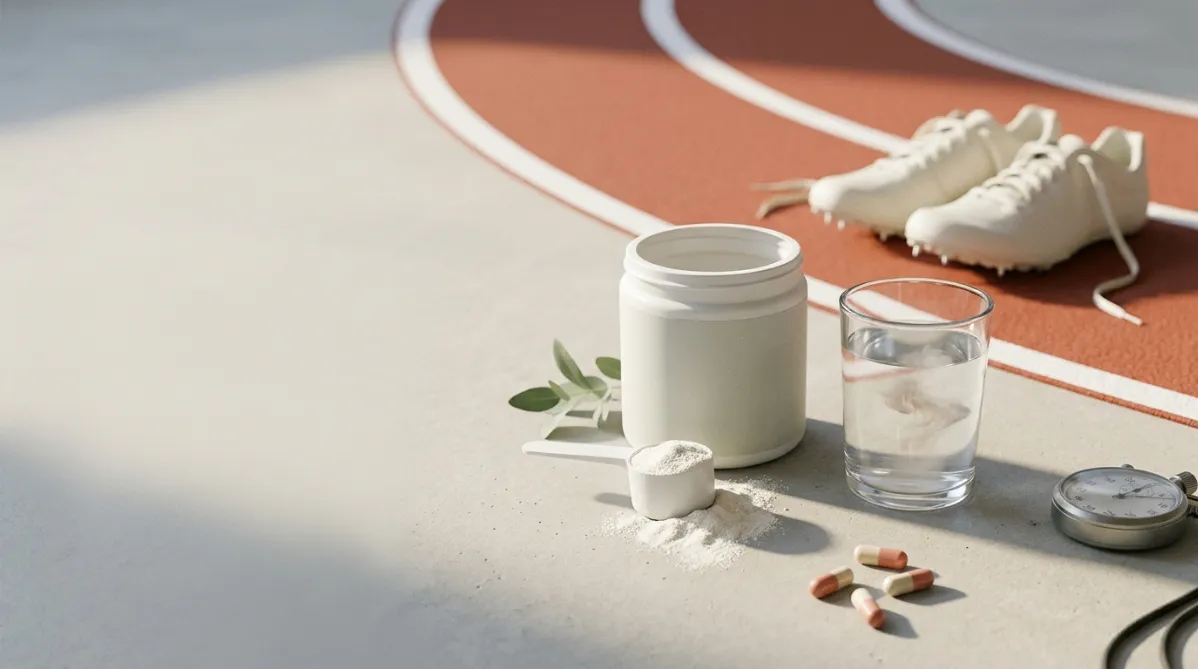
A wide, editorial-style still life photographed on a pale warm-gray concrete surface in soft morning window light. In the center sits an open, matte white supplement tub with a scoop resting beside it, a small mound of fine white powder spilling onto the surface. Next to it is a clear glass of water with a faint cloudy swirl of dissolved powder. A few loose capsules in muted coral and cream tones are scattered casually in the foreground. Behind them, slightly out of focus, is a clean running track lane in terracotta red with crisp white lines curving across the background. A pair of minimalist off-white sprint spikes rests on the edge of the track, laces loosely undone. A stopwatch with a brushed metal casing lies partially in frame at the right, its face reading a blurred, indistinct time.

The composition uses generous negative space on the left third, leaving a calm area of soft gray and cream for headline text. Shadows are long, gentle, and slightly cool, contrasting with the warm terracotta of the track. The palette is restrained: terracotta, bone white, soft sage green accents from a small leaf sprig tucked near the tub, and charcoal gray details. Shallow depth of field with a crisp focus on the scoop and powder, creamy bokeh behind. The mood is thoughtful, skeptical, and calm, like a modern wellness or science journal cover. Subtle film grain, natural color grading, and a tactile, tangible feel, with no text, no logos, and no futuristic elements.
nutrition

Beta‑alanina: presente en casi todos los pre‑entrenamientos, pero los datos de sprint indican que quizá no funcione

BY DR. GYMBRO ·

La beta‑alanina se encuentra en casi todos los pre‑entrenamientos y el hormigueo que provoca suele hacer creer que está funcionando. Sin embargo, un meta‑análisis multinivel de 2026 que reunió 17 ensayos controlados aleatorios no mostró ningún beneficio en la capacidad de sprint repetido, sea cual sea la métrica analizada. La dosis, la duración de la suplementación y el nivel de entrenamiento no modificaron el resultado. Los autores explican que, en sprints repetidos, el factor limitante es la recuperación de fosfocreatina más que la acidosis que la beta‑alanina intenta contrarrestar.

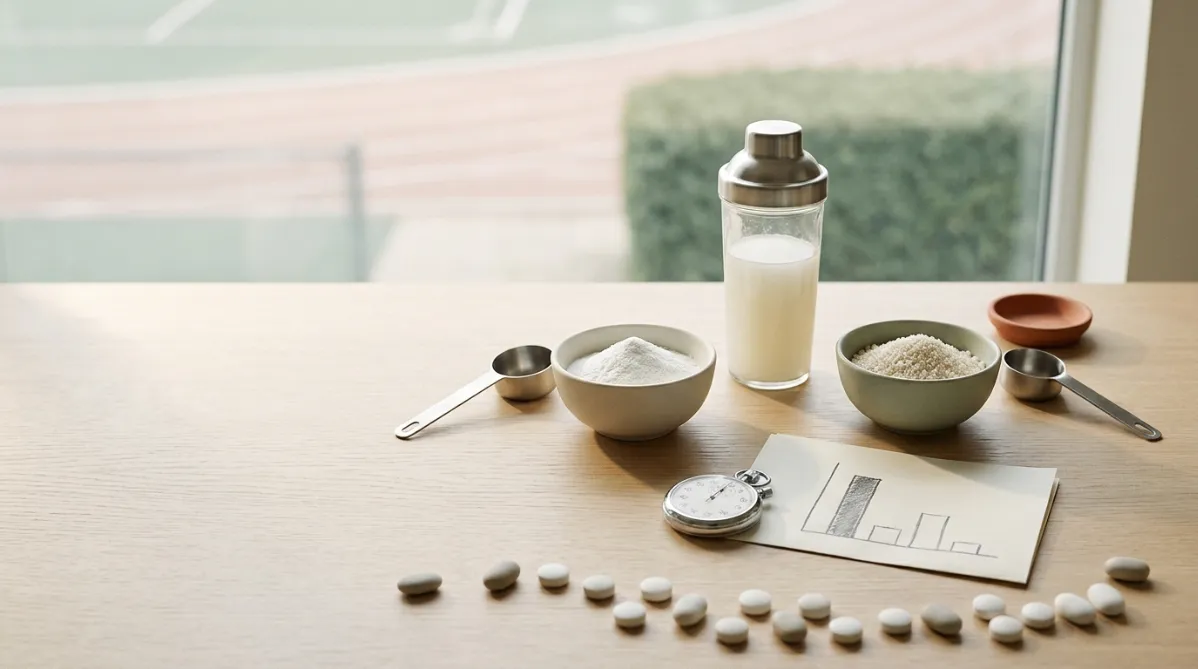
A wide, editorial-style still life shot from a slightly elevated angle on a pale oak laboratory-meets-kitchen countertop, bathed in soft, diffused morning window light. In the center, two small matte ceramic bowls sit side by side: one holds fine white creatine powder, the other holds slightly coarser off-white L-arginine crystals. A brushed steel scoop rests beside each. Between and slightly behind them stands a clear glass shaker bottle filled with a cloudy, pale liquid, catching a gentle highlight. In the foreground, a minimalist analog stopwatch lies on the wood surface, its face crisp and legible, next to a folded sheet of off-white paper with a hand-drawn simple bar chart in charcoal pencil, with one tall bar and a few shorter ones, no text or numbers. In the soft-focus background, a blurred gym-style window view shows a pale running track and a muted sage-green hedge, suggesting sprinting and athletic testing without any people. Eighteen small smooth stones or white pills are arranged in a neat loose arc across the lower edge of the frame, a subtle nod to the small sample size, with one stone set slightly apart. The color palette is calm and modern: warm cream, bone white, soft sage, muted terracotta accents from a small clay dish, and thin touches of brushed metal. Shadows are long and gentle, the depth of field shallow, with a fine film-like grain. The composition leaves generous negative space on the left third for a title overlay. The mood is clean, thoughtful, and trustworthy, like a contemporary health and science journal cover, with no futuristic elements, no glowing effects, and no text.
nutrition

Creatina + L‑arginina aumenta ~99 W de potencia máxima: el truco

BY DR. GYMBRO ·

Un ensayo cruzado reciente mostró que, al tomar creatina y L‑arginina juntas una hora antes de la prueba, la potencia máxima del sprint aumentó en unos 99 W respecto al placebo. La combinación también superó a cada suplemento por separado tanto en potencia máxima como en altura del salto con contramovimiento. Sin embargo, los autores no hallaron sinergia real y el estudio incluyó solo a 18 hombres. Aquí analizamos los datos, las dosis empleadas y quién debería ser cauteloso.

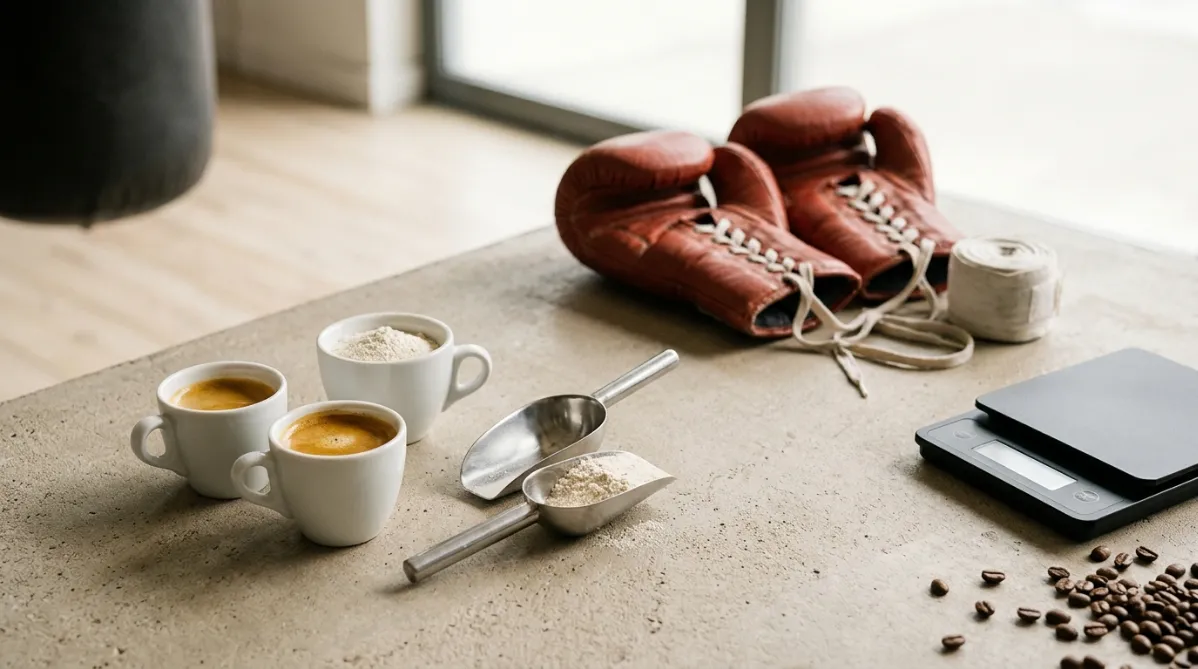
A landscape editorial photograph with a modern, clean magazine feel, shot on a pale warm-gray concrete surface in soft natural window light from the left. In the foreground, two matte white ceramic espresso cups sit side by side. The left cup holds a small amount of dark espresso with golden crema. The right cup is filled twice as high. Beside them, two small stainless steel scoops hold fine coffee-colored powder, one half full and one heaped, suggesting a dose comparison without any text or labels. A pair of worn red leather boxing gloves rests slightly out of focus behind the cups, laces loosely draped, with a white hand wrap rolled neatly beside them. A minimalist digital kitchen scale in matte black sits at the edge of the frame, with a few roasted coffee beans scattered across the surface. In the soft-focus background, a boxing gym corner appears: a hanging heavy bag in muted charcoal, pale wood plank flooring, and a tall window with diffused morning light. The palette is warm cream, espresso brown, brick red, and soft slate gray, with gentle shadows and a shallow depth of field. The composition follows the rule of thirds, with the cups and scoops in the lower left third and open negative space on the right for headline overlay. The look is tactile and refined, like a high-end health and performance journal. It has natural grain, subtle contrast, and a calm, confident mood. There are no people, no text, no logos, and no futuristic elements.
nutrition

Duplicar la dosis de cafeína apenas ayudó a los boxeadores: esto es lo que ocurrió

BY DR. GYMBRO ·

¿Crees que una doble porción de pre‑entrenamiento duplica el rendimiento? Un nuevo estudio cruzado con 15 boxeadores competitivos comparó 3 mg/kg y 6 mg/kg de cafeína, y la dosis mayor no resultó ser consistentemente mejor. Ambas dosis aumentaron la altura del salto y la potencia a los 60 minutos, mientras que 6 mg/kg sólo se adelantó en algunos parámetros, como la potencia del push‑up balístico y el torque de la rodilla. Aquí tienes la tabla de conversión mg‑por‑kg para pesos corporales habituales, el momento en que se observaron los efectos y las advertencias, incluida la ausencia de pruebas de puñetazos.

This page is available in