Dr. Gymbro
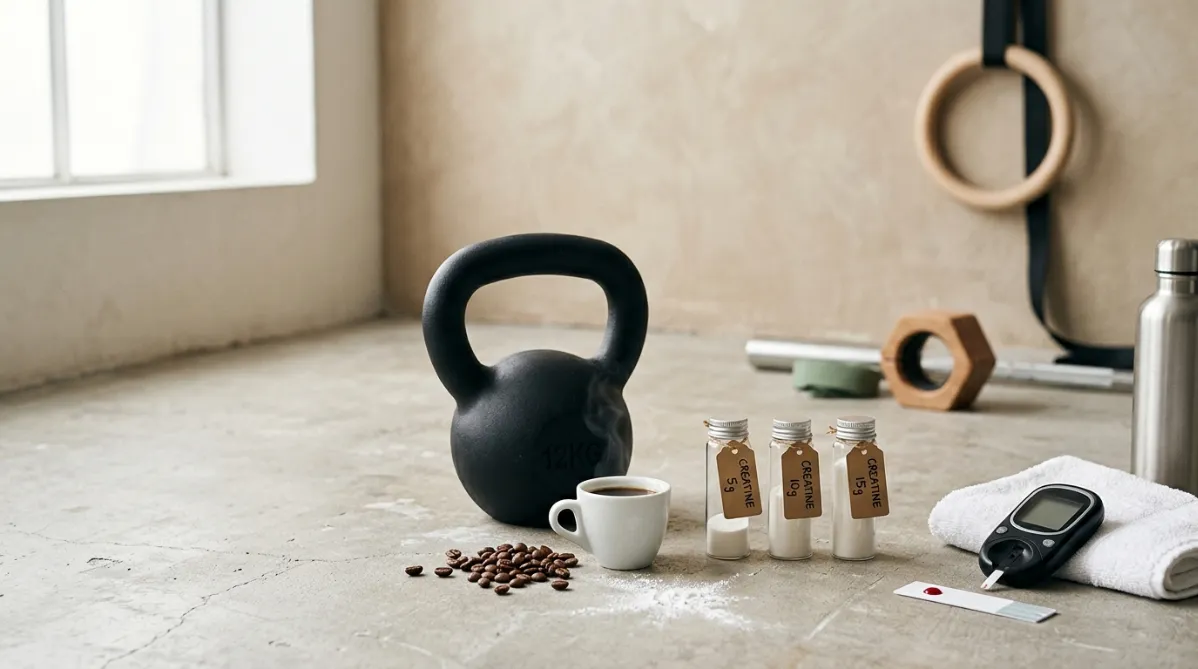
A wide, editorial-style still life photographed in soft natural window light, set on a pale concrete gym floor with a warm oatmeal-toned wall behind it. In the center foreground, a matte black kettlebell sits beside a white ceramic espresso cup filled with dark coffee, a thin wisp of steam rising. Next to the cup, three small glass vials of increasing fill levels stand in a neat row, containing fine white powder, each tied with a small kraft paper tag. Scattered nearby are a few roasted coffee beans and a pinch of chalk dust that catches the light.

On the right side, a minimalist glucose meter with a small blank screen rests next to a folded white towel and a stainless steel water bottle. A single drop of bright crimson blood on a clean test strip adds a subtle focal accent. A wooden barbell collar and a loop of gymnastic rings hang softly out of focus in the background, suggesting a CrossFit box without showing any people.

The palette is warm and restrained: cream, charcoal, terracotta, and muted sage green, with one pop of coral red from the droplet. The composition uses generous negative space on the left third for headline overlay, a shallow depth of field, and gentle long shadows falling across the floor. The mood is calm, clean, and modern, like a premium health and science magazine cover: crisp textures, subtle film grain, natural color grading, and a slightly elevated three-quarter camera angle in landscape 16:9 format.
Nutrition

6 oder 9 mg/kg Koffein vor dem CrossFit? Was Ihr Blutzucker sagt

Dr. Gymbro · · 4 min read

Die Überraschung im Blutbild

Man könnte vermuten, dass ein starker Pre‑Workout‑Koffein‑Schub das Blutbild durcheinanderbringt – Zellzahlen, Mineralstoffe und das ganze Programm. Eine neue randomisierte Studie zeigt jedoch, dass das Blutbild weitgehend unverändert bleibt. Von allen Messwerten, die die Forschenden rund um ein CrossFit‑Workout ermittelten, reagierte nur der Blutzucker eindeutig auf Koffein, und zwar ausschließlich bei den höheren Dosen.

Die Studie, veröffentlicht im Journal of the International Society of Sports Nutrition (2026), stammt von Główka, Podgórski, Malik, Nowaczyk und Durkalec‑Michalski. Sie können sie auf PubMed oder über ihren DOI einsehen.

Wie die Studie ablief

Das Design war solide: randomisiert, doppelblind, placebokontrolliert und im Crossover‑Design, sodass jede Athletin bzw. jeder Athlet jede Bedingung erlebte. Sechsundzwanzig moderat trainierte CrossFit‑Athlet*innen nahmen eine von vier Substanzen ein:

  • Placebo
  • 3 mg/kg Koffein (niedrig)
  • 6 mg/kg Koffein (mittel)
  • 9 mg/kg Koffein (hoch)

Jede Dosis wurde 70 Minuten vor einem 17‑minütigen CrossFit‑Workout eingenommen. Das Team verfolgte hämatologische (Blutzell‑) und biochemische Marker zu verschiedenen Zeitpunkten. Die Studie ist unter NCT03822663 registriert.

Zur Orientierung: Bei einem 80 kg‑Athleten entsprechen diese Dosen etwa 240 mg, 480 mg bzw. 720 mg Koffein. Das ist meine Berechnung, nicht ein im Paper genannter Wert.

Das Hauptresultat: Glukose steigt bei 6 und 9 mg/kg

Die Autoren fanden signifikante Behandlung × Zeit‑Interaktionen nur für die Glukose. Die mittlere (6 mg/kg) und hohe (9 mg/kg) Dosis führten zu signifikant höheren post‑trainings‑Glukosewerten im Vergleich zu Basiswerten und Placebo.

Die niedrige Dosis von 3 mg/kg zeigte keinen Unterschied zum Placebo. Das Abstract liefert keine Angaben zur klinischen Relevanz der Glukoseunterschiede, sodass nicht klar ist, ob sie für Leistung oder Gesundheit bedeutsam sind. Das Ergebnis lautet also: Glukose reagiert bei höheren Dosen anders – nicht, dass diese Dosen per se schädlich wären.

Was Koffein nicht getan hat

Die Null‑Ergebnisse sind für praktische Entscheidungen genauso wichtig:

  • Blutzell‑Indizes: Das Training war der Haupttreiber der hämatologischen Veränderungen. Es gab keine koffein‑spezifische Modulation.
  • Phosphate: Die Werte stiegen über die Zeit, besonders nach dem Training. Sobald der Baseline‑Besuch in einer Sensitivitätsanalyse ausgeschlossen wurde, blieb kein Behandlungseffekt.
  • Calcium: Veränderungen folgten dem Zeitverlauf, nicht dem Koffein.
  • Magnesium: blieb stabil.

Die Autoren schließen, dass akutes Koffein „selektiv die post‑trainings‑Glukoseantwort beeinflusst“, während hämatologische Variablen und die meisten biochemischen Marker unbeeinflusst bleiben.

Wie viel Koffein brauchen CrossFit‑Athlet*innen wirklich?

Diese Studie kann die Frage nicht allein beantworten. Das Abstract berichtet Blutmarker, nicht Leistungswerte, sodass nicht klar ist, ob 9 mg/kg 3 mg/kg in puncto Leistung übertrifft. Was jedoch gezeigt wird, ist, dass höhere Dosen im Glukoseprofil sichtbar werden, nicht jedoch in den anderen gemessenen Markern.

Ein vorsichtiger Ansatz könnte so aussehen:

  • Dosis: Die niedrigste getestete Dosis, 3 mg/kg, zeigte kein klares Glukosesignal. Wenn Sie bereits bei dieser Menge die gewünschte Wachheit oder den Antrieb spüren, liefert Ihnen diese Studie keinen Blut‑Marker‑Grund, auf 6 oder 9 mg/kg zu erhöhen.
  • Timing: Die Studie verabreichte das Koffein 70 Minuten vor einem kurzen, 17‑minütigen Workout. Das ist ein plausibles Vorgehen, wenn Sie die Bedingungen nachahmen wollen.
  • Für wen es passen könnte: Gesunde, moderat trainierte Athlet*innen, die Koffein gut vertragen und eine datenbasierte Dosisrange suchen.
  • Wer vorsichtig sein sollte bzw. hohe Dosen meiden sollte:
    • Personen, die ihren Blutzucker managen müssen (z. B. Menschen mit Diabetes oder Prädiabetes) oder denen geraten wurde, den Glukosespiegel zu beobachten. Hier sollte zuerst ein Arzt konsultiert werden. Die Studie hat diese Gruppen nicht untersucht.
    • Koffein‑sensible Menschen oder solche mit Herzrhythmusstörungen, Bluthochdruck, Angst‑ oder Schlafproblemen. Das Paper behandelt diese Aspekte nicht, sie sind jedoch übliche Warnhinweise.
    • Schwangere Athletinnen und Athleten sowie Jugendliche, für die allgemein niedrigere Koffein‑Grenzwerte empfohlen werden.

Ein zusätzlicher Kontext: Öffentliche Gesundheitsbehörden wie die FDA und EFSA nennen häufig etwa 400 mg pro Tag als sichere Obergrenze für gesunde Erwachsene. Eine Dosis von 9 mg/kg überschreitet das für die meisten Menschen. Diese Empfehlung stammt nicht aus der Studie, ist aber ein Grund, die höchste Dosis mit Vorsicht zu behandeln.

Einschränkungen, die Sie kennen sollten

  • Kleine Stichprobe: 26 moderat trainierte Athletinnen bilden eine überschaubare Gruppe; die Ergebnisse lassen sich nicht ohne Weiteres auf Elite‑ oder Anfänger‑Athletinnen übertragen.
  • Akute Einzeldosis: Die Studie testete einzelne Dosen, nicht den Langzeit‑Konsum über Wochen.
  • Einzelnes Workout‑Format: Ein 17‑minütiges CrossFit‑Session repräsentiert nicht länger dauernde oder andere Trainingsformen.
  • Keine Leistungsdaten: Das Abstract berichtet nicht über Leistung, subjektive Anstrengung oder Nebenwirkungen – diese Fragen bleiben offen.
  • Mineral‑Nuancen: Der Phosphat‑Fund beruhte auf der gewählten Analysemethode und sollte nicht überinterpretiert werden.

Fazit

Mehr Koffein veränderte das Blutprofil von Athlet*innen kaum, abgesehen vom Glukosewert. Bei 6 und 9 mg/kg stieg der post‑trainings‑Glukosewert stärker als beim Placebo, während Blutzell‑, Calcium‑ und Magnesium‑Ergebnisse weitgehend unverändert blieben. Wenn Sie Koffein vor dem CrossFit verwenden, unterstützt diese Studie den Ansatz, mit einer niedrigen Dosis von etwa 3 mg/kg etwa eine Stunde vor dem Training zu starten. Höhere Dosen sollten vorsichtig getestet und nicht als Standard‑Upgrade angenommen werden.

Quellen: PubMed 42924484 | DOI: 10.1080/15502783.2026.2740805
Original study

Read the original research on pubmed.ncbi.nlm.nih.gov →

This article summarizes published research for general information. It is not medical advice.

DG

Written by

Dr. Gymbro

Dr. Gymbro writes for Dr. Gymbro: science-backed fitness, nutrition & performance.

Related Articles

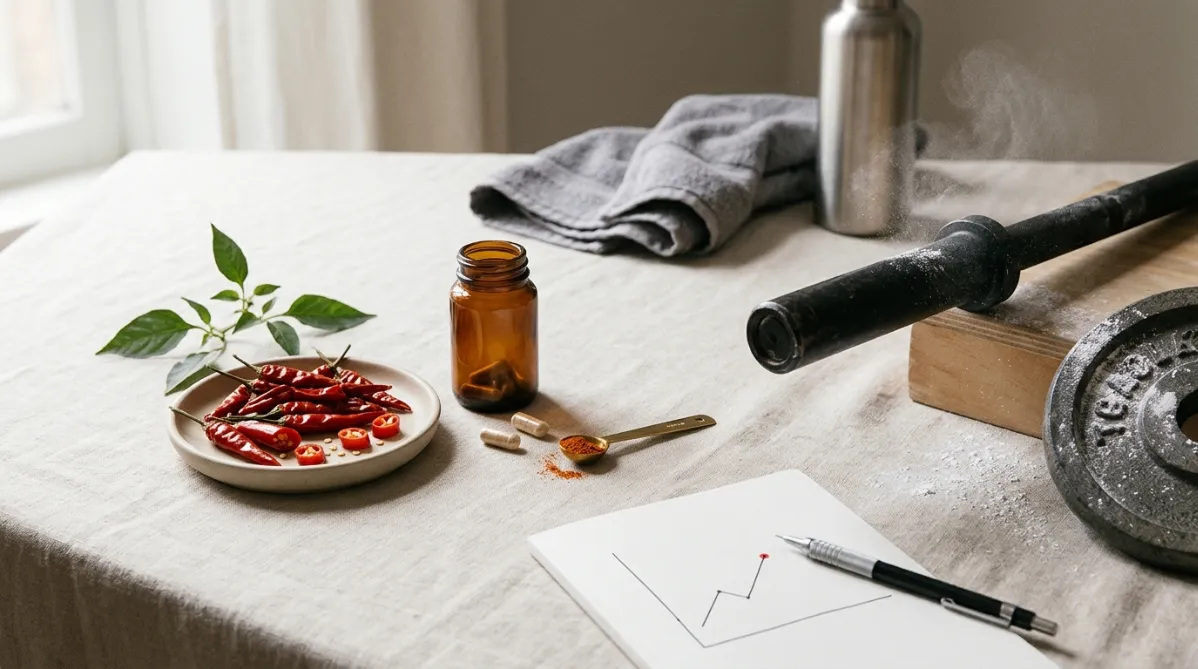
A wide, editorial-style still life photographed in soft natural window light on a pale oatmeal-colored linen surface. In the center-left, a small matte ceramic dish holds a modest pile of vivid red dried chili peppers and a few sliced fresh chilies, their glossy seeds catching the light. Beside it sits a minimalist amber glass capsule bottle without a label, with two translucent capsules spilled onto the linen, along with a tiny brass measuring spoon holding a pinch of fine orange-red powder.

On the right side of the frame, slightly out of focus, a worn black barbell rests across a wooden gym box, with a chalk-dusted steel plate leaning nearby. A small cloud of white chalk dust hangs delicately in the air, backlit by the light. A folded gray cotton gym towel and a simple stainless steel water bottle sit in the soft background.

In the foreground, a minimalist white notebook lies open with a clean hand-drawn line graph in thin black ink, with a small red dot marking one point. A mechanical pencil rests across the page.

The palette is warm and restrained: terracotta red, burnt orange, cream, charcoal, and muted sage green accents from a single leafy chili plant stem. Shallow depth of field, subtle film grain, gentle shadows, generous negative space at the top of the frame for a title overlay. Modern health and science journal aesthetic, calm, clean, tactile, and slightly moody, like a magazine feature on sports nutrition. No people, no text, no logos.
nutrition

Phenylcapsaicin‑Pre‑Workout steigert CrossFit‑Kniebeugen und reduziert Muskelkater

BY DR. GYMBRO ·

Ein aus Chili stammender Wirkstoff namens Phenylcapsaicin hat gerade eine dreifach‑blinde Crossover‑Studie mit 50 CrossFit‑Athleten durchlaufen. Eine Einzeldosis von 2,5 mg, 45 Minuten vor dem Training eingenommen, steigerte das Kniebeugengewicht und die Wiederholungszahl, verringerte den Verlust der Sprunghöhe und senkte die Muskelkaterintensität nach 24 und 48 Stunden. Für das eigentliche WOD zeigte er jedoch keinerlei Wirkung; weder Laktat, RPE noch die Herzfrequenz veränderten sich. Zwei der Autoren sind Berater einer Supplement‑Marke, und die Studie untersuchte lediglich eine einmalige, akute Dosis. Im Folgenden werden die Ergebnisse, die offenen Fragen und die potenziellen Nutznießer vorgestellt.

A wide, editorial-style still life photographed on a pale warm-gray concrete surface in soft morning window light. In the center sits an open, matte white supplement tub with a scoop resting beside it, a small mound of fine white powder spilling onto the surface. Next to it is a clear glass of water with a faint cloudy swirl of dissolved powder. A few loose capsules in muted coral and cream tones are scattered casually in the foreground. Behind them, slightly out of focus, is a clean running track lane in terracotta red with crisp white lines curving across the background. A pair of minimalist off-white sprint spikes rests on the edge of the track, laces loosely undone. A stopwatch with a brushed metal casing lies partially in frame at the right, its face reading a blurred, indistinct time.

The composition uses generous negative space on the left third, leaving a calm area of soft gray and cream for headline text. Shadows are long, gentle, and slightly cool, contrasting with the warm terracotta of the track. The palette is restrained: terracotta, bone white, soft sage green accents from a small leaf sprig tucked near the tub, and charcoal gray details. Shallow depth of field with a crisp focus on the scoop and powder, creamy bokeh behind. The mood is thoughtful, skeptical, and calm, like a modern wellness or science journal cover. Subtle film grain, natural color grading, and a tactile, tangible feel, with no text, no logos, and no futuristic elements.
nutrition

Beta‑Alanin ist in fast jedem Pre‑Workout – Sprint‑Daten zeigen, dass es vielleicht nicht wirkt

BY DR. GYMBRO ·

Beta‑Alanin ist in fast jedem Pre‑Workout enthalten und das typische Kribbeln lässt es wirksam erscheinen. Eine mehrstufige Meta‑Analyse von 17 randomisierten, kontrollierten Studien aus dem Jahr 2026 fand jedoch keinen Nutzen für die wiederholte Sprintfähigkeit – weder beim durchschnittlichen noch beim Spitzen‑Performance‑Score oder beim Ermüdungsabfall. Dosis, Dauer der Einnahme und Trainingsstatus beeinflussten das Ergebnis nicht. Die Autoren vermuten, dass die Begrenzung bei Wiederholungs‑Sprints eher durch die Phosphokreatin‑Erholung als durch Azidose bedingt ist – genau das, worauf Beta‑Alanin abzielt.

A wide, editorial-style still life shot from a slightly elevated angle on a pale oak laboratory-meets-kitchen countertop, bathed in soft, diffused morning window light. In the center, two small matte ceramic bowls sit side by side: one holds fine white creatine powder, the other holds slightly coarser off-white L-arginine crystals. A brushed steel scoop rests beside each. Between and slightly behind them stands a clear glass shaker bottle filled with a cloudy, pale liquid, catching a gentle highlight. In the foreground, a minimalist analog stopwatch lies on the wood surface, its face crisp and legible, next to a folded sheet of off-white paper with a hand-drawn simple bar chart in charcoal pencil, with one tall bar and a few shorter ones, no text or numbers. In the soft-focus background, a blurred gym-style window view shows a pale running track and a muted sage-green hedge, suggesting sprinting and athletic testing without any people. Eighteen small smooth stones or white pills are arranged in a neat loose arc across the lower edge of the frame, a subtle nod to the small sample size, with one stone set slightly apart. The color palette is calm and modern: warm cream, bone white, soft sage, muted terracotta accents from a small clay dish, and thin touches of brushed metal. Shadows are long and gentle, the depth of field shallow, with a fine film-like grain. The composition leaves generous negative space on the left third for a title overlay. The mood is clean, thoughtful, and trustworthy, like a contemporary health and science journal cover, with no futuristic elements, no glowing effects, and no text.
nutrition

Kreatin + L‑Arginin: ~99 W mehr Spitzenleistung – der Haken

BY DR. GYMBRO ·

Eine neue Crossover‑Studie zeigte, dass die Einnahme von Kreatin und L‑Arginin eine Stunde vor dem Test die Spitzen‑Sprintleistung gegenüber Placebo um etwa 99 W erhöhte. Der Stack übertraf zudem jedes einzelne Supplement in Spitzenleistung und Sprunghöhe. Eine synergistische Wirkung konnte jedoch nicht nachgewiesen werden, und die Studie umfasste nur 18 Männer. Im Folgenden erfährst du, was die Zahlen bedeuten, welche Dosierungen verwendet wurden und für wen die Kombination riskant sein kann.

A landscape editorial photograph with a modern, clean magazine feel, shot on a pale warm-gray concrete surface in soft natural window light from the left. In the foreground, two matte white ceramic espresso cups sit side by side. The left cup holds a small amount of dark espresso with golden crema. The right cup is filled twice as high. Beside them, two small stainless steel scoops hold fine coffee-colored powder, one half full and one heaped, suggesting a dose comparison without any text or labels. A pair of worn red leather boxing gloves rests slightly out of focus behind the cups, laces loosely draped, with a white hand wrap rolled neatly beside them. A minimalist digital kitchen scale in matte black sits at the edge of the frame, with a few roasted coffee beans scattered across the surface. In the soft-focus background, a boxing gym corner appears: a hanging heavy bag in muted charcoal, pale wood plank flooring, and a tall window with diffused morning light. The palette is warm cream, espresso brown, brick red, and soft slate gray, with gentle shadows and a shallow depth of field. The composition follows the rule of thirds, with the cups and scoops in the lower left third and open negative space on the right for headline overlay. The look is tactile and refined, like a high-end health and performance journal. It has natural grain, subtle contrast, and a calm, confident mood. There are no people, no text, no logos, and no futuristic elements.
nutrition

Doppelte Koffeinmenge hilft Boxern kaum – das hat die Studie gezeigt

BY DR. GYMBRO ·

Denkst du, ein doppelter Löffel Pre‑Workout verdoppelt die Leistung? Eine aktuelle Studie mit 15 Wettkampf‑Boxern zeigt, dass das nicht zwangsläufig stimmt. Sowohl 3 mg/kg als auch 6 mg/kg Koffein verbesserten die Sprungleistung, jedoch war die höhere Dosis nicht durchgängig überlegen. Nur bei einzelnen Tests, etwa beim ballistischen Liegestütz und dem Knie‑Drehmoment, brachte die größere Dosis einen kleinen Vorteil. Wichtig ist zudem, dass das eigentliche Boxen – also das Schlagen – nie untersucht wurde.

This page is available in