Dr. Gymbro
←

#doms

2 articles
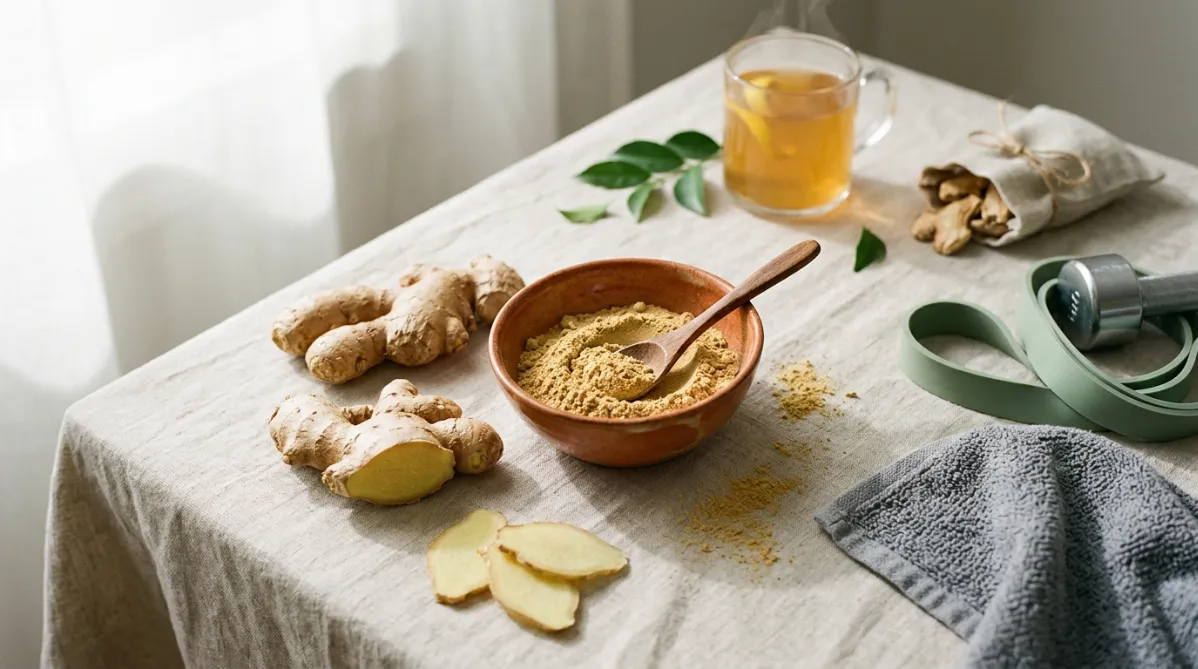
A wide, editorial-style still life photographed from slightly above on a pale oat-colored linen surface, lit by soft natural window light from the left. At the center sits a rustic ceramic bowl of finely ground golden-tan ginger powder, with a small wooden spoon resting in it and a light dusting of spice across the cloth. Beside it lie several whole ginger rhizomes, knobby and honey-brown. One is sliced open to show its pale yellow, fibrous interior, and a few paper-thin slices fan out in the foreground. On the right, a folded heather-gray gym towel, a matte sage-green resistance band coiled loosely, and a single brushed-steel dumbbell sit just inside the frame, softly out of focus. A glass of warm amber ginger tea steams faintly near the upper right, with a thin curl of lemon peel inside. A few fresh green leaves and a small linen pouch of dried ginger add texture. The palette is warm and muted: cream, soft gold, sage, terracotta, and charcoal accents. The shallow depth of field keeps the ginger bowl and sliced root crisp while the gym elements melt into a gentle blur. Shadows are long and soft, and the negative space on the upper left leaves room for a headline. The mood is calm, clean, and modern, like a contemporary wellness or science journal cover. It is a natural, tactile, high-resolution photograph with subtle film grain and no text, no people, and no futuristic elements.
recovery

2 g Ingwer reduzieren Muskelkater am nächsten Tag um etwa 25 % – Ergebnisse aus zwei Studien

BY DR. GYMBRO ·

Ein alltägliches Küchengewürz hat sich mit einem der häufigsten Beschwerden im Fitnessstudio angelegt: dem Muskelkater am nächsten Tag. In zwei doppelblinden Studien berichteten Personen, die 11 Tage lang täglich 2 g Ingwer einnahmen, von etwa 25 % weniger Schmerzen 24 Stunden nach einer harten exzentrischen Belastung. Ingwer verbesserte jedoch weder die Kraft noch die Schwellung, und es gab keinen Vergleich mit Ibuprofen. Im Folgenden wird gezeigt, was die Forschung belegt, warum es funktionieren könnte, wo die Evidenz schwächelt und für wen es einen Versuch wert sein könnte.
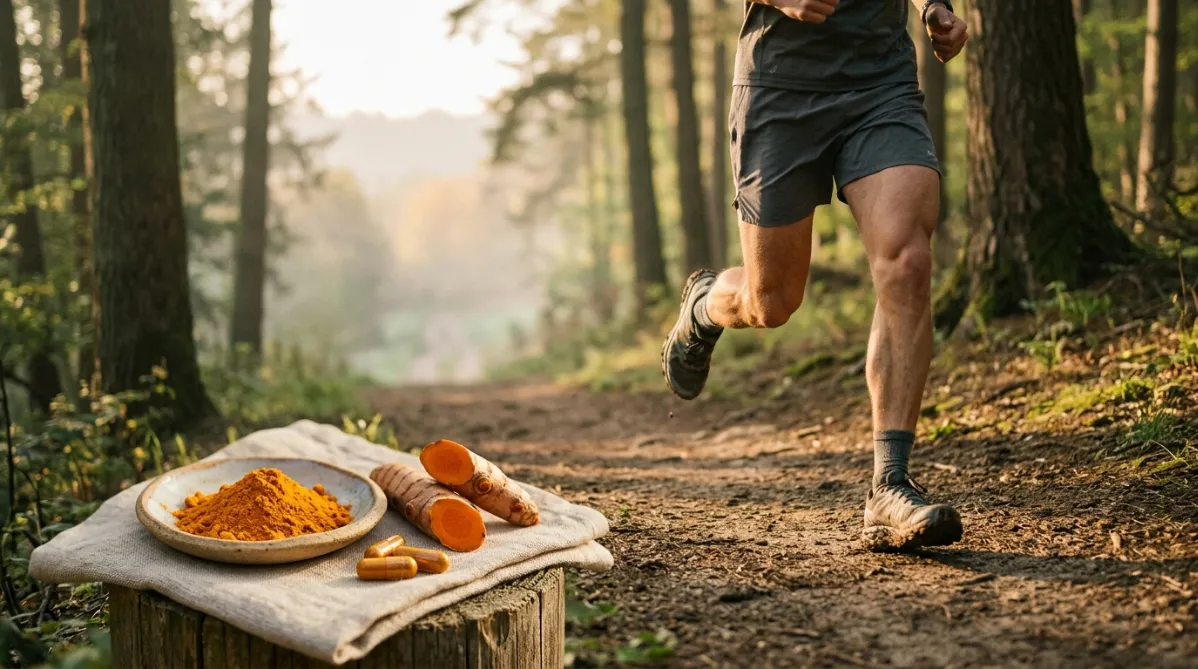
A wide, editorial-style photograph of a male runner mid-stride on a gently sloping forest trail at early morning, shot from a low three-quarter angle. Soft golden light filters through tall trees and casts long dappled shadows across the packed dirt path. The runner is captured from the waist down and slightly from the side, wearing charcoal running shorts and worn trail shoes, with the quadriceps and thigh muscles defined and naturally lit. A fine mist hangs in the background, and the slope descends toward a blurred, softly glowing horizon.

In the foreground, slightly out of focus on a weathered wooden post or flat mossy stone at the trail's edge, rests a small ceramic dish holding a pile of vivid golden-orange turmeric powder. Beside it sit two fresh turmeric roots, one cut open to show a deep saffron interior, and a few amber capsules. A thin linen cloth is draped beneath them. The saturated yellow-orange of the turmeric contrasts with the cool green and muted brown tones of the forest, creating a strong color anchor on the left third of the frame.

The composition follows the rule of thirds, with the turmeric in the lower left foreground and the runner in the right two-thirds, leaving open negative space in the upper left for headline text. Shallow depth of field, creamy bokeh, and natural film-like grain give it a refined, modern health-and-science magazine feel. The palette is warm and earthy: golden amber, moss green, soft cream, and deep umber. The lighting is natural and gentle, with subtle rim light on the runner's calves and hamstrings. No text, no logos, no graphics, and no futuristic elements. The result should feel clean, calm, and aspirational, like a cover image for a premium wellness and sports-nutrition journal.
recovery

Meriva‑Curcumin reduziert MRT‑muskelbeschädigungen nach bergab laufen

BY DR. GYMBRO ·

Eine kleine randomisierte Studie aus dem Jahr 2014 zeigte, dass Meriva‑Curcumin – eine von Indena hergestellte lektinhaltige Form – mit weniger im MRT sichtbaren Oberschenkelmuskelverletzungen nach einem Bergablauf assoziiert war. Zwanzig Männer nahmen zweimal täglich 1 g ein, beginnend 48 Stunden vor dem Test und bis 24 Stunden danach. Das Bildgebungsergebnis fiel besonders auf, während der schmerzlindernde Effekt nur im vorderen Oberschenkelbereich nachweisbar war. Marker für oxidativen Stress und die Muskelhistologie zeigten keine Unterschiede. Hier erfahren Sie Dosis, Timing, den Industriekonflikt und was die Daten tatsächlich aussagen – und was nicht.

This page is available in