Dr. Gymbro
←

#cognitive performance

2 articles
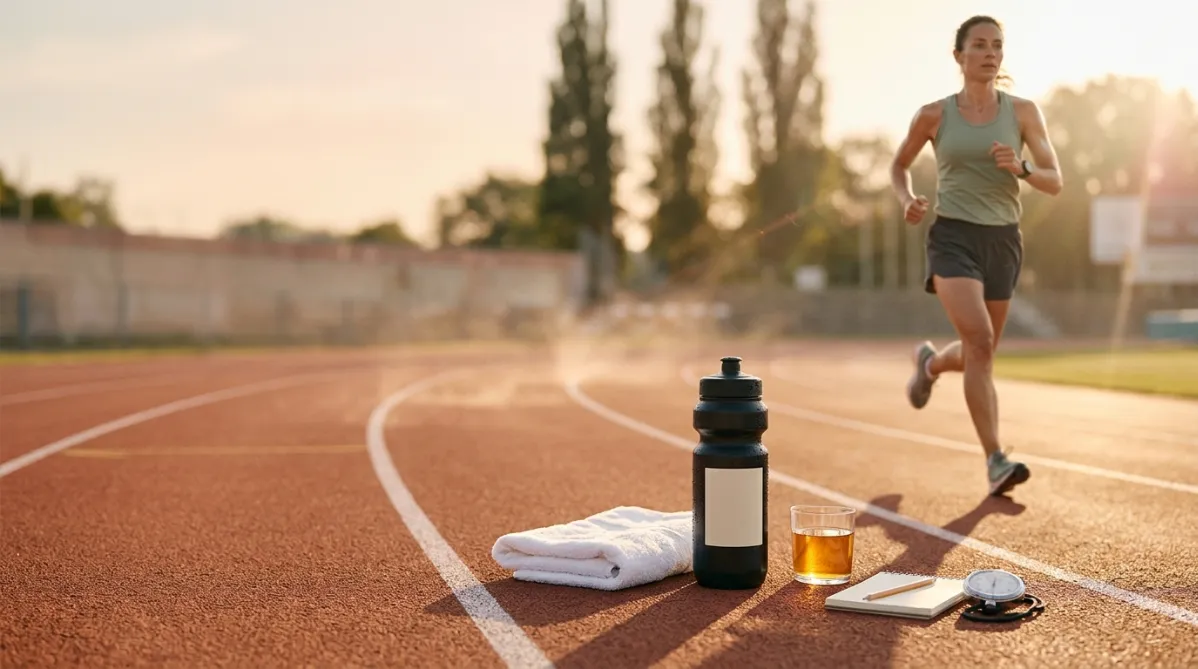
A sunlit outdoor running track in late afternoon, shot from a low angle with shallow depth of field. In the foreground, a matte black bottle with a minimal off-white label sits on the edge of a warm terracotta-colored track lane, beside a folded white towel and a small glass of amber liquid catching golden light. Condensation beads on the bottle. A faint heat shimmer rises from the track surface and softens the background.

In the midground, slightly out of focus, a lean athlete in a sage-green tank top and charcoal shorts runs on a treadmill-like stretch of track, a thin sheen of sweat on their shoulders, their expression focused and calm. Their motion is gently blurred, suggesting endurance and rhythm. Long soft shadows stretch across the lane lines.

The background fades into hazy peach, apricot, and pale yellow tones, with the suggestion of tall trees and a distant stadium wall. Warm sun flare enters from the upper right, creating a subtle glow and a few soft light streaks across the frame.

Subtle editorial touches: a small notebook with a pencil and a stopwatch rest beside the bottle, hinting at data and timing without any text legible. The color palette is warm and muted, with terracotta, cream, sage, and charcoal accents, and a fine film-like grain. The composition leaves open negative space on the left third for a headline overlay. The overall mood is clean, modern, and health-journal inspired, natural and aspirational, with a calm scientific curiosity rather than hype.
nutrition

Ketondranken in de hitte: langer uithoudingsvermogen en scherper geheugen?

BY DR. GYMBRO ·

Ketondranken worden vaak gezien als een hulpmiddel voor vetverbrandende biohackers, maar een nieuwe hitte‑stressstudie suggereert dat ze je ook sterker kunnen laten finishen. Bij 17 getrainde mannen verlengde keton‑monoester plus cafeïne de tijd tot uitputting tot 8,9 minuten tegenover 7,0 minuten met koolhydraten plus cafeïne, na een 90‑minuten‑intensieve loopbandtraining bij 34 °C. Het werkgeheugen verbeterde eveneens bij de 1‑back‑taak, terwijl hartslag en kerntemperatuur nauwelijks verschilden. De studie is echter klein, uitsluitend mannelijk en éénmalig, waardoor de resultaten met voorzichtigheid moeten worden geïnterpreteerd.
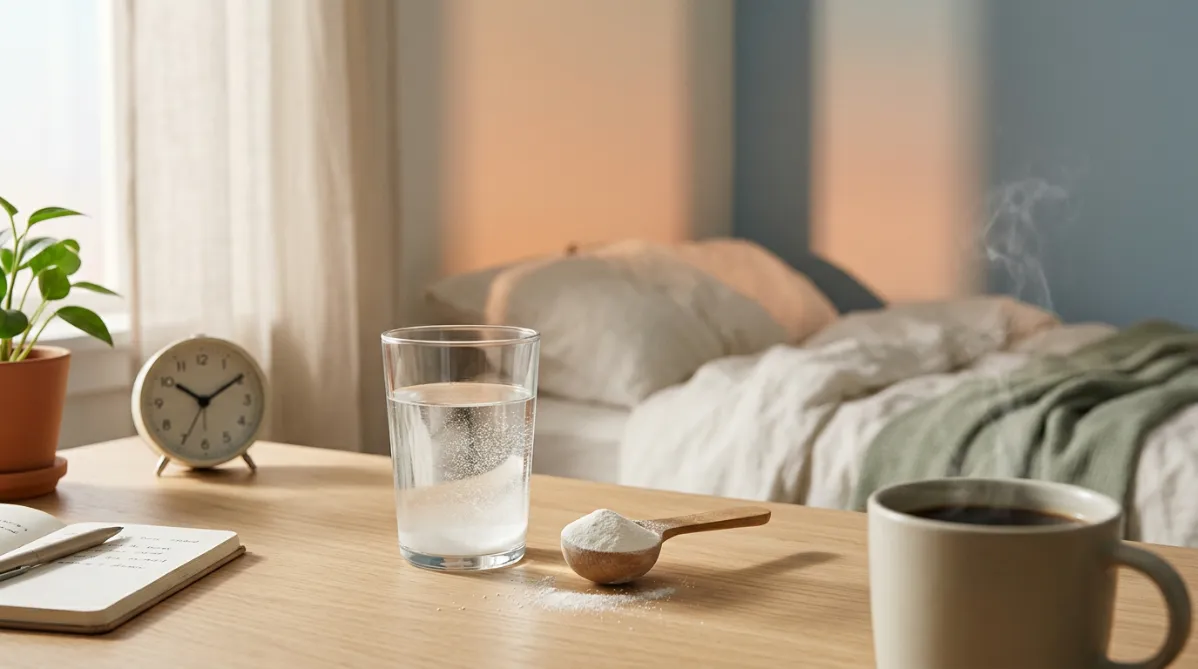
A wide, softly lit morning scene on a pale oak desk beside a window, shot from a slightly elevated three-quarter angle. In the foreground, a clear glass of water is half-filled with dissolved white creatine powder, tiny suspended particles catching the light. A wooden scoop heaped with fine white powder rests beside it, with a few grains scattered across the wood. A matte ceramic mug of black coffee sits slightly out of focus to the right, with a thin curl of steam. Behind them, a rumpled linen-white bed with a muted sage-green throw blanket suggests a sleepless night. Early dawn light spills through sheer curtains and creates long, gentle shadows and a warm peach-and-pale-blue gradient on the wall. On the desk, a minimalist analog alarm clock reads close to 6 a.m., and a small open notebook with a pen lies beside it, its handwriting blurred. A single green plant in a terracotta pot adds a fresh organic touch at the left edge. The color palette is calm and editorial: cream, soft sage, warm oak, dusty peach and muted slate blue. The depth of field is shallow, with crisp focus on the glass and scoop and a creamy bokeh background. The mood is quiet, restorative and contemplative, like a modern wellness magazine or a trendy health journal cover. The composition leaves open negative space in the upper left for title overlay. The image has a natural film-like texture, soft contrast and a clean, minimalist, lifestyle-photography look, with no text, logos or futuristic elements.
nutrition

Een 0,35 g/kg creatine‑dosis bestrijdt slaapgebrek‑gerelateerde hersenmist in enkele uren

BY DR. GYMBRO ·

Creatine is het meest gebruikte supplement in de sportschool, maar een studie uit 2024 suggereert dat een enkele hoge dosis ook binnen enkele uren slaapgebrek‑gerelateerde hersenmist kan verminderen. De proeftoestand kreeg één dosis van 0,35 g/kg – ongeveer 25‑28 g voor de meeste volwassenen – en toonde veranderingen in hersen‑energie‑markers, preventie van een dalende hersen‑pH en verbeterde cognitieve prestaties tijdens 21 uur zonder slaap. De dosis is vijf keer de gebruikelijke onderhoudsdosering van 3‑5 g; de studie was klein en laboratorium‑gebaseerd en ging gepaard met een verhoogd risico op maag‑ en darmklachten.

This page is available in