The Surprise: Strength Didn't Separate the Groups. Jumping Did
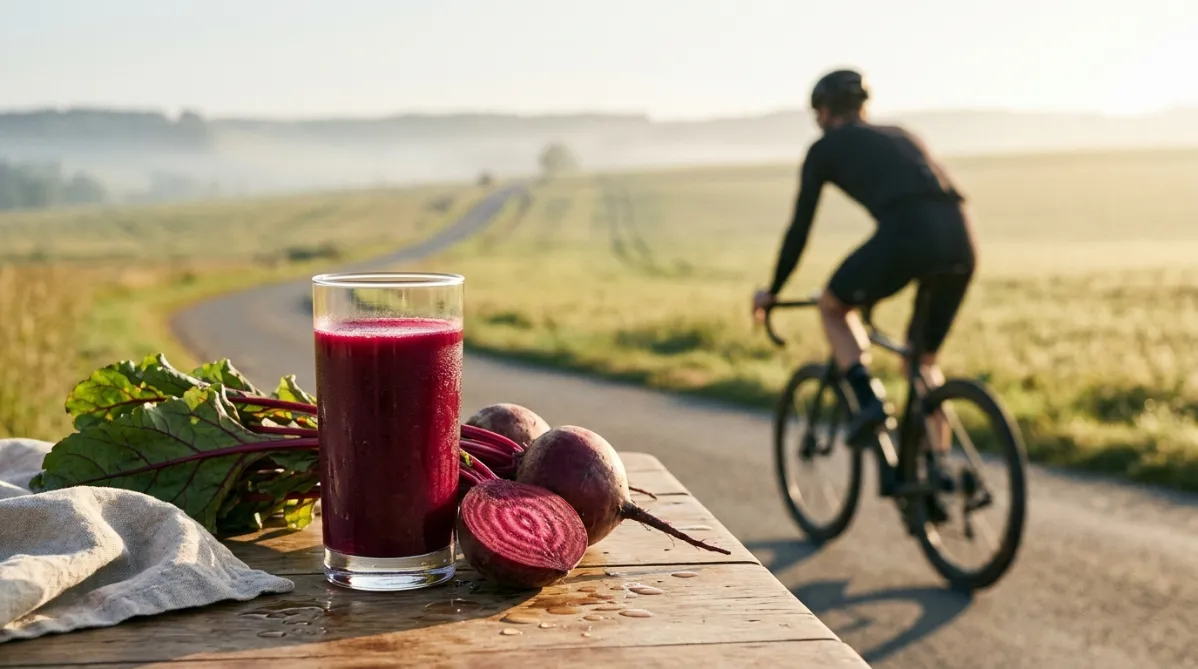
Stack beetroot juice on top of blood flow restriction (BFR) training and you'd expect bigger strength gains. That isn't what a new randomized, double-blind trial in the Journal of the International Society of Sports Nutrition found. Strength rose in both groups. The one place beetroot juice (BRJ) showed a clear edge was countermovement jump height when the athletes were already fatigued.
If you've been sold beetroot juice as a strength hack, that distinction matters. Here is what the study did, what it found, and how to use it without overreaching.
What the Researchers Actually Did
The trial recruited 20 male university students from a school of sports. They were randomly split into two groups of 10:
- BFR only (average age about 21.9)
- BFR + BRJ (average age about 21.8)
The BRJ group took a nitrate dose of 8 mmol per day. That works out to roughly 500 mg of nitrate, using the standard conversion of about 62 mg per mmol. They began with a one-week pre-supplementation phase, then moved into a four-week training block.
The BFR protocol:
- Exercises: bilateral knee extension and knee flexion
- Frequency: three sessions per week
- Cuff pressure: 40% of limb occlusion pressure
- Load: 30% of peak torque
That is light loading with moderate restriction, the standard recipe for getting a training effect without heavy weights.
The researchers tested knee extensor and flexor strength on an isokinetic dynamometer (60°/s, 180°/s and maximal voluntary isometric contraction). They also ran a 100-repetition fatigue test at 90°/s and measured countermovement jump (CMJ) on a force plate, before and after the program.
The Findings, Without the Hype
Both groups got stronger. Four weeks of BFR, with or without BRJ, improved relative peak torque in the knee extensors and flexors across the tested speeds and in isometric strength. Torque in the fatigue test also improved, at both the start (first 20 reps) and the end (last 20 reps) of the 100-rep set.
Both groups improved bilateral CMJ under fatigue. Fatigued jump height, peak force and rate of force development all improved after BFR and after BFR + BRJ.
The BRJ-specific signal: after the intervention, only the BFR + BRJ group showed a statistically significant improvement in fatigued bilateral CMJ height. The authors' own conclusion is that BRJ's effects were "selective rather than broadly superior." Its main contribution was reducing fatigue-related declines in vertical jump performance.
What didn't improve: single-leg countermovement jump showed no significant improvement in either leg, in either group.
How to Read This Honestly
This is a human trial, not an animal or cell study, so the findings apply to people. But several limits keep it from being a green light:
- Tiny sample. Ten people per group is a pilot-scale design, and the effect sizes may not hold up in a larger trial.
- Young men only. Nothing here speaks to women, older adults or elite athletes.
- Significance gap isn't a head-to-head win. "Only the BRJ group reached significance" doesn't automatically mean the BRJ group beat the BFR-only group. The abstract does not report a clear between-group advantage for strength.
- Short duration. Four weeks of training says little about long-term adaptation.
- Messy abstract stats. Some reported values, such as a left-leg p-value of 0.23 listed among the significant results, look inconsistent. Check the full text before quoting numbers.
A mechanism is plausible. Beetroot juice is rich in dietary nitrate, which the body can convert to nitric oxide, and nitric oxide is linked to blood flow and muscle contractile efficiency. The study's data cannot confirm that pathway, so treat it as a hypothesis.
The Protocol, Ready to Copy
Nitrate dose: 8 mmol per day (about 500 mg nitrate). Check the label of your juice or shot for its nitrate content, since products vary widely.
Timing: the study used a one-week loading period before training began. The abstract does not say what time of day participants took the juice relative to workouts, so there is no evidence-backed pre-workout window to quote. Many nitrate studies dose a few hours before exercise, but that comes from the wider literature, not this paper.
Training:
- Knee extension and flexion, three days per week for four weeks
- Cuff pressure around 40% of limb occlusion pressure (ideally set with a proper measurement device)
- Load around 30% of peak torque
Who This Is For
- Jumpers and field-sport athletes who care about explosive output late in a session or game, rather than just fresh-state strength.
- Lifters coming back from injury or limited by heavy loading, who already use BFR and want to see whether a nitrate boost helps.
- Healthy young trainees similar to the study population.
Who Should Skip or Check First
- Anyone with cardiovascular disease, clotting problems, hypertension or on blood pressure medication. BFR restricts blood flow and nitrate can lower blood pressure, so talk to a clinician first.
- Pregnant people and anyone with a history of blood clots.
- People with kidney stones or a history of oxalate issues. Beetroot is high in oxalate. This is general nutrition guidance, not something tested in the study.
- Anyone expecting a strength shortcut. The strength gains here came from BFR itself.
The Bottom Line
BFR training alone improved strength and fatigued jumping in this trial. Adding about 8 mmol of nitrate daily from beetroot juice appears to have helped protect fatigued vertical jump height, without clear, broad superiority elsewhere. It's a promising, narrow signal from a small study, and a reasonable thing to test for explosive athletes but not a guaranteed upgrade. Larger and longer trials, including women and trained athletes, are needed before anyone calls this a proven stack.